Two-thirds of cargo damage claims stem from inadequate securing, according to TT Club data. With U.S. softwood lumber capacity reaching 47.9 billion board feet in 2024 across more than 2,300 tracked mills, every active operation must maximize packaging throughput and reliability to remain competitive.
Key Takeaways
- Lumber strapping machines require high tension capacity, oversized arch openings, and fast cycle speeds that general-purpose machines rarely deliver
- Steel strapping delivers maximum break strength (up to 5,500 lbs) for extreme loads; PET strapping offers superior shock absorption and elongation recovery
- Top manufacturers include Signode, Samuel Strapping, EAM-Mosca, Fromm, and Cyklop—each covered in detail below
- Selection criteria: tension capacity, arch opening size, cycle speed, strap material compatibility, and service network proximity
- John Maye Company provides equipment sourcing, service, and rental options across the Midwest with factory-certified technicians and a 24-hour parts ship guarantee
Overview of Strapping Machines in the Lumber Mill Industry
Industrial strapping machines secure bundles of boards, dimensional lumber, and engineered wood products for safe storage and transport. In lumber operations, this equipment prevents shifting, damage, and load collapse during handling, warehousing, and delivery.
Two machine categories dominate lumber packaging:
- Semi-automatic machines require an operator to position packages and trigger each strapping cycle. These suit varied bundle sizes, lower volumes, or custom packaging runs where flexibility matters more than speed.
- Fully automatic inline machines complete the entire cycle hands-free as bundles move through on conveyors. They integrate directly into high-volume production lines, eliminating manual handling and matching throughput to mill output.
The machine type you choose also determines which strap materials it can handle — and that distinction affects both bundle security and operator safety.
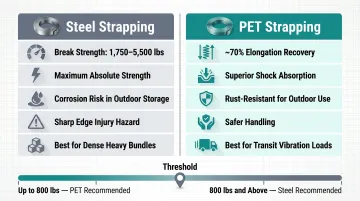
- Steel strapping machines handle dense bundles requiring maximum tension (1,750 to 5,500 lbs break strength). Steel retains the highest absolute strength but risks corrosion and operator injury from sharp edges.
- PET (polyester) strapping machines suit lighter loads or applications where shock absorption matters. PET offers approximately 70% elongation recovery, maintaining tension through transit vibration that would fracture steel.
Best Strapping Machines for Lumber Mills
Five machines stand out for lumber mill applications, each evaluated on tension capacity, strap compatibility, cycle speed, and durability in sawdust-heavy environments. Use the specs and best-fit notes below to match each system to your operation's priorities.
Signode BPX Lumber Strapping Machine
Signode dominates the lumber strapping sector with the only purpose-built compression strapping machine designed specifically for wood products. The BPX system delivers 25,000 lbs top compression and 20,000 lbs side compression—unmatched force for squaring irregular lumber bundles and maintaining tension through long-term storage.
Key advantages: Independent side compression for load squaring, compatibility with high-strength Tenax polyester strap, Allen-Bradley CompactLogix PLC controls with 12-inch touchscreen, and optional automatic batten feeders. The machine handles bundle heights from 5.5 to 52 inches and widths to 62 inches—accommodating quarterpacks, half-packs, and long loads without reconfiguration.
| Specification | Value |
|---|---|
| Strap Type | High-strength Tenax polyester (PET), 5/8" to 3/4" |
| Compression Force | 25,000 lbs top / 20,000 lbs side at 2,300 psig |
| Max Bundle Size | 52" H × 62" W (72" L minimum clearance) |
| Best For | High-volume sawmills requiring maximum compression force and lumber-specific engineering |
Samuel Strapping Systems SLP25 Lumber Press
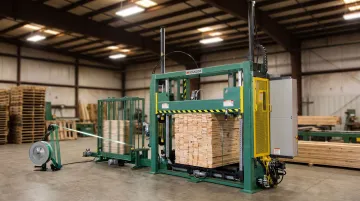
Samuel Packaging Systems Group markets the fastest lumber press cycle time documented in manufacturer specifications: the SLP25 completes strapping in just 8 seconds. This speed advantage directly translates to higher throughput for mills running continuous shifts.
Differentiators: Industry-leading cycle speed, rugged structural steel tube construction designed to resist torsional stress during compression, and North American manufacturing with matched machine and strap supply from a single vendor. The SSE900XP servo-driven head delivers advanced on-board diagnostics and high-tension PET application.
| Specification | Value |
|---|---|
| Strap Type | Polyester (PET) via SSE-series heads |
| Cycle Time | 8 seconds (SLP25) |
| Best For | Throughput-constrained operations prioritizing speed and North American service infrastructure |
EAM-Mosca SoniXs Ultrasonic Strapping Systems
EAM-Mosca's SoniXs ultrasonic sealing technology eliminates heat-blade maintenance entirely, solving one of the most persistent maintenance problems in sawdust-heavy environments: carbon buildup on heat seal plates. The sonotrode uses high-frequency vibration to weld strap ends without heat, performing reliably in wet and dusty conditions.
Key features: 2-year warranty on sonotrode and generator, toolless sealing head maintenance in under 30 seconds, compatibility with PP and PET strap. The ROMS-6 SoniXs achieves up to 40 units per minute with track widths to 2,800 mm for wide lumber bundles.
| Specification | Value |
|---|---|
| Strap Type | PP and PET (SoniXs models) |
| Cycle Speed | Up to 40 units/minute (ROMS-6 SoniXs) |
| Track Width | Up to 2,800 mm |
| Best For | Mills prioritizing low-maintenance operation in harsh, dusty environments |
Fromm Packaging Strapping Machines
Fromm offers the only confirmed dual-capability platform with interchangeable steel and PET strapping heads. The FPA AM series handles steel strap 9.5 to 32 mm wide, while the FPA PM series processes PET in the same width range, allowing mills to switch materials based on load requirements without changing machines.
Advantages: Siemens touchscreen controls, optional top and bottom corner applicators, bearer feeder magazine integration, and modular side press configuration. Custom arch dimensions accommodate on-demand bundle sizing.
| Specification | Value |
|---|---|
| Strap Type | Steel (9.5-32 mm) and PET (8-32 mm) |
| Machine Series | FPA AM (steel) / FPA PM (PET) |
| Best For | Operations requiring flexibility to switch between steel and PET based on load characteristics |
Cyklop SF/SP 112 M Inline Strapping Systems
For mills moving from manual to automated strapping, the Cyklop SF/SP 112 M series offers a practical starting point. These inline machines deliver up to 5,500 N tension via Siemens PLC S7 controls, handling vertical (side head) or horizontal strapping with PP and PET strap in single or multi-strap cycles.
Benefits: Proven reliability at an accessible price point, modular inline integration with existing conveyors, and compatibility with lumber-specific PET grades. Smaller mills and secondary processors get reliable automation without paying for premium cycle speeds they don't yet need.
| Specification | Value |
|---|---|
| Strap Type | PP and PET |
| Tension | Up to 5,500 N |
| Controls | Siemens PLC S7 |
| Best For | Budget-conscious mills seeking reliable automation without premium cycle speeds |
How We Chose the Best Strapping Machines for Lumber Mills
Selecting strapping equipment for lumber requires a different lens than general packaging. Lumber bundles are heavy (often exceeding 1,000 lbs), irregular in dimension, and handled in dusty, high-humidity environments. Machines must be built for these conditions—not just adapted to them.
Our evaluation criteria:
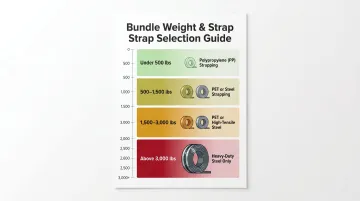
Tension capacity: PET strapping ranges from 600 to 4,000+ lbs break strength; high-tensile steel reaches 5,500 lbs. Match strap strength to actual bundle weight:
- Under 500 lbs: polypropylene (PP) is sufficient
- 500–1,500 lbs: PET or steel
- 1,500–3,000 lbs: PET or high-tensile steel
- Above 3,000 lbs: heavy-duty steel only
Strap material compatibility: Steel delivers maximum absolute strength, but it rusts in outdoor storage and poses injury risk from sharp edges. PET absorbs shock loads during transit through 70% elongation recovery while holding tension. Rail-shipping operations must specify AAR-certified PET meeting ASTM D3950 standards.
Cycle speed and throughput: The machine must keep pace with your production line—bottlenecks here back up the entire mill floor. Samuel's SLP25 cycles in 8 seconds; EAM-Mosca's ROMS-6 SoniXs reaches 40 units per minute. Semi-automatic machines work better for lower volumes or varied bundle sizes where flexibility outweighs raw speed.
Arch opening size: Standard packaging arch dimensions frequently fall short for lumber. Signode's BPX accommodates bundles up to 52 inches high and 62 inches wide. Measure your actual bundle profiles before purchasing—an undersized arch is one of the most common and avoidable mistakes in equipment selection.
Service infrastructure: Proximity to factory-certified technicians and parts availability determines uptime. Manufacturers with strong North American networks (Signode, Samuel, Fromm) reduce response times. Verify 24-hour parts shipping and emergency service coverage before committing to any supplier.
Common mistakes buyers make:
- Choosing machines based on price alone without verifying strap tension specifications for actual bundle weights
- Overlooking arch opening dimensions for large lumber bundles
- Failing to account for total cost of ownership—strap consumption, maintenance frequency, and parts availability
- Ignoring environmental factors like sawdust accumulation and moisture exposure that accelerate wear
Conclusion
The best strapping machine for a lumber mill depends on bundle size, production volume, strap material preference, and floor layout. Matching machine specifications to actual mill conditions drives ROI—not generic "best of" rankings.
Evaluate not just purchase price but long-term factors: parts availability and local service support from factory-certified technicians, strap compatibility costs, and the option to rent equipment during seasonal surges before committing capital.
John Maye Company, a Wisconsin-based packaging equipment distributor serving the Midwest since 1983, helps lumber mills assess, source, and service the right strapping solution—whether purchasing or renting. Their support package includes:
- Factory-certified technicians for on-site service
- 24-hour parts ship guarantee across 2,500+ SKUs
- Rental fleet options for seasonal production surges
- Regional coverage throughout Wisconsin and the broader Midwest
Contact them at 1-800-441-6293 or info@johnmayecompany.com to discuss your strapping needs.
Frequently Asked Questions
What is strapping lumber used for?
Strapping secures bundles of boards or timber for safe storage, handling, and transport. It prevents shifting, damage, and load collapse during movement through the mill yard, warehousing, and delivery to customers.
What is the best strapping for lumber?
Steel strapping is preferred for heavy, high-density bundles requiring maximum tension (up to 5,500 lbs break strength). Polyester (PET) strapping suits lighter loads where shock absorption matters, such as bundles subject to transit vibration or outdoor storage where steel would corrode.
What type of strapping machine is best suited for a high-volume lumber mill?
Fully automatic inline machines integrated with conveyor systems eliminate manual handling and match production line speeds. Models like Signode's BPX, Samuel's SLP25 (8-second cycle), or EAM-Mosca's ROMS-6 SoniXs (40 units/minute) deliver the throughput high-volume mills need.
What is the difference between semi-automatic and automatic strapping machines for lumber?
Semi-automatic machines require an operator to position the strap and trigger each cycle, making them suited for varied bundle sizes or lower-volume runs. Automatic machines complete the full cycle without intervention, ideal for continuous conveyor lines where bundles move through without manual handling.
How do I maintain a strapping machine used in a lumber mill environment?
Daily clearing of sawdust from cutters and feed rollers, weekly lubrication, and monthly belt and pneumatic inspections keep machines running. Schedule a bi-annual deep clean and inspection by factory-certified technicians to prevent unplanned downtime.
Can strapping machines be rented for seasonal lumber production increases?
Yes. Equipment rental provides access to the right machine capacity without full capital commitment during seasonal volume surges. Regional distributors with rental fleets—like John Maye Company serving the Midwest—offer flexible terms with maintenance support included, allowing mills to scale packaging throughput as production demands fluctuate.