Printing non-compliant or blurred labels risks product recalls, failed inspections, and lost sales — making high-resolution (hi-res) printing a core operational requirement. Minnesota's Office of Cannabis Management issued recall orders for Tidal Wave and Beezwax brand products in March 2026, both citing failure to meet labeling requirements. These enforcement actions demonstrate that labeling non-compliance carries concrete operational and financial risk, not just theoretical penalties.
Key Takeaways
- Hi-res label printers (300 DPI or higher) are essential for cannabis compliance — covering THC/CBD content, batch IDs, barcodes, and warning symbols
- Inkjet color and thermal transfer models each suit different print volumes, label types, and budgets
- The 5 best options include the Epson ColorWorks CW-C6000A, Epson TM-C7500G, Afinia L901, Primera LX910, and SwiftColor SCL-4000D
- Selection criteria include print resolution (DPI), media compatibility, print speed, cost per label, and durability for grow room or packaging environments
Why Hi-Res Printing is Critical for Cannabis Cultivators
Cannabis cultivation operations must label products at multiple stages — from grow room plant tags and harvest batch tracking to final compliance labels. Blurred or low-resolution output at any stage creates traceability failures. California requires minimum 6-point font and a universal symbol at least 0.5 inches in height, while Colorado mandates text no smaller than 1/16 of an inch and a universal symbol at least 1/2 x 1/2 inch. Meeting these standards on labels sometimes smaller than 1 inch requires at least 300 DPI — and ideally 600–1200 DPI for dense text, barcodes, and warning symbols.
Cultivators face a dual printing need:
- Grow operation labels — humidity-resistant plant tags, batch IDs, and strain identifiers that demand durable media and sharp output
- Product labels — full-color branding paired with compliance text, where higher DPI directly affects shelf appeal and regulatory approval
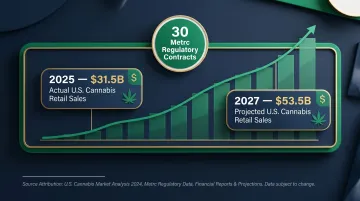
Both needs are intensifying as the market grows. U.S. cannabis retail sales reached $31.5 billion in 2025, with MJBizDaily projecting $53.5 billion by 2027 — and every dollar of that volume flows through labeled, traceable product. Cultivators at every scale need reliable, compliant label output to stay in the market. Metrc operates under 30 regulatory contracts and uses Retail ID data that must appear on physical labels for seed-to-sale traceability. That makes on-site label printing with variable-data workflows a practical requirement, not an option.
Best Hi-Res Printers for Cannabis Cultivators
These printers were evaluated across five criteria:
- Print resolution and output quality
- Media versatility for grow room environments
- Throughput for batch printing
- Cannabis-specific label compatibility
- Total cost of ownership
Epson ColorWorks CW-C6000A / CW-C6500A
Epson's ColorWorks line was designed specifically to replace black-and-white thermal transfer printers with full-color output — without sacrificing the durability or uptime those printers are known for.
Key differentiators:
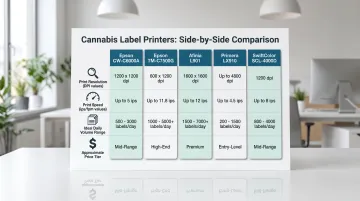
- Print resolution: Up to 1200 x 1200 DPI (300 x 600 DPI in high-speed mode)
- Pigment-based ink: UltraChrome DL pigment ink provides 5-25+ years of indoor fade resistance versus weeks-to-months for dye inks
- BS 5609 certified: Meets marine immersion and GHS chemical labeling standards — critical for labels exposed to humidity or refrigeration
- Media width: CW-C6000A handles up to 4.25 inches; CW-C6500A handles up to 8.34 inches
- Supports synthetic media: Compatible with gloss, matte, and synthetic labels suitable for grow room environments
| Specification | CW-C6000A | CW-C6500A |
|---|---|---|
| Print Resolution | 1200 x 1200 DPI | 1200 x 1200 DPI |
| Print Speed | Up to 5 ips (at 300x600 DPI) | Up to 5 ips (at 300x600 DPI) |
| Media Compatibility | Gloss, matte, synthetic; max width 4.25" | Gloss, matte, synthetic; max width 8.34" |
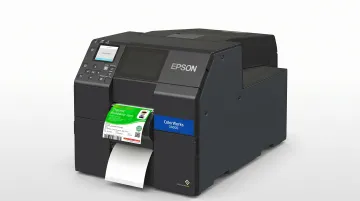
Epson TM-C7500G
The TM-C7500G targets larger cultivation and packaging operations that need to print thousands of labels per run. This model is discontinued but still widely used in production environments.
Key differentiators:
- Print speed: Up to 11.8 inches per second with Flush-onto-Paper enabled
- Optimized for glossy label stock — the "G" designation signals purpose-built glossy media performance
- UltraChrome DL pigment ink: Offers comparable durability to laser printers and thermal printers using full resin ribbons (the most durable thermal transfer media)
- Claims up to 50% lower total labeling cost than laser or thermal printers with equivalent durability
| Specification | TM-C7500G |
|---|---|
| Print Resolution | 1200 x 600 DPI |
| Ink System | UltraChrome DL pigment ink (SJIC30P cartridges) |
| Best Use Case | High-volume operations printing 3,000+ labels per day; glossy product labels |
Afinia L901
Afinia's L901 uses Memjet single-pass technology to deliver high-volume, high-resolution color label printing — with documented deployments across regulated industries including pharmaceuticals and nutraceuticals.
Key differentiators:
- Print resolution: 1600 x 1600 DPI — the highest native resolution among all reviewed printers
- Print speed: Up to 60 feet per minute (6-12 inches per second)
- Low cost per label: Memjet's ultra-low ink cost structure makes it viable for operations printing 10,000 to 100,000+ labels monthly
- Media width: Handles up to 8.5 inches wide
- The L901 Plus variant adds Watershield water-resistant dye-based inks for humidity-prone environments
| Specification | L901 |
|---|---|
| Print Resolution | 1600 x 1600 DPI |
| Print Speed | Up to 60 feet per minute |
| Cost Per Label Advantage | Very low ink cost; 5 high-capacity 250ml cartridges (1.25L total); strong ROI for operations printing 10,000+ labels/month |
Primera LX910
Primera Technology's LX910 targets small-to-mid-volume cannabis operations. It trades throughput speed for exceptional print quality, making it the go-to for craft brands where label appearance drives purchase decisions.
Key differentiators:
- Print resolution: Up to 1200 x 4800 DPI — Primera describes this as "highest in the industry" (interpolated resolution)
- Ink flexibility: Compatible with both dye and pigment inks; ships with dye ink
- Entry-level pricing: $2,749.00 MSRP
- Ideal volume range: Up to 5,000 labels per day (3,000-5,000 recommended)
- Supports white gloss BOPP, polyester, vinyl, and TuffCoat paper for premium short-run output
| Specification | LX910 |
|---|---|
| Print Resolution | 1200 x 4800 DPI (interpolated) |
| Ideal Volume Range | 3,000-5,000 labels per day |
| Label Width and Media | Max width 8.25"; supports white gloss BOPP, polyester, vinyl, TuffCoat paper |
SwiftColor SCL-4000D
SwiftColor's SCL-4000D is purpose-built for on-demand full-color label printing with documented use in cannabis packaging and medical labeling — the only printer manufacturer among those reviewed that explicitly markets to cannabis cultivators.
Key differentiators:
- Print resolution: 1200 x 1200 DPI
- Explicitly targets cannabis operations: SwiftColor's own materials state "Cannabis packagers and growers can now label THC content and cannabis varieties on-site"
- Weather-resistant media compatibility: Supports synthetic media suitable for grow room environments
- Single-pass technology: Described as "high speed" inkjet with single-pass printing
- Price: $7,499 MSRP
| Specification | SCL-4000D |
|---|---|
| Print Resolution | 1200 x 1200 DPI |
| Print Speed | High speed (specific ips not published); single-pass inkjet |
| Cannabis-Specific Suitability | Explicitly marketed for cannabis labeling; weather-resistant label compatibility; on-demand printing for regulatory compliance |
Key Features to Evaluate Before Buying a Cannabis Label Printer
DPI Threshold Decision
300 DPI is the minimum for compliance label legibility and serves as the industry baseline for reliable GS1 barcode printing. However, 600 DPI is recommended for today's complex GS1 barcodes and 2D symbologies.
When to use each threshold:
- 300 DPI: Basic compliance labels with simple text and 1D barcodes; grow room tracking tags
- 600-1200 DPI: Dense regulatory text, small fonts (6-point minimum), QR codes, 2D barcodes, final product labels
- 1600-4800 DPI: Ultra-small labels (under 1 inch), premium branded labels for craft cultivators, photo-quality imagery
Media Compatibility as a Critical Factor
Cannabis cultivators need labels that can survive:
- Humidity in grow rooms — for plant and harvest tags
- Adhesion to mylar bags and glass jars — for product packaging
- Oils and UV exposure — for outdoor or greenhouse tags
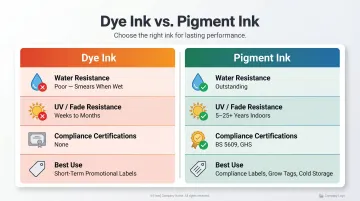
Ink type determines durability:
| Attribute | Dye Ink | Pigment Ink |
|---|---|---|
| Water Resistance | Very poor; smears when wet | Outstanding; resistant to water, chemicals, oils |
| UV/Fade Resistance | Weeks to months under sunlight | 5-25+ years indoors; 1-2+ years outdoors |
| Compliance Certifications | None | BS 5609 (marine), GHS standards |
| Best For | Short-term promotional labels | Compliance labels, grow tags, refrigerated storage |
That durability gap matters when labels must survive cold storage or daily moisture exposure. For those environments, pigment-based inks offer far better moisture and chemical resistance for compliance labels. The Epson CW-C6000A/C6500A uses pigment ink natively; the Primera LX910 offers both options.
Print Volume and Speed
Batch-printing compliance labels at the end of harvest requires different capabilities than continuous daily output at a processing facility.
Decision framework:
- Small craft cultivators (under 1,000 labels/day): Desktop inkjet like Primera LX910
- Mid-volume operations (1,000-5,000 labels/day): Epson CW-C6000A or SwiftColor SCL-4000D
- High-volume facilities (5,000+ labels/day or 10,000+/month): Afinia L901 or Epson TM-C7500G
Total Cost of Ownership Beyond Sticker Price
Sticker price rarely reflects what a label printer actually costs to run — ink yield, media costs, and downtime from nozzle clogs add up fast.
Consider:
- Ink cartridge yield: How many labels per cartridge?
- Cost per label: In-house inkjet label costs range from $0.02 to $0.40 per label depending on ink coverage
- Maintenance requirements: Pigment inks risk nozzle clogging if printer sits idle
- On-demand printing advantage: Avoiding pre-printed label waste when regulations change
By month 12, most in-house label operations report saving 20-30% on label costs versus outsourcing — a meaningful return for cultivators managing frequent regulatory updates.
How We Chose These Printers
Each printer on this list was evaluated against four criteria:
- Print resolution: Minimum 300 DPI, verified against manufacturer specs
- Industry fit: Demonstrated use in cannabis, pharmaceutical, or food labeling environments
- Media versatility: Ability to handle both grow-side and product-side label materials
- Volume range: Suitable options for craft cultivators through commercial-scale operations
Common mistakes cannabis cultivators make when choosing a printer:
- Prioritizing upfront cost over cost-per-label (at 10,000 labels/month, $0.40/label adds up to $4,000 monthly — far outpacing the hardware cost)
- Choosing consumer-grade inkjet printers that can't handle synthetic or oil-resistant media
- Overlooking software compatibility with state traceability systems like METRC, which requires variable-data printing for unique serialized QR codes on every label
- Ignoring ink durability requirements for grow room humidity
If you're operating in a METRC state, review METRC's CSV Retail ID labeling guide before committing to any printer — not every model supports the variable-data workflows compliance requires.
Conclusion
The best hi-res printer for a cannabis cultivator depends on three variables: the compliance standards of the state they operate in, the types of labels they need (internal tracking vs. consumer-facing product labels), and their daily or monthly print volume — no single printer is universally optimal.
Evaluate printers against your full operational workflow — from seed-to-sale traceability tags through final packaging — rather than choosing on resolution spec alone. In a regulated environment, three factors carry as much weight as print quality:
- Software integration with METRC and state-mandated tracking systems
- Media flexibility across grow room and retail label environments
- Pigment ink durability for labels exposed to humidity, solvents, or cold storage
For cannabis cultivators and packaging operations in the Midwest looking to assess or upgrade their broader packaging line, John Maye Company — a Wisconsin-based distributor with 40+ years of experience, factory-certified technicians, and a 24-hour ship guarantee — offers equipment consultation and system design across the region from Wisconsin to Ohio.
Frequently Asked Questions
What is the best printer for printing cannabis labels?
The right printer depends on volume, label size, and whether you need compliance-only or full-color branded output. For small craft operations, the Primera LX910 ($2,749) offers 1200x4800 DPI with flexible ink options. For high-volume facilities, the Afinia L901 delivers 1600 DPI at up to 60 feet per minute with a low cost per label.
Is it worth getting a cannabis label printer?
In-house printing makes sense once you exceed 3,000–5,000 labels monthly — at that volume, most operations save 20–30% on label costs within 12 months compared to outsourcing. It also eliminates minimum order requirements and lets you update labels immediately when regulations change.
Is it cheaper to print your own cannabis labels or buy them?
In-house inkjet printing costs $0.02–$0.40 per label, compared to $0.50–$2.00 per label for outsourced short runs. Once you exceed 3,000–5,000 labels monthly, in-house printing is almost always the cheaper option despite the upfront equipment investment.
What DPI resolution is required for cannabis compliance labels?
State regulations require clearly legible text and barcodes, which means a minimum of 300 DPI in practice. For labels under 2 inches with dense regulatory text, QR codes, or 2D barcodes for track-and-trace systems, 600 DPI or higher is recommended.
Can the same printer handle both grow room tracking labels and product packaging labels?
Some printers handle both use cases, but media compatibility varies by model. The Epson CW-C6000A/C6500A explicitly supports synthetic media with BS 5609-certified durability; the Primera LX910 supports polyester and vinyl with pigment ink. Always verify the specific model's media specs before purchasing for dual-use applications.
What label material works best for cannabis grow room environments?
Grow rooms are high-humidity environments, making polyester (PET) or polypropylene synthetic label stock more durable than paper-based labels. These materials require a printer with compatible ink — typically pigment-based inkjet (like Epson ColorWorks series) or thermal transfer — to maintain legibility and barcode scannability for months in humid conditions.