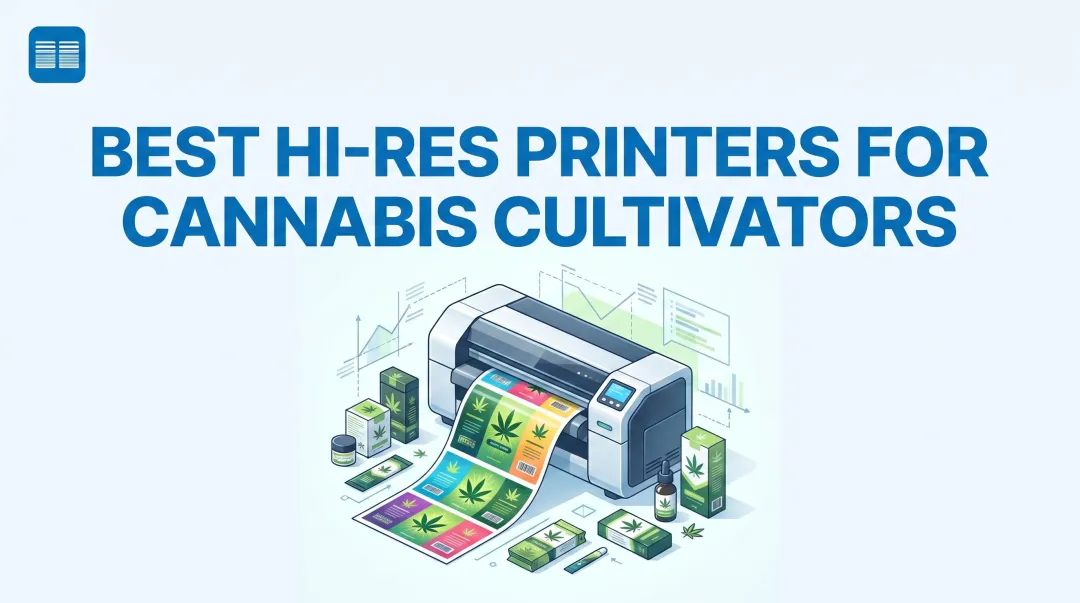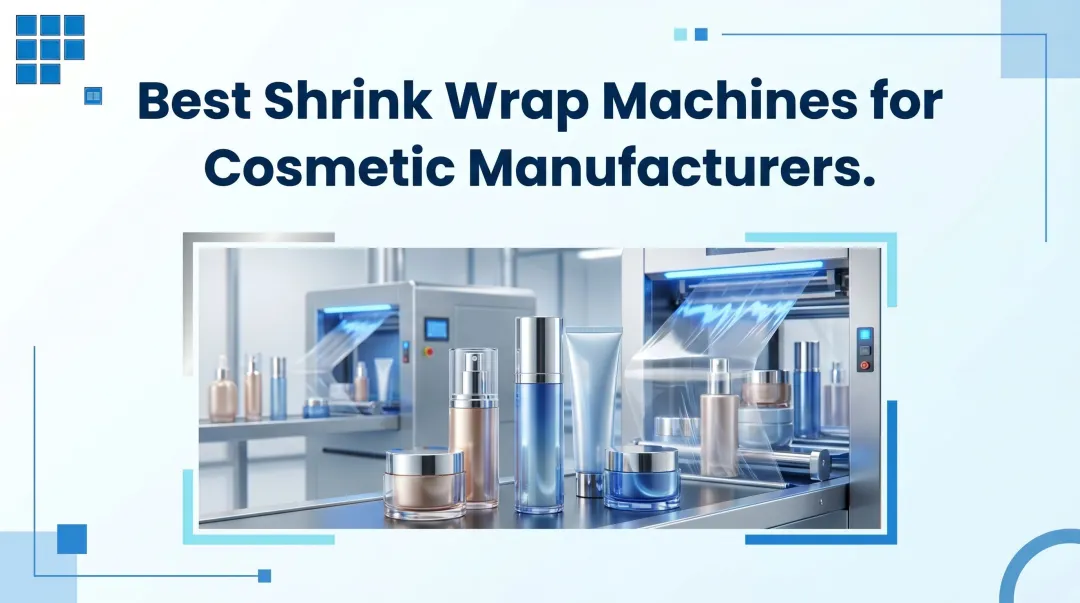
Cosmetic manufacturers face unique printing challenges: variable data (expiry dates, batch codes, serialization), multi-substrate compatibility (glass bottles, HDPE tubes, PET jars, flexible pouches, varnished cartons), high-speed production lines, and zero-tolerance for illegible text. The right printer must handle all of these while maintaining uptime during seasonal surges and product changeovers.
Key Takeaways
- Hi-res cosmetic printers must produce sharp text, scannable barcodes, and compliant labeling across varied substrates
- Three main technologies cover different needs: CIJ for high-speed line coding, TIJ for variable data, and digital label printers for full-color branding
- CIJ printers (Videojet, Markem-Imaje, Domino) run at production-line speeds but top out at 64-82 DPI — enough for lot codes, not graphics
- Label printers (Epson ColorWorks, Zebra) reach 300-1,200 DPI for premium labels, though at slower throughput
- Use CIJ for direct-to-container coding; use label printers for ingredient lists and branded graphics
Why Hi-Res Printing Matters in Cosmetic Manufacturing
Defining Industrial Hi-Res Printing
"Hi-res printing" in industrial manufacturing means something different than consumer photo printing. Industrial printers measure resolution in DPI (dots per inch), with the threshold for "hi-res" determined by application: lot codes may only need 64-82 DPI, while ingredient declarations require 300+ DPI for legible small text. What separates industrial from consumer printing is consistency under pressure: scannable 1D/2D barcodes, crisp alphanumeric text, and readable ingredient lists at line speeds of 6-9 meters per second, shift after shift.
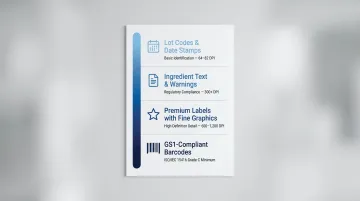
Key resolution benchmarks for cosmetic printing:
- Lot codes and date stamps: 64-82 DPI (CIJ range)
- Ingredient text and warnings: 300+ DPI minimum
- Premium labels with fine graphics: 600-1,200 DPI
- GS1-compliant barcodes: Minimum Grade C (1.5) per ISO/IEC 15416
Regulatory Context: FDA 21 CFR 701 and MoCRA Requirements
Cosmetic packaging is subject to strict federal labeling requirements under 21 CFR Part 701. The regulation mandates:
- Ingredient declarations: Minimum 1/16 inch letter height (1/32 inch for packages under 12 square inches)
- Net quantity statements: Scaled by panel area, from 1/16 inch (PDP under 5 sq. in.) to 1/4 inch (PDP over 100 sq. in.)
- Warning statements: Minimum 1/16 inch letter height
- Conspicuousness requirement: All required text must be readable under customary purchase conditions—smeared, faded, or illegible print renders a product misbranded under the Federal Food, Drug, and Cosmetic Act
The 2022 MoCRA added new labeling burdens: adverse event contact information, fragrance allergen disclosures, and facility registration requirements that demand traceable lot coding.
MoCRA doesn't specify a minimum DPI, but it creates auditable links between batch codes and FDA records. Illegible codes can block compliance during inspections or recalls — a risk no manufacturer should absorb.
Production Scale Demands Reliability
The global beauty and personal care market reached $557.24 billion in 2023 with a projected 7.7% CAGR through 2030. At that volume, print failures aren't minor defects — they trigger real operational consequences:
- A smeared lot code forces batch rejection
- An illegible ingredient line fails retailer compliance audits
- A failed barcode scan generates chargebacks
Industrial printers need to hold up through multi-shift runs, seasonal surges, and frequent SKU changeovers. A single unplanned stoppage can delay a product launch or compromise a manufacturer's compliance record at the worst possible moment.
Best Hi-Res Printers for Cosmetic Manufacturers
The printers below cover three distinct categories: continuous inkjet (CIJ) for high-speed lot coding, digital color label printers for in-house label production, and thermal transfer printers for durable compliance labels. Each was evaluated on print resolution, substrate compatibility, production-line reliability, and fit for cosmetic packaging applications.
Videojet 1860 Continuous Inkjet Printer
The Videojet 1860 is a continuous inkjet (CIJ) printer built for high-speed production line integration across cosmetics, pharma, and personal care. The model has been succeeded by the 1880+ but remains widely deployed in active cosmetic facilities.
Why it stands out for cosmetics: The 1860 handles curved and irregular surfaces—bottles, tubes, jars—at production speeds up to 293 meters per minute. Its SmartCartridge fluid system and Intelligent Maintenance System provide up to 8 hours advance notification of downtime-generating faults, critical for cosmetic lines running multiple shifts. The ink core life extends up to 14,000 hours, reducing consumable changeover frequency.
| Specification | Value |
|---|---|
| Print Resolution | Matrix-based: 5x5 to 25x34 dot matrix; 60-micron or 70-micron nozzle options |
| Substrate Compatibility | PET, HDPE, glass, aluminum, flexible film, coated/uncoated cartons |
| Max Line Speed | Up to 293 m/min (960 ft/min) single line |
| Ink Types | MEK-based, ethanol-based, propanol-based; pigmented, food-grade, UV-fluorescent, chemical-resistant |
| Environmental Protection | IP55 standard; IP66 optional |
Best for: High-speed lot coding on primary packaging (bottles, tubes, compacts)
Markem-Imaje 9450 Series Continuous Inkjet Printer
Part of Dover Corporation, Markem-Imaje's 9450 series (successor to the 9040) delivers 71 DPI resolution optimized for variable data printing—lot codes, expiry dates, and barcodes—on both primary and secondary cosmetic packaging.
Key differentiator: The 9450 offers the industry's largest ink portfolio, including solvent-based inks formulated specifically for cosmetic-grade substrates such as varnished cartons, plastics, foils, and shrink wrap. Its CoLOS software suite integrates directly with MES and ERP systems (SAP, Oracle) for centralized message management and line control—essential for multi-SKU cosmetic operations.
| Specification | Value |
|---|---|
| Print Resolution | 71 DPI vertical; 5 to 32 dot font heights (1.1 mm to 11.2 mm) |
| Ink Portfolio | MEK-based, MEK-free, ethanol-based, acetone-based; pigmented, UV-traceable, food-grade options |
| Max Line Speed | Up to 6.6 m/s (approx. 1,300 ft/min) |
| Integration Capability | CoLOS software for MES/ERP connectivity (SAP, Oracle); Mark&Read vision system for code verification |
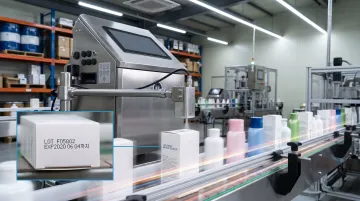
Best for: Multi-substrate coding lines requiring IT-OT integration and automated quality verification
Domino Ax350i Continuous Inkjet Printer
The Domino Ax350i targets cosmetic lines with frequent product changeovers, where minimizing operator intervention between runs directly affects throughput. Its i-Tech intelligence technology enables predictive maintenance, remote diagnostics, and auto-flush across diverse surface types.
Key differentiator: The Ax350i's i-Tech service module reduces maintenance to a sub-10-minute operator task required once per 12 months—no technician service call needed. Domino Cloud provides 24/7 remote monitoring and performance visibility, cutting unplanned downtime. Cartridge replacement takes 20 seconds without stopping the line.
| Specification | Value |
|---|---|
| Print Resolution | 82 DPI max (60-micron nozzle) or 64 DPI max (75-micron nozzle) |
| Max Line Speed | Up to 9 m/s (single line, 5-dot characters) |
| Maintenance Features | i-Tech Module (12-month replacement cycle); auto-flush; Domino Cloud remote monitoring |
| Typical Cosmetic Applications | Lipstick tubes, mascara wands, compact cases, cartons, flexible pouches |
Best for: Operations prioritizing uptime and minimal hands-on maintenance
Epson ColorWorks C7500G Digital Color Label Printer
The Epson ColorWorks C7500G is purpose-built for producing full-color cosmetic labels in-house—supporting short-run production, fast design changes, and on-demand output without outsourcing to label converters.
Why it matters for cosmetics: The C7500G uses UltraChrome DL pigment inks for water and chemical resistance, supports gloss, matte, and synthetic label stocks, and delivers 1,200 x 600 DPI output that holds up to brand color standards across premium finishes. The permanent PrecisionCore printhead eliminates consumable head replacement costs.
| Specification | Value |
|---|---|
| Print Resolution | 1,200 x 600 DPI |
| Label Stock Compatibility | Gloss paper, gloss synthetic, semi-gloss, matte coated, polyester, plain paper |
| Print Speed | Up to 11.8 inches per second (300 mm/sec) |
| Max Label Width | 4.25 inches (108 mm) |
Best for: In-house full-color cosmetic label production with premium finish requirements
Note: The C7500G is discontinued; confirm successor model availability before specifying.
Zebra ZT510 Industrial Thermal Transfer Printer
The Zebra ZT510 is an industrial-grade thermal transfer printer built for high-throughput production of durable, smear-resistant cosmetic labels and compliance labels on the factory floor.
Why it stands out: The ZT510 offers 203 and 300 DPI thermal transfer output for crisp barcodes and fine text on labels. Its rugged construction handles factory-floor environments, and resin ribbon compatibility ensures chemical and moisture resistance on polypropylene and polyester labels—common on cosmetic bottles and tubes. Zebra DNA cloud-based management and VisibilityIQ Foresight analytics enable remote monitoring and predictive maintenance.
| Specification | Value |
|---|---|
| Print Resolution | 203 DPI or 300 DPI (600 DPI not available in this model) |
| Media Compatibility | Wax ribbons (paper labels), wax/resin ribbons (durability), resin ribbons (synthetics: polypropylene, polyester) |
| Print Speed | 12 inches per second (305 mm/sec) |
| Connectivity | Ethernet, USB, Serial; optional Wi-Fi 802.11ac and Bluetooth |
Best for: High-duty-cycle barcode and compliance label printing on synthetic cosmetic packaging
How We Chose the Best Hi-Res Printers for Cosmetic Manufacturers
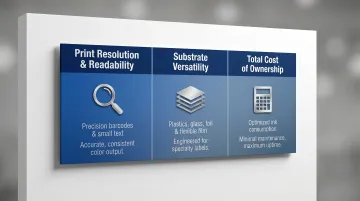
Each printer was evaluated across three core dimensions:
- Print resolution and readability: Scannable barcodes per GS1 standards (minimum Grade C/1.5), legible small text meeting 21 CFR 701 font requirements, and color-accurate graphics at production speeds
- Substrate versatility: Compatibility with plastics, glass, foil, flexible materials, and specialty labels
- Total cost of ownership: Ink consumption, maintenance intervals, and spare parts availability
Common buyer mistakes to avoid:
- Choosing based on upfront cost alone while ignoring ink compatibility with your specific substrates
- Line speed mismatches that create bottlenecks (CIJ printers run at 6-9 m/s; label printers at 11.8 in/sec)
- Overlooking regulatory compliance readiness: printers must support variable data for lot codes, expiry dates, and serialization
Regulatory compliance readiness was also a core factor. Printers needed to produce GS1-compliant barcodes meeting ISO/IEC 15416 standards (minimum 1.5 grade for retail scanning) and support variable data printing for MoCRA-mandated traceability. CIJ printers handle high-speed serialization well; label printers are stronger for detailed ingredient declarations.
Cosmetic manufacturing runs on tight launch timelines and seasonal surges, so uptime and service support carried real weight in our assessment. Printers with remote diagnostics (Domino Cloud, Zebra VisibilityIQ), fast service response, and deep parts inventory offer meaningful operational advantages. For Midwest manufacturers, John Maye Company's 2,500+ SKU inventory and 40+ years of packaging equipment experience translate to faster parts fulfillment and informed equipment selection across Wisconsin, Ohio, and the broader region.
Conclusion
Choosing the right hi-res printer for cosmetic manufacturing isn't a one-size-fits-all decision. The ideal solution depends on packaging format (bottles vs. labels), substrate type (glass, HDPE, flexible film), production volume, and whether the need is for in-line coding, label production, or direct decoration. CIJ printers deliver production-line speed but limited resolution; label printers deliver premium quality but slower throughput. Most cosmetic lines require both.
Evaluate total operational fit—ink compatibility, maintenance requirements, integration with existing MES/ERP systems, and supplier support—rather than defaulting to brand recognition . Confirm current-model availability (both the Videojet 1860 and Epson C7500G are discontinued) and verify long-term consumable supply commitments before specifying equipment.
That evaluation process is exactly where getting the specification wrong gets costly. Contact John Maye Company for expert consultation on sourcing printing equipment that matches your substrate, speed, and compliance requirements. With 40+ years of packaging equipment experience and factory-trained technical support, we help cosmetic manufacturers avoid print-quality failures and stay compliant.
Call 1-800-441-6293 or email info@johnmayecompany.com to get started.
Frequently Asked Questions
How to read lot codes on cosmetics?
Lot codes appear on the bottom or side of cosmetic packaging as alphanumeric or date-based codes printed via inkjet or laser systems. They identify the production batch, manufacturing date, and facility, following a date-based or sequential numbering convention that links back to manufacturing records.
Can I track a product with a batch code?
Yes. Batch codes let manufacturers and regulators trace a product to its specific production run, supporting targeted recalls, quality investigations, and supply chain audits. Serialization systems integrated with ERP or MES platforms extend this to real-time tracking from production to shelf.
What is the minimum DPI required for cosmetic label printing?
Most cosmetic label applications require a minimum of 300 DPI for fine text and barcodes, with 600 DPI or higher recommended for premium labels with detailed graphics, small ingredient text, or high-density barcodes that must pass retail scanner validation per GS1 standards.
What type of printer is best for printing directly on cosmetic containers?
Continuous inkjet (CIJ) printers are most commonly used for direct-to-container printing on cosmetic packaging, as they can handle curved and irregular surfaces at production line speeds (6-9 m/s) without requiring a label substrate. UV inkjet is used for decorative direct-to-container applications.
What inks are safe and compliant for use on cosmetic packaging?
Cosmetic packaging requires low-migration, solvent-resistant inks suited to the specific substrate. The FDA does not regulate inks on cosmetic secondary packaging directly, so manufacturers should confirm compliance with their printer vendor against relevant frameworks such as ISO 22716 and REACH.
What is the difference between thermal inkjet and continuous inkjet for cosmetics?
Thermal inkjet (TIJ) uses replaceable cartridges for lower-speed, high-resolution tasks like short-run or variable data printing. Continuous inkjet (CIJ) circulates ink through a pressurized system for uninterrupted high-speed coding — making it the standard choice on high-volume cosmetic lines running at 6+ m/s.