Introduction
Under the Drug Supply Chain Security Act (DSCSA), every prescription drug package must carry a machine-readable 2D barcode encoding the GTIN, serial number, lot number, and expiration date. A low-resolution print job is a compliance failure — one that can halt production lines, trigger FDA enforcement action, and expose your company to fines up to $500,000. Print quality isn't a secondary concern; it's a regulatory requirement baked into every package that leaves your facility.
Print resolution and ink performance directly determine whether a 2D data matrix barcode passes or fails scanner verification at each supply chain handoff. With the final wholesale distributor deadline of August 27, 2025 now behind us, full EPCIS-based interoperability enforcement is underway in 2026.
A failed scan is a compliance event — and with stalled shipments costing the industry approximately $6 billion annually, the cost of inferior printing equipment compounds quickly.
This guide reviews the top high-resolution printers pharmaceutical manufacturers rely on for DSCSA-compliant serialization, covering technology types, key specifications, and selection criteria to help you choose equipment that protects your compliance posture and your production uptime.
Key Takeaways
- DSCSA mandates unique product identifiers in human-readable text and 2D data matrix barcode on every saleable unit
- 300–600 DPI resolution is the baseline for scannable barcodes meeting ISO/IEC 15415 Grade C minimum
- CIJ, Thermal Transfer, and laser marking each suit different substrates, speeds, and line environments
- Strongest options reviewed: Videojet 1860/1880+, Markem-Imaje 9450, Domino Ax350i, Zebra ZT411, Hitachi UX-D160W
- Match printer technology to your substrate, line speed, and serialization software before buying
What DSCSA Requires from Pharma Manufacturers — and Why Printing Is Central
The Drug Supply Chain Security Act (DSCSA) was signed into law on November 27, 2013, as Title II of the Drug Quality and Security Act. It mandates an electronic, interoperable system to track and trace prescription drugs at the package level across the entire pharmaceutical supply chain — covering manufacturers, repackagers, wholesale distributors, third-party logistics providers, and dispensers.
Serialization Printing Obligations
Under DSCSA Phase 2, manufacturers must affix or imprint a product identifier to each package containing:
- GTIN (Global Trade Item Number, which includes the NDC)
- Serial number (unique alphanumeric identifier)
- Lot number
- Expiration date
These four data elements must appear in both a 2D data matrix barcode (GS1 DataMatrix is the industry standard) and human-readable interpretation (HRI) format on every saleable unit.
Phase 3 Enforcement and the August 2025 Deadline
The statutory deadline for Enhanced Drug Distribution Security (EDDS), which requires full electronic interoperable unit-level tracing, was originally November 27, 2023. Following a one-year stabilization period, the final deadline for wholesale drug distributors arrived on August 27, 2025, officially ending lot-based transaction history.
From 2026 forward, every transaction must involve serialized, package-level data exchange. Products without valid, traceable 2D barcodes and electronic data trails may be deemed "suspect" or "illegitimate."
Why Print Quality Determines Compliance Outcomes
The scannability of printed 2D barcodes — determined by print resolution, ink contrast, substrate adhesion, and code placement — is what makes or breaks compliance at every supply chain verification point. Under FDA and federal criminal code, DSCSA violations carry serious consequences:
- Fines up to $250,000 for individuals and $500,000 for entities
- Imprisonment up to three years
- Wholesale license revocation
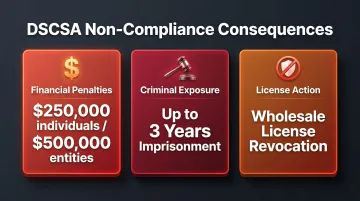
A failed scan isn't a production inefficiency — it's a compliance event with direct financial and regulatory exposure.
Key Features to Look for in a Hi-Res Printer for DSCSA Compliance
Print Resolution and Barcode Grading
The GS1 DataMatrix Guideline documents typical thermal transfer print resolutions between 4 and 24 dpmm (approximately 100 to 600 DPI). For regulated healthcare applications, GS1 specifies an X-dimension of 0.250mm to 0.615mm. While no single regulatory mandate specifies a minimum DPI, industry best practice and barcode grade requirements drive most pharma manufacturers toward 300–600 DPI systems.
What matters for compliance is the resulting barcode quality per ISO/IEC 15415, which measures decode, symbol contrast, modulation, and other parameters. GS1 standards require barcodes to achieve a minimum quality of Grade C (ISO/IEC 15416 Grade 2) at the point of use. Resolution can degrade at higher line speeds on certain printer types, making verification essential.
Printing Technology Match to Substrate
Four primary technologies dominate pharmaceutical serialization:
| Technology | Best Substrates | Key Advantage | Key Limitation |
|---|---|---|---|
| CIJ | Glass vials, plastic bottles, cartons, curved surfaces | Versatility; non-contact; high speed (up to 960 fpm) | Lower resolution vs. thermal transfer |
| Thermal Transfer | Labels, cartons, coated paper | High resolution (300–600 DPI); crisp DataMatrix | Contact printing; ribbon consumables |
| TTO | Flexible film, foil, pouches | Excellent on flexible packaging | Contact printing; limited to film substrates |
| Laser | Paper, plastics, metal, glass | No ink consumables; permanent marks | Higher capital cost; requires fume extraction |
Choosing the wrong technology for a substrate leads to adhesion failure or barcode degradation, both of which create direct compliance risk.
Ink Chemistry and Regulatory Compatibility
Pharma manufacturers must verify that inks comply with FDA 21 CFR Parts 175–178, which govern indirect food and drug contact substances. Pharma-grade inks must meet three core requirements — and ink selection is ultimately governed by the indirect contact framework and manufacturer certifications:
- Dries fast enough to prevent smearing at production line speeds
- Delivers adequate contrast on your substrate color (GS1 specifies black/blue on white/yellow/red for optimal results)
- Maintains adhesion validated for your specific packaging material
Integration with Serialization and EPCIS Software
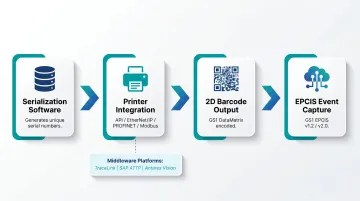
A printer alone doesn't achieve DSCSA compliance. It must integrate with your serialization software to receive unique serial numbers, encode them into 2D barcodes, and trigger EPCIS event capture for cross-system data exchange. FDA's September 2023 guidance identifies GS1 EPCIS (versions 1.2 and 2.0) as the required standard for Phase 3.
Evaluate whether printer brands offer native integration APIs, industrial protocols (EtherNet/IP, PROFINET, Modbus), or middleware compatibility with platforms like TraceLink, SAP ATTP, or Antares Vision.
Uptime, Reliability, and Serviceability
In high-volume pharma production, printer downtime is both a compliance and financial risk. Evaluate:
- Mean time between failures (MTBF)
- Ease of printhead cleaning/replacement
- Availability of spare parts
- Access to manufacturer-trained service support
Technology choice affects maintenance burden directly. Some CIJ printers feature self-cleaning printheads and sealed nozzle technology to minimize manual intervention, while thermal transfer printers offer drop-in cartridge systems that eliminate solvent handling.
Best Hi-Res Printers for Pharma Manufacturers (DSCSA Compliance)
These five printers cover the primary technologies used in pharmaceutical serialization — CIJ, thermal transfer, and laser-compatible systems — selected based on high-resolution output, pharma-industry adoption, and proven fit for DSCSA workflows. Use the specs tables to compare options against your line speed, substrate, and integration requirements.
Videojet 1860 (Succeeded by Videojet 1880+)
The Videojet 1860 is a high-resolution continuous inkjet (CIJ) printer widely deployed on pharmaceutical packaging lines for direct-to-container serialization. Note: The 1860 is no longer available for new sales; Videojet now offers the next-generation 1880+ CIJ printer.
Why it stands out for DSCSA compliance:
The heated printhead with Clean Flow technology minimizes ink build-up — a practical advantage on high-throughput lines where stoppages for nozzle maintenance cut into serialization uptime. The IP55 rating (IP66 optional) and broad connectivity suite (EtherNet/IP, PROFINET) simplify integration with existing serialization platforms.
| Specification | Value |
|---|---|
| Print Technology / Resolution | Continuous Inkjet (CIJ); 60µm or 70µm nozzle; supports DataMatrix codes 10x10 to 32x32; line speed up to 960 fpm |
| Key DSCSA Features | Validated 2D DataMatrix output; IP55 (IP66 optional) rating; Ethernet/EtherNet/IP/PROFINET connectivity for serialization integration |
| Best Suited For | Glass vials, plastic bottles, folding cartons, curved surfaces at high speed |
Markem-Imaje 9450
The Markem-Imaje 9450 is a continuous inkjet printer with a strong presence in pharmaceutical manufacturing, built specifically for precision marking in regulated environments.
Where it differentiates for DSCSA compliance:
The built-in Mark&Read inline verification is the standout feature here — it checks every printed code at the point of application, reducing the risk of serialization failures that trigger DSCSA non-compliance. Paired with the CoLOS software platform for serialization, aggregation, and multi-site management, the 9450 covers both the physical print and the data layer. The manufacturer claims 99.9% availability and 20% faster output than comparable CIJ systems.
| Specification | Value |
|---|---|
| Print Technology / Resolution | Continuous Inkjet (CIJ); high-resolution codes; 20% faster than similar printers in category |
| Key DSCSA Features | Integrated Mark&Read inline verification; CoLOS serialization software; IP56 (IP66 optional); DataMatrix/QR code support |
| Best Suited For | Metal, cardboard, tube laminates, plastic films, foil lids, glass; medium to heavy duty pharma lines |
Domino Ax350i
The Domino Ax350i is a CIJ printer engineered for high-speed pharmaceutical and life sciences packaging lines where production stoppages for printhead maintenance are not an option.
What sets it apart for DSCSA compliance:
The i-Pulse printhead's nozzle sealing technology prevents ink drying and clogging during unplanned stoppages — without manual intervention. That means the line restarts cleanly, with no degraded codes that would require manual verification before resuming DSCSA-compliant serialization. The 20-second cartridge swap without stopping the line adds further uptime protection.
| Specification | Value |
|---|---|
| Print Technology / Resolution | CIJ with i-Pulse sealed printhead; 82 DPI (60µm nozzle), 64 DPI (75µm nozzle); up to 7.2 m/s line speed |
| Key DSCSA Features | Self-cleaning nozzle sealing technology; DataMatrix/QR code support; IP66/IP55 rating; 20-second cartridge replacement without line stop |
| Best Suited For | Direct coding on cartons, vials, bottles, curved surfaces; washdown-compatible environments |
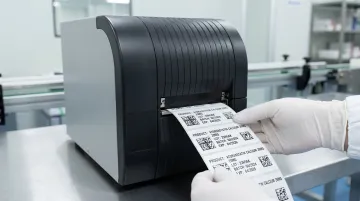
Zebra ZT411
The Zebra ZT411 is an industrial thermal transfer/direct thermal label printer widely used in pharmaceutical packaging and distribution — and the highest-resolution option in this comparison at 600 DPI.
Why it stands out for DSCSA compliance:
At 600 DPI, the ZT411 produces the sharpest 2D DataMatrix codes in this group — critical for label-based serialization where scan failure rates at distribution must stay near zero. Optional UHF RFID encoding (EPC Gen 2 V2, RAIN RFID) lets lines produce dual barcode/RFID labels in a single pass, a capability that positions operations for potential future DSCSA RFID requirements. ZBI 2.0 scripting enables standalone serialization workflows where a direct host connection isn't available.
| Specification | Value |
|---|---|
| Print Technology / Resolution | Thermal transfer and direct thermal; 203, 300, or 600 DPI; print speed up to 14 ips (203 DPI), 10 ips (300 DPI), 4-6 ips (600 DPI) |
| Key DSCSA Features | 600 DPI high-resolution DataMatrix; optional UHF RFID encoding; Link-OS serialization integration; ZBI 2.0 standalone scripting |
| Best Suited For | Label-based pharma packaging applications, carton labeling, secondary packaging serialization |
Hitachi UX-D160W
The Hitachi UX-D160W is a continuous inkjet (CIJ) printer suited for pharmaceutical packaging operations where a compact footprint, cleanroom-compatible IP65 rating, and reliable 2D code output matter more than maximum line speed.
Why it stands out for DSCSA compliance:
The 10.4" color TFT LCD touchscreen with WYSIWYG message design lowers operator training burden — an underrated factor on lines where staff turnover affects serialization accuracy. IP65 rating and Modbus Ethernet connectivity cover cleanroom integration requirements, while support for DataMatrix, QR, and Micro QR codes satisfies current DSCSA 2D symbology needs.
Note: The UX-D160W is a CIJ printer, not a Thermal Inkjet (TIJ) system. It uses solvent-based CIJ ink (1067K), not cartridge-based TIJ consumables.
| Specification | Value |
|---|---|
| Print Technology / Resolution | Continuous Inkjet (CIJ); 65µm nozzle; up to 1,148 chars/sec (2,563 optional); 2-10mm character height |
| Key DSCSA Features | DataMatrix/QR code support; IP65 rating; Modbus Ethernet connectivity; WYSIWYG touchscreen interface |
| Best Suited For | Direct coding on cartons, vials, and packaging requiring compact CIJ systems with cleanroom-compatible IP65 rating |
How We Chose the Best Hi-Res Printers for DSCSA Compliance
Evaluation Criteria
Printers were assessed on:
- Print resolution and barcode grade output — confirmed ability to produce ISO/IEC 15415 Grade C or higher 2D data matrix codes
- Pharma-industry adoption — proven deployment in regulated manufacturing environments
- Ink portfolio suitability — fast dry time, substrate compatibility, and regulatory compliance (21 CFR Parts 175-178)
- Serialization software integration — connectivity protocols (Ethernet, EtherNet/IP, PROFINET, Modbus) and API compatibility with EPCIS platforms
Each criterion ties directly to real-world DSCSA compliance risk. A printer that can't integrate with your serialization software, even if it prints perfect barcodes, creates a compliance gap.
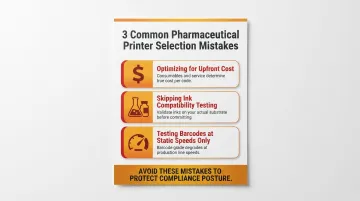
Common Mistakes Pharma Manufacturers Make
- Optimizing for upfront cost, not total cost of ownership — consumable costs, service frequency, and lifespan determine the real price per printed code
- Skipping ink compatibility verification — a CIJ printer validated for glass vials may fail on coated cartons; request substrate compatibility testing before committing
- Testing barcodes at static speeds only — barcode grade can degrade at production line speeds; demand inline verification testing at your actual operating speed
Working with a Packaging Equipment Specialist
A packaging equipment specialist with pharma compliance experience can reduce selection risk by flagging integration gaps and substrate issues before they become production problems. John Maye Company has supported Midwest manufacturers since 1983 with equipment sourcing, factory-certified technical service, and same-day parts availability — resources that matter when a compliance deadline is on the line.
Conclusion
Print quality is the foundation of DSCSA compliance. Selecting a high-resolution printer matched to your packaging substrate, production speed, and serialization software is a regulatory requirement — and the wrong choice creates traceability gaps that can trigger enforcement action. The printers reviewed represent proven solutions across CIJ, thermal transfer, and laser technologies, each with documented deployment in pharmaceutical serialization workflows.
With Phase 3 enforcement continuing through 2026, evaluating your current printing setup against DSCSA requirements should be a near-term priority — not a reactive one.
John Maye Company has supported Midwest manufacturers with packaging equipment sourcing and implementation for 40+ years. Their 2,500+ SKU inventory and 24-hour ship guarantee mean qualified equipment reaches your line without the lead times that stall compliance timelines. Contact them at info@johnmayecompany.com or 1-800-441-6293 to discuss your pharma packaging requirements.
Frequently Asked Questions
What is the DSCSA?
The Drug Supply Chain Security Act (DSCSA) is a U.S. federal law enacted in 2013 requiring an electronic, interoperable system to track and trace prescription drugs at the package level. It covers manufacturers, repackagers, wholesale distributors, and dispensers to prevent counterfeit and harmful drugs from reaching patients.
Who must comply with DSCSA?
DSCSA applies to all trading partners in the U.S. pharmaceutical supply chain: manufacturers, repackagers, wholesale distributors, third-party logistics providers, and dispensers (including pharmacies and hospitals). Obligations vary by role but center on serialization, transaction data exchange, and product verification.
What print resolution is needed for DSCSA-compliant 2D data matrix barcodes?
Industry best practice recommends 300–600 DPI for scannable, DSCSA-compliant 2D data matrix barcodes — no single regulation mandates a specific minimum. The true measure is achieving ISO/IEC 15415 Grade C or higher when barcodes are scanned at actual production line speeds.
What data must be printed on pharmaceutical packages under DSCSA?
Each package must display the GTIN (which contains the NDC), a unique serial number, lot number, and expiration date — encoded in both a 2D data matrix barcode and human-readable format, as mandated under DSCSA Phase 2 serialization requirements.
What is the difference between CIJ and thermal transfer printers for pharma packaging?
Continuous Inkjet (CIJ) printers excel at high-speed, direct-to-container marking on a wide range of substrates with minimal line integration complexity. Thermal transfer printers offer higher resolution output (300–600 DPI) with lower maintenance and are better suited for label applications.
Can any inkjet printer be used for DSCSA pharmaceutical serialization?
No. DSCSA compliance requires printers validated for 2D data matrix output at required barcode grades (ISO/IEC 15415), with inks compliant with FDA 21 CFR regulations and connectivity to serialization/EPCIS software platforms. Using unvalidated equipment risks failed barcode scans, serialization gaps, and potential regulatory action.