Introduction
Packaging materials account for approximately 10-20% of total fulfillment cost for e-commerce and distribution operations, with typical order packaging ranging from $0.50 to $2.00 for standard shipments and $3.00 to $5.00 for specialty products. At 50,000 cartons per month, that adds up to $25,000–$100,000 annually on packaging materials alone.
What many operations fail to recognize is that cost-per-carton isn't fixed. It's shaped by three controllable factors: material design efficiency, system configuration decisions, and operational habits at the packing station. The PAPERplus Chevron system addresses each of these levers through its pleated tubular paper design, which creates maximum void-fill coverage using less raw paper than traditional flat pads or manually crumpled sheets.
TL;DR
- Chevron's air-trapping tubular design uses less paper per carton than flat pads while delivering equivalent protection
- True cost-per-carton includes material waste, packer time, damage returns, and poor carton fit
- Pre-operational decisions on paper grade, tube length, and production mode set your baseline efficiency
- Speed calibration, consumption tracking, and SOP discipline prevent cost leakage during live operations
- Right-sized cartons and workstation integration determine whether Chevron's design advantage translates to real savings
How Carton Packaging Costs Typically Build Up
Cost-per-carton in protective paper packaging is rarely visible as a single line item. It accumulates across four hidden cost centers:
- Material consumption — rolls used per carton output, tracked against no baseline
- Packer labor time — seconds lost per station that multiply across shifts
- Damage-related returns — claims that spike customer service workload and freight costs
- Oversized carton usage — larger boxes chosen to compensate for poor void-fill placement
Because these costs distribute across purchasing, labor, customer service, and freight budgets, no single department owns the problem — and no one measures it until it's already expensive.
Without standardized output controls, packers default to "more is safer," pulling extra material to guarantee protection. One survey found that the average package ships 50% empty, packed in oversized boxes that require excessive void fill to compensate. This overpacking becomes the operational norm, embedded in muscle memory rather than questioned as a cost driver.
That habit surfaces as pattern problems: repeated damage claims, abnormally high paper roll consumption relative to carton output, slow throughput at individual stations that bottleneck entire lines. By the time any single manager recognizes the pattern, the cost has typically been running undetected across multiple departments for a full quarter or more.
Key Cost Drivers for Paper-Based Protective Packaging
Material Consumption Per Carton
The primary cost driver is simple: how much paper gets dispensed relative to actual void space. Systems that produce dense, air-trapping structures achieve the same protection using less material. Right-sizing packaging can reduce void fill needs by up to 60% and overall material usage by 30%, according to Deloitte analysis. The Chevron system's pleated tubular design traps air within the structure, creating lightweight space-filling tubes that require less raw paper than flat sheets wadded manually.
Packer Throughput Speed
Labor represents 45-60% of total distribution center operating cost. Slower packing processes inflate labor cost per carton. Systems requiring manual crumpling, tearing, or resizing add seconds per carton that multiply across high-volume stations. Automated void-fill solutions can reduce packing time by up to 50%, while standardized workflows alone can cut packing time by up to 30%.
Product Damage and Returns
Insufficient or poorly placed void fill creates transit damage that costs far more than the material savings that caused it. 1 in 10 packages arrive damaged, with substandard packaging cited as the main reason, leading to 860 million reships annually across the industry. In-transit damage costs American businesses approximately $1 billion annually, or roughly 0.5% of gross sales. Each damage incident carries hidden costs beyond the replacement product itself:
- Return handling and inspection labor
- Reship freight charges
- Administrative overhead and claim processing
- Customer credits and relationship repair
Carton Fit and Void Volume
Oversized cartons inflate material cost before any paper is dispensed. A carton that's 40% larger than necessary requires 40% more void fill to stabilize contents. Shipping a 2-ounce item in an oversized box can result in carrier charges equivalent to a 2-pound shipment due to dimensional weight pricing.
Right-sizing cartons can reduce box volume by up to 40%, cut void fill by 60%, and lower corrugate use by 26%. Those gains only materialize if the void-fill system can adapt to tighter spaces.
Paper Grade Selection
Paper weight, ply count, and thickness affect both protection level and cost per linear foot. Selecting a heavier grade than the product requires inflates per-carton material cost without adding useful protection. A grade too light for the product weight class risks damage just the same. Standard kraft paper weights break down by application:
| Application | Paper Weight |
|---|---|
| Light-duty (small consumer goods) | 30lb–40lb |
| Mid-range (general industrial) | 40lb–50lb |
| Heavy-duty (industrial parts) | 50lb–60lb |
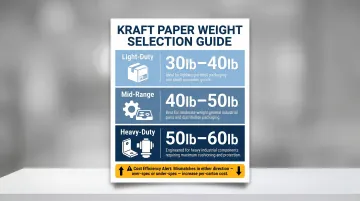
Mismatches in either direction waste money, whether through over-engineering or damage claims.
Cost-Reduction Strategies with PAPERplus Chevron
Reducing cost-per-carton with the PAPERplus Chevron system requires acting on three distinct leverage points: decisions made when configuring the system, how the system is managed during operations, and the broader packaging environment in which it operates.
Pre-Operational Decisions That Control Cost
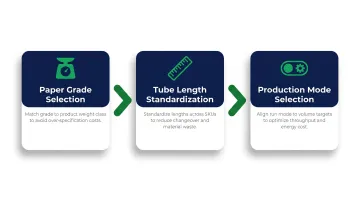
Pre-operational decisions—paper grade selection, tube length standards, and production mode—are the earliest and highest-leverage cost control points.
Match paper grade to product weight class:
- Chevron is available in multiple paper weights
- Selecting the right grade for light, medium, or fragile products avoids over-specifying material
- Over-engineering protection inflates material costs; under-protecting creates damage claims
- Audit product weight distribution across your carton mix and map to appropriate grades
Standardize tube length per carton size:
- Chevron paper features perforation for easy manual separation
- Establish defined length standards for each carton format rather than allowing packers to estimate
- This eliminates the single largest source of material waste in paper void-fill operations
- Document standard lengths (e.g., 12" for small cartons, 18" for medium, 24" for large) in visual SOP guides
Choose the right production mode for your volume:
- On-demand production minimizes inventory and waste for variable-volume stations
- Batch production improves throughput consistency for high-speed lines
- Selecting the wrong mode adds either waste (over-production) or labor cost (artificial slowdowns)
- Evaluate station throughput patterns before locking into a production approach
Operational Management That Prevents Cost Leakage
Active management of machine settings, packer behavior, and consumption visibility controls overspending during live operations.
Use variable speed settings intentionally:
- Chevron machines offer adjustable output speeds
- Calibrate speed to match packing station throughput pace
- Prevents over-production of tubes that sit unused
- Ensures packers aren't artificially slowed waiting for material availability
- Revisit speed settings when volume patterns shift seasonally
Monitor per-station material consumption as a KPI:
- Without tracking roll consumption relative to carton output, overpacking goes undetected
- Establish a simple consumption-to-output ratio as a cost signal
- Track rolls consumed per packing station per shift against cartons packed
- Identify outlier stations for targeted SOP reinforcement
- Industry frameworks like WERC's benchmarking tools provide guidance on packaging efficiency metrics
Turn minimal training requirements into a cost control tool:
- Chevron requires less packer training than manual crumpling methods
- Document a brief SOP covering tube length selection and placement
- Visual guides showing the correct tube length for each carton size maintain discipline
- New or temporary packers can follow the system with minimal onboarding
- Cost discipline holds even when the packing team changes frequently
Packaging Environment Changes That Maximize Chevron's Efficiency
The packaging environment surrounding the Chevron system—carton selection, station layout, and integration with automation—determines whether its cost efficiency is fully realized or partially offset.
Right-size cartons to reduce required void volume:
- Chevron is most cost-efficient when the carton closely matches product dimensions
- Audit carton sizes in use and identify where smaller standards would reduce void volume
- Eliminating 1 square foot of corrugate per box saves $0.10 to $0.50 per carton
- Smaller cartons require fewer Chevron tubes per pack, cutting material cost without changing the system
- Right-sizing also reduces dimensional weight charges and increases units per pallet
Integrate automated delivery systems for high-volume lines:
- Storopack's Working Comfort® system delivers Chevron material directly to packer stations via conveyor belts
- Reduces motion time, improves pack speed, and enables more consistent placement
- Links directly to lower labor cost per carton at scale
- Custom configurations match workforce size, parcel throughput, and available space
- Ergonomic positioning reduces physical strain and turnover
Conduct structured packaging cost analysis before scaling:
- Chevron's cost-per-carton performance is best evaluated through formal review
- Analyze current material consumption, carton formats, damage rates, and throughput
- Distributors like John Maye Company offer packaging assessments as part of system integration planning for Midwest operations
- Assessment identifies baseline costs, quantifies improvement potential, and sets KPI benchmarks
- Establishes data foundation for measuring ROI post-implementation
Conclusion
Optimizing cost-per-carton with PAPERplus Chevron isn't achieved by simply switching systems. It requires identifying where cost originates — material waste, labor inefficiency, damage claims, poor carton fit — and acting deliberately on each lever.
The pleated tubular design provides structural advantages, but capturing those advantages depends on three operational areas:
- Pre-operational decisions: paper grade selection, tube length standards, production mode
- Active management: speed calibration, consumption tracking, SOP discipline
- Environmental context: right-sized cartons, workstation integration
Effective cost reduction with Chevron is continuous, not one-time. As carton mix evolves, product weights shift, volumes fluctuate, and labor conditions change, the decisions and management practices around the system must be revisited. The system provides the structural foundation through efficient material design. Whether that foundation translates into measurable savings across thousands of cartons per month comes down to how consistently the operation is managed around it.
Frequently Asked Questions
What is cost-per-carton and why does it matter for packaging operations?
Cost-per-carton is the total packaging material and labor cost attributed to each individual carton shipped. Reducing it at scale directly improves margins without changing product pricing, turning packaging from a fixed overhead into a controllable profit lever.
How does the PAPERplus Chevron system use less paper per carton than traditional methods?
Chevron's pleated tubular design traps air within the structure, creating a lightweight yet space-filling tube. This achieves equivalent or better void-fill coverage using less raw paper than flat pads or manually crumpled sheets, which collapse and require more material for the same protection.
What types of products and carton sizes is PAPERplus Chevron best suited for?
Chevron is designed for light to medium-weight products packed in small to medium-sized cartons. Its flexible tube format can be separated to precise lengths and placed for both void-fill and block-and-brace applications.
How does paper grade selection affect Chevron's cost-per-carton performance?
Selecting a heavier paper grade than the product requires inflates per-carton material cost without adding useful protection. A grade too light risks damage and returns. Matching grade to product weight class is the simplest way to keep material spend in line.
Can PAPERplus Chevron be integrated into automated or high-speed packing lines?
Yes. Chevron integrates with Storopack's Working Comfort® automated belt delivery system, which feeds material directly to packing stations at ergonomic height and distance — supporting high-speed line configurations while reducing motion time and improving throughput consistency.
Is PAPERplus Chevron a sustainable packaging option?
Chevron tubes are made from recyclable kraft paper that often contains recycled content. Using less material per carton cuts both total paper consumption and environmental impact per shipment — aligning cost savings with sustainability targets.