- Packaging consumables (tape, stretch wrap, strapping, void fill, labels) are variable costs that must be tracked separately from structural packaging for accurate unit cost analysis.
- Calculate per-carton cost by dividing each consumable's cost per roll by cartons covered, then sum all carton-level materials.
- Per-pallet cost combines rolled-up carton costs plus pallet-level consumables like stretch wrap, strapping, and edge protectors.
- Pre-stretch settings, film gauge specification, and equipment calibration are the highest-impact cost drivers affecting per-unit consumption.
- Using these calculations to benchmark current spend and audit equipment performance reveals waste points worth thousands annually.
Introduction
Packaging consumables represent one of the most overlooked cost categories in warehouse and manufacturing operations. Unlike equipment purchases, materials like carton sealing tape, stretch wrap, strapping, void fill, and labels accumulate across thousands of units every week. These costs rarely appear as a single line item on any invoice, making them nearly invisible to traditional cost accounting.
Most operations managers rely on rough estimates or historical spend averages rather than precise per-carton and per-pallet calculations. This approach leads to budget surprises during quarterly reviews, supplier negotiations conducted without supporting data, and margin erosion that's difficult to trace back to its source.
According to PMMI Business Intelligence, 70.5% of packaging operations professionals cite cost as their top decision-making factor — yet most lack the per-unit data needed to act on it.
This article explains exactly how to calculate packaging consumables cost at both the carton and pallet level, what inputs are required, which cost drivers move those numbers the most, and how to use the calculations to identify and eliminate hidden waste in your operation.
What Counts as Packaging Consumables?
Packaging consumables are materials consumed in the process of sealing, protecting, securing, and labeling cartons and pallets. They're distinct from structural packaging (the box or pallet itself) and from the equipment that applies them.
PMMI ProSource, the official packaging directory of The Association for Packaging and Processing Technologies, formally categorizes consumables as a distinct product group that includes adhesives, tape, stretch film, machine knives, and ink—separate from containers and machinery.
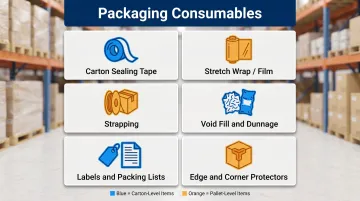
Primary consumable categories tracked at the carton and pallet level include:
- Carton sealing tape — pressure-sensitive and water-activated types, applied per carton
- Stretch wrap/film — hand-applied or machine-grade film; cost varies significantly by wrap pattern and film gauge
- Strapping — polypropylene or steel banding; consumption tracked per pallet or bundle
- Void fill and dunnage — kraft paper, air pillows, foam inserts, and packing peanuts; highly variable by product type
- Labels and packing lists — shipping labels, pallet tags, and documentation sleeves counted per shipment
- Edge and corner protectors — cardboard or plastic reinforcements; typically 4 per pallet
Tracking consumables as their own cost category matters because they're recurring, variable with volume, and directly affected by process and equipment changes. A miscalibrated stretch wrapper or an operator using twice as much tape as necessary creates waste that compounds across every shift—and most facilities don't catch it until they run the numbers. That's exactly what this calculator is designed to surface.
How to Calculate Per-Carton Packaging Consumables Cost
The Per-Carton Formula
The base formula has just two inputs:
Per-Carton Consumables Cost = Sum of (Cost per roll or unit of each consumable ÷ Number of cartons each roll or unit covers)
Perform this calculation separately for each consumable applied at the carton level, then add the results together for a total.
Tape calculation example:
A standard 18" x 12" x 12" carton sealed with an I-seal pattern (center seam only, top and bottom) typically requires 36 inches (3 linear feet) of tape per carton, according to Desktop Industrial. A standard 110-yard roll (330 feet) covers approximately 110 cartons at this consumption rate.
If each roll costs $2.80:
- Cost per carton = $2.80 ÷ 110 cartons = $0.025 per carton
An H-seal pattern, which adds two cross-strips at each end of the center seam, increases tape usage by approximately 50%, reducing cartons per roll to around 60-80 depending on carton dimensions.
Inputs You Need Before You Calculate
Required data points:
- Cost per roll/unit for each consumable (tape, void fill, labels)
- Usage rate per carton — cartons per roll, labels per carton, void fill units per carton
- Actual purchase price — use contracted pricing with volume discounts, not catalog list prices
Of these inputs, void fill is the most variable — fill quantity shifts by product type and operator judgment. Establish a standard fill quantity per SKU category to keep the calculation consistent. For example:
- Electronics: 2 air pillows per carton
- Glassware: 4 oz of kraft paper per carton
- Apparel: 1 oz of packing peanuts per carton
Common Calculation Mistakes to Avoid
Two mistakes consistently skew per-carton cost estimates:
- Not accounting for waste. Tape tears mid-application, stretch film gets wasted during roll changes, and void fill gets overpacked. Shurtape reports that 10-20% waste from tear-outs, dispensing errors, and stub rolls is "accepted as normal" in packaging operations. Build in at least a 10% waste factor. Automated sealing systems can cut this waste by 17% through consistent application and full core utilization.
- Treating all carton sizes as equivalent. A 24" x 18" x 18" carton requires significantly more tape than a 12" x 10" x 8" carton. Operations running multiple carton sizes need separate calculations per size — or a weighted average based on SKU distribution.
How to Calculate Per-Pallet Packaging Consumables Cost
The Per-Pallet Formula
Pallet-level cost has two components:
Total Per-Pallet Consumables Cost = (Per-Carton Cost × Number of Cartons per Pallet) + Pallet-Level Consumables Cost
The first part rolls up all carton-level consumables for every carton on the pallet. The second part captures materials applied specifically at the pallet stage: stretch wrap, strapping, edge protectors, pallet labels, and slip sheets. Each pallet-level consumable needs its own sub-calculation before the totals are summed.
Calculating Stretch Wrap Cost Per Pallet
Stretch wrap is typically the largest pallet-level consumable cost. Two calculation approaches:
Method 1: Grams per pallet
- Measure grams of film used per pallet (roll weight ÷ pallets wrapped per roll)
- Multiply by cost per gram
Method 2: Pallets per roll
- Cost per roll ÷ pallets wrapped per roll = cost per pallet
Industry data from Hanpak shows hand wrapping uses 250-400 grams per pallet, while machine wrapping uses 150-300 grams per pallet—a 20-40% reduction.
Critical variables affecting film consumption:
- Wrap pattern — number of bottom wraps, overlap percentage, top wraps
- Pre-stretch percentage — how much the film is stretched before application
- Number of revolutions — total wraps around the pallet
- Load height — taller pallets require more revolutions
Two operations using the same roll can have dramatically different per-pallet costs depending on wrapping technique and equipment settings. Murphy Packaging puts this in concrete terms: entry-level film at $1.16/lb costs $1.10 per pallet at typical hand-wrap consumption rates, while high-performance film at $1.28/lb costs only $0.83 per pallet because less material is needed.
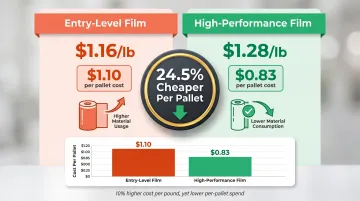
Despite costing 10% more per pound, the high-performance film runs 24.5% cheaper per pallet — a gap that compounds quickly at scale.
Calculating Strapping, Edge Protectors, and Labels Per Pallet
| Consumable | Cost Basis | Typical Example |
|---|---|---|
| Strapping | Cost per strap × straps per pallet | 4 poly straps × $0.15 = $0.60/pallet |
| Edge protectors | Per-unit cost × corners protected | 4 corners × $0.40–$0.80 = $1.60–$3.20/pallet |
| Labels | Per-unit cost × labels applied | 1 shipping label × $0.05 = $0.05/pallet |
Strapping pattern is driven by pallet weight, product type, and transit method. A standard 1,200-lb pallet typically uses 2-4 straps; heavy industrial loads over 2,000 lbs may need 6-8. Label costs look trivial individually, but at 500 pallets per day, that $0.05 label adds up to $9,125 annually — worth tracking.
Key Cost Drivers That Affect Your Per-Carton and Per-Pallet Numbers
Material Specification and Gauge
Choosing lower-gauge stretch film or thinner tape may reduce cost-per-roll but often increases usage per unit, resulting in higher actual per-unit cost.
WCP Solutions reports that switching from traditional 70-90 gauge film to thinner high-performance film typically saves 15-30% per pallet through improved puncture resistance and cling properties. However, downgauging with standard-performance film can backfire—requiring more revolutions per pallet or more frequent film breaks that erase apparent savings.
The key is matching film specification to load characteristics. Uniform loads with identical cartons wrap easily with standard film. Semi-uniform loads with inconsistencies create puncture points requiring more robust film. Non-uniform loads with varied shapes demand high-performance film despite higher per-roll cost.
Purchase Volume and Contract Pricing
Per-unit consumables cost drops significantly with volume purchasing and supplier contracts versus spot buying.
Hub Industrial Supply notes that suppliers commonly incentivize bulk orders with price breaks ranging from single-digit percentages to double digits. Desktop Industrial cites a 10% price reduction per roll as common when purchasing cases of 10+ rolls of carton sealing tape.
Beyond per-unit discounts, bulk purchasing also cuts ordering frequency, reduces stockout risk, and eliminates the reorder labor that adds hidden cost to spot buying.
Equipment Efficiency and Calibration
Automated packaging equipment dramatically reduces consumables waste compared to manual application by standardizing film tension, tape length, and overlap.
Multiple equipment manufacturers consistently report that automated stretch wrappers reduce film consumption by 30-50% versus manual wrapping. Robopac data shows that switching from 10% pre-stretch (hand wrapping) to 250% pre-stretch (machine) can save $30,000+ over five years at 50 loads per day. The table below shows how pre-stretch level directly multiplies usable film yield:
| Pre-Stretch % | Yield from 6,000 ft Roll |
|---|---|
| 100% | 12,000 ft |
| 200% | 18,000 ft |
| 300% | 24,000 ft |
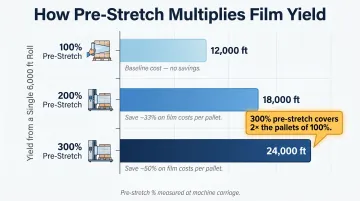
At 300% pre-stretch, a single roll covers twice the pallets it would at 100%—a direct multiplier on your per-pallet cost.
Miscalibrated or poorly maintained equipment can increase consumables usage without operators noticing. A stretch wrapper running at the wrong pre-stretch setting, a tape applicator with a dull blade, or a void fill machine dispensing too much material per activation all create hidden waste. Periodic calibration audits—whether run internally or through a factory-certified technician—catch these issues before they show up as unexplained cost spikes.
Operator Consistency and Process Standardization
Manual application of stretch wrap and tape varies significantly between operators. MHS Lift reports that manual wrapping often uses 2-3 times more film than necessary and that "each employee wraps differently," leading to unpredictable results and non-uniform loads.
Establishing standard work procedures directly reduces per-unit consumables cost and makes your calculations more reliable over time. To build consistency across operators:
- Document the exact wrap pattern: number of bottom wraps, overlap percentage, and top wraps
- Specify tape seal pattern by carton type (I-seal vs. H-seal)
- Define void fill quantity per SKU or box size
- Measure compliance weekly and coach operators when they deviate from standards
How to Use These Calculations to Cut Consumables Spend
Benchmark and Prioritize
Once per-carton and per-pallet costs are calculated, verify accuracy by comparing totals against historical invoices. Divide total monthly consumables spend by monthly carton or pallet volume—the result should closely match your calculated per-unit cost.
Next, identify which single consumable represents the largest cost per pallet or per carton. That's where optimization effort should start. For most operations, stretch film is the largest pallet-level cost and carton sealing tape is the largest carton-level cost.
Run What-If Scenarios
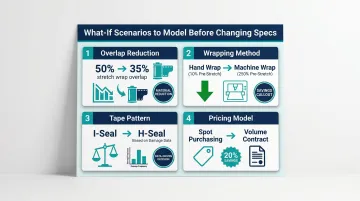
Small changes in specification or purchasing terms can be modeled using the per-unit formulas before making any purchasing decisions.
Example scenarios to model:
- Switching from 50% stretch wrap overlap to 35% overlap
- Moving from hand wrapping (10% pre-stretch) to machine wrapping (250% pre-stretch)
- Changing from I-seal to H-seal tape pattern based on transit damage data
- Negotiating volume contract pricing vs. continuing spot purchases
Hanpak calculates that for a facility shipping 20,000 pallets per year, reducing film by just 100 grams per pallet saves 2,000 kg (4,409 lbs) of film annually.
Audit Your Equipment Performance
If per-carton or per-pallet consumables costs are higher than expected even after calculation, the issue is often equipment. A stretch wrapper running at the wrong pre-stretch setting, a tape applicator with worn components, or a void fill machine dispensing too much material per activation all create waste that operators may not notice day-to-day.
Schedule regular equipment audits to measure actual consumption versus theoretical consumption. Weigh film rolls before and after a set number of pallets. Count tape rolls consumed per 1,000 cartons. Measure void fill material used per shift and divide by cartons packed.
For operations experiencing unexplained consumables cost increases, contact John Maye Company for a packaging equipment audit. Their factory-certified technicians identify exactly where consumption is running over and what equipment adjustments would bring per-unit costs in line.
Frequently Asked Questions
How to calculate the cost of packaging?
Packaging cost is calculated by identifying every material applied per unit (carton or pallet), dividing each material's cost by the number of units it covers, and summing those per-unit costs. Distinguish between consumables cost (tape, film, void fill) and the cost of the packaging container itself (carton, pallet).
What is the average cost for packaging?
Average packaging consumables cost varies widely by industry, product type, carton size, and pallet configuration. According to Murphy Packaging, stretch film alone runs $0.65–$1.10 per pallet depending on film type and application efficiency. Tape, strapping, and labels typically add another $0.50–$2.00 per pallet on top of that.
What packaging consumables are included in a per-carton cost calculation?
Per-carton calculations include carton sealing tape, void fill or dunnage materials, and any labels or packing list sleeves applied at the carton level. Pallet-level materials — stretch wrap, strapping, edge protectors — are calculated separately and folded into the per-pallet total.
How does pallet configuration affect consumables cost?
Cartons-per-pallet count, pallet height, load weight, and stability all drive how much stretch wrap, strapping, and edge protection is needed. Taller pallets need more film revolutions; heavier loads require higher-gauge film or added strapping. A shift in pallet build pattern — say, from 48 to 60 cartons per pallet — directly changes your per-pallet consumables cost.
What is the difference between per-carton and per-pallet packaging consumables cost?
Per-carton cost covers materials applied during carton sealing and prep (tape, void fill, labels). Per-pallet cost includes both the rolled-up per-carton costs for all cartons on the pallet and the additional materials applied at the pallet unitization stage (stretch wrap, strapping, edge protectors, pallet labels).