Introduction
Food manufacturers on the FDA's Food Traceability List must print accurate lot codes, batch numbers, and 2D barcodes on secondary packaging—corrugated cases, shipping cartons—under FSMA Section 204. The original January 20, 2026 compliance deadline has been proposed for extension to July 20, 2028 via Federal Register notice 90 FR 14967.
That extension is time to act, not wait. Manufacturers who use this window to upgrade case coding systems avoid the rushed deployments and integration failures that come with last-minute compliance scrambles.
Hi-res inkjet case coders are the preferred technology for this work. They print large, scannable codes on porous substrates at full production line speeds—something CIJ printers designed for small-character primary packaging can't reliably do.
Thermal inkjet (TIJ) systems fall short on throw distance. Hi-res piezo drop-on-demand printers, by contrast, deliver the print height, substrate versatility, and 2D barcode quality corrugated case marking demands.
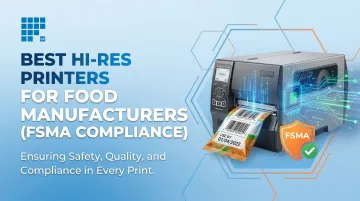
This article covers the top hi-res printers for food manufacturing environments, what makes each one FSMA-suitable, and how to choose the right system for your line.
Key Takeaways
- Hi-res inkjet case coders are the go-to technology for printing traceability codes on corrugated cases for FSMA 204 compliance
- FSMA 204 requires Food Traceability List manufacturers to capture Key Data Elements (KDEs) at every Critical Tracking Event (CTE)
- Top brands include Videojet, Domino, Markem-Imaje, Squid Ink Manufacturing, and Matthews Marking Systems
- Key selection criteria: print resolution, IP washdown rating, ERP/WMS integration, and total cost of ownership
- Partnering with an experienced packaging equipment distributor reduces selection complexity and integration risk
Hi-Res Printers and FSMA Compliance: What Food Manufacturers Need to Know
High-resolution inkjet case coders are large-format, piezo drop-on-demand printers that use oil-based inks to print sharp text, graphics, and machine-scannable barcodes directly onto corrugated cardboard and other porous secondary packaging.
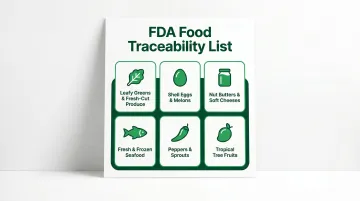
Under FSMA 204, manufacturers handling foods on the FDA's Food Traceability List must capture and communicate Key Data Elements (KDEs)—traceability lot codes, location identifiers, and dates—at each Critical Tracking Event (CTE). Foods covered by the rule include:
- Leafy greens and fresh-cut produce
- Shell eggs and melons
- Nut butters and soft/semi-soft cheeses
- Fresh and frozen seafood
- Peppers, sprouts, and tropical tree fruits
Hi-res case coders are the primary tool for applying this traceability data at the case and pallet level during production.
Hi-res printers vary significantly in their suitability for food manufacturing environments. IP-rated enclosures for washdown areas, food-safe ink formulations, and verified 2D barcode print quality all differ across brands and models—which is why equipment selection matters more than it might seem.
Best Hi-Res Printers for Food Manufacturers
The following hi-res inkjet case coders were evaluated based on print quality, food environment suitability, FSMA traceability support, and overall reliability in food and beverage manufacturing operations.
Videojet Large Character Inkjet (Hi-Res Case Coder)
Videojet's large character inkjet line has decades of deployment in high-throughput food facilities, making it one of the most field-tested options on this list. The Videojet 2380 is the current-generation flagship, replacing the discontinued 2351/2361 series.
Standout features:
- Supports ZPL emulation and CoLOS integration, simplifying rollout in facilities already running Markem-Imaje or Zebra systems
- 4-printhead option enables print heights exceeding 70 mm for large-format case marking
- VideojetConnect embedded Wi-Fi for remote diagnostics and analytics
- Gyroscopic sensor detects and records external impact signals, supporting equipment-level audit trails
| Feature | Specification |
|---|---|
| Print Resolution & Code Quality | 180 dpi; max print height 70 mm per head (>70 mm with 4-head option); supports barcodes and 2D codes with GS1/FSMA compliance |
| Food Environment Suitability | 304-grade stainless steel construction; IP rating and food-safe ink certifications not published on product page (buyers should request datasheets) |
| FSMA-Relevant Features | Variable data printing; ZPL emulation and CLARiTY job file compatibility; Markem-Imaje CoLOS integration; barcode line speed 0.6–66 m/min; alphanumeric up to 132 m/min |
Domino Hi-Res Inkjet Case Coder
Domino's Cx-Series leads the field on print resolution — the Cx150i reaches 600 dpi, making it the only system surveyed capable of printing brand logos and graphics at quality comparable to label printing. Food manufacturers that need marketing-quality codes alongside compliance barcodes should look here first.
Standout features:
- Cx150i reaches 600 dpi; Cx350i offers up to 300 dpi — highest resolution options in this comparison
- Vegetable oil-based inks are food packaging compliant, non-toxic, and non-hazardous per manufacturer specifications
- Domino Cloud connectivity for production analytics, error alerts, and remote guidance
- Domino Automation platform for central code management and ERP integration
| Feature | Cx350i | Cx150i |
|---|---|---|
| Print Resolution & Code Quality | Up to 300 dpi; max 65 mm per head (up to 260 mm with 4 heads stitched); GS1-compliant 1D/2D barcodes including QR codes powered by GS1 | Up to 600 dpi; max 32.5 mm or 65 mm single head; GS1-compliant barcodes |
| Food Environment Suitability | Vegetable oil-based inks (food packaging compliant); IP rating not specified on product pages | Same ink technology; IP rating not specified |
| FSMA-Relevant Features | QuickStep 3 touchscreen interface; Domino Cloud analytics; Domino Automation for ERP integration; 100+ m/min line speed (Industrial variant) | Same software and integration capabilities |
Markem-Imaje Hi-Res Inkjet Case Coder
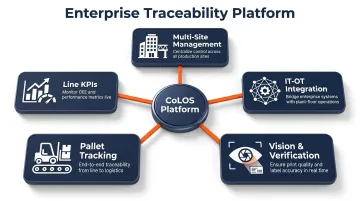
Markem-Imaje's 5800 series stands out for two things most competitors can't match: a wax-based hot melt ink that eliminates smearing on corrugated, and the CoLOS software ecosystem — the most comprehensive traceability platform surveyed. For facilities building toward FSMA 204 compliance at scale, this is the system with the deepest software infrastructure.
Standout features:
- Touch Dry (Intelli'Wax) ink solidifies on contact — resists smearing on corrugated where liquid inks absorb unevenly
- CoLOS platform includes dedicated modules for multi-site management, IT-OT integration, vision and verification, pallet tracking, and line KPIs — all relevant to FSMA 204 workflows
- GS1-128 barcode C-grade marking capability via GS1 partnership
- Up to 4-color printing on a single line
| Feature | Specification |
|---|---|
| Print Resolution & Code Quality | Resolution not explicitly stated; max print height 65 mm; GS1-128 barcodes (C-grade marking); GS1-compliant 1D and 2D codes |
| Food Environment Suitability | Touch Dry hot melt ink (solvent-free, non-hazardous); IP rating not specified on product pages |
| FSMA-Relevant Features | CoLOS platform with multi-site management, IT-OT integration, vision/verification, and pallet tracking modules; ERP integration via CoLOS IT-OT Integration module; line speed up to 121 m/min |
Squid Ink Manufacturing Hi-Res Case Coder
Squid Ink Manufacturing is a US-based company whose CoPilot series targets mid-sized food operations that need reliable porous-substrate printing without enterprise-level price tags. As a GS1 US Solution Partner, it covers the barcode compliance basics — but buyers with complex FSMA 204 integration requirements should note the software limitations below.
Standout features:
- Xaar piezo printhead technology across CoPilot models
- GS1 US Solution Partner certification
- Oil-based ink (PZ-1000 for porous substrates) or solvent-based options available
- Lower acquisition cost relative to enterprise-tier systems
| Feature | CoPilot 500 |
|---|---|
| Print Resolution & Code Quality | 185 dpi vertical / 205 dpi horizontal; max print height 2.8" (71 mm) per head, 5.6" (142 mm) with 2 heads; all standard barcodes including 2D and QR codes |
| Food Environment Suitability | Oil-based (PZ-1000 for porous) or solvent-based inks; IP rating and food-safe certifications not specified on product pages; CE, TUV, FCC, UL, CSA certifications |
| FSMA-Relevant Features | Orion PC Software; variable data including time/date, Julian dates, 16 counters, 4 shift codes; Ethernet communication with database capability; oil-based line speed: 205 ft/min standard, 300 ft/min high-speed |
Limitation for FSMA 204 applications: Relatively basic integration — Ethernet and database capability listed, but no named ERP/WMS integration protocol or traceability-specific software module documented.
Matthews Marking Systems Hi-Res Inkjet (MPERIA T-Series)
Matthews Marking Systems' MPERIA T-Series earns its place on this list through the broadest barcode format support surveyed and a native XML integration path that connects directly to ERP, WMS, and PLCs — no custom middleware required. A case study from a cosmetics manufacturer deployment showed 50% cost reduction and 30% error reduction after implementation.
Standout features:
- MPERIA universal controller supports the widest barcode format range surveyed: GS1-DataMatrix, DataMatrix, QR Code, Micro QR, GS1-128, EAN-8/13, UPC-A, ITF-14, and standard 1D barcodes
- Integrated label validation checks code readability immediately after application
- Native XML integration with ERP, WMS, and PLCs — no custom software or server hardware needed
- Stackable printheads for additional print height
| Feature | T100E |
|---|---|
| Print Resolution & Code Quality | Resolution not specified on product pages; max print height 4" (100 mm); horizontal side printing; piezo DOD technology |
| Food Environment Suitability | Spot color and fade-resistant inks for porous surfaces; enclosed module design; IP rating not specified on product pages |
| FSMA-Relevant Features | MPERIA controller with broadest barcode support; XML integration with ERP/WMS/PLC; integrated label validation; max line speed 276 ft/min (84 m/min); 1/4" throw distance |
How to Choose the Right Hi-Res Printer for FSMA Compliance
The single most common mistake food manufacturers make is selecting a hi-res printer based on upfront price or brand familiarity alone, without verifying whether the system can produce scannable 2D barcodes at line speed—a non-negotiable requirement for FSMA 204 traceability at the case level.
Print Resolution and Substrate Compatibility
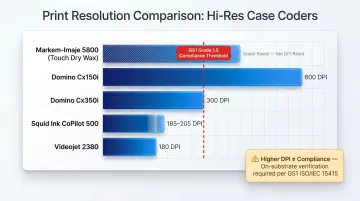
FSMA-compliant 2D barcodes (such as QR codes, DataMatrix) require minimum print quality to remain scannable after handling and shipping. However, GS1 does not specify a minimum DPI—instead, it requires a minimum print quality grade of 1.5 (ISO/IEC 15415 "C" grade) measured at an aperture of 80% of the minimum X-dimension.
Critical insight: GS1 specifically notes that corrugated fibreboard's absorbency can disrupt inkjet reading by causing irregular dot shapes. This means a printer achieving 300 dpi on coated stock may not achieve grade 1.5 on kraft-lined corrugated. On-substrate verification testing is essential—demand barcode grade performance results on your specific corrugated stock, not just DPI claims.
Surveyed manufacturer products range from 180 dpi (Videojet 2380, Squid Ink CoPilot) to 300 dpi (Domino Cx350i) to 600 dpi (Domino Cx150i), but higher DPI does not guarantee compliance. Markem-Imaje's Touch Dry wax ink—which solidifies on contact rather than absorbing—may achieve better effective print quality despite not publishing a DPI figure.
Food Environment Requirements
Food manufacturing facilities—especially those with wet or washdown areas—require printers with appropriate IP ratings (IP54 for dry areas with splashing; IP65 for wet processing and washdown environments). IP65 provides "dust tight" protection and protection against water jets from any direction, per IEC 60529.
Spec gap to flag: None of the five manufacturers' hi-res piezo inkjet case coder product pages surveyed publish an explicit IP rating. Request detailed datasheets directly before specifying equipment for any washdown environment.
Ink compliance is a separate verification step. Formulations must meet FDA regulations under:
- 21 CFR Part 175, Section 175.300 — resinous and polymeric coatings
- 21 CFR Part 176, Section 176.170 — paper and paperboard components
- 21 CFR Part 176, Section 176.130 — anti-offset substances
Confirm ink supplier compliance with these specific CFR sections. Generic "food safe" marketing claims do not satisfy audit requirements.
Variable Data and Integration Capability
FSMA 204 requires unique lot codes, CTEs, and KDEs for each production run. That means the printer's software must support dynamic variable data printing and, ideally, integrate directly with your ERP or WMS to eliminate manual entry errors.
The recall data makes integration a compliance priority, not a nice-to-have. Undeclared allergens accounted for 47% of all FDA recalls in 2022 and 63% in 2023, with labeling errors causing over 60% of those incidents.
ERP-integrated case coding that automates lot code, ingredient, and allergen data flow directly reduces exposure to this leading recall category.
Integration depth varies significantly:
- Basic connectivity: Squid Ink's Ethernet/database capability
- Mid-tier platforms: Videojet's CLARiTY and VideojetConnect; Domino's Automation and Cloud
- Enterprise-grade systems: Markem-Imaje CoLOS (multi-site management, vision verification, pallet tracking); Matthews MPERIA (XML integration with integrated label validation)
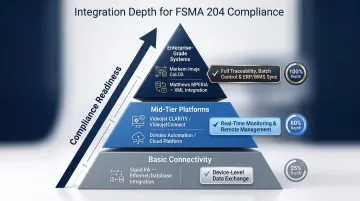
FSMA 204's requirement to produce an electronic sortable spreadsheet within 24 hours of an FDA request makes deep ERP integration a compliance requirement, not merely a convenience.
Work with an Expert Distributor
A manufacturer-trained packaging equipment distributor with food industry experience can run on-substrate print tests across multiple brands, evaluate line integration requirements specific to your facility, and manage ongoing service—cutting both selection risk and unplanned downtime. John Maye Company has supported Midwest food manufacturers in exactly this capacity since 1983.
Conclusion
For food manufacturers under FSMA 204, the ability to print scannable 2D traceability codes on corrugated secondary packaging is a compliance requirement — not a nice-to-have. The printer you choose directly determines whether your traceability records hold up during an FDA audit or a recall event.
Evaluate printers against these compliance and operational criteria:
- Print resolution for 2D code quality (demand on-substrate barcode verification results, not just DPI specs)
- IP rating for your facility environment (especially critical for washdown areas)
- Variable data integration capability (to eliminate manual data entry errors that drive recalls)
- Total cost of ownership (including ink costs, maintenance intervals, and integration effort)
Getting this decision right the first time matters — a mismatched system means retrofitting, downtime, or failed verification audits down the line.
John Maye Company has served food and beverage manufacturers across Wisconsin and the Midwest since 1983. With manufacturer-trained expertise and hands-on knowledge of production line integration, they can help you match the right hi-res printer to your facility, your substrates, and your FSMA compliance requirements. Contact John Maye Company at 1-800-441-6293 or info@johnmayecompany.com to get started.
Frequently Asked Questions
What are the codes on food packaging?
Food packaging codes include lot codes, batch codes, date codes (best-by, use-by, manufactured-on), and traceability codes such as 2D barcodes. These serve both consumer information and supply chain traceability functions, with lot and batch codes specifically required for FSMA 204 compliance.
What food grade ink is FDA approved?
The FDA does not maintain an "approved" list of food-grade inks. Inks must comply with 21 CFR 175.300 and 176.170 for indirect food additives—look for inks explicitly marketed as food-safe and request SDS documentation from your printer supplier to confirm compliance.
What is FSMA 204 and how does it affect food manufacturers?
FSMA 204 requires manufacturers handling FDA Food Traceability List items to capture and share Key Data Elements at each Critical Tracking Event. Traceability lot codes are central at the production and packaging level, and covered entities must provide electronic sortable spreadsheets within 24 hours of an FDA request.
What print resolution is needed for scannable 2D barcodes on corrugated packaging?
GS1 requires a minimum print quality grade of 1.5 per ISO/IEC 15415—not a specific DPI. Industry practice uses 180 dpi as the corrugated baseline, with 300–600 dpi for higher-fidelity applications. Because corrugated's rough surface degrades effective print quality, on-substrate verification testing is essential.
How can I tell the age of my printer?
Most industrial inkjet printers display manufacture date information in their settings menu or on a serial number label. Manufacturers also maintain production date records by serial number, and authorized service technicians or distributors can look up equipment age to advise on service intervals or upgrade timing.
How often should hi-res case coders be serviced in a food manufacturing environment?
Most hi-res inkjet case coders require preventive maintenance annually or by usage hours per the OEM schedule. Dusty or temperature-variable food production environments call for more frequent printhead cleaning and ink system checks to maintain print quality for compliant traceability codes.