Introduction
Chemical manufacturers face significant compliance risk every time they print a GHS label. OSHA's Hazard Communication Standard (HCS) violations carry serious penalties—up to $16,550 per violation as of January 2025, with willful or repeat violations reaching $165,514 per incident. When a production run of hundreds of drums carries mislabeled containers, that exposure multiplies fast. With HCS ranking as the #2 most-cited OSHA standard in FY2025 (2,546 citations), printer selection directly affects your regulatory exposure.
That compliance starts with print quality. GHS labels must reproduce crisp pictograms with clearly visible red diamond borders, sharp signal words, and hazard text that stays legible through chemical splash, UV exposure, temperature extremes, and physical abrasion.
Standard office laser and dye-based inkjet printers can't meet these durability requirements. Labels printed on the wrong hardware degrade under real-world conditions — and a degraded label is a non-compliant label. This guide covers the high-resolution printers built specifically for industrial GHS label stock, so you can match the right equipment to your operation.
Key Takeaways
- GHS labels require six mandatory elements — from hazard pictograms and signal words to supplier information — and all six must survive chemical exposure and handling
- Pigment inkjet and thermal transfer printers on synthetic substrates (BOPP, PET) best meet GHS durability standards for chemical resistance and UV stability
- Top models include the Epson ColorWorks CW-C6500A, Epson TM-C3500, and Brady BBP85
- Key criteria: 600+ DPI resolution, BS5609 certification for maritime shipping, chemical/UV-resistant output
- Midwest chemical manufacturers can contact John Maye Company directly to evaluate which GHS printer system fits their production volume and compliance requirements
What GHS Requires from a Hi-Res Printer
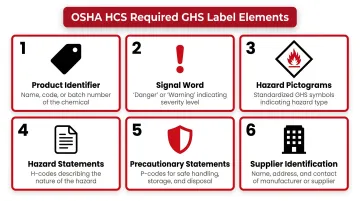
The Six Required GHS Label Elements
OSHA's HCS 1910.1200 mandates every chemical label include:
- Product Identifier – chemical name or code matching the SDS
- Signal Word – "DANGER" or "WARNING"
- Hazard Pictograms – black symbols on white background with red diamond border
- Hazard Statements – standardized phrases describing hazard nature
- Precautionary Statements – prevention, response, storage, and disposal measures
- Supplier Identification – manufacturer name, address, and phone number
The pictogram element specifically demands high print resolution. GHS pictograms must be minimum 10mm × 10mm with a red diamond border clearly visible at that size. Any pixelation, color bleeding, or border irregularity constitutes a compliance risk.
Larger containers like 55-gallon drums require proportionally larger pictograms (25-50mm), but clarity requirements are the same.
OSHA Durability Standards
OSHA HCS 1910.1200 takes a performance-based approach: labels must remain legible throughout the product's full use lifecycle and must not "get defaced (meaning fade, wash off, or removed in any way." While OSHA doesn't specify numeric thresholds, in practice GHS labels need to withstand:
- Temperatures: -40°F to 150°F
- UV exposure: 12-24 months fade resistance for outdoor storage
- Chemical resistance: Solvents, acids, bases, and cleaning agents
- Physical durability: Moisture, humidity, and abrasion
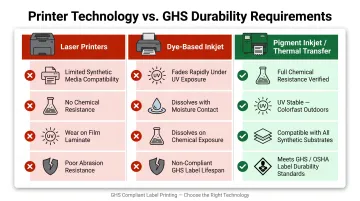
Why standard office printers fail:
- Laser printers have limited synthetic media compatibility, wear quickly on film substrates, and produce labels with no chemical resistance
- Dye-based inkjet inks fade under UV exposure and dissolve when contacted by water or chemicals
- Pigment-based inkjet and thermal transfer with synthetic film substrates (BOPP, PET, polypropylene) deliver the chemical and UV resistance GHS requires
BS5609 Certification
What it is: BS5609 is a British Standard specification for marine-grade label durability, covering:
- Section 2: Blank label stock and adhesive—3-month saltwater immersion, peel adhesion testing, UV weathering
- Section 3: Printed label (ink + media combination)—abrasion resistance, print permanence after salt spray and UV
When it's required: BS5609 compliance is mandatory for chemicals shipped via ocean freight under the IMDG Code (International Maritime Dangerous Goods). It is not a universal OSHA requirement for domestic GHS labeling. Chemical manufacturers exporting products internationally or labeling bulk marine containers need BS5609-certified printer/ink/media combinations. Operations serving only domestic markets may use it as a durability benchmark but are not obligated to meet it.
Best Hi-Res Label Printers for GHS Chemical Labeling
These five printers are selected based on resolution capability, chemical-resistant print output, label width range, and documented use in GHS-compliant workflows.
Epson ColorWorks CW-C6500A
The CW-C6500A is Epson's wide-format (up to 8.34") color inkjet model using UltraChrome DL pigment-based inks—purpose-built for chemical manufacturers producing drum and tote labels. Available in auto-cutter (A) and peel-and-present (P) variants.
Pigment ink delivers chemical and water resistance, the wide print width accommodates full drum-label layouts with all six GHS elements at compliant sizes, and print speed supports production-volume runs. The CW-C6500A is BS5609 certified when paired with Avery Dennison Fasson 3.5M Matte WH Syn Paper.
| Specification | Value |
|---|---|
| Print Resolution | Up to 1200 × 1200 DPI |
| Label Width Range | Up to 8.34 inches (212 mm) |
| Print Speed | Up to 5 inches/second (at 300 × 600 DPI, 3.5" width) |
| Best Use Case | Large-format GHS labels for drums, totes, and multi-SKU chemical production lines |
Epson TM-C3500
The TM-C3500 is a compact, BS5609-certified color inkjet printer widely used by small-to-mid-size chemical operations. It uses Epson DURABrite Ultra pigment ink with individual CMYK cartridges and offers dual connectivity (USB and Ethernet).
BS5609 certification combined with GHS compliance makes this one of the most accessible entry-level options for operations shipping chemicals internationally. It balances affordability, durability, and regulatory compliance without the footprint of larger systems.
| Specification | Value |
|---|---|
| Print Resolution | 720 × 360 DPI (Quality Mode); 360 × 360 DPI (Speed Mode) |
| Print Speed | Up to 4.0 inches/second (Speed Mode, 2.2" width) |
| Label Width Range | 1.2 inches – 4.25 inches (30 mm – 108 mm) |
| BS5609 Certification | Yes (with Epson pigment inks and Neenah Kimdura Poly media) |
Brady BBP85 Sign & Label Printer
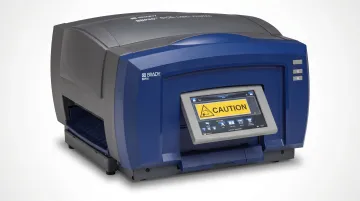
The Brady BBP85 is a multicolor thermal transfer printer built for industrial sign and label compliance workflows, including GHS. It features built-in GHS label creation software accessible via touchscreen—no PC required—and supports pre-printed label stock with red diamond borders that simplify pictogram compliance for operators.
Three factors separate it from inkjet alternatives:
- Integrated GHS software reduces design error risk, a common compliance failure point
- Thermal transfer output is long-lasting and chemical-resistant
- Industrial build handles high-volume facility labeling without downtime
It costs more than inkjet options, but suits operations where built-in compliance tools and speed justify the investment.
| Specification | Value |
|---|---|
| Print Technology | Multicolor thermal transfer (up to 4 colors) with built-in GHS label creation software |
| Print Resolution | 300 DPI |
| Max Print Width | 8.5 inches (216 mm) |
| Best Use Case | High-volume GHS labeling where built-in compliance software and pre-formatted label stock reduce operator design error |
NeuraLabel 300x (Discontinued—Succeeded by Callisto)
Note: The NeuraLabel 300x is discontinued and has been replaced by the NeuraLabel Callisto.
The NeuraLabel 300x was a high-speed, high-resolution color inkjet label printer for small-to-medium GHS production, with resolution up to 2400 × 1200 DPI and label widths from 1.5" to 8.5". At this price tier, 2400 DPI placed it at the top end for pictogram detail reproduction. It ran up to 100 feet per minute and carried BS5609 certification with specific Avery Dennison media.
Its successor, the NeuraLabel Callisto, raises the bar: up to 1200 × 4800 DPI, 90 ft/min speed, and media width from 1 to 12.1 inches with CMYK aqueous pigment ink.
| Specification (300x) | Value |
|---|---|
| Print Resolution | Up to 2400 × 1200 DPI |
| Print Speed | Up to 100 feet per minute (20 inches/second) |
| Label Width Range | 1.5 inches – 8.5 inches |
| BS5609 Status | Certified with specific Avery Dennison media |
Epson ColorWorks C831 (Discontinued—Succeeded by CW-C6500 Series)
Note: The Epson ColorWorks C831 (GP-C831) is discontinued.
The C831 was Epson's large-format GHS label printer for oversized chemical container labels, including oil drums and bulk IBCs. Its industrial 8-pin tractor feed handled label sheets up to 8" × 22", covering applications where standard-width printers fell short on large vessel compliance.
It was also the first inkjet solution to receive BS5609 certification, qualified with DURABrite pigment inks and Neenah Poly media.
Successor models: The Epson ColorWorks CW-C6500 series now serves this application space.
| Specification (C831) | Value |
|---|---|
| Print Resolution | 720 × 720 DPI maximum |
| Print Speed | Up to 16.5 pages/min (Draft); 7.0 pages/min (Super Fine) |
| Maximum Label Size | 8.0 inches × 22 inches |
| Best Use Case | Oversized GHS labels for 55-gallon drums, IBCs, and bulk chemical storage containers |
How We Chose These Printers
These five models were evaluated using a strict compliance-first framework:
Minimum technical requirements:
- Resolution: 600 DPI minimum for compliant pictogram reproduction at 10mm size (1200–2400 DPI preferred for sharp, audit-ready output)
- Ink technology: Pigment-based inkjet or thermal transfer—not dye-based inkjet or standard laser toner
- Label media compatibility: Support for synthetic label stock (BOPP, PET, polypropylene)
- Documented use: Verified applications in GHS chemical labeling workflows
Common mistakes chemical manufacturers make:
- Choosing printers based on office print specs rather than industrial label durability standards
- Selecting printers without confirming label media compatibility with synthetic substrates
- Focusing solely on upfront hardware cost instead of total cost of compliance (label durability, per-label cost at volume, ease of updating labels)
Secondary criteria—fit to operation:
Once compliance requirements are confirmed, the right printer still needs to match how your facility actually runs. Label width range and print speed vary significantly across the models reviewed:
- Small bottles (1-4" labels): Epson TM-C3500
- Standard drums (4-8" labels): Epson CW-C6500A or Brady BBP85
- Oversized containers (8"+ labels): Epson C831 (discontinued) or CW-C6500 series
- High-volume production (hundreds of labels daily): NeuraLabel Callisto or Brady BBP85
John Maye Company has supported manufacturing operations across Wisconsin and the broader Midwest for over 40 years. Their team can help match the right printer and label system to specific compliance workflows and production scale.
Reach them at 1-800-441-6293 or info@johnmayecompany.com for a technical consultation.
Conclusion
For chemical manufacturers, printer selection is a compliance decision. High-resolution output, chemical-resistant ink technology, and compatibility with industrial synthetic label stock are baseline requirements. Choosing the wrong printer doesn't just cause production delays and rework—it creates direct OSHA liability.
Evaluate printers on total cost of compliance, not upfront cost alone:
- Label durability: Will labels remain legible through chemical exposure, UV, and abrasion?
- Per-label cost at volume: In-house printing costs $0.04–$0.12 per label versus $0.25–$0.85 for outsourced production
- Formulation change flexibility: Can you update labels immediately when formulations change, or do you face $150–$300 revision fees and 2-week lead times?
- Label size range: Does the printer support the full range of container sizes in your inventory?
Chemical manufacturers and production teams in Wisconsin and the Midwest looking to evaluate or source GHS-compliant label printing equipment can reach out to John Maye Company. With 40+ years of packaging equipment expertise and factory-certified technicians, they can help identify the right printing equipment and support it long-term. Contact via phone at 1-800-441-6293 or email at info@johnmayecompany.com.
Frequently Asked Questions
What printer should I use for printing GHS labels?
Pigment-based inkjet printers or thermal transfer printers work best for GHS label production. The right model depends on label width requirements (small bottles vs. drums), print volume, and whether BS5609 certification is needed for international shipping.
What is a GHS-compliant hazardous chemical label?
A GHS-compliant label must include six elements under OSHA's HCS: product identifier, signal word, hazard pictograms, hazard and precautionary statements, and supplier contact information. Label material and print method must maintain legibility throughout the product's use lifecycle.
What resolution (DPI) is needed for printing GHS labels?
GHS pictograms require minimum 600 DPI for clean reproduction at the 10mm minimum size, with 1200–2400 DPI preferred for sharp, audit-ready output. Lower-resolution printers risk producing pictograms that are visually unclear and potentially non-compliant.
What is BS5609 certification, and do GHS printers need it?
BS5609 is a marine-grade test standard for GHS label durability covering saltwater immersion, UV exposure, and chemical resistance. It's required for international chemical shipping via ocean freight but is not a universal OSHA requirement for all domestic GHS labeling applications.
Can I use a standard office printer to print GHS labels?
No. Standard office laser and dye-based inkjet printers do not meet GHS durability requirements. Labels produced on these machines degrade under chemical exposure, moisture, and UV, rendering them non-compliant under OSHA HCS 1910.1200.
How much do GHS label printers cost?
Entry-level models (Epson TM-C3500) start around $1,500, mid-range options (Brady BBP85) run roughly $4,300, and high-end units (NeuraLabel 300x) reach $10,000. In-house printing costs $0.04–$0.12 per label versus $0.25–$0.85 outsourced — most operations producing 50+ SKUs see ROI within 6–12 months.