Introduction
Most mid-size manufacturers and distributors currently source their packaging supplies—tapes, stretch film, void fill, strapping, equipment parts—from three, four, or even more vendors simultaneously, often without any clear strategy driving that decision. This fragmentation isn't unusual; research shows the average organization works with 92 MRO suppliers, a figure that represents an 18% increase from the prior year before organizations began actively consolidating.
That level of fragmentation has real consequences. How you structure your packaging vendor relationships directly affects purchasing time, order reliability, and production uptime.
The choice between consolidating with one full-service distributor and maintaining multiple vendor relationships creates compounding effects on operational efficiency. Those effects show up in invoice volume, emergency response speed, and the hours your procurement team spends managing suppliers rather than focusing on higher-value procurement work.
TLDR
- Single-distributor consolidation sources most packaging supplies and equipment through one partner, cutting vendors, invoices, and coordination overhead
- Multi-vendor sourcing splits purchases across specialized suppliers, prioritizing category-specific expertise and competitive unit pricing
- Consolidation typically delivers greater value through operational simplicity, relationship depth, faster service response, and lower total cost of ownership
- The right choice depends on your volume, operational complexity, team capacity, and how much administrative overhead your operation can absorb
- For most Midwest manufacturers running lean teams, consolidation with a capable distributor offers clearer ROI
One Distributor vs. Multiple Vendors: A Quick Comparison
Cost
Single distributor:
- Volume-based pricing leverage increases as consolidated spend grows with one partner
- Fewer transaction costs—processing a single purchase order costs $50-$150 on average, with some studies showing fully loaded costs reaching $527 per PO
- Reduced procurement labor eliminates redundant vendor management tasks
- Lower total cost of ownership despite potentially higher unit prices on individual SKUs
Multi-vendor:
- Lower unit prices possible through competitive bidding on specific commodity items
- Hidden costs accumulate rapidly: separate shipping minimums, duplicated admin time, fragmented approval workflows, and relationship management overhead
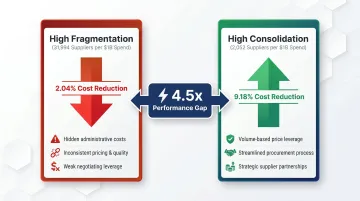
- Organizations with 31,994 suppliers per $1 billion in spend achieved only 2.04% cost reduction, while those with 2,052 suppliers achieved 9.18%. That's a 4.5x performance gap in favor of consolidation.
Operational Complexity
Single distributor:
- One account representative who learns your operation
- Unified invoice cycle and payment process
- One reorder workflow across all packaging categories
- One service escalation path when issues arise
Multi-vendor:
- Multiple contacts, each requiring separate relationship management
- Conflicting lead times that complicate production planning
- Separate billing systems, approval workflows, and vendor onboarding processes
- Coordination overhead compounds with every additional supplier you manage
Reliability and Downtime Risk
Single distributor:
- 2,500+ SKUs in inventory (as stocked by John Maye Company) enables predictable, reliable fulfillment
- 24-hour ship guarantees provide structural protection against supply gaps
- Faster emergency response through established relationship and prioritized service
- Clear accountability when issues occur
Multi-vendor:
- Risk distribution across suppliers sounds safer but creates accountability gaps
- When shortages occur, finger-pointing between vendors delays resolution
- No single party responsible for keeping your production line running
- Fragmented emergency response requires contacting multiple suppliers simultaneously
Service and Technical Support
Single distributor:
- Manufacturer-trained technicians who service both supplies and equipment through one relationship
- Integrated support across your entire packaging operation
- Proactive maintenance and faster diagnostics from technicians familiar with your setup
- Equipment rental options available through the same partner during seasonal surges
Multi-vendor:
- Service fragmentation creates gaps—your equipment vendor and supplies vendor operate independently
- No shared accountability for system-level performance
- Technician visits require coordinating multiple service providers
- Equipment rental handled separately from consumables purchasing
Flexibility and Scalability
Single distributor:
- Easier scaling during seasonal demand peaks when your distributor already knows your operation
- Rental equipment options enable temporary capacity expansion without capital investment
- Single negotiation covers increased volume across all categories
Multi-vendor:
- Each vendor requires separate requalification or renegotiation when scaling
- Rental equipment sourced separately from supplies adds coordination complexity
- Volume increases split across vendors reduce leverage with each individual supplier
What is Single-Distributor Consolidation?
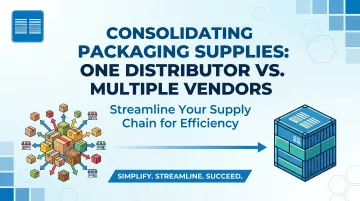
Single-distributor consolidation means channeling all or most packaging supply and equipment purchases—consumables, machinery, parts, and service—through one full-service distributor rather than managing separate relationships for each category. Instead of buying stretch film from one supplier, strapping from another, equipment from a third, and parts from a fourth, you establish one primary partnership that covers your complete packaging operation.
The operational impact reaches well past inventory management. Consolidation reduces purchase orders, invoices, vendor contacts, and approval cycles your procurement team handles daily. Research shows that MRO purchases account for only 5-10% of a manufacturer's cost of goods sold but generate 70-80% of all procurement transactions. For manufacturers and distributors running lean teams, the time recovered from eliminating redundant vendor management has measurable value—hours that can redirect toward strategic sourcing, process improvement, or production support.
Working with one distributor builds institutional knowledge that transactional multi-vendor setups cannot replicate. A trusted distributor learns your production schedule, equipment specifications, seasonal demand patterns, and preferred brands.
That familiarity enables proactive recommendations—suggesting preventive part replacements before failures occur, preparing for seasonal surges before you request quotes, and troubleshooting equipment issues faster because technicians already know your operation.
Consolidating spend with one distributor often generates volume pricing, priority fulfillment, and favorable payment terms unavailable when purchases fragment across multiple suppliers. Top-quartile organizations influence 86% of their indirect spend through strategic relationships, compared to just 60% for bottom-quartile organizations. This spending concentration creates negotiating leverage that reduces total cost even when individual SKU prices appear competitive with commodity suppliers.
What to look for in a consolidation-ready distributor:
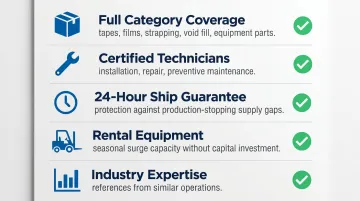
- Covers all packaging categories — tapes, films, strapping, void fill, and equipment parts
- Factory-certified technicians who handle installation, repair, and preventive maintenance
- 24-hour ship guarantees that protect against production-stopping supply gaps
- Rental equipment availability for seasonal demand surges or temporary capacity increases
- Industry-specific expertise and references from similar operations in your sector
What Industries Benefit Most from Consolidation
Food & beverage manufacturers see the clearest consolidation benefits. These operations manage seasonal demand surges, multi-material packaging requirements (bottles, caps, labels, shrink film, corrugated), and hygiene compliance standards that complicate vendor management. Packaging costs account for 10-15% of total product cost in food and beverage, making supply reliability and cost predictability critical business factors. A single packaging shortage—missing caps for bottled products or delayed corrugate deliveries—can halt entire production lines despite having adequate raw materials.
E-commerce fulfillment centers running high consumable volumes benefit from consolidation's administrative efficiency. These operations consume stretch film, corrugated, void fill, and tape at rates that generate hundreds of purchase orders monthly when sourced from multiple vendors. The transactional overhead compounds when staffing runs lean and order accuracy directly affects shipping deadlines.
Compliance is a structural problem for pharmaceutical packagers. Tracing materials, proving specifications meet regulatory requirements, and managing audit documentation across multiple vendors multiplies complexity and increases the risk of non-conforming materials entering production. Packaging costs represent 5-10% of pharmaceutical product costs, making supply chain reliability essential for maintaining production schedules in highly regulated environments.
Warehousing and distribution operations running multiple shifts place unique demands on packaging supply chains. Equipment breakdowns during second or third shifts can idle operations until parts arrive, making 24-hour fulfillment guarantees and emergency service response structural advantages rather than conveniences.
John Maye Company, with 40+ years of packaging expertise, over 2,500 SKUs in inventory, a 24-hour ship guarantee, and factory-certified technicians, specifically serves these industries across Wisconsin and the broader Midwest. For operations where a missed shipment or equipment failure carries real production costs, having one accountable partner — rather than four vendors pointing fingers — changes the risk profile of your supply chain.
What is a Multi-Vendor Approach?
The multi-vendor approach sources different packaging supply categories from separate specialized or competing vendors. A manufacturer might purchase stretch film from a commodity supplier, buy strapping from a regional distributor, source equipment from a dedicated machinery dealer, and order tapes from an office supply house. Each vendor handles one category, with the goal of driving down unit cost through category-specific expertise or competitive bidding.
Organizations legitimately use this model in specific contexts. Large enterprises with fully resourced procurement departments run formal RFPs on high-volume commodities like stretch film or corrugated — and when teams have the capacity to evaluate total cost and manage fulfillment across suppliers, the bidding process can yield real savings.
Multi-vendor sourcing also makes sense when operations require highly specialized or proprietary materials unavailable through full-service distributors, or when geographic gaps mean no single distributor offers comprehensive coverage.
In practice, operational costs erode those unit-price savings faster than most procurement teams expect. While commodity suppliers may offer lower per-unit costs on individual SKUs, the hidden expenses accumulate quickly:
- Administrative time: Manual invoice processing costs $12-$30 per invoice, and each vendor adds separate invoice cycles, payment approvals, and reconciliation tasks
- Misaligned lead times: Different vendors operate on different order cycles, creating coordination complexity when multiple materials must arrive simultaneously for production
- Split shipping minimums: Smaller orders to multiple vendors incur higher per-unit freight costs than consolidated shipments
- Duplicated vendor onboarding: Each new supplier requires credit applications, insurance verification, setup in accounting systems, and ongoing relationship management
- Fragmented service accountability: When production stops due to a packaging shortage, identifying which vendor caused the gap and coordinating emergency replacement involves multiple phone calls and competing explanations
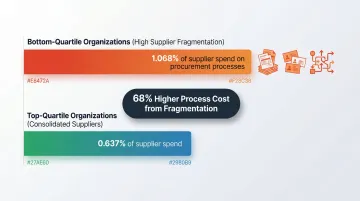
Research examining total procurement cost found that bottom-quartile organizations spend 1.068% of supplier spend on procurement processes, while top-quartile organizations spend just 0.637%—a 68% higher process cost burden directly attributable to supplier fragmentation. This doesn't account for the productivity cost of production stoppages when supply coordination fails.
One Distributor vs. Multiple Vendors: Which Works Better for Your Operation?
Total cost of ownership — not unit price — should drive the distributor consolidation decision. The most common procurement mistake is comparing only per-unit or per-SKU cost while ignoring the labor cost of managing additional vendors, the risk premium of inconsistent lead times, and the productivity cost of production stoppages.
A $2 per case savings on stretch film looks attractive until you calculate the fully loaded cost. If managing that secondary vendor generates 50 additional purchase orders annually at a conservative processing cost of $100 per PO, the administrative overhead alone consumes $5,000—potentially exceeding the commodity savings.
Add the cost of split shipments, delayed deliveries that require expedited freight, and the risk of a stockout that halts production, and the unit-price advantage disappears entirely.
Reliability and Downtime Risk
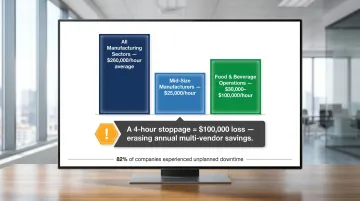
That unit-price math gets even harder to justify when supply shortages halt production. For manufacturing operations, packaging gaps create disproportionate costs. Unplanned downtime costs manufacturers an average of $260,000 per hour across all sectors, with mid-sized manufacturers experiencing approximately $25,000 per hour in losses. Food & beverage operations face particularly acute exposure, with downtime costs ranging from $30,000-$100,000 per hour depending on production scale.
Even brief stoppages erase months of procurement "savings." A four-hour production delay caused by missing strapping material or delayed corrugate deliveries costs a mid-size manufacturer $100,000—more than most operations save annually through aggressive multi-vendor commodity bidding. 82% of companies experienced unplanned downtime in the last three years, with the average plant losing approximately 30 hours of production monthly.
A single distributor with deep inventory (2,500+ SKUs) and a firm fulfillment guarantee structurally reduces this risk. The 24-hour ship commitment becomes a risk management tool, not just a service convenience — protecting against the supply gaps that multi-vendor coordination routinely creates.
Scalability and Seasonal Demand
Businesses with seasonal demand surges—common in food & beverage, retail, and e-commerce—benefit disproportionately from single-distributor relationships. When holiday shipping volume increases 40% in Q4, an e-commerce fulfillment center needs higher stretch film volume, additional corrugate, more tape, and potentially temporary equipment to handle throughput increases.
Coordinating this surge across multiple vendors means:
- Separate volume negotiations with each supplier
- Conflicting lead times that complicate inventory planning
- Split delivery schedules requiring more receiving labor
- No consolidated emergency support when equipment breaks under heavy use
A single distributor who already knows your operation can provide coordinated surge support: increased supply deliveries on your established schedule, rental equipment for temporary capacity needs, and prioritized service when existing machinery runs beyond normal duty cycles. The time freed from multi-vendor coordination during peak periods is time your team can spend on higher-priority operational decisions.
When to Choose Each Approach
Choose single-distributor consolidation if:
- Your team runs lean and cannot absorb significant vendor management overhead
- Your packaging needs span multiple categories (consumables, equipment, parts, service)
- Production uptime is a priority and supply gaps create outsized costs
- You want one accountable partner for both supplies and equipment service
- Seasonal demand variability requires flexible, responsive supplier support
Consider multi-vendor sourcing if:
- You maintain dedicated procurement resources with capacity to manage supplier complexity
- A specific niche supply category requires specialized expertise no full-service distributor offers
- Your operation is large enough that procurement administrative overhead absorbs into existing headcount without reducing other priorities
- You have formal procurement systems capable of managing competitive bidding without manual inefficiency
The hybrid scenario captures benefits from both approaches: consolidate 80-90% of packaging spend with a primary full-service distributor while maintaining one or two specialty vendors for truly unique items unavailable through your main partner. This structure delivers most consolidation efficiency benefits without sacrificing access to niche products.
Real-World Scenarios: When Each Approach Makes Sense
Scenario Favoring Consolidation
Consider a mid-size food & beverage manufacturer in Wisconsin managing five separate packaging vendors: one supplier for stretch wrap purchased through competitive bidding, another for corrugated boxes, a third for pressure-sensitive labels, a dedicated equipment dealer for case erectors and sealers, and a parts supplier for replacement components.
The friction compounds daily:
- Five separate invoice cycles, each requiring individual approvals
- Five reorder processes with different lead times and minimum order quantities
- Five separate contacts when something goes wrong
When a sealer belt breaks during second shift, the parts supplier is closed — creating an eight-hour production delay until morning. When stretch film runs low unexpectedly, the commodity supplier's three-day lead time forces expensive emergency orders from a local distributor at premium pricing.
No single vendor feels accountable for the operation's overall performance. When corrugate arrives late, the box supplier blames the freight carrier. When the case erector jams, the equipment dealer and tape supplier point fingers at each other — and production waits.
A single full-service distributor collapses that complexity into one relationship. Reorders across all categories run through one call. A dedicated relationship manager learns the production schedule and flags ordering windows before seasonal surges hit. Equipment maintenance and emergency parts fulfillment — including 24-hour shipping — come from the same service team.
One chemical manufacturer achieved more than $54,000 in annual savings through vendor consolidation, while another freed $24,000 in working capital through improved inventory management — outcomes that came directly from eliminating multi-vendor coordination overhead.

Scenario Where Multi-Vendor Has Merit
A large-scale distribution operation with a dedicated six-person procurement team actively manages packaging suppliers as part of strategic sourcing. The procurement manager runs formal RFPs quarterly on high-volume commodity items, with stretch film representing 200,000+ rolls annually at a contract value exceeding $800,000.
This scale justifies dedicated procurement attention. The team has capacity to evaluate total cost beyond unit price, comparing not just per-roll pricing but also freight terms, payment schedules, quality consistency, and supply reliability. Their ERP system handles multi-vendor invoice processing efficiently, and established workflows absorb the administrative overhead without reducing productivity.
Here, multi-vendor bidding on the single highest-volume SKU yields meaningful savings — 3-5% annually on that line item — while the procurement team's existing capacity absorbs coordination complexity. The organization maintains relationships with 12-15 packaging suppliers but concentrates 70% of spend with three primary partners, using competitive pressure strategically rather than fragmenting purchases across dozens of vendors.
Key Takeaway
The value of consolidation scales inversely with procurement team size and directly with operational complexity. A lean team managing complex, multi-category packaging needs gains more from consolidation than a fully staffed procurement department handling single-category commodity purchases. For most Midwest manufacturers and mid-size distribution operations, the single-distributor model delivers measurably more value than multi-vendor approaches once total operational cost — including labor, downtime risk, and coordination overhead — is properly accounted for.
Conclusion
Neither approach is universally superior. The right choice depends on total cost of ownership, team capacity, and operational risk tolerance—not unit price alone.
Start with an honest assessment of three factors:
- How much procurement bandwidth your team actually has available
- What production downtime costs your operation per hour
- Whether your packaging needs span categories that benefit from integrated service, or concentrate in single commodities that justify dedicated sourcing attention
For most small to mid-size manufacturing and distribution operations, consolidating with a capable full-service distributor offers the clearest path to operational efficiency and supply reliability. The measurable outcomes matter more than theoretical savings: fewer production stoppages from supply gaps, less time spent managing vendor relationships, faster emergency fulfillment when equipment breaks, and a distributor relationship that deepens over time into a working partnership rather than a series of transactions.
In fast-moving industries where uptime directly affects customer commitments, that reliability becomes a strategic advantage. When your distributor anticipates seasonal surges before you submit forecasts, flags maintenance needs before equipment fails, and responds to emergencies within hours, the value goes well beyond what any unit-price comparison can capture.
No commodity quote, however attractive, replicates that institutional knowledge. Multi-vendor fragmentation trades it away piece by piece.
Frequently Asked Questions
What are the main benefits of consolidating packaging supplies with one distributor?
Consolidation reduces invoice volume and vendor contacts, simplifies reordering across all packaging categories, creates volume pricing leverage on consolidated spend, and provides faster service response through a single accountable partner who knows your operation.
Does consolidating with one distributor actually save money compared to using multiple vendors?
While multi-vendor sourcing may offer lower unit prices on individual SKUs, consolidation typically reduces total costs by eliminating administrative overhead, lowering procurement labor expense, and reducing costly production downtime risk from supply shortages or coordination failures.
What are the risks of relying on a single packaging distributor?
The primary risk is over-dependence on one supplier's performance and inventory availability. Choosing a distributor with deep inventory breadth (2,500+ SKUs), guaranteed fulfillment timelines, and a proven reliability record mitigates this risk far more effectively than spreading orders across narrow-line suppliers.
How do I know if my operation is ready to consolidate packaging vendors?
Signs your operation is ready: your team spends significant time managing vendor relationships, lead times are inconsistent across suppliers, or reorder friction is a recurring problem. Calculate your current procurement processing costs against potential savings to make the case internally.
Can one distributor realistically supply all my packaging needs?
A full-service distributor with broad SKU inventory can cover the majority of packaging supply and equipment categories: consumables, machinery, parts, and service. A reputable partner will be upfront about any capability gaps and can often source specialty items rather than force-fitting unsuitable products.
What should I look for when choosing a single-source packaging distributor?
Key criteria to evaluate:
- Broad inventory depth across packaging categories
- Manufacturer-certified technicians for equipment installation and repair
- Guaranteed fulfillment timelines (24-hour shipping commitments)
- Industry-specific experience with operations similar to yours
- Verifiable references from customers in your sector