Introduction
Packaging supplies are ordered constantly across multiple vendors in manufacturing facilities, yet a disruption in any one supply — stretch wrap, corrugated boxes, strapping — can halt a production line entirely. For manufacturers, this fragmented supply chain creates real vulnerability: tracking five purchase orders across five distributors introduces compounding risk, administrative overhead, and the constant threat of a single missing SKU triggering costly downtime.
Unplanned manufacturing downtime costs an average of $260,000 per hour, according to Aberdeen Group — and packaging supply stockouts are a direct contributor, accounting for 2-4% of annual revenue loss through expedited freight, production delays, and customer churn. Single-source bulk procurement addresses this directly by consolidating supply categories under one distributor relationship, reducing both administrative overhead and stockout risk.
What follows is a practical breakdown of bulk packaging supply categories, sourcing criteria, and the operational case for consolidating to a single supplier.
Key Takeaways
- Bulk packaging supplies span containment, sealing, cushioning, corrugated, and labeling categories — each with specs that must match your equipment
- Single-source procurement cuts vendor management overhead, ensures supply consistency, and typically unlocks 3–7% cost savings
- Evaluate suppliers on equipment compatibility, MOQ flexibility, lead times, and total cost of ownership — not unit price alone
- Service depth, inventory availability, and scaling capability are what actually prevent costly downtime
What Are Bulk Packaging Supplies?
Bulk packaging supplies are the consumable materials manufacturers purchase in high volumes to contain, protect, identify, and ship products through production and distribution operations. Unlike packaging machinery, these are the materials the machines consume: stretch wrap fed into automatic pallet wrappers, carton sealing tape loaded into case sealers, corrugated boxes erected by automated systems.
Bulk buying refers to purchasing above standard retail quantities, often under vendor-managed inventory or standing order arrangements, to reduce per-unit cost and ensure continuous availability. For manufacturers, this typically means pallet quantities, standing monthly orders, or consignment inventory programs that align supply delivery with production consumption rates.
Core Categories of Bulk Packaging Supplies
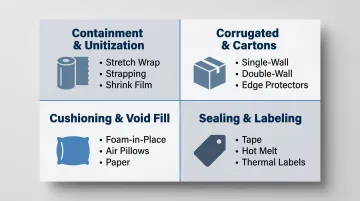
Containment and Unitization Materials
These are the highest-volume SKUs for most manufacturers and affect palletload stability and transit safety:
- Stretch wrap: Hand-grade film (30-130 gauge) and machine-grade film (63-115 gauge standard). Machine film typically requires 63 gauge minimum for standard pallet wrapping; 80 gauge is industry-standard for everyday applications.
- Shrink film: Polyolefin and PVC films for product bundling and tamper-evident packaging
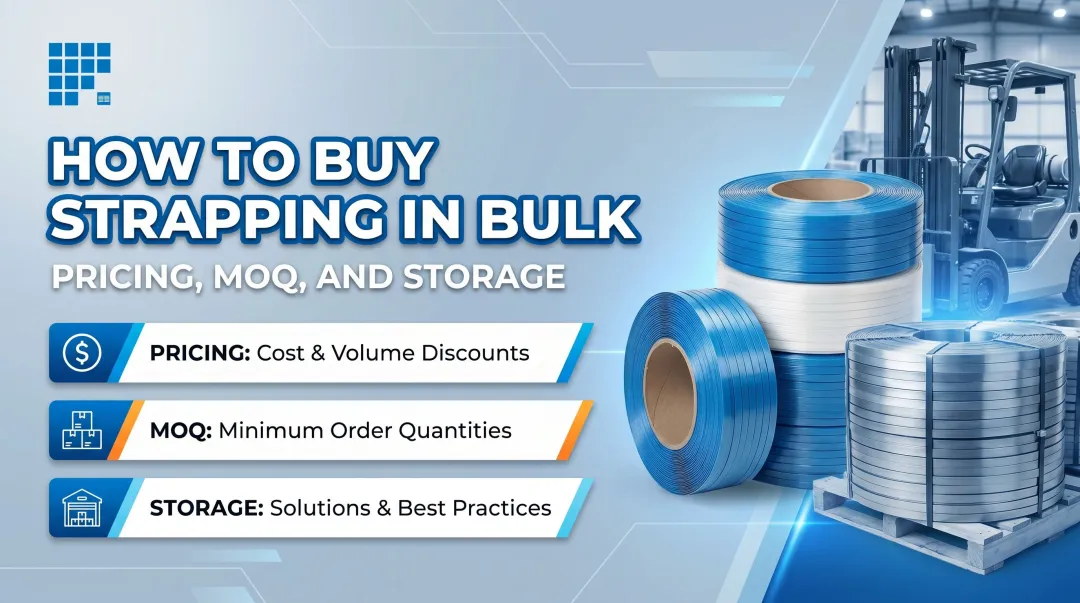
- Strapping: Steel (high tensile strength for heavy loads), polyester (tension retention under temperature fluctuation), and polypropylene (light to medium-duty applications)
- Banding: Lightweight alternatives for bundling smaller products
Corrugated and Carton Materials
The U.S. corrugated and paperboard segment represents approximately $47 billion in annual spend, making it the largest single packaging category:
- Single-wall corrugated boxes (lighter products, standard shipping)
- Double-wall corrugated boxes (heavier products, increased stacking strength)
- Die-cut inserts for product protection and presentation
- Edge protectors for pallet load reinforcement
- Layer pads for stacking stability
Flute type and board grade must align with product weight and stacking requirements — a mismatch results in crushed cartons or product damage in transit.
Cushioning and Void Fill
Selection depends on product fragility, fill rate, and sustainability compliance:
- Foam-in-place systems (custom-fit protection for irregular shapes)
- Air pillow systems (on-demand production, space-efficient storage)
- Paper cushioning systems (recyclable, compostable options)
- Molded pulp (heavy-duty protection for industrial components)
Sealing and Closure Supplies
Compatibility with automated sealing equipment is critical for maintaining line speed:
- Pressure-sensitive tape (general-purpose carton sealing)
- Heavy-duty industrial tape (2.8mil for 50-65 lb cartons)
- Water-activated tape (reinforced closure for high-value shipments)
- Hot melt adhesives and staples (automated case sealing systems)
Labeling and Identification Materials
Tied directly to traceability and retailer compliance requirements:
- Thermal transfer labels (durable, chemical-resistant)
- Direct thermal labels (cost-effective, shorter lifespan)
- Barcode ribbon (various formulations for different surfaces)
- Pre-printed carton labels (retailer-specific compliance markings)
Label errors caused 45.5% of all food recalls in 2024, costing the industry an estimated $1.92 billion. For regulated industries, that means verifying label material, adhesive chemistry, and print durability before approving a supply source.
Why Manufacturers Depend on High-Volume Packaging Supplies
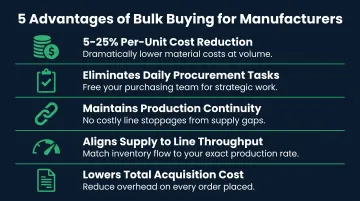
Buying in volume delivers compounding advantages across cost, operations, and supply continuity:
- Reduces per-unit costs by 5-25% depending on product and order quantity
- Eliminates daily procurement tasks through standing order arrangements
- Maintains production continuity by keeping buffer inventory on hand
- Matches consumable supply to line throughput requirements
- Lowers total acquisition cost as purchase orders consolidate
The stakes are tangible: manufacturers typically spend 10-40% of a product's retail price on packaging. When 70% of customers switch brands after a stockout — and 40% never return — uninterrupted supply is less a procurement goal than a competitive requirement.
Key Factors to Consider When Sourcing Bulk Packaging Supplies
Price per unit is rarely the most important variable. Procurement teams need to evaluate sourcing across several dimensions — throughput, compliance, and total operational cost — before committing to a supplier. The factors below reflect what separates a supply strategy that holds up under real production conditions from one that looks good only on paper.
Material-Equipment Compatibility
The physical properties of a consumable — film gauge, tape width, core diameter, strapping width — must precisely match machine specifications. Mismatches cause jams, rejects, and unplanned downtime.
Example: Using 60-gauge stretch film on an automatic stretch wrapper calibrated for 80-gauge film causes film breaks and under-wrapped loads. The line stops for re-wrapping, and improperly secured pallets shift in transit. Equipment manufacturers specify film grade ranges for a reason — operating outside those parameters introduces failure points.
Hand stretch wrap ranges from 30-130 gauge, while machine film typically starts at 63 gauge. A distributor with technical expertise confirms material-equipment compatibility before the first order ships — eliminating the guesswork that causes production disruptions downstream.
Volume Requirements and MOQ Structure
Minimum order quantities set by distributors must align with your actual consumption rate. Too high an MOQ ties up working capital in excess inventory; too low means frequent reorders and potential stockouts.
Manufacturers with seasonal demand spikes need a supplier who can flex MOQ structures or maintain buffer stock on their behalf. A rigid "500-case minimum" policy becomes a liability when you need 200 cases now and 800 cases in three months.
Supplier Lead Times and Inventory Depth
For a production environment, a supplier's ability to ship within 24-48 hours is a hard operational requirement, not a preference. Unplanned downtime costs the world's 500 largest companies approximately $1.4 trillion annually — 11% of total revenues. In automotive manufacturing, an idle production line costs up to $2.3 million per hour.
Inventory depth — the number of SKUs available in-stock — determines whether a single supplier can realistically cover all your material categories without forcing you back to multi-vendor sourcing. Large distributors stock 40,000+ SKUs; specialized distributors may carry only 500.
Deep catalog suppliers offer substitution capability: when a specific item is backordered, they can recommend an in-spec alternative without halting production. Deep catalog suppliers offer substitution capability: when a specific item is backordered, they can recommend an in-spec alternative without halting production. That flexibility matters most when lead times are already tight.
Total Cost of Ownership vs. Unit Price
Unit price is visible. Most of what drives total cost of ownership is not. TCO components include:
- Unit price (visible)
- Freight cost per shipment
- Purchase order processing cost (average: $15.10; world-class: $4.40)
- Minimum order charges
- Emergency sourcing premiums
- Waste from incompatible materials
- Downtime from stockouts
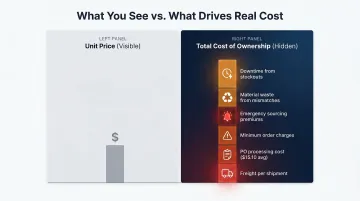
A slightly higher unit price from a single-source supplier with 24-hour fulfillment and zero line disruptions often yields lower total cost than chasing the cheapest unit price across five vendors. Well-executed consolidation programs typically unlock 3-7% cost savings and reduce purchase order touches by 40%.
Product Range and SKU Depth
A supplier's catalog breadth determines how many of your material categories they can fulfill. A distributor with 2,500+ SKUs across multiple material types can serve as a true single source; one focused on a single category cannot.
SKU depth also affects substitution capability and future scalability. As your product mix evolves or equipment upgrades, a deep-catalog supplier adapts without forcing you to onboard a new vendor mid-production cycle.
Regulatory and Industry Compliance
Certain industries — food, pharma, medical — require packaging materials that meet FDA, USDA, or ISO standards. Non-compliant materials expose manufacturers to product recalls, audit failures, and liability.
FDA regulates food contact substances under 21 CFR Parts 175-178, covering adhesives, paper components, polymers, and production aids. ISO 11607-1:2019 specifies requirements for materials and sterile barrier systems for terminally sterilized medical devices.
A knowledgeable supplier confirms compliance specs at the material level and provides certifications and test documentation upfront. Leaving that verification to the buyer adds delay — and in regulated industries, genuine liability exposure.
The Operational Case for Single-Source Bulk Packaging Procurement
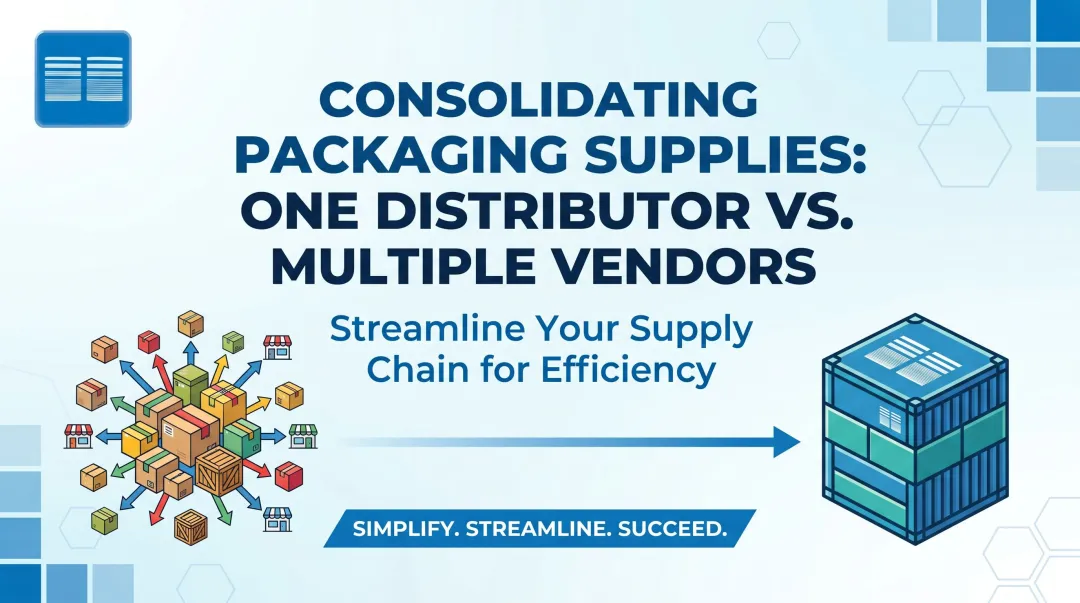
Single-source procurement means consolidating all or most packaging supply categories under one distributor relationship rather than managing category-specific vendors for each material type.
Measurable operational advantages:
- Fewer purchase orders (reducing administrative cost by $15.10 per PO eliminated)
- Unified invoicing (one accounting touchpoint instead of five)
- One point of contact for supply issues (faster resolution)
- Volume pricing across the entire supply program (not just per-category)
- Simplified vendor management and compliance tracking
A single-source supplier with deep inventory and fast-ship guarantees also reduces exposure to stockouts and the cascading downtime those cause. Multi-vendor models are inherently fragile — one supplier's delay can stall an entire category.
The financial case is well-documented: supplier consolidation delivers internal rates of return around 25%. One documented example saw a company reduce administrative PO costs by $450,000 after consolidating indirect services from 42 suppliers to one.
Single-source doesn't mean paying a premium. Total program value — service depth, response time, technical expertise, zero-downtime fulfillment — outweighs marginal unit-price savings from splitting orders, especially at scale. Volume pooling into consolidated agreements yields approximately 6% price reduction; specification harmonization targets an additional 8% cost reduction.
How John Maye Company Helps Manufacturers Source Smarter
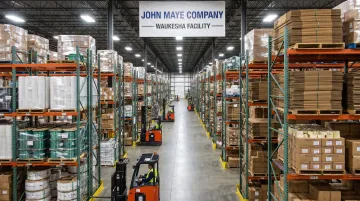
John Maye Company is a 40+ year Midwest packaging specialist with the inventory depth, technical credibility, and fulfillment capability to serve as a single-source supplier for bulk packaging supplies across multiple industries. Their Waukesha, Wisconsin facility carries 2,500+ SKUs and backs every order with a 24-Hour Ship Guarantee.
Key differentiators for manufacturers:
- Factory-certified technicians who understand material-equipment compatibility, not just product specs. They confirm correct stretch film gauge for your specific automatic wrapper model, verify tape width compatibility with case sealers, and recommend in-spec alternatives when primary SKUs backorder.
- Full category coverage across stretch wrap and shrink film, strapping (steel, polyester, polypropylene), carton sealing tapes, air pillow and paper cushioning systems, and automated sealing supplies.
- Rental fleet supporting seasonal demand surges without forcing excess inventory purchases. Rent case erectors, palletizing systems, and shrink wrappers during peak periods, then return equipment when demand normalizes.
Their technicians advise on material selection to cut waste, prevent equipment mismatches, and meet compliance requirements for food-grade, pharmaceutical, and medical packaging.
Serving 500+ industrial customers across 15+ industries, John Maye Company gives procurement teams a single contact, a guaranteed ship window, and the technical backup to keep lines running.
Conclusion
Selecting bulk packaging supplies isn't a one-time procurement decision — it's an ongoing operational commitment that directly affects line throughput, cost structure, and supply chain resilience. Manufacturers who treat it strategically see measurable returns:
- Lower total cost of ownership through volume pricing and fewer emergency orders
- Fewer stockout events with predictable lead times and buffer stock
- Reduced administrative overhead by consolidating vendor relationships
- Protection against unplanned downtime, which can cost manufacturers up to $260,000 per hour
Consolidating to a single-source supplier with proven inventory depth, fast fulfillment, and technical expertise is the most reliable way to eliminate supply-related disruption and simplify procurement. John Maye Company, for example, backs that promise with 2,500+ SKUs in stock, a 24-hour ship guarantee, and factory-certified technicians — built over 40+ years of serving Midwest manufacturers.
Review supplier performance periodically as production needs, materials, and equipment evolve. The right partnership grows with your operation, not against it.
Frequently Asked Questions
What are the 4 types of packaging materials?
The four main categories are paper/cardboard, plastics, metals, and glass. In manufacturing and industrial packaging, paper and cardboard dominate corrugated shipping containers; plastics include stretch wrap, shrink film, and strapping; metals appear in steel strapping and cans; glass is used primarily in food and beverage applications.
What are the 5 P's of packaging?
The 5 P's are Product, Protection, Preservation, Promotion, and Price/Performance. Manufacturers use this framework to ask whether a material protects adequately, preserves shelf life, communicates brand identity, and delivers acceptable cost-performance at scale.
What are the 5 requirements of packaging?
The five requirements are containment, protection, convenience, communication/identification, and compliance:
- Containment prevents product loss during handling
- Protection guards against damage in transit
- Convenience enables efficient opening and use
- Communication covers barcodes and labeling for traceability
- Compliance ensures materials meet regulatory standards for food contact, medical, or hazmat applications
What is single-source procurement for packaging supplies?
Single-source procurement means purchasing all or most packaging consumables through one distributor rather than managing multiple category-specific vendors. Primary benefits include simplified ordering, volume pricing across the entire supply program, consistent supply availability, and reduced administrative overhead from consolidated invoicing and fewer purchase orders.
How can manufacturers reduce packaging supply costs when buying in bulk?
Start by consolidating vendors — this alone typically unlocks 3-7% volume pricing savings while cutting PO processing costs. From there, align MOQ structures with actual consumption rates to avoid tying up capital in excess inventory. Evaluate total cost of ownership rather than unit price alone, factoring in freight, admin time, and downtime risk from supply gaps.