Introduction
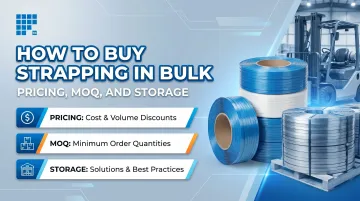
Strapping ranks among the most consumed packaging materials in warehouses and manufacturing facilities worldwide. The global strapping materials market reached $9.8 billion in 2025 and is projected to hit $15.7 billion by 2033, reflecting its essential role across industrial and commercial sectors.
For most medium and high-volume operations, bulk purchasing is the standard approach. Per-unit costs drop significantly at case-level or pallet-level quantities — but outcomes vary based on how well you plan. Poor decisions around material type, MOQs, supplier terms, or storage conditions create three costly problems:
- Wasted spend on incompatible products
- Degraded material before it's ever used
- Operational disruption when stock runs out
This guide walks through the complete process: how to buy strapping in bulk, how pricing and MOQs actually work, what you need to verify before ordering, and how to store bulk inventory correctly to protect your investment.
Key Takeaways
- Bulk strapping prices drop significantly at case and pallet MOQ thresholds, with discounts varying by material and supplier
- PP, PET, steel, and composite strapping each have different pricing structures, MOQs, and storage needs
- Confirm strapping width, thickness, core size, and tensile strength match your equipment before ordering
- Store in cool, dry conditions away from UV and chemicals—improper storage destroys material value
- Regional distributors typically offer lower MOQs and faster lead times than ordering direct from manufacturers
How to Buy Strapping in Bulk: A Step-by-Step Process
Step 1: Audit Your Current Strapping Usage
Calculate your baseline consumption rate before contacting suppliers. Pull 3-6 months of purchase history or track rolls used per production shift to establish a reliable monthly and annual volume. This data determines your realistic order ceiling and prevents over-ordering.
Document every strapping specification currently in use:
- Material type (PP, PET, steel, composite)
- Width and thickness
- Tensile strength rating
- Core diameter and width
- Finish type (smooth or embossed)
Inconsistent spec data is the most common cause of incompatible bulk orders. If you operate multiple lines or facilities, audit each separately.
Step 2: Determine the Right Material and Specifications
Match material type to your application requirements:
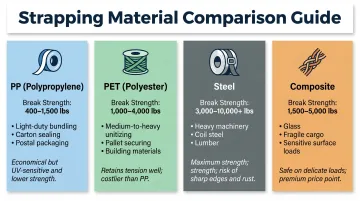
Polypropylene (PP):
- Break strength: 300-600 lbs (standard widths)
- Best for: Lightweight packages under 2,000 lbs, carton sealing, bundling soft goods
- Tradeoff: Most economical option, but poor tension retention and vulnerable to UV degradation
Polyester (PET):
- Break strength: 600-2,500 lbs depending on width and grade
- Best for: Palletized loads over 300 lbs, outdoor storage, long-haul shipping
- Tradeoff: Higher cost than PP, but superior tension retention and weather resistance
Steel:
- Break strength: 675-12,300 lbs (varies by width and heat treatment)
- Best for: Heavy manufacturing equipment, steel coils, compressed bales, railroad shipments
- Tradeoff: Highest strength and cost; loses 50% of strength when bent at sharp angles
For applications requiring steel-level strength without sharp edge risk, composite is worth considering:
Composite:
- Construction: High-strength polyester yarns with polymer coating
- Best for: Hand-applied heavy-duty bundling; safer alternative to steel with no sharp edges
- Cost note: Higher upfront cost than steel, but lower long-term cost due to zero corrosion
Critical compatibility check: Verify that strapping width and core size match your machine's specifications exactly. An 8x8" core will not fit equipment designed for 9x8" cores, even though they differ by only one inch. This is the most common—and costly—bulk ordering error.
Step 3: Source Suppliers and Request Quotes
You have three primary supplier channels, each with distinct tradeoffs:
Direct Manufacturers:
- Lowest per-unit pricing at high volumes
- Higher MOQs (typically full pallet or truckload)
- Longer lead times (2-4 weeks common)
- Limited flexibility on custom specs
National Distributors:
- Moderate pricing
- Lower MOQs than manufacturers
- Broader SKU availability
- Variable lead times depending on stock levels
For Midwest operations where speed and spec-matching matter, regional distributors are often the most practical starting point:
Regional Distributors:
- Slightly higher per-unit cost than direct
- Lowest MOQs (often case-level)
- Fastest delivery (John Maye Company offers 24-hour shipping on 2,500+ SKUs across the Midwest)
- Local technical support and spec-matching assistance
Request quotes at multiple volume tiers—single case, half pallet, full pallet, and truckload if applicable—to map the actual pricing curve. The break points vary significantly by material. For example, Uline's PP strapping shows an 8-11% discount at the 11+ roll tier compared to single-roll pricing.
Step 4: Place the Order and Plan Delivery Logistics
Confirm the delivery format before finalizing your order. Bulk strapping typically ships on pallets and requires forklift or pallet jack access at your receiving dock. Verify:
- Pallet dimensions fit your dock and storage aisles
- Receiving staff can handle shrink-wrapped pallet loads
- Storage location is ready (see storage section below)
Calculate your reorder point based on consumption rate and supplier lead time:
Reorder Point = (Daily Usage × Lead Time in Days) + Safety Stock
For a facility using 10 rolls per week with a 7-day lead time, the reorder point is roughly 12-15 rolls depending on your risk tolerance.
Understanding Bulk Strapping Pricing and MOQs
Strapping pricing uses a tiered discount structure, and knowing where the volume breaks fall lets you plan purchases that cut total spend — not just unit price.
How Pricing Tiers Work
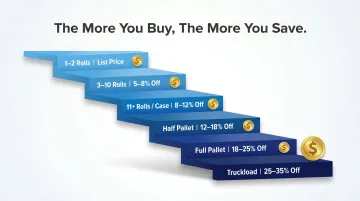
Suppliers quote prices per 1,000 feet or per roll, with breaks at specific volume thresholds. Typical structure for distributors:
- 1-2 rolls: List price
- 3-10 rolls: 5-8% discount
- 11+ rolls (case quantity): 8-12% discount
- Half pallet: 12-18% discount
- Full pallet: 18-25% discount
- Truckload: 25-35% discount (manufacturer-direct only)
Representative pricing example from Uline's PP strapping catalog: 1/2" hand-grade strapping (7,200 ft, 300 lb break strength) lists at $62 per roll for quantities of 1-2, drops to $58 for 3-10 rolls, and $55 for 11+ rolls.
Critical consideration: Freight cost can heavily affect total landed cost. A supplier offering $50 per roll with $200 freight may cost more than a regional distributor charging $55 per roll with free delivery. Always calculate total landed cost (product + freight + storage) rather than chasing the lowest unit price.
What MOQs Typically Look Like
MOQs vary by supplier type and material:
- Distributors: Case-level MOQs (typically 1-4 rolls) with no freight minimum
- Manufacturers: Half-pallet or full-pallet MOQs; some require truckload commitments for specialty materials
- Specialty materials: Composite strapping, wide-width PET, and steel often carry higher MOQs and longer lead times than standard 1/2" PP
Negotiating Pricing and Terms
MOQs are negotiable, especially for repeat customers. Effective tactics include:
- Commit to a blanket purchase order with scheduled quarterly releases
- Bundle strapping orders with other consumables from the same supplier to reach higher volume tiers
- Offer extended payment terms (net-60 or net-90) in exchange for lower per-unit pricing
- Ask about vendor-managed inventory (VMI) programs that lock in bulk pricing without requiring you to hold full inventory on-site — some distributors add auto-replenishment based on consumption tracking, so you get volume pricing with lean on-site stock
When Does Buying Strapping in Bulk Make Sense?
Bulk purchasing creates value when volume, consistency, and storage capacity all line up — but when any of those factors are off, large orders tie up capital and expose inventory to degradation risk before it's used.
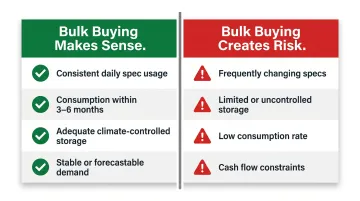
Bulk buying is the right strategy when:
- You use the same strapping spec daily at predictable volumes (manufacturing lines, distribution centers, fulfillment operations)
- Your consumption rate allows you to use bulk quantities within 3-6 months
- You have adequate climate-controlled storage space
- Demand is stable or follows seasonal patterns you can forecast with confidence
The calculation changes when operational conditions are less consistent. Bulk buying creates risk when:
- Strapping specs change frequently across different product lines or shifting load requirements
- Storage is limited, uncontrolled for temperature/humidity, or exposed to UV light
- Consumption is too low to cycle through inventory before degradation sets in — PP strapping can degrade within 1-2 years under poor storage conditions
- Cash flow doesn't support large upfront purchases
Planning horizon best practice: Limit bulk orders to 3-6 months of projected consumption, according to Packaging Systems' bulk purchasing guide. This balances volume pricing benefits against degradation risk and demand variability.
What to Prepare Before Placing a Bulk Strapping Order
Equipment and Compatibility Requirements
Request your strapping machine's specification sheet before finalizing any bulk order. Required data points:
- Strapping width tolerance (typically ±0.002")
- Core size (8x8", 9x8", 16x6", etc.)
- Maximum roll diameter
- Tensile strength rating
- Material compatibility (some machines handle only PP; others accept PP and PET)
If you don't have this documentation, contact your equipment manufacturer or service provider. Ordering the wrong spec in bulk is a costly mistake — incompatible material can't be returned or used elsewhere.
Storage Capacity and Conditions
Calculate your maximum storage capacity in pallet positions. A full pallet of strapping typically occupies 40" x 48" of floor space and stands 48–60" high. Assess:
- Available dry, sheltered storage space
- Distance from windows, skylights, and UV exposure
- Separation from chemicals, solvents, and oils
- Temperature stability (avoid unheated spaces in cold climates)
Storage capacity sets your practical order ceiling — no matter how attractive the pricing looks at higher volumes.
Budget and Cash Flow Readiness
Bulk orders require upfront capital. Calculate total landed cost:
Total Landed Cost = (Unit Price × Quantity) + Freight + Handling + Storage Allocation
Confirm this fits within your purchasing authority and cash flow timeline before committing to any volume tier.
Many distributors offer net-30 or net-60 terms on volume orders. That flexibility can ease cash flow impact, so factor payment terms in when comparing suppliers.
How to Store Bulk Strapping to Protect Your Investment
Improper storage is the leading cause of bulk strapping waste. Material that degrades before use is a direct financial loss — and it's avoidable. The three areas that matter most: temperature control, UV and chemical exposure, and physical handling.
Temperature and Humidity Control
Store PP and PET strapping between 50°F and 80°F in low-humidity environments. Extreme heat causes PP to become brittle and lose tensile strength; moisture accelerates steel corrosion and triggers hydrolysis in plastic strapping.
Unheated Midwest warehouses create a specific problem in winter: PP strapping brought directly from cold storage to a warm strapping machine can experience thermal shock. Allow cold material to acclimate to room temperature for 2-4 hours before use.
UV and Chemical Exposure
PP strapping is highly vulnerable to UV degradation. Research shows that even indirect light exposure causes measurable degradation within 1-2 years. Store rolls:
- Away from windows, skylights, and loading dock doors
- Clear of fluorescent light banks in warehouse ceilings
- Separated from solvents, oils, cutting fluids, and cleaning chemicals that compromise material integrity
PET strapping offers better UV resistance (3-5 years before performance decline outdoors) but still benefits from indoor storage.
Physical Storage Best Practices
Storage configuration:
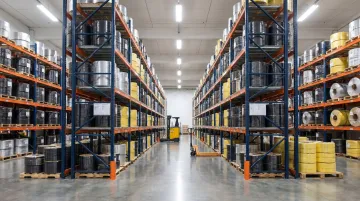
- Store rolls upright on shelving or pallet racking — never flat on concrete floors
- Flat stacking deforms cores and causes feed jams in strapping machines
- Maintain 6–12" clearance from walls for air circulation
- Rotate using FIFO (first-in, first-out) to keep older stock moving
Inventory tracking keeps bulk purchases working for you:
- Label each pallet with receipt date and lot number
- Log material type, specs, quantity remaining, and reorder trigger point in a spreadsheet or WMS
- Set reorder alerts before stock runs critical — reactive purchasing at low volumes costs significantly more per unit than planned bulk orders
Common Mistakes to Avoid When Buying Strapping in Bulk
Bulk strapping purchases go wrong in predictable ways. These three mistakes account for most of the avoidable losses.
Spec mismatch from price-first buying. The cheapest strapping available is worthless if it doesn't fit your machine's width, core size, or tensile requirement. Confirm compatibility before committing to any bulk quantity.
Over-ordering to hit a lower price tier. Pushing past your realistic 3–6 month consumption window creates two problems: material degradation and cash locked in slow-moving inventory. Calculate your consumption ceiling first, then find the best price within that limit.
Ignoring total landed cost. Unit price is only part of the equation. A supplier charging $2 less per roll but adding $300 in freight can easily cost more than a regional distributor offering same-day delivery with no freight minimum. Always calculate delivered cost per unit before committing.
Frequently Asked Questions
What are the different types of strapping?
The four main types are polypropylene (PP) for lightweight bundling, polyester (PET) for heavy-duty palletized loads, steel for maximum tensile strength in industrial applications, and composite for hand-applied heavy-duty bundling as a safer steel alternative.
What is strapping in a warehouse?
Strapping (also called banding) is material used to secure, bundle, or unitize loads on pallets or in transit. It's a foundational consumable in warehouse and distribution operations.
What is the difference between banding and strapping?
The terms are often used interchangeably, but "banding" typically refers to lighter-duty or narrow-width applications such as paper bands or light poly bundling, while "strapping" refers to heavier-duty securing of palletized or bundled loads.
What is the minimum order quantity for bulk strapping?
MOQs vary by supplier and material. Distributors often sell by the case (1-4 rolls), while manufacturers typically require half-pallet or full-pallet minimums. Specialty materials like steel or composite usually carry higher MOQs.
How should strapping be stored to prevent degradation?
Store in a cool, dry environment (50-80°F) away from UV light, chemicals, and moisture. Keep rolls upright on shelving rather than flat on floors, and use FIFO stock rotation.
Is it cheaper to buy strapping in bulk?
Yes, bulk purchasing reduces per-unit cost significantly. Discounts of 8-25% are common at case and pallet quantities. However, total savings depend on freight costs, storage capability, and whether consumption is high enough to use inventory before degradation occurs.