Introduction
The core size—the hollow cardboard spool a strapping roll is wound on—is just as important as strap width and material. Get it wrong, and the roll won't fit your machine or dispenser. That's an immediate production stoppage, not a minor inconvenience.
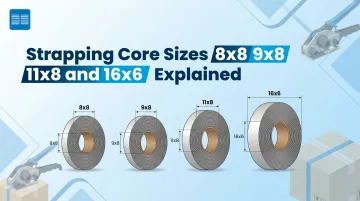
Four core sizes dominate the industrial strapping market: 8x8, 9x8, 11x8, and 16x6. Each serves distinct equipment types, and even a one-inch diameter difference makes rolls incompatible. This guide breaks down what each dimension means, which equipment uses which core, and how to order the right spec the first time.
Key Takeaways
- Core size = CORE DIAMETER x CORE WIDTH (both in inches)
- 16x6 is the standard for manual hand-strapping dispensers
- 8x8 is the most common machine-grade core, compatible with most automatic strapping equipment
- 9x8 is used by specific tabletop and semi-automatic machines—NOT interchangeable with 8x8
- 11x8 is a specialty machine core for select equipment models
- Always verify core size against your equipment manual before ordering
What Core Size Actually Means in Strapping
Core size is a two-number specification describing the hollow cylindrical cardboard tube onto which strapping is wound. The first number is the inner diameter of the core; the second number is the width (depth) of the core—both measured in inches. For example, a 16x6 core has a 16-inch inside diameter and a 6-inch face width.
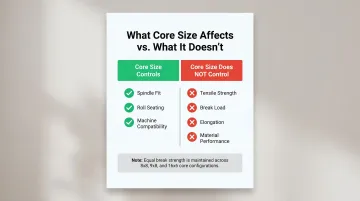
This is a mechanical fit parameter, not a performance specification. Core size determines whether a roll physically seats correctly on the spindle or mandrel of your strapping machine or dispenser. It has no bearing on:
- Strap tensile strength or break load
- Elongation characteristics
- Material performance at temperature or under tension
Those properties are controlled by material type, width, and gauge—not by the core the strapping is wound on.
Why Multiple Core Sizes Exist
The existence of four distinct core sizes traces back to proprietary equipment design. Strapping machinery manufacturers originally specified unique core dimensions to lock customers into buying consumables from them exclusively. While that practice has faded, those size differences persisted: Strapack's iQ-400 accepts both 8x8 ("A" core) and 9x8 ("B" core), while Stickel Packaging machines feature adjustable core cradles for 8-inch, 9-inch, and 11-inch diameters. Today, core size is driven by your equipment brand and model, not industry-wide standards.
That's why identifying which core your machine requires—8x8, 9x8, 11x8, or 16x6—is the first step before ordering strapping consumables.
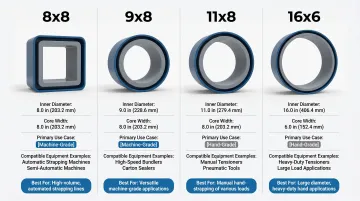
The Four Core Sizes Explained: 8x8, 9x8, 11x8, and 16x6
These four sizes may look similar on paper, but a one-inch difference in diameter makes a roll incompatible with the wrong machine. Know your equipment's core requirement before purchasing.
8x8 Core
8x8 (8-inch inner diameter, 8-inch wide core) is the most widely used machine-grade core size, compatible with the majority of automatic and semi-automatic strapping machines. It's the safe default for machine-grade PP or PET strapping unless your equipment spec indicates otherwise.
Compatible brands include Signode, Strapack, and EAM-Mosca — all documented for 8x8 AUTO-grade products.
Available product range:
- Widths: 5mm through 5/8-inch (select products up to 12mm)
- Break strengths: 110 lbs to 600 lbs
- Materials: Polypropylene and polyester
- Finish: Smooth and embossed
This core size offers the widest selection of strap widths and materials, making it the easiest to source.
9x8 Core
9x8 (9-inch inner diameter, 8-inch wide core) is the second most common machine-grade size, used by specific tabletop and semi-automatic strapping machines. The one-inch diameter difference over 8x8 means these rolls will not seat correctly on an 8x8 spindle, and vice versa.
Equipment using 9x8 includes the Strapack iQ-400 ("B" core option), Samuel Strapping machine-grade PP, and USAStrap tabletop models.
Available product range:
- Widths: 1/4-inch through 1/2-inch
- Break strengths: 200 lbs to 600 lbs
- Primarily polypropylene
Selection is narrower than 8x8, so verify supplier stock before ordering.
11x8 Core
11x8 (11-inch inner diameter, 8-inch wide core) is the least common of the four, used by a narrower range of specialty strapping equipment. Buyers with 11x8 machines encounter fewer off-the-shelf options, so verify supplier availability before purchasing.
Dynaric is the primary manufacturer with documented 11x8 products: P382-11 (3/8-inch, 300 lbs), P414-11 (1/2-inch, 425 lbs), and P418-11 (1/2-inch, 550 lbs). John Maye Company also stocks 11x8 through their Flexband Machine-Grade Polypropylene line.
No major machine brand is documented as exclusively requiring 11x8. This core appears primarily in Dynaric equipment specifications and select adjustable-core machines.
16x6 Core
16x6 (16-inch inner diameter, 6-inch wide core) is the standard for hand-grade strapping used with manual dispensers and hand tools. The larger diameter fits the coil format of hand-grade PP and PET strapping, along with the spindle geometry of handheld and cart-mounted dispensers.
Common 16x6 products include:
- PAC Strapping hand-grade PP: 1/2-inch x 7,200 ft and 5/8-inch x 5,400 ft, designed for manual application
- Strapack HP40xxx series: all use 16x6 cores (1/2-inch width, 250–600 lbs)
- Portable strapping cart dispensers: rated for a max core size of 16x6
CRITICAL: 16x6 rolls are not designed for most automated strapping machines. Confusing hand-grade (16x6) with machine-grade (8x8/9x8) is one of the most common purchasing errors in the category. Some arch-style automatic machines do accept 16x6 cores, but verify compatibility first.
How to Identify the Right Core Size for Your Equipment
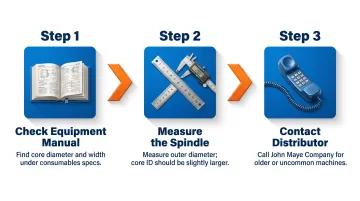
Check the Equipment Manual First
The most reliable source is your strapping machine's original equipment manual or spec sheet, which lists required core inner diameter and width under consumables or strapping specifications. If you don't have a physical copy, download the manual from the manufacturer's website or contact the manufacturer directly.
Physical Measurement Method
If documentation is unavailable, use a tape measure or caliper to measure the outer diameter of the spindle or mandrel the roll sits on. The required core inner diameter should match or be slightly larger (typically 0.1–0.2 inches) than the spindle outer diameter to allow the roll to spin freely without excessive play.
When You're Still Not Sure
Some situations call for a different approach. A few quick checks cover the most common scenarios:
- Hand dispensers: Check the center post diameter. Virtually all hand-grade dispensers are designed for the 16x6 core standard, so verification is usually straightforward.
- Older or uncommon machines: Documentation can be hard to track down. John Maye Company's technical team can confirm core size compatibility for your specific model before you order — reach them at 1-800-441-6293 or info@johnmayecompany.com.
Consequences of Using the Wrong Core Size
Two Failure Modes
Using the wrong core size creates one of two problems, and neither is minor:
- Oversized core: The roll wobbles on the spindle, causing uneven strap feed, tension inconsistencies, mis-seals, and jams. Erratic machine behavior follows quickly.
- Undersized core: The roll won't fit over the spindle at all — production stops immediately. You cannot force an 8x8 roll onto a 9x8 machine.
Operational Impact
Wrong-core rolls discovered after delivery create unplanned downtime while replacement rolls are sourced. In high-volume operations, this translates directly to missed shipment windows and revenue loss.
The scale of that risk isn't trivial. Vanson Bourne research puts unplanned machine downtime at an average of $260,000 per hour across manufacturing industries. Packaging line stoppages typically run lower — but even a small fraction of that figure makes a pre-order core size check worth every second.
Consumable Waste
A wrong-core roll purchase typically cannot be used and may not be returnable once opened, meaning the cost of the roll itself is lost. Verifying core size before ordering is a zero-cost step that prevents tangible financial loss.
Common Misconceptions About Strapping Core Sizes
"8x8 and 9x8 Are Close Enough"
This is the most dangerous misconception. A one-inch diameter difference is significant in a precision-machined spindle context. A 9x8 roll on an 8x8 spindle will wobble and feed unevenly; an 8x8 roll simply won't fit on a 9x8 spindle. These two sizes are not interchangeable.
"Core Size Affects Strap Strength"
Core size is purely a dimensional fit parameter. Two rolls of identical strap material, width, and thickness wound on 8x8 vs. 9x8 cores will perform identically once loaded. Strapack's specification chart confirms this: 1/2-inch x 0.025-inch PP strapping rates 350 lbs on 8x8, 9x8, and 16x6 cores. Core size does not influence break strength, elongation, or tension retention—material type and gauge do.
"Roll Size" = "Core Size"
Some buyers conflate the outer diameter of the full strapping roll (which changes as strap is consumed) with core size (which is fixed). Core size refers only to the inner cardboard tube dimensions. Roll outer diameter varies by footage and strap gauge but does not affect machine compatibility the way core size does. Roll outer diameter varies by footage and strap gauge, but only the core dimensions determine whether a roll fits your machine. When in doubt, check the spindle spec on your strapper before ordering.
Frequently Asked Questions
What size is a PP strapping roll?
PP strapping roll sizes are described by three parameters: strap width (e.g., 1/2-inch, 5/8-inch), footage on the roll, and core size (e.g., 8x8, 16x6). "Roll size" in casual usage often refers to core size, but buyers should confirm all three dimensions before ordering.
What is the difference between 8x8 and 9x8 strapping cores?
Both have an 8-inch core width but differ by 1 inch in inner diameter (8-inch vs. 9-inch), making them incompatible with each other's spindles. 8x8 is more widely available and used by more machine models; 9x8 is associated with specific tabletop and semi-automatic equipment brands like Strapack and Samuel.
Can I use an 8x8 core roll on a machine that requires 9x8?
No, the rolls are not interchangeable. An 8x8 roll will not seat correctly on a 9x8 spindle, and vice versa. Attempting to force a wrong-core roll risks equipment damage and production downtime.
How do I find out what core size my strapping machine needs?
Check the equipment manual or spec sheet first, then physically measure the spindle outer diameter as a backup. For older machines, contact the equipment manufacturer or a knowledgeable distributor like John Maye Company (1-800-441-6293) for verification.
How much weight can plastic strapping hold?
Break strength depends on material, width, and gauge — not core size. Light-duty PP starts around 110 lbs and reaches 600 lbs for heavy-duty widths; PET strapping spans 300 lbs to 4,000 lbs depending on gauge and width, per Signode Tenax specs.
What is an alternative to plastic strapping?
Steel strapping handles the heaviest and sharpest-edged loads with maximum break strength, though it offers no elongation recovery. Woven polyester cord strapping reaches up to 2,700 lbs (3/4-inch HD) with better shock absorption, making it a practical choice for timber, bricks, or loads that settle in transit.