Introduction
Businesses that use packaging supplies regularly — corrugated boxes, stretch wrap, tape, void fill, poly bags, mailers — often lose time and money placing the same orders repeatedly, scrambling when stock runs out, or over-ordering and tying up warehouse space.
According to a 2020 survey of 400 senior supply chain executives, supply chain disruptions cost businesses 6-10% of annual revenues on average. Inventory carrying costs compound the problem, typically consuming 20-30% of total inventory value annually, according to industry benchmarks from NetSuite and Clear Spider.
Setting up a standing order seems straightforward — but results vary widely. A standing order that actually eliminates reorder hassle requires knowing your consumption patterns, negotiating the right terms, and monitoring the arrangement over time. Done poorly, it trades one problem (stockouts) for another (chronic overstock).
This guide covers:
- When a standing order makes sense for your operation
- What to have in place before you set one up
- The step-by-step setup process
- Key variables to control
- Mistakes that cause standing orders to fail
Key Takeaways
- A packaging supplies standing order automatically delivers set quantities on a scheduled basis
- Works best for operations with consistent usage across manufacturing, fulfillment, or distribution
- Requires usage audit, defined reorder points, supplier negotiation, and delivery schedule alignment
- Most standing orders fail due to inaccurate consumption data, weak MOQ terms, or skipping periodic reviews as volume shifts
- A reliable regional supplier with deep inventory (2,500+ SKUs) and fast ship guarantees makes standing order programs far easier to sustain
How to Set Up a Packaging Supplies Standing Order
Step 1: Audit Your Current Packaging Supply Usage
Before contacting any supplier, you must know exactly which packaging supplies are used, in what quantities, and how frequently. This includes SKUs like corrugated boxes, stretch wrap, poly bags, tape, and void fill.
Pull 3-6 months of purchase history and identify high-frequency, high-volume SKUs that are strong candidates for a standing order. The 80/20 inventory rule — where approximately 20% of SKUs account for roughly 80% of total volume — helps you prioritize. Focus standing orders on the items that drive the majority of your consumption, such as:
- Standard box sizes used daily
- Stretch wrap rolls for pallet wrapping
- General-purpose packing tape
- High-volume void fill materials
Low-volume or seasonal items are poor candidates. A specialty mailer used occasionally or corrugated boxes tied to a single product launch should remain on manual purchase orders.
Account for seasonal demand spikes in your audit. E-commerce companies face Q4 surges; food and beverage operations see peak demand during harvest or holiday seasons. Build these fluctuations into order parameters from the start, or plan for temporary volume adjustments in your supplier agreement.
Step 2: Define Your Reorder Point and Minimum Stock Levels
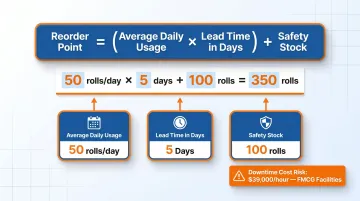
A reorder point is the inventory level at which a new order should trigger to prevent a stockout before the next delivery arrives. The standard formula, confirmed by the Association for Supply Chain Management (ASCM), is:
Reorder Point = (Average Daily Usage × Lead Time in Days) + Safety Stock
Example: If you use 50 rolls of stretch wrap daily, your supplier's lead time is 5 days, and you maintain a safety stock of 100 rolls:
- Reorder Point = (50 × 5) + 100 = 350 rolls
When inventory drops to 350 rolls, the next delivery should already be in transit.
Safety stock is a critical buffer, especially for operations with zero-downtime requirements. Research from Siemens and Senseye found that unplanned downtime costs FMCG facilities an average of $39,000 per hour — even a packaging supply shortage can halt production lines with severe financial consequences.
Don't use arbitrary safety stock percentages. Setting safety stock at a flat 10-20% of cycle stock "generally results in poor performance," according to APICS guidance. Instead, calculate safety stock based on demand variability and desired service levels using Z-score-based formulas tied to your operational risk tolerance.
Minimum stock levels should also reflect storage capacity constraints. Holding too much inventory creates its own burden — increased carrying costs, tied-up capital, and warehouse congestion. The goal is balance between continuity and efficiency.
Step 3: Select a Supplier and Negotiate Standing Order Terms
Not all suppliers support standing orders equally. Evaluate potential partners on:
- SKU breadth — Can they supply all your high-frequency packaging materials?
- Delivery reliability — Do they consistently meet lead time commitments?
- Minimum order quantities (MOQs) — Are they aligned with your consumption rate?
- Flexibility to adjust volumes — Can you scale up or down with seasonal demand?
- Account management support — Do you get a dedicated contact who understands your operation?
Key terms to negotiate:
- Unit pricing at volume — Lock in pricing tiers based on annual commitment
- Frequency of delivery — Weekly, bi-weekly, or monthly schedules
- Lead times — Confirm acceptable lead times and variability
- Minimum order thresholds — Ensure MOQs don't force chronic overstock
- Cancellation or pause policies — Define notice periods and adjustment terms
- Price lock-in periods — Protect against volatility (see price escalation discussion below)
For Midwest manufacturers and distributors, the equipment infrastructure behind your standing order program matters as much as the supplier agreement itself. John Maye Company — a Wisconsin-based packaging equipment specialist with 40+ years of experience — helps operations select and configure the right pallet wrappers, strapping systems, and shrink equipment to handle consistent, high-volume supply consumption reliably. The right equipment reduces manual handling variation that can distort your actual usage data and throw off standing order calibration.
Step 4: Configure Delivery Schedule and Order Quantities
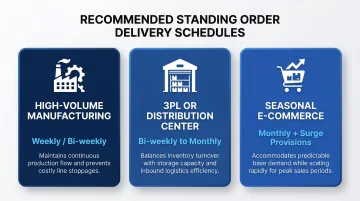
Delivery frequency should align with how quickly you deplete packaging stock. A daily production line will need a different schedule than a seasonal e-commerce operation. Match delivery intervals to your consumption rate:
| Operation Type | Typical Frequency | Rationale |
|---|---|---|
| High-volume manufacturing | Weekly or bi-weekly | Minimizes storage needs while maintaining continuity |
| 3PL or distribution center | Bi-weekly to monthly | Balances inventory turns with operational demand |
| Seasonal e-commerce | Monthly, with surge provisions | Reduces carrying costs outside peak periods |
Set quantities conservatively at first, with a built-in review window (60-90 days). This prevents locking in the wrong volumes before actual consumption patterns are confirmed. Start with quantities that meet your calculated reorder point, then adjust based on observed usage.
Multi-SKU standing orders require SKU-level customization. Different items may deplete at different rates — tape and stretch wrap may be consumed faster than specialty mailers or custom-printed boxes. Delivery intervals may vary by SKU, with fast-moving items delivered weekly and slower-moving items delivered monthly.
Step 5: Monitor Performance and Adjust the Order Over Time
Standing orders drift out of calibration as production volumes shift, product lines change, and supplier lead times fluctuate. Regular reviews keep quantities and delivery frequency aligned with actual operational needs.
Set quarterly review checkpoints to assess:
- Whether stockouts or overstock situations have occurred
- Whether new SKUs should be added or underperforming SKUs removed
- Whether volumes need to be scaled up or down
Track key metrics:
- Stock days on hand — How many days of inventory you're holding at any time
- Frequency of emergency top-up orders — A high rate signals your standing order is miscalibrated
- Total supply spend versus budget — Are you spending more or less than anticipated?
These metrics signal whether the standing order is calibrated correctly. If you're consistently running stockouts, increase quantities or shorten delivery intervals. If you're accumulating excess inventory, reduce quantities or extend intervals.
When Should You Set Up a Packaging Supplies Standing Order?
Standing orders are not the right fit for every business. They work best when packaging supply usage is regular, predictable, and tied to consistent production or fulfillment output. According to CSCMP's glossary, a blanket purchase order is "normally used when there is a recurring need for expendable goods" — exactly the profile of consumable packaging supplies.
Ideal use cases:
- High-volume manufacturers running packaging lines daily
- Distribution centers or 3PLs with steady, predictable throughput
- Food and beverage operations on consistent production schedules
Poor-fit scenarios:
- Businesses with variable or project-based demand that makes consumption hard to forecast
- Operations with frequent SKU changes where standing orders become obsolete quickly
- Facilities without storage space to hold modest safety stock between deliveries
If your operation lacks at least 60–90 days of consistent demand history or adequate storage, wait to set one up. Once those conditions are in place, you're ready to work through the setup steps.
What You Need Before Setting Up a Standing Order
Getting a standing order right comes down to three things: adequate storage, reliable usage data, and clear internal authority. Missing any one of them creates problems before the first delivery arrives.
Equipment and Storage Requirements
You need adequate shelving, racking, or floor space to hold at least one full order cycle's worth of packaging supplies without creating blocked aisles or crowded picking lanes or safety issues. Calculate the physical footprint of your standing order quantities:
- Corrugated boxes often ship on pallets (48" × 40" footprint per pallet)
- Stretch wrap rolls require vertical storage or horizontal racks
- Tape and poly bags can be stored on shelving, but require accessibility for picking
If your current warehouse is at capacity, adding a standing order without expanding storage will create bottlenecks, not efficiencies.
Accurate Consumption Data
You need at least 60–90 days of reliable usage data to set sensible quantities. Businesses without this baseline should run a manual tracking period before committing. Track:
- SKUs ordered
- Quantities purchased
- Order dates
- Time elapsed between reorders
This data provides the foundation for calculating average daily usage, identifying seasonal variation, and setting realistic reorder points.
Supplier Readiness and Internal Procurement Authority
Before negotiating terms, confirm two things are in place:
- Designated contacts: An internal purchasing or operations manager and a supplier account representative on the other side
- Procurement authority: Standing orders with price locks or minimum volume commitments often require budget approval beyond the plant floor level
A standing order negotiated by a plant manager can be invalidated if corporate procurement holds final sign-off — confirm the approval chain first.
Key Variables That Affect How Well Your Standing Order Performs
Two businesses with identical packaging needs can get very different outcomes from a standing order based on how well they control the variables below.
Order Frequency vs. Consumption Rate
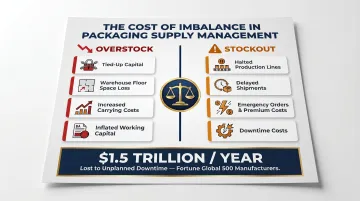
Misaligning delivery frequency with actual consumption rate is the most common root cause of both stockouts and overstock. Orders arriving too frequently relative to usage rates create storage problems and tie up capital. Orders arriving too infrequently leave operations exposed to disruption.
Overstocked supplies tie up capital and floor space, while stockouts can halt production lines or delay shipments. With unplanned downtime costing Fortune Global 500 manufacturers approximately $1.5 trillion per year (11% of turnover), even packaging supply shortages carry real financial consequences.
Match delivery intervals to your actual consumption data:
- Weekly delivery: Order 1,000–1,200 units if you use 1,000/week (the extra 200 covers safety stock)
- Bi-weekly delivery: Order 2,000–2,400 units for the same usage rate
- Seasonal spikes: Adjust quantities 4–6 weeks ahead rather than reacting after a stockout
Minimum Order Quantities (MOQs)
Supplier MOQs can force a business to order more than it actually needs, skewing standing order quantities from the start. When MOQs exceed actual demand, businesses face inventory inflation, tied-up working capital, and increased obsolescence risk — problems that often mask the real consumption rate for months.
Negotiate MOQs that align with realistic monthly usage, particularly for specialty SKUs that move more slowly than commodity items like tape or stretch wrap. The Institute for Supply Management (ISM) recommends consolidating volume across plants or business units to meet MOQ thresholds without accumulating excess inventory at any single location.
Supplier Lead Time Reliability
If a supplier's lead time fluctuates — averaging 2 days but occasionally extending to 7 — your safety stock calculation must account for that variance. An underestimated lead time without a buffer means one delayed shipment can halt your line.
Calculate lead time variability using standard deviation, then set safety stock to cover your supplier's worst-case scenario — not their average. APICS research shows that lead time variability can sharply increase required safety stock buffers, especially when combined with demand variability.
Price Escalation Clauses
Some standing order agreements include price escalation provisions tied to material costs, fuel surcharges, or index rates. If these are not negotiated or capped upfront, you may see unexpected cost increases mid-contract.
Recent packaging material cost trends:
- Containerboard production capacity dropped approximately 10% in 2025, with Fastmarkets RISI forecasting a $50/ton kraftliner price increase in early 2026
- Plastics packaging film prices rose approximately 2.7% in four months (November 2025–March 2026), based on BLS Producer Price Index data
When reviewing any standing order contract, ask specifically about price-lock periods, escalation triggers, and the annual renegotiation process. ISM recommends index-based price adjustments with "caps and floors" tied to BLS and S&P Global market indexes — a structure that handles commodity volatility while protecting both buyer and supplier.

Common Mistakes When Setting Up a Packaging Supplies Standing Order
Most standing order problems trace back to the same three oversights:
Relying on estimated quantities instead of verified data. Eyeballing consumption leads to quantities that are either too high or too low, and the gap compounds with every delivery cycle. A 20% estimation error can become a chronic overstock or stockout situation within three months.
Ignoring seasonal demand swings. A standing order calibrated for average demand will leave operations short during peak periods, such as Q4 for e-commerce or harvest season for food and beverage. Build seasonal buffers into the agreement, and negotiate temporary volume increases or pause provisions for off-peak months.
Setting it and forgetting it. Many businesses let standing orders run unchanged for 12-18 months despite shifts in product mix, production volume, or packaging formats. Schedule quarterly reviews and adjust before the mismatch causes disruption.
Frequently Asked Questions
What is a packaging supplies standing order?
A packaging supplies standing order is a recurring supply agreement between a business and its supplier, where a pre-agreed quantity of packaging materials is automatically delivered on a set schedule, eliminating manual repeat ordering and reducing procurement overhead.
Where is the best place to buy packaging supplies?
Look for a supplier with broad SKU availability, reliable lead times, and account management support. Regional specialists like John Maye Company offer Midwest businesses the advantage of proximity, 2,500+ SKUs in inventory, and a 24-hour ship guarantee for rapid fulfillment and minimal production downtime.
What are the 4 types of inventory management systems?
The four main types are periodic review (fixed reorder cycles), perpetual inventory (real-time stock tracking), just-in-time (JIT) (materials arrive exactly when needed), and vendor-managed inventory (VMI) (supplier controls order size and timing). Standing orders align most closely with periodic review and VMI.
How do I calculate how much packaging supply inventory to keep on hand?
On-hand inventory should cover at minimum one full supplier lead time cycle plus a safety stock buffer. Multiply average daily usage by lead time in days, then add a buffer based on demand variability. For stable operations, 10-20% is typical; variable demand or unreliable lead times warrant a higher buffer.
Can I adjust or pause a packaging supplies standing order after it's set up?
Most suppliers allow adjustments with adequate notice, but the specific terms — including notice periods, minimum adjustment thresholds, and pause policies — should be confirmed and documented before signing any standing order agreement. Negotiate flexibility upfront to accommodate seasonal demand shifts or product line changes.