Introduction
The third-party logistics sector operates at a scale that demands precision across every operation. With the U.S. 3PL market reaching $323.4 billion in 2025 and over 72,000 logistics businesses managing diverse client inventories across multiple shifts, small inefficiencies in high-volume workflows add up fast. Pallet wrapping sits at a critical juncture in this chain: it's the final step before freight leaves the dock and the first line of defense against damage claims.
Manual or inconsistent wrapping creates cascading problems specific to 3PL operations. Freight damage costs the logistics industry $50-60 billion annually, with LTL shipments experiencing damage rates of 2-5%.
For 3PLs managing multiple client accounts, a single damaged shipment doesn't stop at a claim. It jeopardizes client SLAs, strains customer relationships, and triggers costly exception-handling workflows.
This guide covers the best pallet wrapper models for 3PL warehouses, the machine types suited to multi-client environments, and the key criteria to evaluate before purchasing.
Key Takeaways
- Pallet wrappers cut freight damage by up to 70% and reduce per-pallet wrap time from 5-10 minutes down to 1-2 minutes
- 3PLs need machines that handle varied pallet profiles across clients, maintain uptime across multiple shifts, and scale capacity during seasonal surges
- Top picks include Lantech Q-300XT Plus, Robopac Rotoplat 708, Orion Flex HPA, and Handle It 850PS
- Key selection factors: throughput capacity (35-95 pallets/hour), pre-stretch ratio (200-400%), and U.S.-based service support
Why 3PL Warehouses Have Unique Pallet Wrapping Needs
Unlike single-client distribution centers or dedicated manufacturing lines, 3PL warehouses wrap pallets for multiple clients with varying product types, weights, and dimensional profiles. A cosmetics pallet might measure 48" × 40" × 65" and weigh 800 lbs, while an automotive parts load could hit 4,000 lbs on a 48" × 48" footprint. That range demands programmable wrap cycles and fast changeover — two features that separate purpose-built 3PL equipment from standard warehouse wrappers.
Operating pressure runs high: 59% of 3PLs are running above 90% capacity, which means equipment runs continuously across extended or 24/7 schedules. When a wrapper goes down in a 3PL environment, the ripple hits every client account at once — not just one production line. Rapid parts availability and manufacturer-trained service aren't extras; they're operational requirements.
Seasonal swings introduce a final wrinkle. E-commerce fulfillment volumes can triple from October through December, with Q4 accounting for 30–40% of annual revenue. 3PLs need to scale wrapping capacity during those peaks without adding permanent headcount or committing to full capital purchases — which is why equipment rental and modular configurations tend to be the practical answer.
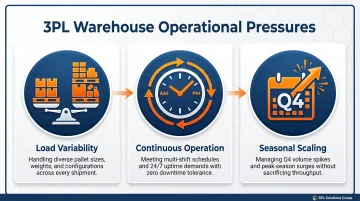
In short, 3PL wrapping requirements break down into three distinct pressures:
- Load variability — wide swings in pallet size, weight, and product type across clients
- Continuous operation — multi-shift or 24/7 use with near-zero tolerance for downtime
- Seasonal scaling — rapid capacity increases during Q4 without permanent investment
Types of Pallet Wrappers Best Suited for 3PL Warehouses
Not every wrapper fits every 3PL operation. The right choice depends on your load types, daily volume, and floor layout — three factors that vary widely across third-party logistics environments.
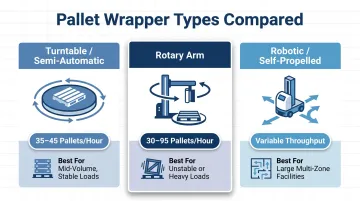
Turntable Wrappers (Semi-Automatic)
The pallet rotates on a powered platform while a film carriage travels vertically. Semi-automatic models require an operator to attach the film and start the cycle, but handle the wrapping process automatically. These machines suit moderate-volume operations wrapping 50–150 pallets daily with consistent pallet profiles.
| Spec | Detail |
|---|---|
| Throughput | 35–45 pallets per hour |
| Best for | Mid-volume 3PLs, budget-conscious operations, or facilities with multiple wrapping locations |
Rotary Arm Wrappers
The load stays stationary while a rotating arm wraps film around it. This design is the go-to for unstable loads — top-heavy products, lightweight containers, stacked bags — that can't safely spin on a turntable. It also handles loads exceeding standard turntable weight limits.
| Spec | Detail |
|---|---|
| Throughput | 30–95 pallets per hour depending on configuration |
| Best for | 3PLs handling diverse load stability profiles, heavy industrial products, or high-speed conveyorized lines |
Robotic/Self-Propelled Wrappers
A mobile unit travels to the pallet and wraps it in place, requiring no fixed installation. The machine operates wherever loads are staged on the warehouse floor — useful when wrapping happens across multiple zones rather than at a single station.
| Spec | Detail |
|---|---|
| Throughput | Variable based on travel distance and pallet placement |
| Best for | Large-footprint facilities with high location variability, operations with limited floor space, or warehouses wrapping across multiple zones |
Best Pallet Wrappers for 3PL Warehouses
These machines were selected based on criteria critical to 3PL operations:
- Throughput reliability across varied loads
- Film efficiency to reduce per-pallet costs
- Programmability for multi-client environments
- Access to U.S.-based service and parts networks
Lantech Q-300XT Plus
Louisville, Kentucky-based Lantech invented the stretch wrapper in 1973. The Q-300XT Plus is their flagship semi-automatic turntable platform, used widely across high-volume distribution environments requiring consistent containment force across diverse loads.
The Load Guardian control system uses profile-based questions about each load to automatically calculate and maintain correct containment force — eliminating guesswork when switching between client accounts. Automatic film cut-and-clamp keeps forklift operators productive between cycles, and 250% power pre-stretch reduces film consumption significantly across large daily volumes.
| Specification | Value |
|---|---|
| Automation Level | Semi-Automatic Turntable |
| Load Capacity | 4,000 lbs |
| Pre-Stretch | 250% (Power Roller Stretch) |
| Turntable Diameter | 65" |
| Max Load Height | 80" standard |
Robopac Rotoplat 708
Robopac USA operates from Duluth, Georgia, with over 250 stretch wrappers in stock at their Atlanta-area facility. The Rotoplat 708 is a premium semi-automatic turntable machine built for operations that need measurable film savings and real-time operational visibility.
Cube Technology delivers up to 400% pre-stretch — among the highest available — with nine variable containment force levels per load. For multi-shift 3PL operations, R-Connect remote diagnostics let facility managers monitor performance, track usage data, and receive proactive maintenance alerts without halting production.
| Specification | Value |
|---|---|
| Automation Level | Semi-Automatic with touchscreen control |
| Production Speed | Up to 40 loads per hour |
| Max Load Weight | 4,400 lbs |
| Max Load Dimensions | 52"W × 52"L × 110"H |
| Key Technology | Cube Technology + R-Connect remote diagnostics |
Orion Flex HPA
Orion Packaging (Alexandria, Minnesota) manufactures industrial-grade stretch wrappers under the ProMach brand portfolio. The Flex HPA is a fully automatic turntable model built for rugged, high-throughput environments where film savings directly affect operating margins.
At 260% powered pre-stretch, film cost reductions add up to real savings across hundreds of daily pallets. Photo-eye height detection automatically adjusts wrap cycles for loads of varying heights — no manual input needed when cycling through multiple client SKUs with different dimensional profiles.
The automatic film clamp, cut, and wipe system eliminates operator film handling entirely.
| Specification | Value |
|---|---|
| Automation Level | Fully Automatic Turntable |
| Pre-Stretch | 260% (powered) |
| Load Capacity | 4,000 lbs standard; 5,000 lbs optional |
| Turntable Speed | Variable, up to 15 RPM |
| Max Wrap Height | 80" standard |
Handle It 850PS
Milwaukee-based Handle It produces mid-range packaging equipment built for smaller and growing operations. The 850PS is a semi-automatic turntable wrapper that delivers advanced features at a price point suited to 3PLs without enterprise-scale capital budgets.
The 250% pre-stretch matches higher-priced competitors, and the LCD control panel supports programmable wrap cycles for each client account. The optional built-in scale enables weight verification without a separate weighing step — useful for 3PLs billing by weight or managing freight cost allocation. Regional Wisconsin manufacturing means faster parts availability across the Midwest.
| Specification | Value |
|---|---|
| Automation Level | Semi-Automatic Turntable |
| Pre-Stretch | 250% powered |
| Load Capacity | 4,400 lbs |
| Turntable Diameter | 59" |
| Throughput | Up to 30 loads per hour |
| Notable Option | Integrated scale for weight verification |
How We Chose the Best Pallet Wrappers for 3PLs
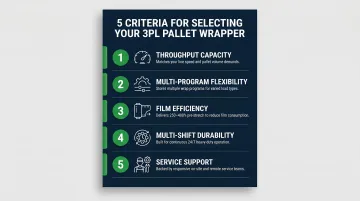
These machines were evaluated specifically against 3PL operational requirements — not just general warehouse use. The assessment focused on five critical factors:
Throughput Capacity: Machines must match daily volume requirements across peak and off-peak periods. Turntable wrappers cap around 35-45 pallets/hour; rotary arm systems reach 45-95 pallets/hour for high-volume lines.
Multi-Program Flexibility: 3PLs wrapping for multiple clients need machines that store and recall different wrap patterns, containment forces, and film applications without manual recalibration between loads.
Film Efficiency: Machines with 250-400% pre-stretch reduce film usage by 30-50% compared to manual wrapping. At 100 pallets daily, this translates to thousands of dollars in annual material savings.
Multi-Shift Durability: Equipment running extended or 24/7 shifts requires industrial-grade construction and access to rapid parts replacement. Downtime in a multi-client environment impacts multiple SLAs simultaneously.
Service Support: U.S.-based manufacturer support ensures technician availability, parts inventory, and warranty service without international logistics delays.
The most common mistake 3PL operators make: selecting equipment based solely on upfront cost or single-client specifications without accounting for load variability across the entire client base, peak season capacity requirements, or total cost of ownership including film waste and labor. That capital risk is exactly where rental becomes a practical option. John Maye Company's rental fleet lets Midwest 3PL operations scale wrapping capacity during Q4 peaks without a full equipment purchase — matching capacity to demand without locking in fixed costs.
The right machine produces measurable results across your operation:
- Reduces per-pallet film cost through higher pre-stretch efficiency
- Minimizes freight damage claims with consistent containment force
- Supports client SLA compliance during high-volume periods
- Frees labor for higher-value warehouse tasks
Conclusion
3PL warehouses operate under pressures that distinguish them from single-client distribution centers: diverse load profiles across multiple accounts, multi-shift throughput demands, and seasonal volume volatility that can triple normal capacity requirements. The right pallet wrapper must deliver flexibility, reliability, and film efficiency at the scale these operations demand.
Evaluate machines against your actual load profiles and peak volume scenarios — not average daily numbers. Three decision factors matter most:
- Size for peak, not average: A wrapper rated for 80 pallets/day becomes a bottleneck when Q4 volumes hit 200
- Calculate total cost of ownership: A machine with 400% pre-stretch may cost $3,000 more upfront but save $8,000 annually in film alone
- Match flexibility to your client mix: Turret and rotary arm styles handle varied load types that fixed-arm machines can't
John Maye Company has worked with Midwest 3PLs and distribution centers since 1983, with factory-certified technicians and an extensive rental fleet built for seasonal surges. Reach out to their team to spec the right wrapper for your operation — or ask about rental options when you need capacity fast.
Frequently Asked Questions
What is a pallet wrapper called?
Pallet wrappers are also commonly called stretch wrappers, stretch wrap machines, or pallet stretch wrappers. All terms refer to equipment that applies stretch film (LLDPE) around a palletized load to secure it for storage or transit.
What does a pallet wrapper do?
A pallet wrapper mechanically applies stretch film under controlled tension, securing product to the pallet and stabilizing the load against shifting during transit. It also protects loads from dust and moisture, reducing freight damage and improving handling efficiency.
What material is used to wrap pallets?
The standard material is LLDPE (Linear Low-Density Polyethylene) stretch film, which is elastic, tear-resistant, and self-adhering. Machine-grade stretch film is engineered for consistent elongation (300-500%) under the pre-stretch ratios automated machines apply.
How much does an automated pallet wrapper cost?
Semi-automatic turntable wrappers range from $5,000-$20,000+, while fully automatic inline systems start around $15,000 and can exceed $50,000 depending on throughput capacity, integration features, and customization. Budget should also account for installation, conveyor integration, and accessories, which can add meaningfully to the final figure.
What type of pallet wrapper is best for a 3PL warehouse?
The best type depends on volume and load variability: semi-automatic turntable wrappers suit most mid-volume 3PLs (50-150 pallets/day), rotary arm models handle unstable or heavy loads, and robotic wrappers work best in high-variability operations with diverse pallet placement or floor layout constraints.
How often should a pallet wrapper be serviced?
Most manufacturers recommend preventive maintenance every 500-1,000 machine hours or annually at minimum. For multi-shift 3PL operations, inspect the film carriage, pre-stretch rollers, and turntable drive more frequently — unplanned downtime in a 3PL affects every client account on the floor.