Introduction
Modern fulfillment centers face relentless pressure to process more orders faster, with e-commerce growth showing no signs of slowing. According to Prologis research, U.S. e-commerce sales increased 8.0% year-over-year in 2024, accounting for 56% of total retail goods sales growth and reaching 24% market penetration—projected to hit 30% by 2030. This sustained volume surge makes manual case forming not just inefficient, but unsustainable for mid-to-large operations.
The productivity gap is stark: an average worker manually erects approximately 3 cases per minute, while automated case erectors operate at 8 to 30+ cases per minute—a 300-1,000% productivity increase. Beyond speed, manual case forming creates measurable ergonomic risk. The U.S. Bureau of Labor Statistics reports 4.8 total recordable injuries per 100 full-time workers in warehousing and storage, with repetitive box assembly contributing significantly to musculoskeletal disorders.
Choosing the right case erector means matching the machine to your specific operation: peak volume requirements, case variety, conveyor integration, and total cost of ownership. This guide covers the top options for fulfillment environments, the key specs to compare, and what to evaluate before committing.
Key Takeaways
- Case erectors automatically form flat corrugated blanks into ready-to-fill boxes, replacing labor-intensive manual assembly
- Speed ranges from 8-75 cases per minute — the best machines also balance case size flexibility, sealing method (tape vs. hot melt), and line integration
- Top brands include Wexxar BEL, Lantech, Pearson Packaging Systems, Combi Packaging Systems, and Wayne Automation
- Key buying criteria: throughput requirements, changeover time, total cost of ownership, and local service availability
- Midwest fulfillment centers can work with John Maye Company (Waukesha, WI) for equipment selection and on-site technical support
Case Erectors in Fulfillment Centers: An Overview
A case erector is a machine that takes flat corrugated cardboard blanks (pre-folded flat blanks, also called knocked-down flats or KDFs), opens them into box form, folds and seals the bottom flaps, and delivers erected cases ready for product loading.
In high-volume, multi-SKU fulfillment environments, manual case forming creates three critical problems:
- Ergonomic risk from repetitive bending and folding
- Inconsistent box quality — un-square cases lose up to 30% of their stacking strength
- Productivity constraints that bottleneck entire packaging lines
Case erectors eliminate all three by automating the forming process from start to finish.
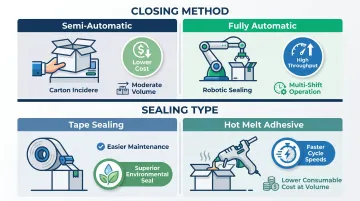
These machines typically deploy as part of an end-of-line packaging system alongside case sealers, conveyors, and labelers. Two variables define which machine fits which operation:
- Semi-automatic: Requires an operator to feed blanks; lower upfront cost, suited for moderate volumes
- Fully automatic: Handles the entire process with minimal human intervention; ideal for high-throughput lines
- Tape sealing: Simpler to maintain and provides superior environmental sealing
- Hot melt adhesive: Faster cycle speeds and lower consumable costs at high volumes
Best Case Erectors for Fulfillment Centers
These machines were selected based on throughput capacity, case size range, reliability, integration capability, and proven performance in fulfillment and e-commerce environments.
Wexxar BEL (by ProMach)
Background: Wexxar BEL is one of the most widely deployed case erector brands in North American fulfillment centers, offering a comprehensive range from semi-automatic to fully automatic robotic systems. The product line serves high-volume e-commerce and retail distribution environments where uptime and changeover speed directly impact profitability.
Differentiators: Wexxar BEL's standout features include fast changeover—the flagship BEL 625 achieves tool-free changeover in under 30 seconds via robotic auto-adjustment—and wide case size compatibility across the product line. The BEL 625 claims 99% uptime with adaptive control that automatically adjusts for varying corrugate types. All BEL erectors use DEKKA tape heads for reliable sealing and connect directly into ProMach's broader packaging ecosystem.
| Feature | Specification |
|---|---|
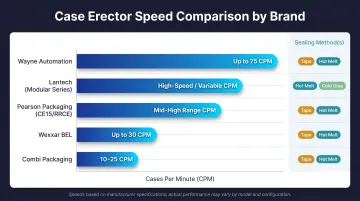
| Speed / Throughput | 15 CPM (BEL 505/615) to 30 CPM (BEL 625) |
| Case Size Range | 7.5-24" L × 5.5-15" W × 5.62-18" H (varies by model) |
| Sealing Method | Tape (DEKKA heads across product line) |
Lantech
Background: Kentucky-based Lantech brings over 50 years of end-of-line packaging expertise, offering the broadest case erector portfolio among brands reviewed. Their machines range from compact standard models to modular configurations specifically engineered for high-SKU fulfillment environments. Growing demand for modular automation drove a recent expansion of their Louisville manufacturing facility.
Differentiators: Lantech's key distinction lies in modular vs. standard configurations. Standard models (C300, C400) prioritize small footprints for lower-volume lines, while modular models (C1000, C2000, MFC series) support both tape and hot melt closure, handle random case sizes, and integrate into high-speed production lines. The proprietary LINC remote monitoring system provides real-time machine data visibility, event-based notifications, and predictive maintenance capabilities—giving multi-site operators a single view across all deployed machines. Lantech guarantees 24/7/365 technical support with an unlimited-cycle warranty.
| Feature | Specification |
|---|---|
| Configuration Options | Standard (single magazine), Modular (multiple magazines with minimal changeover), Compact Inline, Multi-Format |
| Monitoring Capability | LINC IoT platform with remote diagnostics, predictive maintenance, and real-time performance tracking |
| Closure Type | Tape (standard models); Tape or Hot Melt (modular, compact, and multi-format models) |
Pearson Packaging Systems
Background: Spokane, Washington-based Pearson Packaging Systems has built its 70-year reputation around end-of-line automation for e-commerce and distribution. Their equipment is designed from the ground up to fit into robotic pick-and-place systems and automated packing lines—not bolted on as an afterthought.
Differentiators: Pearson emphasizes integration-readiness as its core design priority. The CE15 model is explicitly PackML compliant—the industry standard for packaging machine communication—and uses Allen-Bradley CompactLogix PLC with OptixPanel 2800 Color HMI for straightforward line integration. Tool-free changeovers take approximately 5 minutes with HMI-guided graphical instructions. The RRCE (Random Robotic Case Erector) handles up to six different case sizes in a single cell, making it well-suited for high-SKU e-commerce operations. Secure VPN remote access enables off-site troubleshooting.
| Feature | Specification |
|---|---|
| Integration Capability | PackML compliant, Allen-Bradley CompactLogix PLC, standard Ethernet/Wi-Fi/cellular connectivity |
| Changeover Method | Tool-free with HMI graphical guidance, quick-release handles, approximately 5 minutes |
| Target Application | High-volume, mixed-SKU e-commerce fulfillment; optional stainless steel and low-pressure washdown for food/chemical environments |
Combi Packaging Systems
Background: Ohio-based Combi Packaging Systems (North Canton, OH) offers a full line of case forming, erecting, and sealing equipment serving 14+ industries including e-commerce, third-party logistics, food and beverage, and consumer goods. Their Midwest location provides geographic advantages for regional fulfillment operations requiring fast field service response.
Differentiators: Combi's strength lies in handling diverse case styles—including RSC, HSC, and die-cut formats—plus left-hand and right-hand cases on the same unit without reconfiguration. The Dual Magazine model erects two different case sizes without changeover, while the Robotic Case Erector handles up to eight case sizes on demand. Optional automatic changeover uses servo motion technology and brushless EC motors, storing case-size configurations in the HMI and automatically adjusting hold-down plate height, side belt width, and magazine carriage—reducing reliance on trained operators and making it practical for facilities with frequent staff changes.
| Feature | Specification |
|---|---|
| Supported Case Styles | RSC, HSC, die-cut formats; left-hand and right-hand cases on same unit |
| Throughput Range | 10-25 CPM across semi-automatic and fully automatic models |
| Geographic Support | North Canton, Ohio headquarters; regional service advantage for Midwest operations |
Wayne Automation
Background: Pennsylvania-based Wayne Automation focuses on high-speed, continuous-duty performance for demanding production environments. Their equipment serves large fulfillment centers, retail distribution, beverage, and industrial operations running multiple shifts with minimal downtime tolerance.
Differentiators: Wayne leads in maximum throughput capability—the flagship VCE model operates at up to 75 cases per minute, the highest speed among machines reviewed. All models feature MIG welded steel construction with Lexan doors for heavy-duty continuous operation. The 15/22 MOD B offers the widest sealing flexibility with tape, hot melt, and cold glue options, plus the broadest case style support (RSC, HSC, AFM, CSSC, Tablock). All Wayne erectors use Allen-Bradley CompactLogix PLCs with PanelView Color Touch Screen HMIs for standardized integration.
| Feature | Specification |
|---|---|
| Maximum Speed | Up to 75 CPM (VCE model); 35-40 CPM for standard models |
| Construction / Durability | MIG welded steel frame, Lexan doors, designed for 24/7 continuous-duty cycles |
| Sealing Options | Tape (Dekka), Hot Melt (Nordson), or Cold Glue; 15/22 MOD B supports all three |
How We Selected the Best Case Erectors for Fulfillment Centers
Selecting a case erector requires going beyond brand reputation. The biggest mistakes operators make include sizing machines to current volume rather than projected peak demand and overlooking changeover time when running multiple box sizes. Evaluation covered four dimensions:
Throughput and Scalability
Machines were evaluated on whether their cases-per-minute capacity could support high-volume fulfillment during peak seasons—not just average daily volume. Lantech identifies 600 cases per day as the general automation threshold; operations exceeding this on a single shift should prioritize fully automatic models. Modular or upgrade-compatible machines scored higher because they scale without full replacement.
Integration and Line Compatibility
Case erectors don't operate in isolation. Each machine was assessed on how well it communicates with conveyors, case sealers, labelers, and WMS software. PackML compliance (Pearson's CE15) and Allen-Bradley CompactLogix PLC compatibility (Wayne, Pearson, Lantech) enable seamless integration and future-proof line expansion. Match upstream/downstream belt heights and speeds during specification.
Total Cost of Ownership
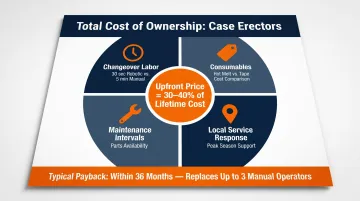
Upfront price represents only 30-40% of lifetime costs. Key factors include:
- Changeover labor: 30-second robotic vs. 5-minute manual tool changes
- Consumables: Hot melt costs 1/2 to 1/3 the price of tape per unit, though equipment investment is higher
- Maintenance intervals and parts availability
- Local service response time during peak season
Automated case erectors typically deliver payback within 36 months or less, replacing up to 3 manual operators per machine.
Working with a manufacturer-trained distributor reduces the risk of misspecifying equipment or facing extended downtime. John Maye Company serves fulfillment operations across the Midwest with factory-certified technicians, a 24-hour parts ship guarantee backed by 2,500+ SKUs, and a rental fleet built for seasonal surges.
Conclusion
The best case erector for your fulfillment center isn't simply the fastest or cheapest machine—it's the one that aligns with your peak volume requirements, case variety, available floor space, integration architecture, and long-term scalability strategy.
Before committing, evaluate ongoing performance needs, rental vs. purchase economics (especially for seasonal fulfillment surges), changeover frequency across your SKU mix, and the quality of local service and parts support.
A machine with a 5-minute changeover may cost less upfront, but if you're switching case sizes 20 times per shift, a robotic 30-second changeover model delivers measurably better ROI.
Fulfillment operations throughout Wisconsin and the broader Midwest can contact John Maye Company—a packaging equipment distributor with 40+ years in the industry, factory-certified technicians, an extensive rental fleet for seasonal surges, and a 24-hour parts ship guarantee—to get a direct recommendation matched to your operation's actual requirements.
Frequently Asked Questions
What does a case erector do?
A case erector takes flat corrugated blanks, automatically folds and forms them into open boxes, seals the bottom flaps via tape or hot melt glue, and delivers erected cases ready to be filled with product—replacing the manual box-assembly step on a packaging line.
What is the difference between a case former and a case erector?
These terms are used interchangeably across the industry—both refer to machines that form flat corrugated blanks into open cases. Some manufacturers use "case former" to describe machines handling non-standard or die-cut box styles, while "case erector" typically refers to RSC-style cases.
What is the difference between a semi-automatic and fully automatic case erector?
Semi-automatic models require an operator to manually feed and position the flat blank before the machine folds and seals the bottom. Fully automatic models handle the entire process—feeding, forming, folding, and sealing—with minimal human intervention. They're the standard choice for high-volume fulfillment environments running multiple shifts.
How fast can a case erector operate in a fulfillment center?
Throughput varies by model. Semi-automatic machines form cases at operator pace, while fully automatic models range from 10 to 75+ cases per minute depending on model and case size.
Should I buy or rent a case erector for my fulfillment center?
Purchasing makes sense for consistent, year-round fulfillment volume. Renting is cost-effective for seasonal demand spikes, short-term capacity increases, or operations evaluating automation before committing to a purchase—John Maye Company maintains a rental fleet built for exactly these situations.
Can a case erector be integrated with other packaging line equipment?
Most fully automatic case erectors are designed for line integration and can communicate with case sealers, conveyors, labelers, and palletizers via PLC interfaces. Proper integration requires matched belt heights, speeds, and control system compatibility between machines.