Introduction
In food processing, conveyor systems do more than move product — they determine whether a facility stays compliant, sanitary, and running on schedule. The wrong choice introduces contamination risk, regulatory violations, and unplanned production shutdowns. The right system becomes the operational backbone your facility depends on.
The stakes show up across every performance metric: ingredient throughput, microbial control between sanitation cycles, FSMA inspection readiness, and total cost of ownership over a 10-15 year service life.
For Midwest food processors navigating these decisions, knowing which conveyor types hold up under daily washdowns, pass regulatory scrutiny, and fit your specific layout is what separates a smart capital investment from a costly one.
This guide covers the five most effective conveyor systems for food processing environments, the features that separate compliant equipment from liability risks, and how to match conveyor specs to your facility's specific product types, layout constraints, and sanitation requirements.
Key Takeaways
- Conveyors move ingredients, in-process materials, and finished goods safely through every stage of food production
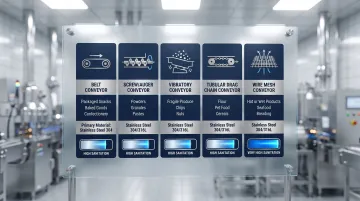
- Five conveyor types dominate food environments: belt, screw, vibratory, tubular drag chain, and wire mesh
- All systems must meet FDA, USDA, and FSMA requirements using cleanable, corrosion-resistant materials like 304 stainless steel
- Selection depends on product type, required sanitation level, facility layout, and throughput volume
- Partnering with a distributor experienced in food-grade equipment speeds procurement and reduces compliance risk
Why Conveyor Systems Are Critical in Food Processing Plants
Conveyors are the primary material handling infrastructure in food processing facilities. Every production stage depends on them:
- Moving raw materials into storage and staging areas
- Feeding batching, mixing, and processing lines
- Transferring finished product to packaging stations
- Routing packed goods to shipping and fulfillment
Each stage demands different system configurations, sanitation levels, and material contact requirements.
The Conveyor Equipment Manufacturers Association (CEMA) recognizes more than 80 types of conveyors specified by load capacity, rated speed, throughput, frame configuration, and drive location. The global food processing equipment market was valued at $56.79 billion in 2025, projected to reach $78.71 billion by 2033, underscoring the commercial scale of these operations.
Food-grade conveyors differ from standard industrial models in one critical area: mandatory compliance with sanitary design principles, including corrosion resistance, cleanability, and material contact requirements. Poor sanitation is one of the leading causes of FDA Form 483 observations, warning letters, and product recalls. That makes conveyor selection a direct food safety decision — not just an operational one.
Best Conveyors for Food Processing Plants
These five conveyor types cover the broadest range of food processing applications — chosen based on sanitation performance, regulatory compliance, operational versatility, and real-world maintenance demands.
Food-Grade Belt Conveyors
Belt conveyors are the most common choice in food processing due to their continuous smooth surface and broad compatibility with FDA-approved belt materials — including rubber, plastic, and stainless steel mesh. They handle horizontal and inclined orientations across nearly every product category.
Why they work in food processing:
- Available in wipe-down, washdown, and full hygienic configurations
- Support high-volume continuous throughput across diverse product types
- Extensive manufacturer support for replacement parts and custom widths
Leading manufacturers like Dorner offer AquaGard conveyors — the only USDA-certified conveyors in the industry, engineered to meet BISSC, 3-A, USDA, and FDA standards. Intralox belt materials (PP, PE, POM, PA66) comply with FDA regulations and EU Directives for food contact.
| Feature | Details |
|---|---|
| Ideal Food Applications | Raw produce transport, packaged goods, baked goods, proteins, bottling lines |
| Construction/Material | FDA-approved belt (rubber, plastic, or stainless); 304 stainless steel frame for washdown |
| Sanitation Level | Wipe-down to full hygienic — depends on configuration selected |
Screw / Auger Conveyors
Screw conveyors are the preferred choice for moving semi-solid and bulk dry materials — powders, granules, grains, and flakes. A rotating helical screw inside an enclosed tube or trough moves product efficiently with minimal spillage.
Key differentiators:
- Controlled agitation or blending during conveyance
- High-speed operation over long distances
- Split-tube designs simplify cleaning without specialized tools
- FDA/USDA compliance achievable with polished internal surfaces and continuous welds
CEMA provides engineering standards for screw conveyor design. Capacity ranges from 57 ft³/hr (4" diameter) to 18,440 ft³/hr (36" diameter) at 30% trough loading. Food-grade designs incorporate air-purged shaft seals, sanitary gaskets, and Ultra-Kleen bearings.
| Feature | Details |
|---|---|
| Ideal Food Applications | Flour, sugar, spices, pet food, grain, coffee, protein powders |
| Construction/Material | Stainless steel helical screw and housing; split-tube variants for easy access |
| Sanitation Level | High — enclosed design limits contamination; cleanable in place or with disassembly |
Vibratory Conveyors
Vibratory conveyors excel in applications requiring frequent washdown cycles and minimal residue buildup — using controlled vibration to move product along a trough with no moving parts in contact with food material beyond the trough surface itself.
Food-grade advantages:
- Low maintenance due to absence of belts or chains
- Fast and thorough sanitation between product runs
- Suitable for fragile or sticky food products that could be damaged or adhere to belt surfaces
GEA Scan-Vibro systems meet EHEDG and USDA Dairy 3-A standards, with CIP-nozzle mounting options for automated cleaning. Product never contacts bearings, augers, or seals — eliminating the primary contamination and degradation pathways entirely.
| Feature | Details |
|---|---|
| Ideal Food Applications | Snack foods, frozen vegetables, coated or seasoned products, produce |
| Construction/Material | Stainless steel trough; no belt or chain components in the product zone |
| Sanitation Level | Very high — open trough design allows thorough washdown and visual inspection |
Tubular Drag Chain Conveyors
Tubular drag chain conveyors are preferred for facilities handling fragile, blended, or contamination-sensitive products. Material moves through a fully enclosed tube via evenly spaced discs on a chain or cable, preventing dust, spillage, and cross-contamination throughout the run.
Key differentiators:
- Route around obstacles and through tight layouts using steep inclines without material separation
- Support in-place wet and dry cleaning protocols
- Gentle product handling minimizes breakage compared to screw conveyors
Cable-type tubular drag conveyors use sealed nylon-jacketed cables preventing debris accumulation, offering shorter cleaning cycle times and more thorough sanitation than chain systems. They use up to 10 times less energy than pneumatic conveyors.
| Feature | Details |
|---|---|
| Ideal Food Applications | Pet food, coffee beans, nuts, seasoned snacks, fragile coated products |
| Construction/Material | Enclosed stainless steel tube; cable or chain-driven discs; no exposed moving parts |
| Sanitation Level | Very high — dust-free enclosed system; supports CIP (clean-in-place) protocols |
Wire Mesh Belt Conveyors
Wire mesh belt conveyors are ideal for applications requiring drainage, airflow, or visibility through the belt surface — commonly used in cooking, cooling, freezing, frying, and inspection lines where temperature extremes or liquid runoff are factors.
Where they stand out:
- Resistance to both high and low temperature extremes
- Open mesh construction allows steam, air, and water to pass through for thermal processing
- Easy visual inspection of product condition
- Available in custom widths and speeds
Metal conveyor belts handle temperatures from -50°C to 1,200°C depending on alloy and application. Both 304 and 316 stainless steel grades are approved for food contact under FDA regulations and NSF/ANSI 51.
| Feature | Details |
|---|---|
| Ideal Food Applications | Baking, frying, freezing/chilling, washing, dewatering, inspection lines |
| Construction/Material | Stainless steel wire mesh; all-stainless frame suitable for full washdown |
| Sanitation Level | High — open mesh facilitates thorough cleaning; meets FDA sanitary design standards |
Key Features to Look for in a Food-Grade Conveyor System
Sanitation and Cleanability
The single most important design criterion is cleanability. Conveyors must minimize product buildup points, support the required cleanup method (wipe-down, washdown, or hygienic/CIP), and use materials that do not harbor bacteria.
Stainless steel grades — typically 304 — are the industry standard for surfaces in direct food contact. 3-A Sanitary Standards specify a surface finish of 32 Ra micro-inch (0.8 Ra micrometer) or better to prevent bacterial adhesion.
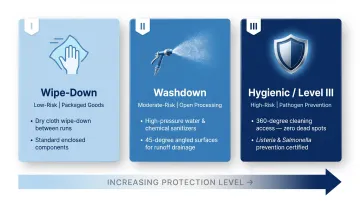
Sanitation configurations include:
- Wipe-down: For packaged goods with lower contamination risk
- Washdown: Engineered to withstand pressure washing and chemical sanitizers with minimum 45-degree angled surfaces to prevent pooling
- Hygienic/Level III: Eliminates all dead spots where Listeria or Salmonella can colonize; requires 360-degree cleaning access
Regulatory Compliance
Food-grade conveyors must meet specific standards. Non-compliant equipment can trigger costly production shutdowns and legal liability.
Required certifications:
- FDA food contact regulations: 21 CFR Part 177 (polymers), 21 CFR 177.2600 (rubber articles), 21 CFR 178.3570 (lubricants)
- USDA 3-A Sanitary Standards: Gold standard for dairy, ready-to-eat foods, and high-moisture processing; currently Standard 41-03 covers mechanical conveyors for dry products
- FSMA requirements: 21 CFR Part 117 mandates written food safety plans including sanitation controls and preventive measures
- BISSC certification: ANSI/ASB/Z50.2-2013 applies to bakery equipment
In 2024, U.S. food recalls cost the industry $1.92 billion in direct recall expenses, with poor sanitation among the leading root causes.
Material Compatibility and Product Type
Conveyor selection must account for whether the food product is dry bulk, wet/liquid, frozen, fragile, sticky, or temperature-sensitive. Each property changes belt material, trough design, incline limitations, and required sealing.
Examples:
- Fragile products (nuts, cereal) require tubular drag chain or vibratory systems
- Sticky seasonings benefit from vibratory or wire mesh designs
- Frozen goods need thermal-resistant wire mesh or specialized belt materials
- Bulk powders perform best with enclosed screw or tubular drag systems
Durability and Total Cost of Ownership
Material selection drives upfront cost significantly. Food-grade conveyors — particularly stainless steel systems — are 50-100% more expensive than standard industrial conveyors, with 304 stainless steel running approximately $1,800–2,500/ton versus $600–800/ton for carbon steel.
Lower maintenance costs, longer service life, and compliance assurance offset that premium. When calculating total cost of ownership, weigh:
- Mean time between failures
- Parts availability and lead times
- Ease and frequency of routine sanitation
Layout Flexibility and Integration
Food processing plants often have complex floor layouts requiring conveyors that navigate inclines, tight curves, or multi-level transfers without product loss. Modular or custom-configurable systems reduce retrofitting costs when production lines change.
Prioritize systems that support:
- Tool-less disassembly for faster sanitation cycles
- Adjustable speeds for variable throughput
- Integration with existing SCADA or control systems
- Quick-change configurations to minimize changeover downtime
How We Chose the Best Conveyors for Food Processing Plants
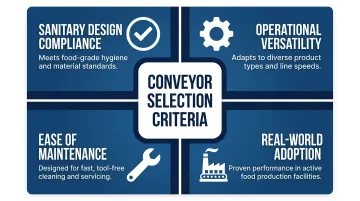
This list was evaluated against four criteria, each chosen to reflect what actually matters on a food processing line:
- Sanitary design compliance — meets food-grade material and cleanability standards
- Operational versatility — performs across common processing stages, not just one application
- Ease of maintenance — minimizes downtime during cleaning and servicing
- Real-world adoption — proven use in food and beverage manufacturing facilities
Common mistakes food plant operators make:
- Prioritizing upfront cost over total cost of ownership
- Overlooking sanitation ratings when purchasing "standard" stainless steel units (not all stainless meets food-grade requirements)
- Selecting a conveyor built for a specific product type without accounting for future line changes
For Midwest food processing facilities, John Maye Company brings 40+ years of packaging equipment expertise and manufacturer-trained technicians who can match conveyor specs to your compliance requirements, facility layout, and throughput targets — before you commit to a purchase.
Conclusion
The right conveyor for a food processing plant depends on the product being handled, sanitation requirements, regulatory obligations, and the specific demands of each production stage. No single system works for every application.
Before committing to a system or supplier, weigh these factors alongside initial purchase cost:
- Long-term performance under your production volume
- Ease of cleaning and compliance with sanitation protocols
- Parts availability and lead times for critical components
- Scalability as output demands grow
A system that saves $15,000 upfront but adds three sanitation hours daily — or fails a USDA inspection — will cost far more over a 12-month period.
When those trade-offs get complex, working with a distributor who knows food-grade equipment helps narrow the options quickly. Food processors in Wisconsin and across the Midwest can contact John Maye Company for guidance on sourcing conveyor systems that fit their production goals — backed by 40+ years of equipment expertise and a 24-hour ship guarantee on in-stock parts.
Frequently Asked Questions
What conveyors are used in the food industry?
The most common types are belt, screw, vibratory, tubular drag chain, and wire mesh conveyors. Selection depends on product characteristics (bulk, fragile, wet, frozen), sanitation requirements, and the specific stage of the processing line.
What is the grocery conveyor belt called?
In retail grocery settings, the checkout belt is typically called a POS or checkout conveyor belt. In food processing plants, the equivalent product-movement systems are known as food-grade or sanitary belt conveyors.
What material should food-grade conveyor systems be made from?
304 stainless steel is the industry standard for food-contact surfaces. FDA-approved belt materials include rubber (21 CFR 177.2600), plastic polymers (21 CFR Part 177), and wire mesh — with powder-coated carbon steel frames acceptable for non-contact components in lower-risk applications.
What regulations must food processing conveyor systems meet?
FDA food contact regulations (21 CFR Parts 174, 177, 178), USDA 3-A Sanitary Standards, FSMA requirements (21 CFR Part 117), and BISSC certification (for bakery equipment). Non-compliant equipment can result in production shutdowns or product recalls.
What is the difference between washdown and hygienic conveyor ratings?
Washdown conveyors use stainless steel frames with stitch welds and NEMA-4X rated drives, suitable for pressure washing. Hygienic/sanitary conveyors use continuously welded frames, fully stainless drives, ground/polished welds, and IP69K ratings for the highest level of contamination prevention.
How do I choose the right conveyor for my food processing plant?
Assess product type, texture, and moisture level alongside required sanitation grade, facility layout, throughput volume, and applicable regulations. Matching all these factors to the right conveyor type upfront avoids costly retrofits and keeps your line compliant from day one.