Introduction
Steel fabricators handle some of the heaviest, harshest material flows in manufacturing — abrasive scrap, sharp offcuts, oily metal chips, and multi-ton structural components. These conditions quickly destroy standard conveyors not engineered for the job.
Choosing the wrong conveyor in a steel fabrication environment leads to frequent breakdowns, unsafe working conditions, and bottlenecked production. Unplanned downtime costs manufacturers a minimum of $10,000 per hour, with 44% of industrial leaders experiencing equipment-related interruptions at least monthly. The right conveyor system cuts manual material handling, protects throughput, and keeps production lines moving.
Key Takeaways
- Steel fabricators require conveyors purpose-built for high loads, abrasive scrap, and harsh shop-floor conditions
- Key conveyor types include heavy-duty roller systems, chip/scrap conveyors, magnetic conveyors, and precision belt systems
- Top brands include Hytrol, Jorgensen Conveyors, Dorner, Magnetic Products Inc. (MPI), and Ultimation Industries
- Critical selection criteria: load capacity, IP65+ motor protection, sealed bearings, and modular reconfigurability
- Distributors with deep in-stock inventory and fast shipping — like John Maye Company's 2,500+ SKU catalog with 24-hour ship guarantee — cut lead times significantly for Midwest fabricators
Why Steel Fabricators Need Specialized Conveyors
Steel fabrication introduces unique conveyor stressors that rule out standard warehouse-grade systems entirely:
Environmental Hazards:
- Metal chips and cutting coolant from CNC operations
- Heavy weldments, plate stock, and structural components
- Heat from cutting and welding processes
- Sharp edges that tear standard belts and damage rollers
Operational Costs of the Wrong Conveyor
Fabricated metal manufacturing injury rates exceed the national average at 3.5 incidents per 100 workers versus 2.3 for private industry overall. Manual material handling workarounds contribute directly to these statistics.
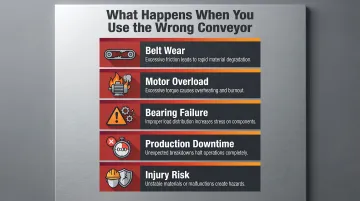
Those workarounds exist because under-specified conveyors fail to keep up — and the mechanical consequences compound quickly:
- Accelerated belt wear from metal chip abrasion
- Motor overload from exceeding load ratings
- Bearing contamination causing premature failure
- Excessive maintenance downtime halting production
- Ergonomic injury risks from manual material handling
Choosing the right conveyor means looking specifically for reinforced frames, sealed bearings, and abrasion-resistant components built for metalworking — not adapted from warehouse applications.
Best Conveyors for Steel Fabricators
The five conveyor systems below cover the full range of steel fabrication material handling — from raw stock staging and chip removal to finished part inspection and scrap transport. Each was selected based on demonstrated performance in metal fabrication environments, load specifications, configuration flexibility, and industry reputation.
Hytrol Conveyor Co. — Heavy-Duty Roller Conveyors
Hytrol is one of the largest conveyor manufacturers in North America, offering robust belt and roller conveyors engineered for demanding manufacturing environments. Founded in 1947 in West Allis, Wisconsin and now headquartered in Jonesboro, Arkansas, the company employs 1,600+ people across two facilities totaling nearly 1 million square feet.
Built for Heavy Production Lines:
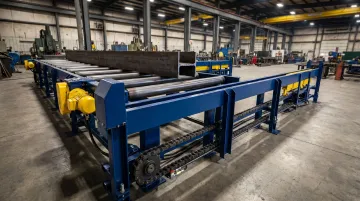
Hytrol's heavy-duty roller conveyors feature steel frame construction rated for high unit loads and modular layouts that integrate with existing production lines. A nationwide distributor network keeps parts readily available. Their sealed, pre-lubricated ball bearings reduce maintenance frequency in contaminated shop environments.
Specifications:
| Feature | Hytrol 25-CRR Heavy-Duty Roller |
|---|---|
| Load Capacity | 300 lbs/ft (10 ft centers); 1,000 lbs/ft (5 ft centers) |
| Key Configurations | Powered roller, belt-over-roller, zero-pressure accumulation, incline/decline |
| Best Use in Steel Fab | Moving finished weldments, steel plate assemblies, and structural components between stations |
The 25-CRR chain-driven live roller conveyor uses 2.5-inch diameter rollers with 4-gauge powder-coated steel frames, supporting substantial loads common in steel fabrication workflows.
Jorgensen Conveyors — Chip and Scrap Conveyors
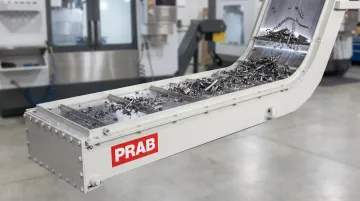
Jorgensen Conveyors, celebrating 75 years of operation in Mequon, Wisconsin, specializes in industrial chip conveyors and magnetic chip conveyors purpose-built for CNC machining, stamping, and metal cutting operations. The employee-owned, ISO 9001:2015 certified manufacturer engineers systems specifically for steel fabricators managing high-volume metal chip and coolant waste.
Hinged Steel Belt That Won't Clog:
The hinged steel belt design handles wet chips, dry chips, and coolant simultaneously — resisting the clogging and jamming that shuts down standard belt conveyors. Custom engineering accommodates unusual floor layouts and tight space constraints.
Specifications:
| Feature | Jorgensen Chip Conveyors |
|---|---|
| Belt Material | Hinged steel belt (carbon steel standard; stainless available) |
| Coolant Handling | Integrated FlexFiltration systems and coolant return capabilities |
| Best Use in Steel Fab | CNC plasma, laser, or saw cut chip removal; scrap collection beneath press brakes and punching machines |
Jorgensen engineers assess each application based on cutting process, chip geometry and volume, coolant flow rate, and space constraints to deliver fully automated chip-to-recycling workflows.
Dorner Manufacturing — Precision Belt Conveyors
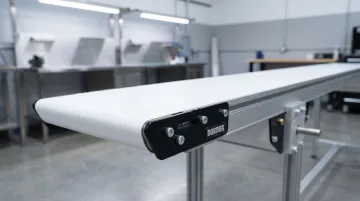
Dorner Manufacturing, headquartered in Hartland, Wisconsin since 1966, produces precision, low-profile belt conveyors for the finishing, inspection, and packaging stages of steel fabrication. Their systems prioritize dimensional accuracy and smooth part transfer over brute load capacity.
Modular Design, Low Maintenance:
The 2200/3200 Series conveyors offer modular aluminum T-slot framing, sealed-for-life bearings, and customizable widths and lengths. Rack and pinion belt tensioning simplifies maintenance and keeps reconfiguration straightforward when production layouts shift.
Specifications:
| Feature | Dorner 2200 Series | Dorner 3200 Series |
|---|---|---|
| Belt Width Range | 1.75″ to 24″ | 3.75″ to 48″ |
| Drive Options | End drive, center drive, common drive | End drive, center drive, iDrive |
| Speed Capacity | Up to 264 ft/min | Up to 600 ft/min |
| Load Capacity | 80 lbs (lift gate) | Up to 1,000 lbs |
| Best Use in Steel Fab | Finished part inspection lines, small component sorting, pre-packaging transfer |
Dorner specifically targets metal working operations with the 2200 Series, making it a direct fit for steel fabrication finishing lines.
Magnetic Products Inc. (MPI) — Magnetic Conveyor Systems
MPI, based in Highland, Michigan, manufactures magnetic conveyor systems engineered to handle ferrous metal scrap, stamped parts, and fine metal chips. Their systems solve a problem belt and roller conveyors cannot: securely transporting loose ferrous materials on inclines, overhead, or through contaminated environments without spillage.
Magnetic Control on Any Angle:
Rare earth and ceramic magnetic circuits embedded in the conveyor belt hold steel parts and chips firmly even at steep inclines. Systems feed directly into scrap bins or recycling equipment, cutting manual scrap handling labor without additional process steps.
Specifications:
| Feature | MPI Beltless Magnetic Conveyor (Series BLM) |
|---|---|
| Magnetic Force Options | Ceramic (standard); rare earth as required |
| Conveyor Orientations | 0 to 90 degrees (horizontal, inclined, overhead/inverted) |
| Slider Bed Material | Stainless steel, min 12 gauge; liquid-tight sealed housing |
| Standard Speed | 45 FPM |
| Best Use in Steel Fab | Ferrous chip removal from cutting tables, conveying stamped blanks, scrap metal transport to collection hoppers |
MPI's beltless magnetic conveyors can be totally submerged in machine reservoir tanks, with no external moving parts except the drive motor assembly.
Ultimation Industries — Modular Gravity and Powered Roller Conveyors
Ultimation Industries, a Michigan-based manufacturer and distributor, offers modular, competitively priced gravity roller and powered roller conveyors. Their systems give small-to-mid-size steel fabrication shops an accessible way to reduce manual material handling without large capital investment.
Fast Ship, Easy Reconfigure:
Systems ship from stock — same-day availability for orders placed by 3:00 PM Eastern — and are designed for straightforward installation. Modular sections reconfigure as production needs change, making Ultimation a better fit for growing shops than rigid, custom-engineered alternatives.
Specifications:
| Feature | Ultimation RS25 Heavy-Duty Gravity Roller |
|---|---|
| Roller Material/Diameter | 2.5″ zinc-plated steel rollers on 11/16″ hex axles |
| Frame Material | 8-gauge powder-coated steel (4″ tall x 1.5″ flange) |
| Load Capacity | 373 lbs per roller; 5,000 lbs per 5 ft section (3″ or 4.5″ centers) |
| Best Use in Steel Fab | Incoming material staging, inter-station transfer of tube/bar/plate stock, finished goods staging at shipping dock |
Ultimation's heavy-duty rollers feature grease-packed ball bearings at both ends, with pre-punched frame centers at 3″, 4.5″, and 6″ spacing for flexible configuration.
Key Features to Look for in a Steel Fabrication Conveyor
Load Rating and Frame Durability
Conveyors in steel fabrication must be rated well above the heaviest single component in the workflow. Undersizing load ratings is the most common purchasing mistake.
When sizing a conveyor, identify the maximum single-unit or distributed load it will carry — then verify the rating covers surge loads and dynamic stresses, not just static weight. Manufacturers' published ratings incorporate engineering safety factors, but real-world metalworking adds impact and vibration that static specs don't capture.
Frame material matters just as much as load rating:
- Welded steel frames outperform aluminum in metalworking environments
- Hytrol's 4-gauge steel frames handle heavy, repetitive loading without flex
- Ultimation's 8-gauge construction provides structural integrity for long-term reliability
Resistance to Chips, Coolant, and Abrasion
Metal chips, cutting fluid, and weld spatter penetrate and destroy bearings, belts, and drive components not specifically rated for this environment.
Critical specifications:
IP65 minimum for motors — IEC 60529 defines IP65 as dust-tight with protection against low-pressure water jets from any direction. IP66 is recommended for heavy coolant splashing. IP67 supports temporary immersion for flood coolant applications.
Sealed bearings — SKF documents that sealed bearings prevent contaminant ingress (dust, moisture, debris, process fluids) in rolling mills and conveyors. They reduce relubrication frequency, extend service life, and reduce unplanned downtime. Hytrol, Dorner, and Ultimation all specify sealed bearings as standard.
Chip-resistant belt materials — Jorgensen's hinged steel belts resist puncture and abrasion. MPI's stainless steel slider beds handle high-impact, abrasive metal scrap without wear.
Maintenance Accessibility and Parts Availability
Conveyor downtime in a steel fab shop directly halts production. Prioritize systems with:
- Accessible drive components for rapid inspection
- Tool-free or minimal-tool belt tensioning (Dorner's rack and pinion system)
- Distributors stocking local spare parts
Midwest fabricators benefit from working with regional distributors like John Maye Company (Waukesha, WI), which maintains 2,500+ SKUs in inventory and guarantees 24-hour shipping on conveyor components. That means same-day sourcing instead of waiting days for parts to ship from distant warehouses — a meaningful difference when a line is down.
Modularity and Reconfigurability
Steel fabrication workflows change constantly — new equipment arrives, product lines shift, floor layouts get rearranged. Conveyors built on modular frames adapt to those changes without requiring a full replacement.
Several systems are designed with this in mind:
- Ultimation: Bolt-together 5-foot and 10-foot sections that extend or reroute without specialized tools
- Dorner: T-slot aluminum framing that accommodates accessories and layout changes
- Hytrol: Modular roller sections that integrate with existing line configurations
Choosing a modular system from the start protects the capital investment when operations scale or shift direction.
How We Chose the Best Conveyors for Steel Fabricators
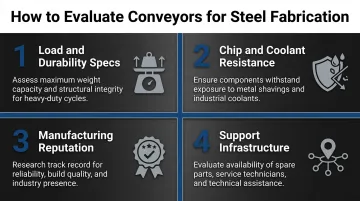
Steel fabrication is harder on conveyor equipment than almost any other industrial environment. We assessed each brand and system on four criteria that reflect those real-world demands:
- Published load and durability specifications appropriate for metalworking environments (1,000 lbs/ft capacity, sealed bearings, IP65+ motors)
- Availability of chip-, coolant-, and abrasion-resistant configurations (hinged steel belts, magnetic systems, sealed housings)
- Established manufacturing reputation with verifiable industry presence in metal fabrication applications (ISO certifications, industry memberships like CEMA, documented metalworking focus)
- Support infrastructure accessible to Midwest fabricators (distributor networks, parts availability, technical service)
Meeting these criteria matters most when buyers approach the purchase with the right mindset — and the most common mistake undermines even good vendor choices.
That mistake is selecting conveyors based on price per foot rather than total cost of ownership. Cheap conveyors in steel fabrication fail fast, driving up replacement cycles and labor costs that quickly wipe out any upfront savings. With 44% of manufacturers experiencing monthly equipment disruptions, a single $10,000/hour production stoppage from conveyor failure dwarfs whatever you saved at the point of purchase.
Conclusion
The right conveyor for a steel fabricator is not one-size-fits-all. Chip conveyors, magnetic systems, heavy-duty roller lines, and precision belt conveyors each serve distinct roles. The best operations match each conveyor type to its specific application — mixing and pairing systems where the work demands it.
Getting that match right often requires working with someone who knows both the equipment and the environment. Steel fabricators in Wisconsin and across the Midwest can contact John Maye Company (Waukesha, WI) to source, configure, or upgrade conveyor systems. With 40+ years of material handling expertise and manufacturer-trained technicians, they provide guidance matched to your specific production needs.
Frequently Asked Questions
What type of conveyor is best for removing metal chips and coolant in a CNC steel fabrication shop?
Hinged steel belt chip conveyors (like those from Jorgensen) are purpose-built for this application, handling wet and dry chips simultaneously while routing coolant back for recovery. They outperform standard belt conveyors by resisting clogging and jamming in continuous-duty metalworking environments.
Can standard warehouse conveyors be used in a steel fabrication facility?
Standard warehouse conveyors are typically under-rated for the load, abrasion, and contamination conditions in steel fabrication. Using them risks accelerated belt wear, bearing failure, and motor overload. Steel-fab-rated systems are built to handle abrasive, contaminated environments with sealed bearings and reinforced frames sized for the actual duty cycle.
What is a magnetic conveyor and when should a steel fabricator use one?
Magnetic conveyors use embedded permanent magnets to hold ferrous metal chips, blanks, or parts against the belt surface. They're ideal for inclined scrap removal, overhead part transfer, or any application where loose ferrous materials need to be moved without spillage or contamination carryover.
How do I determine the right load capacity for a conveyor in my fabrication shop?
Identify the heaviest single unit or maximum distributed load the conveyor will carry, then verify the manufacturer's rated capacity covers that load with at least a 20-25% safety factor. Dynamic surge loads — common in high-volume fab shops — can exceed static ratings, so review peak throughput scenarios, not just average loads, before finalizing specs.
How often do industrial conveyors in steel fabrication environments need maintenance?
Maintenance frequency depends on duty cycle and chip/coolant exposure. Sealed bearings, chip-shedding belt designs, and proper tensioning significantly extend service intervals — many heavy-duty chip conveyor systems run 500+ hours between scheduled inspections under normal fab shop conditions.
Can conveyor systems be customized for non-standard floor layouts in a fabrication shop?
Most industrial conveyor manufacturers offer custom frame lengths, curved sections, elevation changes, and integrated guarding. A local distributor or application engineer can take your floor plan and build a spec that works around existing equipment, columns, and workflow paths without requiring a facility redesign.