Introduction
Beverage bottlers face a real packaging challenge: balancing high-volume output demands with the need for tamper-evident, shelf-ready presentation across multipacks. When production lines run at thousands of bottles per hour, even a 10-minute shrink wrapper bottleneck translates to hundreds of lost units and missed shipment windows. The right shrink wrap machine directly impacts production uptime and cost-per-unit—the wrong choice drives up cost-per-unit and stalls throughput.
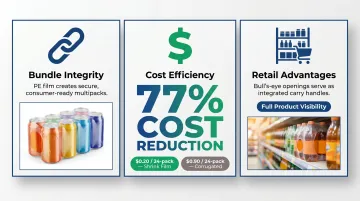
Shrink wrapping has become the dominant secondary packaging method for bottled beverages—water, juice, beer, and carbonated drinks. Three factors explain why:
- Bundle integrity: PE shrink film creates secure, consumer-ready multipacks that hold up through distribution handling
- Cost efficiency: At roughly $0.20 per 24-pack versus $0.90 for corrugated alternatives, shrink film cuts material costs by 77%
- Retail advantages: Multipacks with bulls-eye openings double as integrated handles and show off the product better than closed cardboard cartons
Key Takeaways
- Shrink wrap machines bundle beverage bottles into retail-ready multipacks using heat-shrinkable film after labeling and before palletizing
- Core machine types include semi-automatic L-bar sealers, fully automatic bundlers, sleeve wrappers, and tray-plus-film systems
- Top beverage-grade brands include Texwrap, ARPAC Group, Shanklin, and Kallfass — each built for high-throughput, multi-format production
- Match throughput to your filling line speed and confirm PE/POF film compatibility before selecting a machine
- John Maye Company has supplied Midwest beverage operations with industrial shrink wrap equipment and factory-certified service since 1983
Overview of Shrink Wrap Machines in the Beverage Bottling Industry
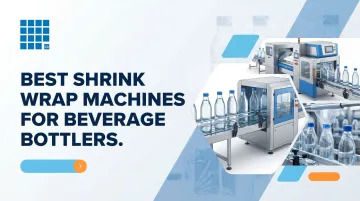
A shrink wrap machine in beverage production sits between labeling and palletizing, performing four critical functions: grouping bottles (typically 6, 12, or 24 packs), enveloping them in heat-shrinkable film, passing bundles through a heat tunnel, and producing secure, shelf-ready multipacks. The machine replaces manual bundling, eliminates cardboard carton assembly, and runs continuously with upstream filling equipment.
Shrink wrapping is now the industry standard across PET, glass, and aluminum container formats. The global shrink films market reached $5.1 billion in 2025 and projects to $7.4 billion by 2034 at 4.3% CAGR, with food and beverage generating maximum demand. This growth reflects widespread adoption: 68% of beverage companies anticipate moderate to significant packaging machinery investments over the next two to three years, with nearly 90% planning new equipment purchases.
Machine selection is not one-size-fits-all. The right equipment depends on three variables that vary significantly across operations:
- Throughput requirements: A mid-scale juice bottler running 60 bottles per minute needs fundamentally different equipment than a high-speed water plant pushing 135+ packs per minute.
- Container material: Glass requires gentler handling and slower conveyor speeds than lightweight PET.
- Format flexibility: Single-SKU lines can optimize purely for speed, while multi-format lines need quick-changeover tooling to minimize downtime between 500ml and 2L bottle runs.
Best Shrink Wrap Machines for Beverage Bottlers
These machines were selected based on throughput capability, proven beverage-industry adoption, film flexibility, automation level, and integration compatibility with existing bottling lines.
SOCO System
Background: SOCO System is a European packaging machinery manufacturer with worldwide distribution, including a dedicated US presence. John Maye Company serves as the regional leader for SOCO System across the Midwest, providing local sales, installation, and factory-certified service—a critical advantage for Wisconsin, Ohio, and Illinois beverage bottlers requiring rapid parts access and minimal downtime response.
Differentiators: SOCO System equipment emphasizes end-of-line efficiency through modular design and intelligent automation. Key advantages include:
- Modular design lets bottlers start semi-automatic and upgrade to fully automatic as production grows
- PLC-based controls reduce operator training time during onboarding and format changes
- FDA-compliant stainless steel options meet food-grade requirements for direct beverage contact
| Feature | Details |
|---|---|
| Machine Type | Semi-automatic and fully automatic case sealing/erecting systems with shrink wrap integration capability |
| Speed / Throughput | Semi-automatic: up to 10 packs/min; Fully automatic: up to 3,000 packs/hour (50 packs/min) depending on model |
| Best Suited For | Mid-volume beverage operations requiring flexible multi-format capability and regional Midwest service support |
Regional Service Advantage: John Maye Company stocks SOCO System replacement parts at their Waukesha, Wisconsin distribution center, offering 24-hour ship guarantee and 24-hour service response times. This infrastructure eliminates multi-day waits for components shipped from overseas suppliers—a common pain point for European-manufactured equipment.
ARPAC Group
Background: ARPAC Group operates as a brand within nVenia, which is a Duravant company headquartered in Wood Dale, Illinois. ARPAC shrink bundlers and tray wrappers are widely adopted across North American food, beverage, and consumer goods operations, with particular strength in continuous-motion systems designed for 24/7 beverage production environments.
Differentiators: The BrandPac BPTW series targets medium-to-high volume food and beverage lines with features built for continuous uptime:
- Bottom-overlap film sealing eliminates seal bars, cutting routine maintenance
- On-demand operation removes warm-up cycles, reducing energy use and startup delays
- Intralox conveyor belts prevent tracking issues on wet beverage plant floors
| Feature | Details |
|---|---|
| Machine Type | Continuous motion shrink bundlers and tray wrappers with Allen-Bradley PLC controls |
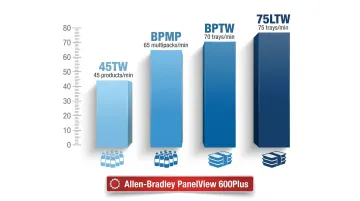
| Speed / Throughput | 45TW: 45 products/min; BPMP: 65 multipacks/min; BPTW: 70 trays/min; 75LTW: 75 trays/min |
| Best Suited For | High-volume water, sports drinks, and carbonated beverage multipacks requiring 24/7 uptime |
Control Platform: All ARPAC models use Allen-Bradley PanelView 600Plus operator interfaces with color touchscreen, self-diagnostics, and digital controls for fast setup during product changeovers—critical when switching between 12-pack and 24-pack formats mid-shift.
Shanklin (by Sealed Air)
Background: Shanklin Corporation operates as a subsidiary of Sealed Air Corporation, bringing over 50 years of North American shrink wrap expertise and global distribution infrastructure. Shanklin's integration into Sealed Air creates a single-source advantage for beverage plants buying both film and equipment, simplifying film-machine optimization and consolidating warranty support.
Differentiators: Shanklin horizontal form-fill-seal (HFFS) wrappers are built for premium beverage applications:
- Compatible with all Shanklin commercial shrink films: PE, polyolefin, and PVC
- Microprocessor controls auto-adjust sealing timing and temperature, reducing operator intervention
- USDA-approved models available for juice and dairy beverage operations
- Dual-chamber tunnels deliver precise airflow for irregularly shaped bottles or cosmetic-quality retail packs
| Feature | Details |
|---|---|
| Machine Type | Automatic L-bar sealers with HFFS capability and single/dual chamber shrink tunnels |
| Speed / Throughput | Up to 35 packages per minute (L-bar models); higher speeds available in HFFS continuous-motion configurations |
| Best Suited For | Premium bottled water, wine, juice, and specialty beverage brands prioritizing clean seal aesthetics and film-machine optimization |
Film Compatibility: Shanklin's variable-speed drives and programmable controls accommodate film gauge ranges from 60-100 micron PE to 15-25 micron POF, allowing single machines to handle both heavy-duty transit packs and retail-display multipacks without equipment changes.
Texwrap (by Pro Mach)
Background: Texwrap is a Pro Mach brand operating within the Robotics & End of Line business unit, headquartered in Washington, Missouri. Integration into Pro Mach's larger packaging ecosystem provides access to coordinated service networks, standardized PLC platforms, and cross-equipment troubleshooting expertise—valuable for beverage plants running multiple Pro Mach brands.
Differentiators: The OVS Series addresses three common challenges on glass and high-speed bottle lines:
- Patented orbital motion seal head keeps bottles upright throughout wrapping, eliminating tipping risk on glass lines
- Independent conveyor controls allow relaxed film at the cross-seal point, enabling minimum-gauge film that reduces material cost
- Print registration supports branded shrink film with consistent logo placement accuracy
| Feature | Details |
|---|---|
| Machine Type | Orbital continuous motion vertical wrappers (OVS Series) and continuous motion dual-roll bundlers |
| Speed / Throughput | OVS Series: up to 135 cycles/min at 200 FPM film speed; Kayat SRX single roll: up to 60 cycles/min |
| Best Suited For | Glass bottle operations (wine, premium spirits, juice), high-speed can lines, and multi-format operations requiring gentle product handling |
Glass Bottle Handling: The OVS Series' 5-axis servo control maintains vertical bottle orientation throughout the wrap cycle, preventing label misalignment and breakage—critical for heavy glass multipacks where horizontal handling creates stress fractures.
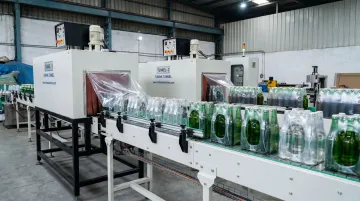
Kallfass
Background: Kallfass Verpackungsmaschinen GmbH is a German packaging machinery manufacturer with over 50 years of experience and a US presence via kallfass-us.com. The company serves mid-to-large beverage and industrial bottling operations globally, with particular adoption in European brewery and mineral water markets requiring precision and multi-shift durability.
Differentiators: Kallfass systems emphasize build quality through servo-driven sealing, automatic film control, and adjustable temperature/airflow heat tunnels optimized for consistent performance across 24/7 production schedules. Unique among reviewed OEMs, Kallfass lists compatibility with PLA (bio-based) shrink films alongside PE and polyolefin—relevant for sustainability-focused beverage brands exploring compostable packaging alternatives.
| Feature | Details |
|---|---|
| Machine Type | Fully automatic sleeve wrappers, L-sealers, and side sealers (intermittent and continuous motion) with integrated shrink tunnels |
| Speed / Throughput | Built for continuous, multi-shift production; specific throughput figures vary by model and require direct consultation |
| Best Suited For | High-output water and beer bottling plants, multi-format operations handling PET/glass/cans, and sustainability-driven brands requiring PLA film compatibility |
Multi-Format Capability: Kallfass blog guidance emphasizes conveyor speed as the key variable when switching between PET (lighter, heat-sensitive) and glass (heavier, heat-tolerant) formats—faster speeds reduce tunnel dwell time for delicate PET, slower speeds allow complete shrink for heavy glass multipacks.
How We Chose the Best Shrink Wrap Machines for Beverage Bottlers
Throughput and Line Synchronization
The most common mistake beverage bottlers make is selecting a shrink wrapper based on upfront cost alone, ignoring throughput compatibility with their filling line. A $30,000 machine that runs 45 packs per minute creates a permanent bottleneck for a 70 bottles-per-minute filling line, forcing constant upstream slowdowns or costly buffer accumulation zones.
Match machine class to line speed requirements:
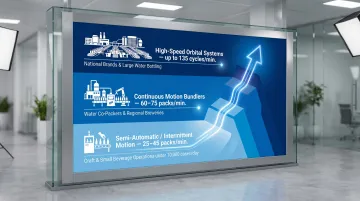
- Semi-automatic/intermittent motion runs 25-45 products per minute, suitable for craft beverage operations under 10,000 cases per day
- Continuous motion bundlers reach 60-75 packs per minute, covering mid-volume operations like water co-packers and regional breweries
- High-speed orbital systems hit up to 135 cycles per minute, required for large-scale water bottling and national beverage brands
PMMI research shows 51% of beverage companies are actively investing in conveying, feeding, and handling equipment — the category governing secondary packaging line synchronization. This investment priority signals that throughput bottlenecks represent a recognized industry pain point.
Film and Bottle Format Flexibility
Beverage bottlers running seasonal SKUs or promotional pack sizes need machines that support multiple film types and quick-changeover tooling. PE film (60-100 microns) dominates high-volume bundling: it creates bulls-eye openings for consumer handles, provides structural rigidity for packs exceeding 2 kg, and costs roughly $0.20 per 24-pack versus $0.90 for corrugated cartons.
POF (polyolefin) film serves retail-display applications requiring crystal-clear optics but lacks the tensile strength for heavy multipacks. Machines with dual-roll capability and tool-free adjustments between 250ml and 2L bottle formats minimize changeover downtime, which matters most during promotional periods when production schedules shift daily.
Integration and Controls
PLC/HMI controls determine how smoothly a shrink wrapper integrates into an existing bottling line. The right control architecture reduces commissioning time and avoids costly custom programming when upstream fillers and labelers come from different manufacturers.
Key integration standards to look for:
- PackML (ISA-TR88.00.02): Common machine-state framework enabling consistent data exchange across OEM equipment
- Allen-Bradley PLC platforms: Native compatibility with Rockwell Automation infrastructure, widely used in Midwest beverage plants
- EtherNet/IP and OPC-UA: Open protocols that route shrink wrapper status data directly into supervisory systems
Service Infrastructure and Parts Availability
Strong integration capabilities only matter if the machine stays running. For beverage operations, shrink wrapper downtime translates directly to production loss: a stuck seal bar or misfed film roll costs hundreds of bottles per minute. Proximity to factory-certified service technicians and in-stock replacement parts should rank alongside price in your evaluation.
John Maye Company's 24-hour ship guarantee covers 2,500+ SKUs including shrink wrap machine components, with most parts shipping within 24-48 hours. Their 24-hour service response commitment and factory-trained technicians minimize unplanned downtime, especially valuable for European-manufactured equipment where overseas parts shipments can take weeks.
Conclusion
The best shrink wrap machine for a beverage bottler matches line speed, bottle format, and production environment—not simply the most recognized brand. A 60-packs-per-minute ARPAC bundler excels for mid-volume water operations, while a 135-cycle Texwrap orbital wrapper suits high-speed glass bottle lines requiring gentle handling. Plan for scalability: machines with modular upgrade paths let you add throughput capacity without replacing the entire system when production grows.
Total cost of ownership drives the final decision. Three cost factors deserve close attention:
- Film waste rates — tight tension controls reduce scrap and lower material costs over time
- Energy consumption — tunnel insulation and blower efficiency vary significantly between OEMs
- Maintenance frequency — Teflon tape replacement every 2–4 weeks on high-volume lines adds up fast
Machines with digital temperature controls and self-diagnostic HMIs reduce troubleshooting time and minimize operator error.
Verify ongoing service access, regional parts availability, and acquisition flexibility before finalizing a decision. John Maye Company offers purchase, lease, and rental programs for shrink wrap equipment—useful for seasonal beverage operations managing summer demand surges or short-run promotional packs. Their Midwest service network and SOCO System regional coverage mean technical support typically arrives in hours, not days.
John Maye Company has worked with Midwest beverage and food manufacturers on packaging equipment selection, service, and parts for 40+ years. Reach their team at 1-800-441-6293 or info@johnmayecompany.com to talk through which system fits your line.
Frequently Asked Questions
How much does a shrink wrap machine for bottles cost?
Entry-level semi-automatic shrink wrappers start around $15,000–$25,000, while fully automatic continuous-motion systems range from $75,000 to $200,000+. Automation level, throughput, and construction materials (powder coat vs. stainless steel) drive most of the cost difference. Request quotes based on your specific line speed and bottle format.
What type of shrink film is best for beverage bottles?
PE (polyethylene) film in 60-100 micron thickness is the industry standard for high-volume beverage multipacks, offering structural rigidity, self-terminating tear resistance, and bulls-eye openings that serve as integrated handles. POF (polyolefin) film suits lighter, retail-display applications requiring crystal-clear optics. PVC is being phased out in food and beverage packaging due to environmental and regulatory concerns.
What is the difference between a sleeve wrapper and a tray wrapper for beverage multipacks?
Sleeve wrappers use film only, wrapping bottles from the sides and creating open bulls-eye ends—ideal for lightweight PET packs and cost-sensitive operations. Tray wrappers combine a corrugated base with film overwrap, adding rigidity for heavy glass multipacks or long-distance distribution where bottom support prevents bottle-to-bottle shifting and breakage.
How fast can a shrink wrap machine package beverage bottles?
Semi-automatic systems handle 25–45 packs per minute, continuous-motion bundlers reach 60–75, and high-speed orbital wrappers top out at 135 cycles per minute. Always match machine throughput to your filling line speed—a mismatch creates a permanent bottleneck. Film type and pack format (tray vs. film-only) also affect actual output.
Can shrink wrap machines handle both glass and PET bottles?
Most beverage-grade shrink wrappers handle both materials, but glass bottle lines require gentler infeed handling, reduced film tension to prevent tipping, and slower conveyor speeds to avoid breakage. Texwrap's OVS Series vertical wrapper keeps bottles upright throughout the wrap cycle—critical for heavy glass multipacks. Verify specific glass-handling capabilities with your equipment supplier before purchase.
What maintenance does a beverage shrink wrap machine require?
Daily checks cover seal bar Teflon tape wear and film tracking alignment; weekly tasks include verifying seal bar temperature and inspecting conveyor belts for fraying. On high-volume lines, replace Teflon tape every 2–4 weeks and run monthly tunnel temperature mapping to catch hot or cold spots before they cause uneven shrinkage.