Introduction
For supplement manufacturers, shrink wrapping isn't optional — it's how products stay compliant, protected, and retail-ready. In an industry where regulatory compliance and consumer trust are non-negotiable, the right packaging equipment determines whether your product reaches customers intact or gets pulled from shelves.
The right machine handles three production-line priorities at once:
- Shields bottles and pouches from contamination during storage and transit
- Applies tamper-evident seals that meet retailer and FDA requirements
- Enables multi-pack bundling for club retail channels like Costco
With the global dietary supplement packaging market projected to reach $21.5 billion by 2035, choosing the right shrink wrap technology now positions your operation for scalable growth and regulatory confidence.
Key Takeaways
- Shrink wrap machines deliver tamper-evident packaging, product protection, and retail-ready presentation for supplement manufacturers
- L-bar sealers, sleeve wrappers, and shrink tunnels each serve different throughput levels and container formats — knowing the difference narrows your options fast
- Top brands — Eastey, Texwrap, Minipack-Torre, Arpac, and Axon — suit different bottle sizes, line speeds, and automation requirements
- Selection criteria should prioritize line speed, film compatibility, container format, and compliance readiness
- Working with a distributor experienced in supplement packaging helps match the right machine to your production volume and compliance requirements
Overview of Shrink Wrap Machines in Supplement Manufacturing
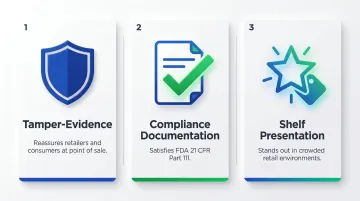
Shrink wrap machines combine a sealing system and heat tunnel to wrap products in a tight, protective film layer. For supplement manufacturers, this technology addresses three core needs:
- Tamper-evidence that reassures retailers and consumers at point of sale
- Compliance documentation that satisfies FDA expectations under 21 CFR Part 111
- Shelf presentation that helps products stand out in crowded retail environments
Supplement formats requiring shrink wrapping span single bottles, bundled multipacks, blister cards, and flexible pouches — each demanding different machine configurations. A standalone vitamin bottle needs precise sleeve application, while a 6-pack bundle for club retail requires heavy-duty bundling equipment capable of handling grouped containers at high speed.
The section below outlines the top shrink wrap machines supplement manufacturers rely on, evaluated on throughput, film compatibility, regulatory fit, and how well they integrate with existing filling and capping lines.
Best Shrink Wrap Machines for Supplement Manufacturers
These machines were selected based on four criteria: throughput capability, supplement-industry suitability, reliability track record, and proven performance across common supplement packaging formats.
Eastey Enterprises
Eastey is a U.S.-based manufacturer (Brooklyn Park, MN) of L-bar sealers and heat tunnel systems with a strong track record in nutraceutical and supplement production. Their equipment delivers durability at accessible price points for small-to-mid-size operations.
Eastey's modular design philosophy is the key differentiator — L-bar sealers pair seamlessly with their own shrink tunnels to build semi-automatic or fully automatic production lines. Growing supplement brands can scale up from manual operations without overcommitting to capacity they don't yet need.
| Machine Type | L-bar sealer + shrink tunnel systems; semi-automatic and automatic configurations |
|---|---|
| Speed/Throughput | Performance Series tunnels rated at 67 feet per minute; semi-automatic L-sealers handle seal areas up to 16" x 36" |
| Key Features | Heavy-duty sealing wire, adjustable tunnel temperatures for POF (polyolefin) and PVC film, compact footprint, Made in USA construction |
Texwrap (ProMach)
Texwrap, part of the ProMach packaging group, produces continuous-motion sleeve wrappers widely deployed in high-speed supplement bottling lines. Their equipment excels with round containers moving at high volume in 24/7 production environments.
Continuous motion sealing eliminates stop-and-go production slowdowns — a meaningful advantage for supplement facilities running multi-shift operations. Their systems integrate cleanly with upstream filling and capping lines, reducing changeover complexity when switching between product SKUs.
| Machine Type | Continuous motion sleeve wrapper with integrated shrink tunnel |
|---|---|
| Speed/Throughput | Spartan ST-2215R up to 30 packages per minute; OVS Series up to 135 cycles per minute |
| Key Features | Servo-driven film feed, automatic film splice capability, compatible with POF and polyethylene films, lap-sealer configurations up to 250 packages per minute |
Minipack-Torre
Minipack-Torre is an Italian-origin brand (based in Dalmine) with strong North American presence, offering compact shrink wrap machines suited to medium-throughput supplement operations needing flexibility across multiple SKUs and container formats.
The same machine handles bottles, pouches, and boxed supplements with minimal changeover time — making Minipack-Torre a practical fit for contract supplement manufacturers or brands managing diverse product lines where run-to-run downtime adds up fast.
| Machine Type | Chamber and flow-wrap shrink systems; manual to semi-automatic configurations |
|---|---|
| Speed/Throughput | Pratika 56-T MPS up to 3,600 pieces per hour (60 packages per minute); handles products up to 400mm W x 240mm H |
| Key Features | Touchscreen controls, quick-change film rolls, optimized for POF shrink film, compact footprint for space-constrained facilities |
Arpac (nVenia/Duravant)
Arpac, an nVenia brand under Duravant, specializes in high-output shrink bundle wrappers commonly used by large supplement manufacturers producing multipacks (2-pack or 6-pack bottle bundles) for club retail channels like Costco or Sam's Club.
Arpac's heavy-duty, industrial-grade build is designed specifically for continuous high-volume runs. Their systems excel at stretch/shrink bundling of grouped bottles — a format that supplement brands selling into club retail need to execute consistently and at scale.
| Machine Type | Shrink bundler / tray shrink wrapper; fully automatic, high-speed |
|---|---|
| Speed/Throughput | 708HB up to 20 bundles per minute (pharma/HBA applications); 45TW up to 45 packages per minute |
| Key Features | Robust film delivery system, PLC controls, configurable for various bundle configurations, designed for pharmaceutical and health/beauty applications |
Axon (ProMach)
Axon, also part of ProMach, focuses specifically on tamper-evident neck band and full-body sleeve applicators for bottled supplements — addressing FDA tamper-evidence requirements and retail compliance directly.
Both branded supplement companies and contract manufacturers serving major retail accounts rely on Axon systems for sleeve and neck band application at speed. Their equipment integrates into existing bottling lines without requiring significant line reconfiguration.
| Machine Type | Sleeve applicator / neck bander with heat tunnel; semi-automatic and fully automatic options |
|---|---|
| Speed/Throughput | EZ-100HSX up to 300 containers per minute; Aurora series up to 400 containers per minute |
| Key Features | Precise sleeve placement accuracy, compatible with PVC and PETG shrink films, integrates with existing bottling lines, nutraceutical/pharmaceutical focus |
How We Chose the Best Shrink Wrap Machines
Selecting machines for this list required evaluating them against the specific demands of supplement manufacturing: tamper-evidence capability, compatibility with common supplement formats (bottles, pouches, multipacks), film type flexibility, and line-speed requirements. A common mistake is choosing based on price alone without matching machine type to packaging format. An L-bar sealer optimized for boxes, for example, won't efficiently handle round bottles at scale.
Key evaluation factors included:
- Throughput and speed ratings — ensuring machines match current production volume and provide headroom for growth
- Film compatibility — POF (polyolefin) versus PVC versus PETG, each offering different clarity, seal strength, and regulatory profiles
- Integration ease — how cleanly machines connect with existing filling and capping lines without extensive custom engineering
- Service and parts availability — production uptime depends on rapid response when components fail
- FDA-regulated environment suitability — materials and construction that align with 21 CFR Part 111 cGMP requirements
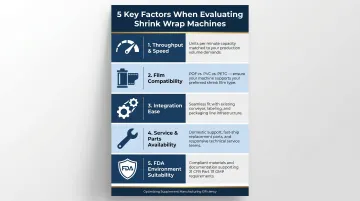
Each factor ties directly to production uptime and compliance outcomes. Film compatibility determines both cost per unit and regulatory acceptability: POF is FDA-approved for direct food contact and produces fewer fumes than PVC during sealing. Service availability dictates whether a breakdown costs you hours or days of lost production.
For Midwest supplement manufacturers evaluating these factors hands-on, John Maye Company's team brings 40+ years of packaging equipment expertise and manufacturer-trained technicians to the process. Their rental fleet lets you test equipment during seasonal surges before committing to a purchase, reducing capital risk and keeping output steady when demand spikes.
Conclusion
The right shrink wrap machine for a supplement manufacturer depends on container format, production volume, tamper-evidence requirements, and how cleanly the equipment integrates with your existing line. A contract manufacturer running diverse SKUs needs different capabilities than a brand producing a single high-volume product for club retail.
Before finalizing your equipment choice, weigh the total cost of ownership — not just the sticker price. Key factors to evaluate:
- Film cost per unit at your expected run volume
- Parts availability and whether components are proprietary or standard
- Service network coverage in your region
- Scalability as SKU count or production volume grows
A machine with a lower upfront cost but a limited service network will often cost more over its lifecycle than a well-supported system with readily available consumables.
Midwest supplement manufacturers can contact John Maye Company in Waukesha, WI for equipment recommendations, live demonstrations, or short-term rentals through their extensive fleet — useful for validating a machine configuration before committing to a purchase. With 40+ years of packaging equipment experience and factory-certified technicians, their team can assess your line and identify the right fit for your container format and throughput requirements.
Frequently Asked Questions
How much does a shrink wrap machine cost?
Entry-level semi-automatic shrink wrap systems (L-bar sealer with tunnel) start around $5,100–$20,000, while fully automated industrial systems range from $30,000–$60,000+. Throughput capacity, brand reputation, and configuration complexity are the primary cost drivers. Continuous-motion sleeve wrappers, for example, run two to three times the price of a basic chamber system.
How much does it cost to shrink wrap?
Per-unit shrink wrapping costs typically range from $0.05–$0.25 depending on film type, product size, and automation level. High-volume automated lines drive per-unit costs toward the lower end by reducing labor and cutting film waste compared to semi-manual setups.
What shrink wrap is food safe?
Polyolefin (POF) shrink film is the standard food-safe choice for supplements, as it meets FDA requirements under 21 CFR Part 177 for direct food contact, produces minimal fumes during sealing, and delivers superior clarity. PETG is another FDA-compliant option for applications requiring extra rigidity.
What type of shrink wrap machine is best for supplement bottles?
For individual supplement bottles, a sleeve applicator or L-bar sealer with heat tunnel handles most applications efficiently. When retail compliance and tamper-evidence are priorities, dedicated neck banding machines (like Axon systems) provide the precise sleeve placement retailers expect and consumers trust.
Do shrink wrap machines need to meet any compliance standards for supplement packaging?
The machines themselves don't require FDA certification, but the film must be food-safe — POF or PETG meeting 21 CFR Part 177 standards. Your packaging process should also align with cGMP requirements under 21 CFR Part 111, which governs dietary supplement manufacturers and covers material suitability for product contact.
What can I use instead of shrink wrap?
Alternatives include stretch wrap for pallet stabilization, blister packaging for unit-dose products, heat-sealed pouches for powders, or induction sealing for bottle tamper-evidence. However, for combined tamper-evidence, retail presentation, and multi-pack bundling in supplement manufacturing, shrink wrap remains the most cost-effective and versatile option.