Introduction
Frozen food manufacturers face a unique challenge: packaging must protect product integrity through freezing temperatures, transport, and retail display — all while keeping production lines moving at high volume. A single packaging failure at -10°F can mean thousands of dollars in lost product and brand reputation damage.
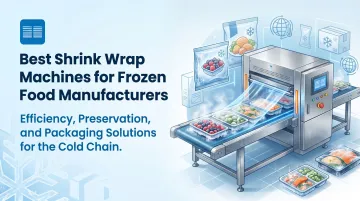
Shrink wrap machines have become the preferred choice for frozen food operations because they deliver tamper-evident, freezer-burn-resistant seals, enhance shelf appeal, and accommodate both tray and trayless formats.
The global frozen food market was valued at $531.46 billion in 2025 and is projected to reach $841.48 billion by 2033, growing at a CAGR of 5.9%. This guide covers the top shrink wrap machine types suited for frozen food lines, the key specs to evaluate, and how to match equipment to your production volume.
Key Takeaways
- Shrink wrap creates a tight, heat-sealed film barrier protecting frozen food from freezer burn and contamination
- Polyolefin (POF) film is the industry standard: it stays flexible at freezing temperatures and meets FDA compliance requirements
- Machine selection depends on volume: hood/L-bar sealers for low-to-mid output; continuous motion side sealers for industrial lines
- Choosing the wrong machine leads to seal failures, film cracking, and costly downtime
- Verify film compatibility, product dimensions, and line speed before committing to any machine
Shrink Wrapping in the Frozen Food Industry
Shrink wrapping uses heat to contract thermoplastic film tightly around a product, creating a tamper-evident, form-fitting seal. For frozen food, this process is particularly valuable because the film conforms to irregular shapes — pizza, tray meals, multi-packs — creating a moisture barrier that prevents freezer burn and extends shelf life.
Primary vs. Secondary Shrink Wrapping:
- Primary shrink wrapping: Applied directly to the food product — frozen pizzas, individually wrapped meals, and similar items
- Secondary shrink wrapping: Applied over a tray or primary container — bundled ready meals, multi-packs, and retail club-size sets
Understanding this distinction matters because different machine types serve each application. L-bar sealers typically handle lower-speed primary and secondary packaging, while continuous motion side sealers are engineered for high-volume secondary bundling.
Choosing Film That Holds Up at Freezing Temperatures
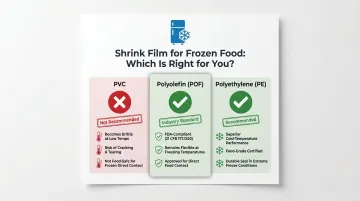
PVC film is not recommended for frozen food packaging because it becomes brittle and cracks at low temperatures. Polyolefin (POF) film maintains physical integrity in freezer environments, is FDA-approved for direct food contact, and provides excellent low-temperature resistance. Polyethylene (PE) films also offer strong performance at freezing temperatures, making POF and PE the industry standards for frozen food applications.
Best Shrink Wrap Machines for Frozen Food Manufacturers
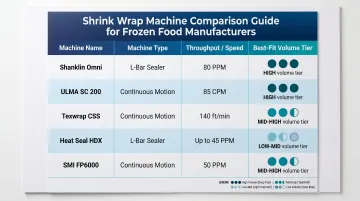
These five machines were selected based on food-grade compatibility, throughput range, film flexibility, and proven performance in frozen food production environments.
Shanklin Omni Series (Sealed Air)
Shanklin, a Sealed Air brand, has set the benchmark for industrial food packaging for decades. The Omni Series are high-speed continuous motion side sealers widely used on frozen food lines, built for demanding, high-volume production.
The continuous motion design — no stops between packages — is what sets it apart for high-volume lines. It handles POF and polyethylene films, ships in USDA-approved and CE-compliant configurations for regulated facilities, and is backed by Sealed Air's global service and parts network.
| Machine Type | Continuous Motion Side Sealer |
|---|---|
| Speed/Throughput | Up to 80 packs per minute |
| Best For | High-volume frozen food lines: pizza, tray meals, multi-packs |
ULMA SC 200
ULMA Packaging is a Spanish equipment manufacturer with deep roots in the food industry. The SC 200 automatic side seal shrink machine is built specifically for food applications — including frozen products — with stainless steel construction options and flexible film handling.
For frozen food environments, the SC 200's hygienic design stands out: stainless steel builds, CE compliance, and an optional cross-sealing bar that lets manufacturers handle varied product formats on a single line, simplifying changeover when running multiple frozen food SKUs.
| Machine Type | Automatic Side Seal Shrink Wrapper |
|---|---|
| Speed/Throughput | Up to 85 cycles per minute |
| Best For | Frozen tray products, ready meals, portion-packed items |
Texwrap CSS Series (ProMach)
Texwrap, a ProMach brand, builds continuous motion shrink wrappers that appear regularly on frozen food and beverage lines. The CSS Series is a workhorse — known for film versatility, quick changeover, and sustained performance at speed.
Key strengths for frozen food operations:
- Handles POF and PE films without complex reconfiguration
- Quick size changeover suits mixed-SKU production runs
- Conveyor speeds up to 140 ft/min on higher-end models
- 10-year warranty backing long-term durability
| Machine Type | Continuous Motion Shrink Wrapper |
|---|---|
| Speed/Throughput | Conveyor speeds up to 140 ft/min (model dependent) |
| Best For | Mid-to-high volume frozen food lines with mixed product sizes |
Heat Seal HDX Series
Heat Seal is a US manufacturer of L-bar sealers and shrink systems. The HDX Series spans semi-automatic models (HDX250, HDX350) up to the fully automatic HDX-2000 — covering low-to-mid production volumes across food packaging operations.
This is the right fit for smaller-scale or specialty frozen food producers. The MaxAir tunnel airflow system delivers nearly triple the airflow of standard tunnels, eliminating hot spots and ensuring consistent shrink across every package. Full stainless steel options keep it food-safe.
| Machine Type | Semi-Automatic or Automatic L-Bar Sealer with Shrink Tunnel |
|---|---|
| Speed/Throughput | HDX250/350: Operator-dependent; HDX-2000: up to 45 ppm |
| Best For | Low-to-mid volume frozen food operations; craft or specialty frozen food producers |
SMI FP6000
SMI Group (via subsidiary Smipack) is an Italian packaging equipment manufacturer with distribution across North America. The FP6000 fully automatic L-bar sealer targets medium-to-high volume food packaging lines, available in the US through authorized distributors.
For frozen food facilities, the FP6000 earns its place with:
- Automatic film feed that reduces operator dependency
- L-seal design enabling flexible product size changeover
- Throughput bridging mid- and high-volume production needs
- INOX version with FDA, EU, and USDA-compliant conveyor belts and AISI 304 food-grade stainless steel construction
| Machine Type | Fully Automatic L-Bar Sealer |
|---|---|
| Speed/Throughput | Up to 50 packs per minute (3,000 packs per hour) |
| Best For | Medium-to-high volume frozen food lines; operations transitioning from semi-auto to full automation |
Key Features to Look for in a Frozen Food Shrink Wrap Machine
Film Compatibility: POF and Food-Grade Polyethylene
Machines must support polyolefin (POF) or food-grade polyethylene films — not PVC. Film selection directly affects food safety, seal integrity, and cold-chain performance.
Key film specifications to evaluate:
- FDA compliance: POF film meets 21 CFR 177.1520 for direct food contact and stays flexible at freezing temperatures
- Gauge range: 60-100 microns provides better puncture resistance for sharp-edged frozen products
- Shrink ratio: Match to your product's size variability and temperature exposure range
Throughput Alignment
Avoid selecting a machine based on peak capacity alone. Match rated speed to your actual line speed using realistic uptime figures — not theoretical maximums.
A machine rated at 80 ppm may realistically deliver 60-65 ppm once you account for changeovers, maintenance, and operator efficiency. Building in overcapacity protects you from running at the machine's limits continuously.
Hygienic Construction and Compliance
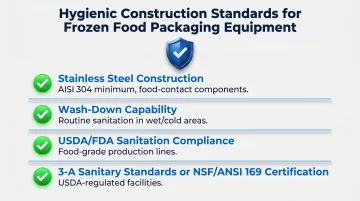
Frozen food environments demand food-safe, easy-clean machine designs. Confirm these standards before specifying any equipment:
- Stainless steel construction: AISI 304 minimum for all food-contact components
- Wash-down capability: Essential for routine sanitation in wet or cold processing areas
- USDA/FDA sanitation compliance: Required for food-grade production lines
- 3-A Sanitary Standards or NSF/ANSI 169 certification: Mandatory for USDA-regulated facilities
How We Chose the Best Shrink Wrap Machines
Evaluation Criteria
We selected machines based on five factors, verified through manufacturer product pages and authorized distributor documentation:
- Food-grade film compatibility (POF and PE specifically)
- Throughput range suited to frozen food production volumes
- Reliability in cold and freezer-adjacent environments
- Availability of US-based parts and service support
- Demonstrated use in frozen food production settings
Common Mistakes to Avoid
Even with the right criteria in mind, several avoidable mistakes consistently derail purchasing decisions.
Frozen food manufacturers often prioritize upfront cost over total cost of ownership, overlooking film changeover time or choosing a machine not rated for the humidity and temperature swings common in frozen food facilities. Film waste, changeover complexity, and maintenance frequency can each erode ROI faster than the initial purchase price suggests.
Machine Longevity and Service Access
A high-speed machine without reliable parts support leads directly to production downtime. Evaluate the distributor's parts inventory and technician availability alongside the machine itself.
Factory-certified technicians familiar with a specific machine brand typically resolve issues far faster than generalist service providers — a meaningful difference when a line goes down mid-shift. John Maye Company's factory-certified technicians, for example, carry manufacturer-specific training across the shrink wrap equipment lines they distribute.
Conclusion
The right shrink wrap machine for a frozen food operation depends on three aligned factors: production volume, product format (tray vs. trayless, single vs. multi-pack), and film compatibility — no single machine fits every line. A craft frozen meal producer running 15 packs per minute has vastly different needs than an industrial pizza manufacturer running 80 packs per minute.
Evaluate total cost of ownership — not just the sticker price or throughput spec. Key factors to weigh:
- Film waste rate — even small percentage differences compound at scale
- Changeover time — critical for multi-SKU lines with frequent format switches
- Maintenance intervals — planned downtime beats unplanned breakdowns
- Local service availability — fast technician response protects production schedules
A $15,000 machine with 20% film waste and frequent downtime can cost more over three years than a $35,000 machine with tight integration and reliable support.
If you're a frozen food manufacturer in the Midwest working through that evaluation, John Maye Company has 40+ years of packaging expertise, factory-certified technicians for brands like Heat Seal and SMI, and a rental fleet for seasonal demand surges. Reach out for a consultation at 1-800-441-6293 or info@johnmayecompany.com.
Frequently Asked Questions
Can you shrink wrap frozen food?
Yes, frozen food can be shrink wrapped using polyolefin or food-grade polyethylene films, which remain flexible at low temperatures. PVC is not suitable for frozen applications due to brittleness and cracking at freezing temperatures.
What is the best shrink wrapper for food?
The best machine depends on production volume and product format. L-bar sealers suit low-to-mid volume food operations (6-50 ppm), while continuous motion side sealers are preferred for high-speed industrial food lines (80+ ppm).
What is the best packaging for frozen food?
Shrink wrapping is the leading primary and secondary packaging method for frozen food. It creates an airtight, freezer-burn-resistant seal while keeping products visible on shelf — advantages that rigid packaging and overwrapping generally can't match.
What type of shrink film is best for frozen food packaging?
Polyolefin (POF) film is the industry standard for frozen food — it is FDA-compliant for food contact, flexible at freezing temperatures, and available in a range of gauges to suit different product sizes and line speeds.
What is the difference between an L-bar sealer and a side sealer for food packaging?
L-bar sealers use centerfold film and seal three sides in one motion — suited for lower speeds and varied product sizes. Side sealers use continuous motion to wrap products at higher speeds, making them the stronger choice for high-volume frozen food lines.
How fast do shrink wrap machines run for frozen food production lines?
Semi-automatic L-bar sealers typically run 6–20 ppm depending on operator pace. Automatic L-bar sealers reach 15–50 ppm, and continuous motion side sealers hit 80–180+ ppm depending on model. Match rated speed to your actual line requirements, not manufacturer maximums.