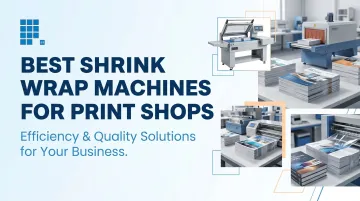
Shrink wrap machines play a central role in print shop finishing operations, helping protect posters, bound documents, books, catalogs, and foam board from dust, moisture, and handling damage throughout the supply chain. Choosing the wrong machine—mismatched film compatibility, insufficient throughput, or the wrong sealer type—leads to damaged deliverables, wasted labor, and frustrated customers. This guide breaks down the best shrink wrap machine options specifically for print shop environments.
Key Takeaways
- Shrink wrap machines protect printed materials during packaging and delivery using heat-sealed polymer film
- Key evaluation factors: daily output volume, product size range, polyolefin film compatibility, and automation level
- Print shops typically need L-bar sealers, I-bar sealers, or shrink chambers depending on daily volume
- Equipment ranges from entry-level impulse sealers to semi-automatic L-bar + tunnel combos for higher-volume shops
Why Print Shops Use Shrink Wrap Machines
Shrink wrap machines use heat-sealing and a controlled heat source — tunnel or gun — to encase printed products in polymer film. The result is a tight, protective barrier that shields against moisture, dust, and handling damage while delivering a finished, tamper-evident package.
Common print shop applications include:
- Bundles direct mail packs, magazine sets, book collections, and catalog groups into a single tight unit
- Protects posters and foam board from scratching, corner damage, and moisture in transit
- Creates tamper-evident packaging for bookstore and retail distribution
- Delivers a finished, retail-ready look that clients expect on high-value print jobs
Print shops handle everything from business card packs to large-format poster rolls, so the right machine depends heavily on your output mix and volume.
Best Shrink Wrap Machines for Print Shops
These machines were selected based on seal reliability, polyolefin film compatibility, throughput range, and suitability for common print shop product dimensions — from catalogs and booklets to bundled posters. Each entry below covers a distinct output tier, so you can match the right machine to your actual daily volume.
Eastey ET Series L-Bar Sealer + Shrink Tunnel
Eastey is a well-established U.S.-based manufacturer (Rogers, Minnesota) of shrink packaging equipment widely used in print and fulfillment environments for medium-output packaging needs. Their ET Series L-bar sealer and shrink tunnel combination delivers the seal consistency and throughput that print shops require.
Print shop advantage: The L-bar configuration seals two sides simultaneously, cutting cycle time compared to I-bar systems. The shrink tunnel delivers consistent, adjustable heat distribution across the full film surface — producing clean, bubble-free results on flat printed items like catalogs and booklets. Eastey's welded 12-gauge steel construction holds up in production environments.
| Feature | Specification |
|---|---|
| Seal Bar Options | 16" x 22" or 16" x 36" |
| Tunnel Aperture | 30" x 16" x 8" (ET1622-TK) or 40" x 20" x 10" (ET2028-TK) |
| Conveyor Speed | 0-75 feet per minute (variable) |
| Throughput | 10-15 packages per minute |
| Film Compatibility | Polyolefin (POF), Polyethylene (PE), PVC; 45-150 gauge |
| Certifications | CE compliant, UL listed components |
| Ideal For | Mid-volume print shops packaging catalogs, booklets, and bundled printed materials |
PAC Machinery Clamco Series
PAC Machinery manufactures the Clamco line of shrink packaging systems targeting small-to-medium operations that need reliable, consistent sealing without a large footprint. Note that PAC Machinery's brand for heat sealers is "Clamco," not "SureSealer."
What makes it work: The Clamco 1614 manual L-bar sealer offers a compact tabletop design that fits space-constrained print shop environments. The Clamco 6800CS automatic side sealer scales to high-volume operations with PLC controls and touchscreen operation. It handles up to 4,200 packs per hour for shops with serious throughput demands.
| Feature | Specification |
|---|---|
| Seal Bar Length | 16" x 14" (Clamco 1614); larger options available in automatic models |
| Automation Level | Manual tabletop (1614) to fully automatic with PLC (6800CS) |
| Max Film Width | 20" (manual models) |
| Throughput Range | 6-8 packs/min (manual) to 100 ft/min and 4,200 packs/hr (automatic) |
| Film Compatibility | Polyolefin (POF), PVC, ReviveWrap recyclable polyolefin (30% recycled content) |
| Safety Features | UL/C-UL listed; automatic models include safety sensors and emergency stop |
| Ideal For | Small-to-medium print shops with limited floor space needing reliable tabletop or scalable automatic solutions |
Minipack-Torre Sprint/Pratika Series
Minipack-Torre is an Italian manufacturer with over 40 years of experience producing high-quality shrink wrapping systems used in print finishing, publishing, and retail packaging worldwide. The Sprint and Pratika series are industry favorites for professional-grade output.
Best for coated and laminated stock: Precision sealing with consistent heat distribution makes Minipack-Torre systems particularly well-suited for delicate printed materials with coatings or lamination. The Pratika 55 Smart T50 pairs servo technology with a compact footprint, delivering professional results without consuming floor space. The Minima Evo chamber system is an ultra-compact desktop option for smaller operations.
| Feature | Specification |
|---|---|
| Sealing Speed | 5-15 packs per minute (model-dependent) |
| Configuration Options | Chamber models (Minima Evo, Freska) or L-bar + tunnel combos (Pratika series) |
| Seal Bar Dimensions | Varies by model; Pratika 56-T offers 560 x 430 mm seal area |
| Footprint | Compact desktop (chamber) to floor-standing (L-bar systems) |
| Film Compatibility | Polyolefin (POF), PVC, Polyethylene; gauge range varies by model |
| Special Features | Servo technology for precision control, MPS (Multifunction Power System) for energy efficiency |
| Ideal For | Print shops requiring high-quality, professional-finish shrink wrapping for premium printed products |
SMIPACK Shrink Wrap Systems (via John Maye Company)
For Midwest print shops that also want local service backup, John Maye Company distributes SMIPACK shrink wrap systems designed for flexibility across various product sizes and shapes. SMIPACK manufactures a range of L-bar sealers and integrated systems suitable for print shop applications.
Regional support built in: Modular configurations let print shops scale from semi-automatic to higher throughput setups as volume grows. John Maye Company's factory-certified technicians and 24-hour parts shipping keep downtime minimal — a real advantage for shops running on tight production deadlines.
| Feature | Specification |
|---|---|
| Model Range | FP560A (semi-automatic) to FP6000 (automatic L-sealer) |
| Sealing Method | L-bar seal with optional shrink tunnel integration |
| Throughput Range | Up to 1,500 packs/hour (FP560A) or 3,000 packs/hour (FP6000) |
| Film Compatibility | Polyolefin, Polyethylene, PVC; 20-100µ thickness range |
| Support | Factory-certified technicians, 24-hour response time, Midwest regional coverage |
| Ideal For | Print shops in the Midwest seeking locally supported equipment with flexible configuration options and rapid service response |
Not sure which tier fits your volume? John Maye Company can help you match machine capacity to your actual daily output — contact them at info@johnmayecompany.com or call 1-800-441-6293 to discuss right-sized options for your print shop.
Key Features to Look for in a Print Shop Shrink Wrap Machine
Output Volume and Throughput Rate
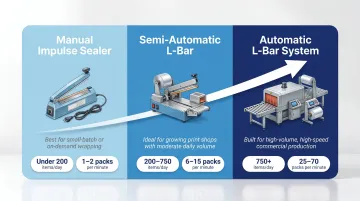
Daily output is the single most important starting point when selecting a shrink wrap machine. Print shops wrapping under 200 items per day can use manual or semi-automatic setups like impulse sealers or basic L-bar systems. Shops wrapping 200–750 items daily should consider semi-automatic L-bar + tunnel combos. Operations exceeding 750 items per day require automatic L-bar systems with integrated tunnels to avoid production bottlenecks.
Throughput benchmarks:
- Manual impulse sealer: 1-2 packs per minute
- Semi-automatic L-bar: 6-15 packs per minute
- Automatic L-bar system: 25-70 packs per minute
Product Size and Sealer Bar Dimensions
Print shop outputs vary widely—from business card packs to large-format poster rolls. The sealer bar width and tunnel aperture must accommodate the largest items in your typical product mix.
How to measure:
- Identify your largest common item (e.g., 24" x 36" poster)
- Add 2-3" to each dimension for film overlap
- Match to sealer bar dimensions (e.g., 16" x 36" bar handles items up to roughly 13" x 33")
- Verify tunnel aperture can pass your tallest stacked items
Film Type Compatibility
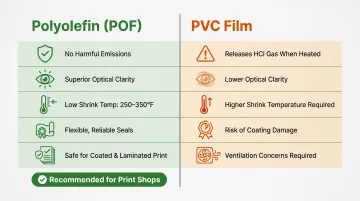
Polyolefin (POF) shrink film is generally preferred for print shops because it produces no hydrogen chloride gas (unlike PVC), which matters in enclosed shop environments and for protecting print quality. According to OSHA accident reports, PVC thermal decomposition produces HCl gas, which can damage respiratory systems and corrode nearby equipment. NIOSH research confirms that PVC heated above 322°F releases hydrogen chloride.
For heavier print bundles, crosslinked POF is worth the upgrade over standard POF:
- Stronger seals on dense book sets and multi-piece bundles
- Higher puncture resistance for sharp-edged print packaging
- Better heat tolerance, reducing risk of film failure at higher tunnel temperatures
Heat Control Precision
For printed materials—especially items with ink, coatings, or lamination—consistent, adjustable heat is critical to avoid film distortion or product damage. Shrink tunnels with adjustable conveyor speed and multiple temperature zones outperform heat guns for volume runs, delivering uniform shrinkage without hot spots that can warp covers or melt coatings.
Footprint and Workflow Integration
Print shops often have limited floor space and must integrate shrink wrapping into existing finishing processes. Compact tabletop systems (like the Clamco 1614 or Minipack Minima Evo) fit on existing workbenches, while inline conveyor-based systems require dedicated floor space but enable continuous throughput for high-volume operations. Once you've mapped these five criteria against your operation, you're ready to match them to specific machines.
How We Chose the Best Shrink Wrap Machines for Print Shops
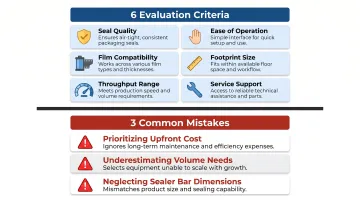
Each machine on this list was evaluated against six criteria relevant to print shop environments:
- Seal quality and consistency across print-safe film types
- Film compatibility with materials that won't damage printed surfaces
- Throughput range relative to typical print shop production volumes
- Ease of operation for staff who aren't dedicated packaging specialists
- Footprint size suited to production floor constraints
- Service and parts support availability to minimize downtime
Most common mistakes print shops make:
- Prioritizing upfront cost over film compatibility and throughput capacity — a tradeoff that creates problems down the line
- Underestimating volume needs, which creates bottlenecks when production peaks
- Neglecting to check sealer bar dimensions against their largest product format, resulting in items that won't fit
Service support and parts availability deserve as much attention as the machine specs themselves. A fast seal bar replacement matters far more than a low sticker price when a bottleneck hits mid-run. For Midwest print shops, John Maye Company backs every equipment purchase with a 24-hour parts ship guarantee and factory-certified technician support — practical coverage when production schedules can't wait.
Conclusion
The right shrink wrap machine for your print shop depends on more than price or brand name. Before committing to a machine, weigh these factors:
- Output volume — current and projected, not just today's throughput
- Product size variety — mixed formats need wider sealing ranges
- Film compatibility — polyolefin film protects print quality and keeps shop air clean
- Floor space — L-bar sealers and tunnel systems have different footprint requirements
Prioritizing polyolefin compatibility in particular matters for print environments, where PVC fumes can damage finished products and create ventilation problems.
If you're ready to move from evaluation to equipment, John Maye Company works with print shops across the Midwest to match the right machine to the right operation. With 40+ years of packaging equipment experience, a rental fleet for seasonal production surges, and manufacturer-trained technicians on staff, they can help you avoid costly mismatches. Reach out to discuss your volume, product mix, and space constraints before you buy.
Frequently Asked Questions
Can I shrink wrap books with a shrink wrap machine for a print shop?
Yes, books can be shrink wrapped using an L-bar sealer with a shrink tunnel or a shrink chamber. Polyolefin film is recommended for books as it produces a cleaner, odor-free seal and conforms well to rectangular shapes without damaging covers or bindings.
What are the different types of shrink wrap used by shrink wrap machines?
The main types are polyolefin (POF), versatile and preferred for print materials; PVC, common for boxed products but produces fumes; and polyethylene (PE), a heavy-duty option for large bundled items. Film gauge and crosslinking affect seal strength and heat requirements.
Can you print images on shrink plastic or materials used in shrink wrapping for print shops?
Shrink sleeves can be printed with custom graphics for branded product packaging. Standard centerfold film and shrink bags used in most print shop workflows are clear and unprinted, designed for protection and bundling rather than custom branding.
What is the best shrink wrap film for printed materials?
Polyolefin (POF) shrink film is the top choice for print shops. It offers superior clarity, flexibility, and a low shrink temperature (250–350°F), with no harmful emissions — making it safer for staff and less likely to damage coatings or lamination on printed pieces.
What is the difference between an L-bar sealer and an I-bar sealer for print shops?
An I-bar sealer cuts and seals one side at a time, requiring more manual steps and suiting only very low-volume work. An L-bar sealer seals two intersecting sides simultaneously for faster, more consistent throughput — making it the better fit for most print shop operations.
How much does a shrink wrap machine cost for a print shop?
Entry-level impulse sealer + heat gun setups start around $300-600. Tabletop L-bar sealers range from roughly $1,200-$5,000. Combined L-bar + shrink tunnel systems typically range from $3,000-$15,000+ depending on automation level and throughput capacity. Fully automatic systems can exceed $20,000 for high-volume operations.