Introduction
Procurement managers sourcing packaging equipment face a familiar challenge: dozens of vendor options, inconsistent quote formats, and constant pressure to avoid production line downtime. Without a structured evaluation framework, comparing a $47,000 machine against a $67,000 alternative becomes nearly impossible. The cheaper option can easily climb to $75,000 in total ownership cost once shipping delays and emergency service calls hit the books.
A well-structured packaging supplies RFP solves this by creating a level playing field. It forces vendors to respond to identical criteria, surfaces critical service information upfront, and protects operations teams from costly supplier mismatches. Consider the stakes: 83% of industrial leaders report unplanned downtime costs at least $10,000 per hour, with 76% estimating up to $500,000 per hour. Choosing the wrong packaging partner isn't a budget line item — it's an operational risk.
This guide walks through what a packaging RFP is, how to structure one, what to evaluate beyond price, and the mistakes most teams make along the way.
TLDR
- A packaging supplies RFP solicits proposals based on operational fit, service capability, and long-term reliability — not just price
- Clarify packaging volume, equipment types, industry compliance requirements, and service standards before writing
- Strong RFP templates include vendor qualification criteria, equipment specs, pricing structure, and a weighted evaluation methodology
- Evaluate total cost of ownership, parts availability guarantees, technician certifications, and rental flexibility — not just unit price
- Avoid vague specifications, price-only selection, and skipping reference verification
What Is a Packaging Supplies RFP?
A packaging supplies RFP is a formal procurement document that invites packaging equipment and materials vendors to submit proposals against defined operational requirements. Unlike simple price comparisons, an RFP assesses vendor fit, technical capability, service infrastructure, and long-term partnership potential.
RFP vs. RFQ vs. RFI: Choosing the Right Procurement Tool
The packaging procurement process uses three distinct instruments, each serving a specific purpose:
| Tool | Primary Goal | Best Used When | Selection Criteria |
|---|---|---|---|
| RFI (Request for Information) | Gauge vendor capabilities | Exploring market options before committing | Capability screening |
| RFP (Request for Proposal) | Evaluate solutions and fit | Assessing vendor partnerships and technical approaches | Technical capability + TCO + service |
| RFQ (Request for Quote) | Compare pricing | Specifications are finalized and price is primary concern | Lowest price + lead time |
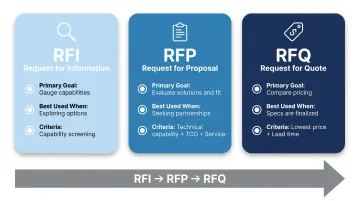
These tools follow a natural sequence. Start with an RFI to screen who can meet your requirements, move to an RFP when you need vendors to propose solutions rather than quote prices, then issue an RFQ once specs are locked and price becomes the deciding factor.
When to Issue a Packaging Supplies RFP
Use an RFP when:
- Sourcing equipment across multiple categories (case sealers, stretch wrappers, conveyors, strapping systems)
- Service and support matter as much as product specifications
- Establishing a new vendor relationship that will directly affect production continuity
- Evaluating rental or lease options alongside capital purchases
- Compliance requirements (FDA food-grade, pharmaceutical GMP) must be verified before selection
According to CIPS procurement guidance, complex industrial projects benefit from a two-stage process: pre-qualification to screen for technical capability, followed by a detailed RFP issued only to qualified vendors. Vendors who clear pre-qualification already meet your baseline requirements — so the proposals you receive are more relevant and easier to compare.
Before You Write: What to Define Before Sending Your Packaging RFP
Identify Your Packaging Program Scope
Before drafting your RFP, document:
- Case sealers, stretch wrappers, labelers, conveyors, void fill systems, strapping machines, and shrink tunnels needed for your operation
- Annual volumes and line speeds: packs per hour, pallets per shift, and seasonal surge capacity
- Compliance requirements: FDA 21 CFR Parts 174-178 for food-contact materials, ISO 15378:2017 for pharmaceutical primary packaging
- Material compatibility across corrugated, plastic, glass, and flexible films
- ERP, WMS, or line control system integration requirements
With scope documented, you can define the minimum standards any vendor must meet.
Establish Your Non-Negotiables
Set hard cutoffs for service standards — vendors who can't meet these are filtered out before detailed review:
- Same-day or 24-hour parts fulfillment with sufficient SKU depth to cover your equipment mix
- Guaranteed on-site technician response windows for emergency repairs
- Operator training programs, maintenance manuals, and remote troubleshooting support
- Rental or lease options for seasonal surge capacity (especially relevant given holiday e-commerce peaks now exceeding $258 billion)
These non-negotiables give your evaluation team clear criteria before proposals arrive.
Align Internal Stakeholders Early
Confirm that operations, finance, and procurement agree on:
- Budget thresholds and capital approval processes
- Decision timelines and vendor selection deadlines
- Evaluation priorities (uptime vs. cost vs. automation level)
Getting this alignment documented before the RFP goes out prevents vendors from exploiting gaps in your decision-making process during negotiations.
The Packaging Supplies RFP Template: Key Sections to Include
Section 1 — Company Overview and Project Summary
This opening section gives vendors the context they need to tailor proposals effectively. Include:
- Brief company description and industries served
- Current packaging operations overview (volume, equipment types, challenges)
- Primary reason for issuing the RFP (new supplier search, cost reduction, capacity expansion, compliance upgrade)
- Expected project timeline and decision process
A clear summary filters out mismatched vendors early — saving both sides time before a full proposal is written.
Section 2 — Vendor Qualification Requirements
This section pre-screens vendors before full proposals are reviewed. Require:
- ISO registrations and any relevant manufacturer authorizations
- Documented experience in your sector — food & beverage, e-commerce, pharmaceutical, or similar
- On-site service coverage across all your operating locations
- Minimum years in business as a stability benchmark
- References or case studies from accounts with comparable project scope
Vendors who can't meet baseline requirements should be filtered out at this stage, preventing wasted evaluation time.
Section 3 — Equipment and Supplies Specifications
This is the technical core of your RFP. For each equipment type or supply category, specify:
- Type and function — for example, turntable vs. rotary arm pallet wrapper, semi-automatic vs. fully automatic strapping machine, or inline vs. standalone shrink wrap system
- Required throughput or capacity: packs per minute, cases per hour, maximum load weight
- Material compatibility: film gauges, strapping widths, conveyor load ratings
- Automation level: semi-automatic, fully automatic, or integrated into an existing line
- Condition: new units or rental equipment acceptable
Critical reminder: CIPS warns that vague specifications lead to products not fit for purpose, wasted resources, and regulatory fines. More precise specs yield more accurate and comparable proposals.
Section 4 — Volume, Delivery, and Logistics Requirements
Vendors need to understand not just what you're buying, but how much, how often, and where. Capture:
- Annual purchase volumes: units per year, pallet counts, total consumable usage
- Order frequency: weekly replenishment, quarterly bulk orders, or just-in-time delivery
- Delivery locations: single facility or multi-site distribution across your region
- Lead time expectations for both standard orders and emergency replenishment
- Inventory arrangements: consignment stock, JIT replenishment, or vendor-managed inventory
Section 5 — Pricing Structure and Contract Terms
Ask vendors to break out pricing across:
- Equipment purchase or rental costs: capital pricing vs. monthly rental rates
- Consumable supply costs: film, tape, strapping, and labels — per unit and volume discount tiers
- Parts and replacement components: standard pricing for common wear items
- Labor and service rates: installation, training, preventive maintenance, and emergency repair
- Surcharges: freight, peak season premiums, and after-hours service fees
Request a multi-year cost projection if you're evaluating long-term contracts. According to CIPS, TCO-based supplier evaluation reduces procurement costs 8-15% compared to price-only bidding.
Specify desired payment terms (net 30, net 60, early payment discounts) for a consistent, apples-to-apples comparison across all bids.
Section 6 — Evaluation Criteria and Response Format
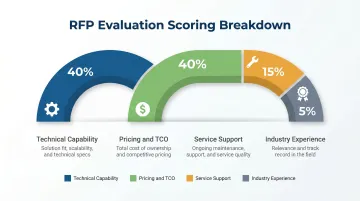
Including explicit evaluation criteria signals professionalism and helps vendors prioritize what matters most. Define weighted scoring categories:
- Technical capability: 40%
- Pricing and TCO: 40%
- Service support: 15%
- Industry experience: 5%
Specify the exact format and sections required in the response (executive summary, technical specifications, service plan, pricing schedule, references). This makes side-by-side comparisons far easier during review.
Evaluating Packaging Supplier Proposals
Go Beyond Unit Price to Total Cost of Ownership
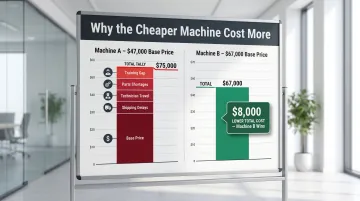
A packaging machinery case study documented a $47,000 machine that ultimately cost $75,000 — $8,000 more than a $67,000 quality alternative — due to shipping delays, technician travel costs, and parts shortages. Hidden cost drivers included:
- Logistics delays and installation expenses not included in the base price
- International technician travel for machines with no local service network
- Back-ordered replacement parts extending downtime
- No operator training program, requiring additional outside resources
Request a 3-year TCO model that includes equipment purchase price, annual maintenance costs, parts replacement frequency, expected service calls, and downtime risk. This reveals whether the lowest bid is truly the most cost-effective option.
Assess Parts Inventory Depth and Fulfillment Speed
Packaging line downtime is expensive. When 44% of industrial leaders experience equipment interruptions at least monthly, a vendor's ability to ship replacement parts within 24 hours becomes a critical differentiator.
Your RFP should require vendors to document:
- Number of SKUs stocked for your equipment types
- Standard fulfillment lead times and expedited shipping options
- After-hours support, weekend shipping, and loaner equipment policies
John Maye Company, for example, stocks 2,500+ SKUs and ships within 24 hours — a useful baseline when comparing vendor responses.
Verify Technical Service Qualifications
Factory-certified technicians represent a higher level of service quality than general repair staff. Require RFP respondents to document:
- Which manufacturers or equipment types their technicians are certified to service
- How quickly on-site support arrives after a service call is placed
- Whether scheduled inspection, calibration, and wear part replacement programs are available
- What remote troubleshooting support (phone or video) is offered for minor issues
Vendors with manufacturer-trained technicians minimize diagnostic time and reduce repeat service calls.
Evaluate Rental and Flexible Access Options
For companies with seasonal peaks — especially in food and beverage, e-commerce, or retail — a vendor's ability to provide short-term rental equipment handles volume surges without capital investment.
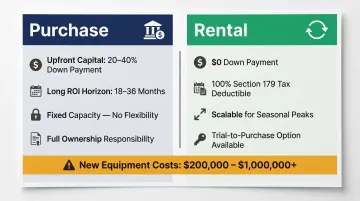
New packaging equipment typically costs $200,000 to over $1,000,000 with 18-36 month ROI horizons. Rental programs offer:
- Zero or low down payment ($0 down vs. 20-40% for purchases)
- 100% tax-deductible payments under Section 179
- Scaling capacity up or down for holiday seasons or promotional events
- Trial periods to test equipment before committing to purchase
Ask vendors to describe their rental fleet availability, equipment types offered, minimum rental periods, and rental-to-purchase conversion options.
Check References from Comparable Accounts
Proposal scores should be validated through reference calls. Target references from companies with similar production volumes and equipment needs, then ask:
- Did technicians arrive within the promised service windows?
- Were replacement parts in stock and delivered as guaranteed?
- How did the vendor respond when equipment failed during peak production?
- Would they renew the contract, or are they evaluating alternatives?
Reference checks take under an hour but prevent costly vendor misjudgments — particularly around service response and parts fulfillment.
Common Packaging RFP Mistakes to Avoid
Three mistakes derail more packaging RFPs than any others — and all three are avoidable with the right process in place.
Vague or Incomplete Specifications
Under-specifying equipment requirements leads to proposals so different they can't be meaningfully compared. CIPS guidance confirms that poor specifications produce bids that are unfit for purpose, waste procurement resources, and can trigger regulatory fines.
If specs are incomplete at RFP issuance:
- Document your assumptions clearly
- Ask vendors to flag where additional information would change their proposal
- Involve cross-functional teams (operations, procurement, finance, technical) in specification development
Evaluating on Price Alone
Selecting the lowest bidder without weighing service capabilities, parts availability, and technical support tends to cost more within 12-18 months. According to global industrial downtime research, 83% of decision-makers report unplanned downtime costs at least $10,000 per hour. One additional stoppage per month quickly offsets any upfront savings from cheaper machinery.
Price-only evaluation also misses:
- Machines rated at 250 PPM that only deliver 210-220 PPM under real operating conditions
- Hidden performance losses of 12-16% from micro-stops and blockages
- Labor cost inflation when overtime is needed to bridge throughput gaps (premiums of +50%)

Skipping the Vendor Reference Step
Buyers who skip reference checks often discover vendor shortcomings only after contract award. Reference checks:
- Add minimal time to the process (typically 15-20 minutes per call)
- Reveal whether vendors deliver on promised service response times
- Uncover hidden issues with parts fulfillment or technical support quality
- Validate whether the vendor is a good cultural and operational fit
- Confirm the vendor as a mandatory step — before final selection, not after
Frequently Asked Questions
What should be included in a packaging supplies RFP?
Core sections include company overview and project summary, vendor qualification criteria, equipment and supply specifications, volume and logistics requirements, pricing structure and contract terms, and weighted evaluation criteria with required response format.
Which comes first, RFP or RFQ?
The typical sequence starts with an RFI to gauge vendor capabilities and narrow the field. Follow with an RFP when you need vendors to propose solutions and demonstrate fit, then use an RFQ last once specifications are finalized and price is the primary comparison point.
What are common RFP mistakes to avoid?
The most common errors are:
- Vague specifications that produce incomparable bids
- Selecting solely on price without weighing service and support capabilities
- Skipping vendor reference verification before contract award
How many vendors should receive a packaging RFP?
A shortlist of 4-6 vendors generates competitive responses without creating an unmanageable review process. Pre-screening through an RFI helps narrow the field before issuing the full RFP to qualified vendors only.
How long does a packaging supplies RFP process typically take?
A well-run packaging RFP process takes 6-10 weeks from document issuance to vendor selection. That window covers a 2-3 week proposal period, scoring and evaluation, follow-up calls or site visits, and final contract negotiations.