Introduction
Every brick and block manufacturer faces the same end-of-line challenge: finished units pile up faster than manual labor can stack them. A standard 8x8x16 hollow CMU weighs approximately 28 lbs, and modern block machines produce 1,260–1,800 units per hour. Workers can't keep pace with that output without injury risk, and inconsistent pallet loads cause shipping damage and distribution delays.
The right palletizer eliminates that bottleneck — matching production speed, protecting workers, and delivering consistent loads ready for transport. This guide covers the top palletizer types suited for brick and block production, including robotic, gantry, and layer-forming systems, along with the key buying criteria plant managers should weigh before investing.
Key Takeaways
- Automates stacking of heavy masonry units, cutting manual labor and boosting throughput
- Systems range from semi-automatic conventional units to fully robotic gantry platforms
- Top models manage payloads up to 4,000+ lbs per pallet, irregular shapes, and high cycle rates
- Choose based on throughput speed, payload capacity, pattern flexibility, and total cost of ownership
- Leading brands include Columbia Machine, SOCO System, TopTier, FANUC America, and Haver & Boecker
Why Brick & Block Manufacturers Need Automated Palletizers
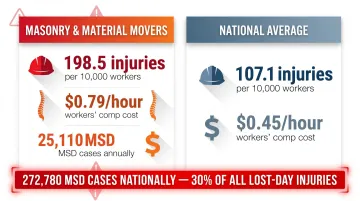
Manual brick stacking carries serious risks. Workers in production and material moving occupations face injury rates of 198.5 per 10,000 full-time workers—nearly double the national average of 107.1. Employers in these sectors spend $0.79 per hour worked on workers' compensation, compared to the $0.45 national average. In 2018, musculoskeletal disorder (MSD) cases reached 272,780 nationally, representing 30% of all days-away-from-work injuries with a median of 12 days lost per case. Laborers and material movers alone logged 25,110 MSD cases in a single year.
Product weight compounds that toll. Workers handle hundreds of units per shift across a wide weight range:
- Standard clay brick: ~4.5 lbs
- Hollow CMUs: ~28 lbs
- Large retaining wall blocks: up to 240 lbs
Repeated lifts at these weights produce the cumulative strain behind most MSD cases in brick and block facilities.
That strain also points to a throughput problem. A production line running 1,400 blocks per hour cannot rely on manual stacking crews to keep pace — especially during peak construction season. The gap between machine output and human capacity creates bottlenecks that idle expensive upstream equipment and delay shipments. Automated palletizers solve both issues at once.
Beyond speed, consistent pallet patterns improve load stability during transport and allow faster unloading at distribution points. Uniform stacks handle forklift movements and road vibration better than hand-stacked loads — cutting product loss and reducing damage claims.
Types of Palletizers Used in Brick & Block Manufacturing
Choosing the right palletizer starts with understanding how each type handles the weight, abrasion, and stacking demands specific to concrete products. Three main configurations apply to brick and block manufacturing:
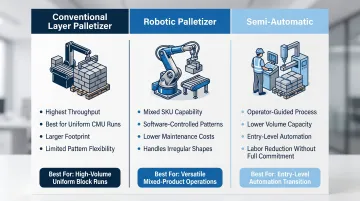
Conventional (Layer) Palletizers are built for speed and volume. Mechanical arms or sweep systems arrange products into full rows on a layer-forming table, then transfer the complete layer onto the pallet in one motion. The trade-off: larger footprints and limited flexibility when production patterns change.
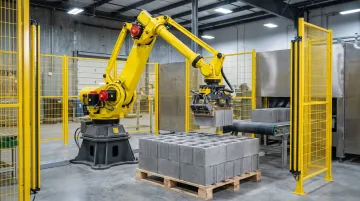
Robotic Palletizers use articulated arms with custom end-of-arm tooling (EOAT — the gripper or clamp attached to the robot) to pick and stack bricks from a conveyor. Software controls the stacking pattern, making it straightforward to switch between product sizes. Fewer moving mechanical components also means lower long-term maintenance costs.
Semi-Automatic Systems let operators guide layer placement while the machine handles heavy lifting. Workers stand on safety mats that deactivate the machine during manual intervention, blending automation benefits with operator oversight for lower-volume plants.
Trade-Offs by Type
Conventional layer palletizers deliver the highest throughput for uniform products — the right call for plants running standard 8x8x16 CMUs in long, uninterrupted production runs. Robotic systems handle mixed SKUs and irregular shapes on the same line, making them the practical choice for plants producing pavers, retaining wall units, and architectural blocks. Semi-automatic systems fit lower-volume operations that want meaningful labor reduction without committing to full automation.
Brick and block applications specifically require:
- High payload ratings (pallets often exceed 3,000 lbs)
- Hardened tooling to handle abrasive concrete surfaces
- Pattern programming for interlocking stack configurations
- Durability against cement dust and rough aggregate contact
Best Palletizers for Brick & Block Manufacturers
The following systems were evaluated for payload capacity, cycle speed, suitability for masonry products, and market track record in the construction materials sector.
Columbia Machine
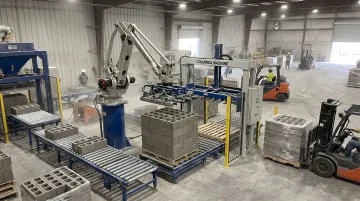
Founded in 1937 by Fred Neth, Sr., Columbia Machine began as "Columbia Forge and Machine Works" in Vancouver, Washington. Today, the company is the only manufacturer in this group offering both block-making machines and integrated cubing/palletizing systems purpose-built for the concrete products industry. This provides single-source accountability from production through end-of-line.
Columbia serves customers in over 100 countries, outfitting concrete products plants from batching and mixing to automatic cubing and splitting. Their palletizing offerings span mechanical and robotic systems through Columbia/Okura LLC, covering the full range from entry-level plants to high-output operations.
Differentiators:
Columbia stands out for its deep integration with upstream block production. Their cubing systems (robotic, clamp style, and plate style) are specifically engineered for concrete block environments. The Pallet Transporter System (PTS) moves green and cured product without metal racks, scaling from 3-block machines to large pallet plants. The Auto-Rack system serves multiple block machines simultaneously at high speed. Columbia is an ICPI-NCMA member exhibitor, confirming industry-specific commitment.
| Key Specifications | Details |
|---|---|
| Payload Capacity | Designed for concrete block production; systems handle pallets exceeding 4,000 lbs |
| Cycle Rate | Matches upstream block machine output (1,260-1,800+ blocks/hour) |
| Compatible Unit Types | Standard CMU, hollow block, pavers, retaining wall units, architectural block |
| Best For | Medium to large concrete products operations requiring integrated production-to-shipping workflow |
| Automation Level | Fully automatic (robotic, clamp, plate cubing systems) |
SOCO System
Founded in 1961 in Taastrup, Denmark, SOCO System employs approximately 170 people across two manufacturing facilities. The company operates subsidiaries in six countries (UK, France, Germany, Spain, USA, Hungary) plus a global network of more than 50 agents. With over 1,000 pallet loaders and palletizing robots in operation since 1986, SOCO focuses on end-of-line packaging for cartons, trays, plastic crates, and pallets.
Differentiators:
SOCO System offers accessible entry points through semi-automatic pallet loaders capable of integration into fully automated systems. Their modular conveyor systems (roller, belt, vertical) enable connection with upstream block-making equipment. The layer-by-layer palletizing approach optimizes pallet utilization and load stability.
For Midwest brick and block manufacturers, John Maye Company distributes SOCO System equipment across Wisconsin, Illinois, Indiana, Michigan, Ohio, Minnesota, and Iowa. That means direct access to factory-trained technicians, on-site installation, 24/7 service support, and rapid parts fulfillment — without routing service requests through a national call center.
| Key Specifications | Details |
|---|---|
| Payload Capacity | Up to 250 kg per layer; 1,500 kg per pallet |
| Cycle Rate | Up to 3 layers per minute |
| Compatible Unit Types | Lighter masonry products, pavers, architectural units |
| Best For | Small to mid-volume plants seeking semi-automatic or entry-level automation |
| Automation Level | Semi-automatic (operator-attended) or fully automatic |
TopTier
TopTier, based in Portland, Oregon, markets itself as "America's #1 Selling Palletizer Manufacturer" and has served more than 800 companies in 15 countries. The company offers both conventional and robotic palletizing systems designed around modular component architecture for layout flexibility and cost efficiency.
Differentiators:
TopTier's high-level infeed palletizers deliver 1-5 layers per minute with standard layer weights of 300 lbs and optional capacity up to 1,000 lbs. The EasyStack Pro HMI enables rapid pattern creation, machine setup, changeover, and maintenance logging. Systems handle cases, trays, trayless products, bundles, and nested configurations. Options include all-electric operation, concurrent stretch wrapping, and freezer environment preparation.
TopTier's documented customer base includes industrial names such as Caterpillar, BASF, Dow Chemical, General Motors, and Honeywell, primarily in food, beverage, and consumer packaged goods. No published case studies specifically documenting masonry or construction materials applications were found.
| Key Specifications | Details |
|---|---|
| Payload Capacity | Standard 300 lbs per layer; optional up to 1,000 lbs |
| Cycle Rate | 1-5 layers per minute (conventional); 1-3 layers per minute (robotic) |
| Compatible Unit Types | Cases, trays, bundles; adaptable for uniform masonry products |
| Best For | Plants requiring flexible conventional systems with heavy-layer capability |
| Automation Level | Fully automatic (conventional and robotic options) |
FANUC America
FANUC offers the widest payload range for robotic palletizing in this comparison. The M-410 series spans seven models with payloads from 110 kg to 800 kg, featuring parallel link arm design and internal cable routing. The M-2000 series handles up to 2,300 kg — FANUC's largest 6-axis robot — with reach up to 4.7 meters.
Differentiators:
FANUC's strength lies in payload scalability and integrator network depth. Their robots handle everything from standard bricks to 240-lb retaining wall blocks on the same platform via software control. PalletPRO software enables offline simulation, while PalletTool supports on-site setup and optimization. FANUC supports customers in more than 100 countries from over 280 service locations worldwide, providing the industry's largest network of authorized system integrators.
Authorized integrators design end-of-arm tooling for masonry applications rather than pulling from a standard catalog, which allows custom solutions for abrasive concrete surfaces and irregular block geometries.
| Key Specifications | Details |
|---|---|
| Payload Capacity | M-410 series: 110-800 kg; M-2000 series: up to 2,300 kg |
| Cycle Rate | Application-dependent; designed for 2-meter pallet stacking heights |
| Compatible Unit Types | Full range from standard brick to large retaining wall units (240+ lbs) |
| Best For | Plants with diverse product mixes requiring maximum flexibility and heavy-payload capability |
| Automation Level | Fully automatic (robotic) |
Haver & Boecker
Founded in 1887 in Oelde, Germany, Haver & Boecker began as a wire manufacturer producing mesh to close jute bags of cement. The U.S. subsidiary, Haver & Boecker USA, operates from a 30,000+ sq ft facility in Conyers, Georgia, with 60+ employees. The 2012 acquisition of NEWTEC Bag Palletizing strengthened their position in construction materials packaging.
Differentiators:
Haver & Boecker's heritage in cement and building materials gives them deep construction materials expertise. Their NEWTEC high-level bag palletizers handle 200-4,000 bags per hour, while low-level systems process 300-1,200 bags per hour. The AMICUS robotic palletizer handles bags, pails, drums, and boxes weighing 5-50 kg (10-110 lbs) at up to 1,200 bags per hour.
All systems integrate with upstream Roto-Packer bag filling equipment and downstream stretch wrapping for complete end-of-line solutions. Their focus is bagged products (cement, aggregates, dry mix) rather than unbagged concrete blocks or bricks.
| Key Specifications | Details |
|---|---|
| Payload Capacity | 5-50 kg per bag (AMICUS robotic); layer weights not specified for high-level systems |
| Cycle Rate | 200-4,000 bags per hour (high-level); 300-1,200 bags per hour (low-level); up to 1,200 bags per hour (robotic) |
| Compatible Unit Types | Bagged cement, bagged aggregates, dry mix, cementitious products |
| Best For | Plants handling bagged construction materials requiring integrated filling and palletizing |
| Automation Level | Fully automatic (high-level, low-level, robotic options) |
How We Chose the Best Palletizers for Brick & Block
Plant managers frequently select general-purpose palletizers without accounting for the unique demands of masonry products. Abrasive surfaces wear tooling faster than corrugated cases or shrink-wrapped bundles, irregular geometries require custom gripping solutions, and pallet loads exceeding 3,000 lbs demand structural ratings far beyond standard packaging applications. These three challenges shaped every criterion below.
Evaluation Criteria
We evaluated each system across six criteria specific to masonry production environments:
- Throughput compatibility — Must match or exceed upstream line speeds. Columbia CPM-series machines hit 1,440 blocks/hour; Besser Dynapac reaches 1,800 units/hour. A slower palletizer becomes the bottleneck.
- Payload and structural ratings — Unit weights range from 4.5 lbs (clay brick) to 240 lbs (large retaining wall block). A standard pallet of 8x8x16 CMUs reaches 4,140 lbs. Systems must handle these loads without structural fatigue.
- Format flexibility — Multi-product plants benefit from robotic systems with software-controlled pattern changes. Single-product operations favor conventional layer palletizers for higher throughput.
- Integration with existing systems — Must connect with upstream conveyors, curing chambers, and downstream stretch wrapping without extensive facility modification.
- Total cost of ownership — Purchase price is one factor. Also weigh EOAT replacement frequency from abrasion, cement dust filtration requirements, maintenance intervals, and the cost of unplanned downtime (a downed palletizer halts shipping even while the block machine keeps running).
- After-sales support — Technician proximity and parts availability weigh heavily. FANUC's 280+ global service locations contrast with SOCO System's 50+ agent network. Regional distributors like John Maye Company (serving Wisconsin, Illinois, Indiana, Michigan, Ohio, Minnesota, Iowa) provide localized response that keeps downtime short.

Conclusion
Choosing the right palletizer for a brick or block plant isn't about purchase price—it's about matching machine capability to your specific production rate, unit mix, and floor layout, while ensuring reliable long-term support.
Before committing, evaluate each system against these practical criteria:
- Scalability: A semi-automatic system handling today's 800-blocks-per-hour output may bottleneck when you upgrade to a faster block machine next year
- Total cost of ownership: Factor in maintenance intervals, tooling wear rates, and the cost of unplanned downtime—not just the purchase price
- Floor layout compatibility: Confirm the footprint and infeed orientation fit your existing production line without costly civil work
Request live demonstrations or facility visits . Seeing equipment handle actual concrete products—not just corrugated cases—reveals whether tooling, cycle times, and pattern flexibility meet real-world demands.
That evaluation process is where an experienced equipment partner adds real value. John Maye Company has worked with manufacturers across the Midwest for 40+ years, helping brick and block operations evaluate, source, and support the right palletizing system. As a regional partner for SOCO System, we provide sales, installation, and ongoing service across Wisconsin, Illinois, Indiana, Michigan, Ohio, Minnesota, and Iowa.
Contact us for a consultation at 1-800-441-6293 or info@johnmayecompany.com.
Frequently Asked Questions
How much does a palletizer for brick cost?
Palletizer pricing varies widely based on automation level, throughput capacity, and integration complexity—and most manufacturers quote by application rather than publish list prices. General tiers run:
- Semi-automatic pallet loaders: entry-level investment
- Conventional layer palletizers: mid-range
- Robotic systems with custom EOAT: premium pricing
Can brick making be automated?
Yes. Modern brick and block production can be highly automated—from mixing and molding through curing to palletizing and stretch wrapping. Fully automatic lines run with minimal operator oversight, while semi-automatic systems require operator guidance at key stages.
How many concrete blocks are in a pallet?
Standard 8x8x16 hollow CMUs typically stack 75 blocks per pallet at approximately 28 lbs each (approximately 2,100 lbs product weight). Solid 8x8x16 CMUs stack 60 blocks per pallet at 68 lbs each (4,140 lbs total pallet weight). Actual counts shift based on block size and pallet configuration.
How much does a pallet of bricks weigh?
A standard pallet of bricks typically weighs between 2,200 and 3,000 lbs depending on brick type, size, and stacking count. Clay bricks at approximately 4.5 lbs each stack 500-600 per pallet (2,250-2,700 lbs). This weight matters for palletizer payload rating selection—systems rated for light packaging won't handle masonry loads.
What is the difference between a robotic and a conventional layer palletizer?
Robotic palletizers use articulated arms to pick individual products or small groups—ideal for mixed SKUs and tighter floor space. Conventional layer palletizers build and place full layers at once, delivering higher throughput for uniform products at lower per-unit cost. Most brick and block plants use conventional systems for single-product runs and robotic systems when product mix is diverse.
What throughput speed should a brick palletizer support?
Palletizer throughput should match or exceed upstream block-making machine output. Columbia CPM-series machines produce up to 1,440 blocks per hour (8 cycles per minute with 3 blocks per cycle). Besser Dynapac achieves up to 1,800 blocks per hour (10 cycles per minute). Any palletizer running below these rates becomes the bottleneck, idling costly upstream equipment.