Key Takeaways
- Brenton specializes in flexible, multi-format palletizing — ideal for irregular shapes, bags, cans, or mixed SKUs with frequent changeovers
- Columbia excels in high-volume operations with unlimited pattern-forming capabilities and zero tool changeover — built for consistent, single-SKU lines
- Brenton suits mixed-product facilities; Columbia's throughput advantage compounds significantly at volumes above ~20 cycles/minute
- Robotic systems cost roughly double to maintain annually — ~3% vs. 1.5% of initial investment for conventional lines
- Start your decision with three questions: What's your SKU count, your target cycles per minute, and your available floor footprint
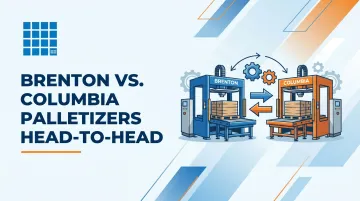
Brenton vs. Columbia: Quick Comparison
| Category | Brenton (ProMach) | Columbia Machine Inc. |
|---|---|---|
| Headquarters | Alexandria, MN | Vancouver, WA |
| Conventional Throughput | 30 to 100+ CPM | 150+ CPM (up to 200 CPM on HL2200) |
| Floor-Level Throughput | 20+ CPM (LLP Medium Speed) | Up to 100 CPM (FLD6200) |
| Robotic Throughput | Up to 14 CPM (RPX Series) | 1-4 lines, 1-6 pallets simultaneously |
| Product Compatibility | Cases, bags, cans, bottles, trays, bundles, glass, barrels, irregular shapes | Cases, bundles, trays, RPCs, totes, aerosols, nested crates, spot packs |
| Safety Standard | Category II standard; Category III optional | Category 3, Performance Level D standard |
| Key Industries | Food & Beverage, Household Products, Personal Care | Beverage, Dairy, Food, Tissue/Towel, Paint, Chemical, Produce |
| Installation Base | 1,700+ palletizer installations | 1,200+ robotic installations; 100+ countries served |
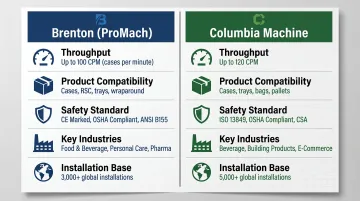
Both brands carry high initial investment, but differ in total cost of ownership based on operational fit. Robotic palletizers require approximately 3% of initial investment in annual maintenance (including cable harness replacement every 3-5 years and major overhaul every 5 years), while conventional systems run approximately 1.5%. Brenton's multi-format versatility reduces changeover downtime. Columbia's software-driven pattern switching eliminates mechanical retooling entirely.
Both platforms require careful assessment of existing line infrastructure, floor space, and upstream/downstream equipment compatibility before purchasing. An experienced Midwest distributor can evaluate your line layout, flag compatibility gaps, and narrow the decision before you commit to capital spend.
What is Brenton?
Brenton Engineering, a ProMach brand based in Alexandria, MN, offers a full line of conventional and robotic palletizers designed for manufacturers handling diverse or irregular product formats. With over 1,700 palletizer installations, the company has built its reputation on flexibility — the ability to accommodate bags, cans, bulk items, and irregularly shaped packs without dedicated tooling swaps.
Core Product Lines:
Robotic Palletizers:
- RP1000 — Standard robotic palletizer for cases and large objects with complex pack patterns; supports mixed-layer palletizing with multi-zoned vacuum, clamp, or bag grippers
- MP1000 Bulk — Palletizes full layers at a time (up to 500 lbs per pick); handles bags, cans, bottles, glass, sealed or open cases, trays, and bundles
- RL1000 — High-speed layer forming where vacuum EOAT isn't practical; modular design
- RPX Series — Configurable cells for small/medium operations; up to 14 CPM; footprints from 11.5 x 17.5 ft to 15.5 x 22.5 ft; delivery in as little as 14 weeks
Conventional Palletizers:
- HL1000 — 30 to over 100 CPM; serves single or multiple packaging lines; pattern programming via HMI
- HLP High Speed — 50 to 100+ CPM; up to 10 layers per minute
- HLP Medium Speed — 20 to 50 CPM; up to 3.5 layers per minute
- LLP Medium Speed — 20+ CPM; footprint as small as 14 x 7 ft
Key Operational Benefits:
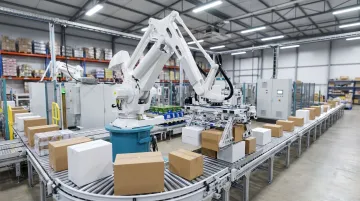
Brenton's mixed-layer palletizing capability is the clearest operational advantage. Operations stacking different SKUs on the same pallet — common in consumer goods, personal care, and household chemicals — can switch patterns on the fly without retooling. End-of-arm tooling (EOAT) versatility lets a single system handle bags, cans, and irregularly shaped products, cutting downtime and the cost of dedicated machines.
Industries and Environments Where Brenton Excels
Brenton fits best in production environments with:
- Multiple product formats on shared lines
- Frequent SKU changes or batch production schedules
- Irregular, flexible, or bag-format products requiring gentle handling
Dominant Industries:
- Personal care products
- Household chemicals
- Food and beverage (bags/pouches)
- Agricultural products
What is Columbia?
Columbia Machine Inc., a privately held manufacturer based in Vancouver, WA (founded 1934), specializes in inline high-speed, high-level, floor-level, and robotic hybrid palletizers built for high-volume production facilities. The company serves customers in 100+ countries and has installed 1,200+ robotic palletizing solutions through its Columbia/Okura joint venture.
Core Product Lines:
High-Level Palletizers:
- HL2200 — Compact footprint; handles nearly any package type including unwrapped trays, film-only bundles, plastic totes, and RPCs; VFD-controlled hoist
- HL4200 — High speed, small footprint; features Smart Diagnostics
- HL6200 — Columbia markets the HL6200 as the fastest row forming palletizer in the industry
- HL9200 BevMax — Built for high-speed beverage applications; servo-controlled variable position turners, dual-path layer pushing, Category 3 safety compliant
Floor-Level Palletizers:
- FLD6200 — Ultra-high performance, up to 100 CPM
- FL3000 — High performance with floor-level convenience
- FL2000 — Flexible layouts, easy to maintain
- FLD2500 and FLD2500-SW — Compact footprint; SW models simultaneously stack and wrap
All floor-level models have a 36-inch infeed elevation, with all maintenance accessible from floor level.
Robotic Hybrid Configurations:
Columbia/Okura robotic systems handle 1-4 lines and 1-6 pallets simultaneously, with custom-engineered configurations for complex applications.
Key Operational Benefits:
Columbia's zero-time tool-less changeover is a standout productivity feature. Operators switch between pallet patterns through software alone — no mechanical adjustments, no hardware swaps, no downtime.
The company's unlimited pattern-forming capabilities let facilities running dozens of SKUs reconfigure on demand without sacrificing throughput speed.
All systems ship with Category 3, Performance Level D safety as standard (not optional), and Columbia backs its equipment with a 98% uptime guarantee.
Use Cases of Columbia
Those operational strengths translate directly into the environments where Columbia performs best:
- High-throughput requirements (150+ CPM)
- Consistent product dimensions with many pattern variations
- Facilities prioritizing speed and software-led adaptability
- Tight integration with upstream and downstream equipment
Dominant Industries:
- Beverage and dairy (particularly high-speed beverage lines)
- Food processing (large volumes of uniformly packaged product)
- Pharmaceuticals
- Chemical products
Brenton vs. Columbia: Which is Right for Your Operation?
The decision isn't about which brand is superior — it's about which operational profile matches your facility's reality.
Key Decision Factors:
- Product mix complexity (uniform vs. irregular/mixed formats)
- Required throughput (cases per hour)
- Frequency of SKU changeovers
- Available floor space
- Existing automation infrastructure
Choose Brenton If:
Your facility handles irregular, mixed, or bag-format products and changeover flexibility is critical. Brenton's EOAT versatility and mixed-layer capability reduce manual intervention and retooling cost. Operations running personal care products, household chemicals, or diverse food packaging formats on shared lines will see the highest ROI from Brenton's adaptability.
Lower Long-Term Overhead:
For mixed-SKU facilities, Brenton's single-platform approach lowers ongoing costs by avoiding tooling replacements and changeover downtime. Robotic systems do carry higher maintenance costs (3% annually vs. 1.5% for conventional), but handling multiple formats on one machine eliminates the need for dedicated equipment per product line.
Choose Columbia If:
Your operation runs high volumes of uniformly packaged product and pallet pattern variety needs to be managed through software, not hardware. Columbia's zero-tool-changeover and unlimited pattern logic are built for this profile. High-speed beverage, dairy, and chemical operations benefit most from Columbia's throughput ceiling (up to 200 CPM on the HL2200) and software-driven reconfiguration.
Speed Compounds Savings:
Columbia's efficiency gains compound at high production volumes. Software-only pattern switching eliminates mechanical changeover downtime entirely. For facilities running 150+ CPM consistently, the incremental speed advantage and uptime guarantee deliver measurable per-unit cost reductions that offset higher initial investment.
Real-World Context
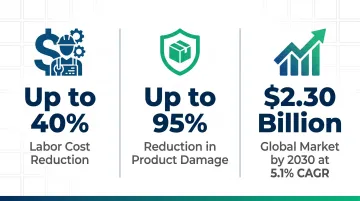
Automated palletizers can cut labor expenses by up to 40%, reduce product damage by up to 95%, and deliver typical ROI within 12-24 months. The global automatic palletizer market is projected to reach $2.30 billion by 2030, growing at 5.1% CAGR — driven by facilities seeking exactly this kind of operational transformation.
Get Expert Guidance:
Those ROI windows narrow or widen depending on how well the equipment matches your specific operation — which is where pre-purchase consultation pays off. John Maye Company brings 40+ years of Midwest packaging expertise and manufacturer-trained technicians to help evaluate both brands against your floor layout, throughput targets, and budget.
They serve Wisconsin, Illinois, Indiana, Michigan, Ohio, Minnesota, and Iowa with on-site consultation, integration design, and ongoing technical support. Reach them at 1-800-441-6293 or info@johnmayecompany.com.
Conclusion
Brenton is the stronger fit for operations demanding flexibility across formats and frequent changeovers. Columbia is built for high-volume, pattern-driven operations where speed and software-led adaptability matter most. Which one wins depends entirely on what your line actually needs.
The real cost of a mismatched palletizer isn't the purchase price — it's production delays, maintenance burden, and throughput loss that accumulate over a machine's full lifecycle. Align the decision with your long-term operational goals, assess your actual product mix and changeover frequency, and talk to someone who's installed both platforms in Midwest facilities.
Reach out to John Maye Company for a personalized equipment consultation tailored to your production environment.
Frequently Asked Questions
What does palletizing mean?
Palletizing is the automated or manual process of arranging and stacking products onto pallets in a structured pattern for efficient shipping and storage. Automated palletizers eliminate manual labor from this step, improving consistency and reducing injury risk.
How does palletizing reduce costs?
Automated palletizers cut labor costs by up to 40% by replacing repetitive manual stacking and reduce product damage through consistent placement (up to 95% reduction). Higher throughput also lowers per-unit handling costs over time.
Can a palletizer handle fragile items?
Yes. Modern palletizers — especially robotic systems like those from Brenton and Columbia — can be configured with gentle-handling end-of-arm tooling and programmable placement logic to accommodate fragile products without damage.
What is the difference between robotic and conventional palletizers?
Conventional palletizers use fixed mechanical systems for high-speed, repetitive stacking of uniform products. Robotic palletizers use programmable arms offering greater flexibility for mixed product types and irregular formats, though they require higher maintenance (3% vs. 1.5% annually).
How do I choose between Brenton and Columbia palletizers?
Consider your product mix, SKU changeover frequency, and throughput volume. Brenton excels with mixed formats and frequent changes; Columbia dominates in high-volume, pattern-driven operations. A distributor like John Maye Company can evaluate both against your specific production environment.
What industries use Brenton or Columbia palletizers?
Both serve food & beverage, pharmaceuticals, and consumer goods. Brenton is particularly favored in personal care and mixed-format production. Columbia is widely used in high-volume beverage, dairy, and chemical operations where consistent pallet patterns and speed matter most.