Introduction
Many Midwest manufacturers evaluating end-of-line automation assume Brenton and Currie represent competing brands. In reality, both are trusted names under the same ownership—Brenton Engineering, a ProMach company—and the real choice buyers face is between Brenton's robotic palletizer line and the Currie by Brenton conventional palletizer line.
Picking the wrong system has real consequences — throughput rates, changeover times, labor costs, and long-term ROI all shift depending on which approach fits your operation. According to the National Safety Council, U.S. industries lose $167 billion annually to non-fatal workplace injuries, many from manual material handling in packaging.
Automated palletizing solves the safety problem. But choosing between robotic flexibility and conventional high-speed throughput still requires a clear-eyed look at your facility's specific demands.
What follows is a direct comparison of both lines — with enough operational detail to make a confident decision.
Key Takeaways
- Currie by Brenton is a conventional palletizer line; both brands now operate under ProMach's end-of-line portfolio
- Brenton's robotic palletizers excel at multi-SKU handling, gentle product placement, and flexible pallet patterns
- Currie conventional palletizers (HLP, LLP) are built for high-speed dedicated lines running 20–100+ cases per minute
- Conventional systems typically deliver lower upfront investment and total cost of ownership for uniform, high-volume production
- High-volume, single-SKU lines typically favor Currie; mixed-SKU or space-constrained operations tend to lean toward Brenton robotics
Brenton vs. Currie by Brenton: Quick Comparison
| Factor | Brenton Robotic Palletizers | Currie by Brenton Conventional |
|---|---|---|
| Palletizer Type | Robotic (FANUC 6-axis arms) | Conventional (servo-driven pushers/elevators) |
| Speed Range | Up to 70-80 cases/min | HLP: 30–100+ CPM; LLP: 20+ CPM |
| Ideal Use Case | Multi-SKU, varied products, gentle handling | High-volume, uniform loads, dedicated lines |
| Flexibility/Changeover | Programmable patterns in 30 seconds | Pattern storage (100+ recipes), but less adaptable |
| Footprint | Compact (varies by model) | Modular, configurable for plant layout |
| Safety Systems | CAT II/III safety circuits, light curtains | CAT II standard, CAT III optional, muting light curtains |
| Integration Capability | ProMach end-of-line (Orion stretch wrappers, conveyors) | ProMach ecosystem (stretch wrappers, corner board placers) |
Key Clarification: In 2012, Currie by Brenton expanded to include robotic palletizing options, so buyers should confirm whether they're evaluating the Currie conventional line (HLP/LLP) or Brenton's dedicated robotic series (RP1000, MP1000, RL1000). Both lines share Brenton's core engineering standards: servo-driven precision, HMI touchscreen controls, and CAT II/III safety systems.
What Are Brenton Palletizers?
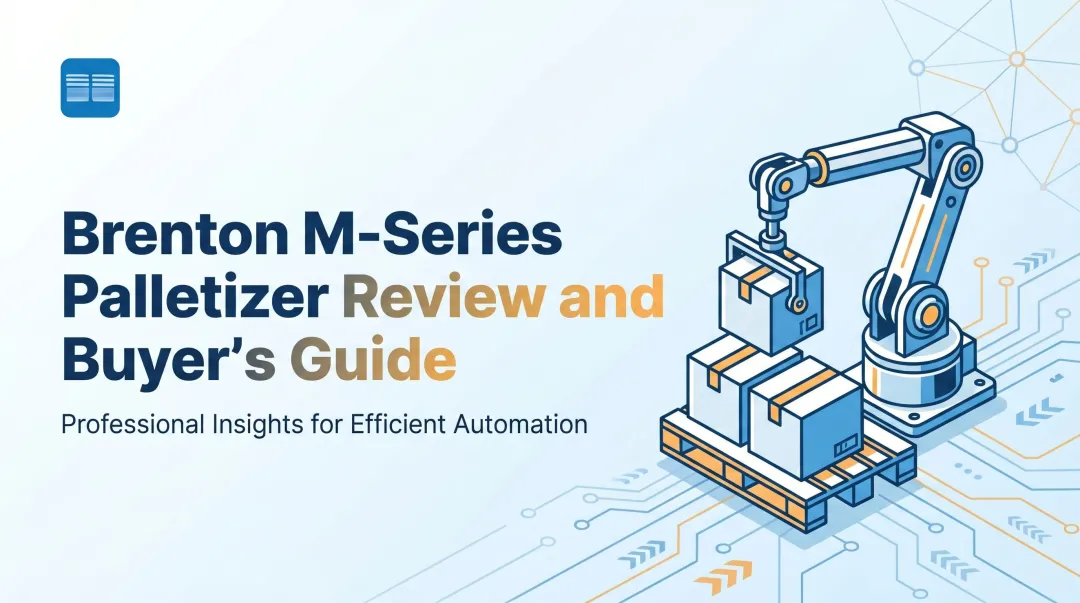
Brenton's palletizer line is a robotic and integrated palletizing system built for operations that handle multiple SKUs, complex pallet patterns, or products that require careful placement.
Core Product Models:
- RP1000 Robotic Palletizer – standard robotic arm palletizing
- MP1000 Bulk Robotic Palletizer – bulk cases/containers
- RL1000 Robotic Layer Palletizer – layer-by-layer placement
- HL1000 High Level Conventional Palletizer – conventional option within Brenton's portfolio
Brenton is recognized as one of FANUC's biggest partners in packaging, holding FANUC Strategic Market Specialist status and having won FANUC's Sales Leadership Award for three consecutive years. The company maintains five Master Certified FANUC Technicians—the highest certification level—and is a FANUC Certified Servicing Integrator (CSI), a distinction held by just 4% of companies.
Key Operational Benefits:
- Reprogram pallet patterns on-site without factory service visits
- Switch between product lines in as little as 30 seconds
- Reduces injury risk — OSHA data shows manual palletizing workers are 8x more likely to suffer back injuries; one documented robotic implementation eliminated 95% of back/spine injury risk and 100% of wrist/hand musculoskeletal disorder risk
- Built for long-term use with adaptable configurations as product lines evolve

Use Cases of Brenton Palletizers
Brenton robotic palletizers fit best where:
- Operations run multiple product lines or SKUs simultaneously
- Facilities need gentle handling for fragile or irregularly shaped products
- Plants prioritize flexibility over raw speed
- Pallet pattern complexity is high (nesting, mixed-case configurations)
Industries: Food and beverage, pharmaceutical, personal care, household products, medical devices, and retail—where product variety and pallet pattern complexity are priorities.
What Are Currie by Brenton Palletizers?
The Currie by Brenton line is a conventional palletizing solution with over 100 years of field-proven design heritage. Brenton Engineering acquired the California-based Currie Machinery Company in 2006 and now manufactures the Currie line at its Minnesota facilities. The line is built for rugged, heavy-duty, high-throughput operations.
Primary Conventional Models:
HLP (High Level Infeed Palletizer)
- Hydraulic-free, servo-driven (elevators, row pushers, layer pushers)
- Speed: 30–100+ cases per minute
- Pattern storage: 100+ recipes
- Modular design accommodates various plant configurations
LLP (Low Level Infeed Palletizer)
- Heavy-duty medium-speed design
- Speed: 20+ cases per minute
- Pallet compatibility: GMA/CHEP pallets
- Ships in a single container for easier installation
Both models feature:
- User-friendly HMI with quick operator programming
- CAT II/III safety circuits with muting light curtains designed from the ground up
- All servo-drive precision (no hydraulics to maintain on HLP)
- Modular plant layout compatibility
Since 2012, Currie by Brenton has also offered robotic palletizing options — giving buyers a single source for conventional, robotic, gantry, and bulk solutions.
Use Cases of Currie by Brenton Palletizers
Currie conventional palletizers fit best where:
- High-volume, single-product or limited-SKU production lines
- Operations require speeds above 30 cases per minute with consistent uniform loads
- Long-term uptime and durability in demanding environments (food processing, beverage, construction materials) are paramount
- Automation budget is a priority and SKU variety is low enough that flexibility isn't a deciding factor
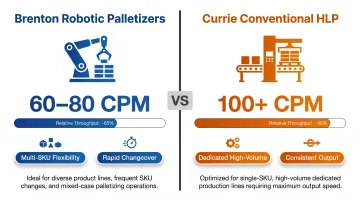
The LLP's modular design and lower price make it a practical entry point for mid-sized operations that need heavy-duty reliability without enterprise-level spend. For high-volume dedicated lines — particularly in beverage — the throughput gap is real: where robotic systems typically achieve 60–80 CPM, conventional HLP units can sustain 100+ CPM, making them the faster choice when product mix stays consistent.
Brenton vs. Currie by Brenton: Which Palletizer Is Right for You?
The right palletizer comes down to matching machine capability to your operational reality—throughput, product mix, floor space, and long-term costs all factor in.
Key Evaluation Factors:
- Throughput rate requirements
- Product/SKU diversity
- Available floor space
- Existing line configuration
- Total cost of ownership (upfront vs. long-term)
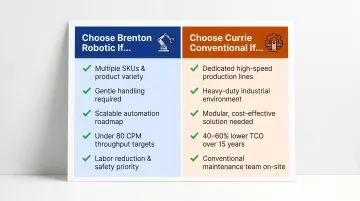
Choose Brenton Robotic Palletizers If:
- Your operation runs multiple SKUs or product types requiring frequent pallet pattern changes
- You need gentle handling to minimize product damage
- You want scalable automation that adapts as your product mix evolves
- Throughput requirements are under 80 cases per minute
- Labor reduction and worker safety are top priorities
Choose Currie by Brenton Conventional Palletizers If:
- Your operation runs high-speed, dedicated lines with consistent uniform loads exceeding 30+ cases per minute
- You need a proven heavy-duty machine for demanding plant environments
- You want a modular, cost-effective solution that can be scaled and integrated with stretch wrapping or corner board placing systems
- Lower total cost of ownership matters—conventional palletizers deliver 40-60% lower TCO over 15 years compared to robotic systems
- Your maintenance team can handle conventional mechanical systems without specialized robotic expertise
Integration Advantage: Both Brenton robotic and Currie by Brenton conventional palletizers integrate with ProMach's broader end-of-line ecosystem—stretch wrappers, case sealers, conveyors, and corner board applicators—meaning "system fit" matters as much as the individual machine choice.
Regional Expertise Matters: Midwest manufacturers weighing these options often benefit from working with a distributor who knows both machines. John Maye Company has 40+ years of packaging expertise and manufacturer-trained technicians who can match the right Brenton or Currie palletizer to your facility requirements, throughput goals, and budget.
Conclusion
Brenton's robotic line and the Currie by Brenton conventional line aren't competing products—they're complementary tools for different operational needs. High-speed, uniform production lines favor the Currie conventional approach; flexible, multi-SKU operations favor Brenton robotic systems. The right fit depends entirely on your operation.
That choice has real consequences for uptime, labor costs, and how quickly you see a return. Before committing, assess your throughput requirements, product variety, and floor layout.
John Maye Company carries both Brenton and Currie by Brenton lines and has served Midwest manufacturers since 1983. Their factory-certified technicians, on-site parts inventory, and system integration experience make them a practical starting point for any palletizer evaluation. Reach them at johnmayecompany.com or call 1-800-441-6293.
Frequently Asked Questions
What is palletizing in robotics?
Robotic palletizing uses a programmable robotic arm (such as a FANUC 6-axis robot) to automatically pick, orient, and stack cases or products onto pallets in pre-defined patterns. This replaces manual labor while improving speed, consistency, and worker safety.
Is Currie the same as Brenton?
Currie by Brenton is a product line within Brenton Engineering. Brenton acquired the California-based Currie Machinery Company in 2006 and now manufactures the Currie conventional palletizer line at its Minnesota facilities alongside its own robotic palletizer series.
What is the difference between a conventional and a robotic palletizer?
Conventional palletizers use mechanical systems (row and layer pushers, elevators) to stack cases at high speeds on dedicated lines. Robotic palletizers use programmable robotic arms that offer greater flexibility for varied SKUs and pallet patterns but typically at lower peak throughput rates.
How many cases per minute can a Currie by Brenton palletizer handle?
The Currie HLP high-speed conventional palletizer handles speeds from 30 to over 100 cases per minute, while the LLP medium-speed model handles 20+ cases per minute, making them well-suited for high-volume production lines.
What industries use Brenton and Currie palletizers?
Both lines serve food and beverage, pharmaceutical, personal care, household products, and industrial goods manufacturers. The Currie conventional line is also commonly used in construction materials and other high-volume operations where sustained throughput is the priority.
Can a Brenton or Currie palletizer integrate with other end-of-line equipment?
Yes, both lines are designed to integrate with ProMach's end-of-line ecosystem (including stretch wrappers, corner board applicators, and case sealers) and can serve single or multiple packaging lines in various plant configurations.