Introduction
Modern bottling operations move thousands of bottles per hour through automated filling and labeling lines, creating intense pressure at the end-of-line palletizing station. A single high-speed bottling line can produce 800–900 bottles per minute during surge periods, meaning your palletizing system must match that pace or become the bottleneck that stops everything upstream.
Manual palletizing simply cannot keep up with that pace — and the injury costs compound the problem. According to the U.S. Bureau of Labor Statistics, manual handling operations generated serious numbers in 2018:
- 272,780 musculoskeletal disorder cases — 30% of all days-away-from-work incidents
- Laborers and material movers logged 25,110 MSD cases
- Median recovery time: 12 days away from work per incident
These injury risks, combined with labor shortages and rising wage pressures, have accelerated automation adoption. The global palletizer market was valued at $3.17 billion in 2024 and is projected to reach $4.09 billion by 2029, according to MarketsandMarkets. This guide breaks down the best palletizer types for bottling plants, what to look for in each, and how to match the right system to your line speed and layout.
Key Takeaways
- Automated palletizers—both conventional and robotic—have become necessary for high-volume bottling plants outgrowing manual labor
- Top systems balance throughput speed, floor footprint, glass vs. PET handling, and conveyor integration
- Top manufacturers include Columbia Machine, Brenton, TopTier, Kaufman Engineered Systems, and ABC Packaging Machine
- Selection criteria should cover bottles-per-minute capacity, floor space, pallet pattern flexibility, and total cost of ownership
- Midwest bottling operations can work with regional packaging equipment experts like John Maye Company for sourcing, configuration, and ongoing support
Overview of Palletizers in the Bottling Industry
A palletizer is an automated machine positioned at the end of a bottling line that stacks filled, labeled, or empty bottles onto pallets in precise patterns for shipping or warehouse storage. Choosing the wrong one introduces a bottleneck that limits your entire line's output — regardless of how fast everything upstream runs.
The bottling industry relies on two dominant palletizer categories:
- Layer (conventional) palletizers — form and stack complete rows or layers at once; dominate ultra-high-speed, single-SKU glass bottle lines
- Robotic palletizers — use articulated arms with custom grippers to pick and place bottles; excel in multi-format operations requiring frequent changeovers
Both remain in active use because each performs better in different production environments.
The systems below represent the leading palletizer brands suited to bottling environments, evaluated on throughput capability, glass and PET bottle handling, floor space requirements, and track record in active bottling operations.
Types of Palletizers Used in Bottling Plants
Layer/Conventional Palletizers
Layer palletizers pre-form a complete layer of bottles on a staging table before lowering the entire layer onto the pallet in one motion. The process involves precise mechanical sequencing:
- Bottles enter via an infeed conveyor where turners orient them into the required configuration
- Cases or bottles are pushed into rows and accumulated on a staging table to form a tightly packed layer
- A sweep mechanism moves the completed layer onto a stripper plate (apron)
- The plate centers the layer over the pallet, then retracts to settle the layer onto the previous load
- A hoist lowers by one layer-height to receive the next cycle
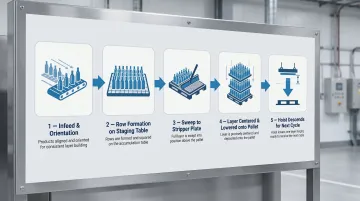
These systems excel at very high-speed lines—particularly glass bottle production—where throughput rates of 30 to 100+ cases per minute are common. They offer predictable pattern control and wide industry adoption in large-volume beverage facilities. Advanced models like Columbia Machine's HL4200 feature VFD-controlled pacer meter belts and Smart Squeeze Technology for misformed layer detection. TopTier's modular systems take a different approach, using dual meter belts with differential speeds for product singulation.
Robotic Palletizers
Robotic palletizers use articulated arms equipped with specialized end-of-arm tooling (EOAT) to pick and place bottles or groups of bottles. The EOAT category you select determines system performance more than the robot itself.
Five primary EOAT types serve bottling applications:
- Venturi vacuum: Handles up to 30 lbs (1-2 cases/cycle), lowest cost, requires frequent dust cleaning
- Dense array vacuum: Handles up to 50 lbs (multiple rows/cycle), mid-range cost, suited for regular slotted cases
- Clamp (servo or pneumatic): Handles half pallet per cycle, ideal for bottled water cases and shrink-wrapped bundles
- Fork: Picks entire rows per cycle at high speed, best for display cases and heavy/unstable loads, requires larger robot
- Full-layer drawer: Picks complete layers of glass bottles in one movement, highest speed for bulk applications
The decisive advantage of robotic systems is changeover speed. Modern palletizing robots enable complete changeovers with a few button pushes, and new palletizing patterns can be built in minutes using software tools. That flexibility pays off fast for any operation running 10 or more bottle formats.
Semi-Automatic Palletizers
Not every bottling line needs full automation. Semi-automatic palletizers sit between manual stacking and fully automated systems — an operator assists with layer formation while mechanical lifting handles the stacking work, eliminating the heaviest physical strain and injury risk.
These systems serve as cost-effective entry points for smaller bottling operations or lower-volume SKUs before justifying full automation investment. They reduce labor costs and injury liability while preserving operator involvement for quality control.
Best Palletizers for Bottling Plants
The following brands are recognized for reliability, throughput performance, flexibility across bottle types (glass and PET), and proven deployment in bottling environments. All technical specifications should be verified directly with manufacturers before purchase decisions.
Columbia Machine
Columbia Machine is one of North America's longest-established conventional palletizer manufacturers, widely deployed across beverage, water, and glass bottle operations. Their product range spans semi-automatic to high-speed fully automatic layer palletizers.
Key differentiators:
- Consistent layer formation for fragile glass bottles
- Broad model range matching any production speed
- Strong service and parts network across the U.S.
| Key Models | Speed/Throughput Range | Best For |
|---|---|---|
| FL2000 Floor Level Palletizer | 20+ cases per minute | Mid-to-high volume beverage packaging, shrink bundles, cases, trays |
| HL4200 High Level Palletizer | High performance (specific CPM not published) | Compact footprint applications, display packs, totes, crates |
The FL2000 includes:
- Category 3 safety electrical systems
- Product Manager software for pattern creation
- Smart Squeeze Technology that detects misformed layers before they cause jams
- FDA-accepted stainless steel paint for wet environments
- Labels-out stacking for retail visibility
Brenton (ProMach)
Brenton, a ProMach brand, specializes in robotic and conventional end-of-line packaging automation with a strong presence in beverage and consumer goods bottling lines. Their integration capabilities extend across full packaging lines, not just palletizing stations.
Key differentiators:
- Robotic palletizing solutions built for multi-SKU flexibility
- Quick-changeover tooling for operations running multiple bottle formats
- Full end-of-line integration expertise beyond the palletizing station
| Key Models | Speed/Throughput Range | Best For |
|---|---|---|
| MP1000 Bulk Robotic Palletizer | Full layers up to 500 lbs | Bulk bottles, cans, jars, canisters (empty or full) |
| RP1000 Robotic Palletizer | Not published (multi-zoned vacuum/clamp grippers) | Multi-SKU operations, mixed layer palletizing |
The MP1000 uses MasterPal technology with a servo-operated rotary tool and slatted apron EOAT, providing "cradle and place" handling specifically designed for bottles. The RP1000 supports mixed layer palletizing, making it well-suited for distribution centers running multiple beverage brands on a single line.
For context, larger beer, wine, and spirits producers typically target 60–80 cases per minute when running multiple high-volume SKUs — a benchmark Brenton's robotic systems are engineered to meet.
TopTier
TopTier specializes in high-speed layer palletizing systems recognized for patented dual-conveyor infeed technology and fast cycle times that make them a strong fit for high-output bottling lines.
Key differentiators:
- Among the fastest layer palletizing speeds available for bottling applications
- Gentle handling suited to unstable or lightweight bottles
- Compact footprint relative to throughput capacity
| Key Models | Speed/Throughput Range | Best For |
|---|---|---|
| High Level Infeed Palletizer | 1–5 layers per minute | High-speed PET water or beverage lines |
| Modular Palletizing Systems | Over 4 layers per minute | Operations needing speed without large floor space sacrifice |
TopTier's High Level Infeed delivers a minimum footprint of 80″ × 80″ (typical 190″ × 142″) while achieving up to 5 layers per minute. The system stores 99 pallet patterns with instant access, and the PerfectPattern infeed system ensures positive product handling for accurate row and layer building.
Standard layer weight capacity is 300 lbs, with options extending to 1,000 lbs for heavy glass bottle applications. Standard load height is 72″, with options reaching 110″.
Kaufman Engineered Systems (KES)
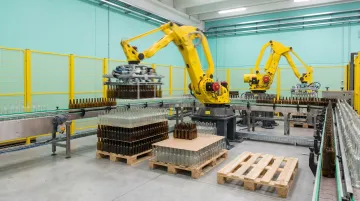
Kaufman Engineered Systems is a custom robotic palletizing integrator with documented experience in bulk glass bottle palletizing, including systems running at 800–900 bottles per minute using FANUC robots with patented full-layer drawer tooling.
Key differentiators:
- Fully custom-engineered systems for complex bottling environments
- Patented K5 full-layer EOAT handling glass bottles directly to open trays and cases
- Built-in load strapping integrated within the palletizing cell
- Dynamic dunnage management to prevent line stoppages
| Key Systems | Speed/Throughput Range | Best For |
|---|---|---|
| KPal K5 Full Layer Bulk Glass Palletizing System | 800 BPM nominal / 900 BPM surge | High-volume glass bottle producers with constrained footprints |
The KPal K5 uses three FANUC robots in a coordinated cell:
- Primary robot (M-410iC/500H): K5 patented full-layer drawer tool for bottle placement
- Support robots (2× M-410iB/140H): dunnage handling and sweep operations
Each pallet holds 440 bottles per tier across 10 layers, producing 4,400-bottle loads at approximately 3,000 lbs and 90″ height. The integrated strapping system secures loads immediately after palletizing — no conveying unstrapped loads over long distances. Dynamic dunnage management automatically monitors pallet, sheet, and top frame levels, cutting manual operator intervention.
ABC Packaging Machine
ABC Packaging Machine is a U.S.-based manufacturer offering both conventional and robotic palletizers with a long track record in bottling and glass container industries. Their focus centers on gentle, stable handling of glass and PET bottles.
Key differentiators:
- Bottle-specific design heritage spanning decades
- Proven deployments in wine, spirits, and water bottling
- Flexibility across bottle sizes and shapes with minimal changeover time
| Key Models | Speed/Throughput Range | Best For |
|---|---|---|
| M72A | 3 layers per minute | All-around bottling applications, wine, spirits, water |
| M72AG | 4 layers per minute | Higher-speed glass bottle operations |
ABC's 72 Series palletizers handle maximum tier weights of 650 lbs and support cases, trays, RPCs, shrink-wrapped packs, bundles, display packs, and totes. The systems feature one-touch control, pallet builder software, and rapid product changeover with a modular design maintaining a compact footprint.
ABC's beverage industry documentation confirms service to distilled spirits, wine, craft beer, juice, nutritional beverages, sports drinks, soft drinks, water, and flavored teas and coffees — handling glass, PET, HDPE, and plant-based container materials.
How We Chose the Best Palletizers for Bottling Plants
Every system on this list was evaluated against criteria that reflect real bottling plant conditions—not just spec sheet numbers. Selection factors included throughput relative to line speed, glass and PET handling capability, footprint efficiency, conveyor integration flexibility, and deployment track record.
Don't buy on price alone. Changeover time, dunnage handling complexity, and unplanned downtime costs routinely flip the economics on a low-bid purchase. Industry data shows a 12-18 month average payback period for palletizer automation, with $65,000-$85,000 annual labor savings per automated station. Installation costs range $175,000-$350,000, but the ROI analysis strongly favors automation for multi-shift operations.
Key performance criteria to weigh:
- Bottles-per-minute (or layers-per-hour) to match filling line speed
- EOAT/gripper design for your specific bottle material and geometry
- Pallet pattern programmability for SKU flexibility
- Available floor space versus machine footprint
- Total cost of ownership including maintenance, changeover labor, and dunnage consumption
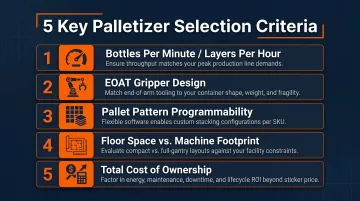
The wrong EOAT selection creates bottlenecks that directly erode ROI. For example, venturi vacuum systems cost less upfront but require frequent cleaning of corrugated dust, while fork systems are maintenance-free (other than lubrication) but require a heftier robot, increasing capital cost.
These trade-offs make distributor expertise matter as much as the equipment itself. Working with a regional specialist familiar with Midwest bottling operations—like John Maye Company, which has served food and beverage manufacturers since 1983 with factory-certified technicians and 2,500+ SKUs in inventory—can reduce mismatched selections and compress installation timelines.
Conclusion
The best palletizer for a bottling plant is not a one-size-fits-all decision. It depends on bottle type (glass vs. PET), line speed, floor layout, and whether your operation needs single-SKU efficiency or multi-format flexibility. Investing in the right system reduces labor costs, improves load stability, and eliminates the throughput bottleneck at the end of the line.
Before finalizing any purchase, evaluate these metrics alongside sticker price:
- Uptime percentage — the single most reliable indicator of long-term ROI
- Changeover duration — critical for multi-SKU lines running frequent format switches
- Dunnage consumption — ongoing material cost that compounds across millions of cycles
- Local service availability and parts lead times — a $200,000 system becomes a liability if technicians are three states away
For bottling plant operators in Wisconsin and across the Midwest, John Maye Company offers hands-on guidance for selecting, sourcing, and supporting the right palletizing system. With 40+ years of experience, 2,500+ SKUs in inventory, a 24-hour ship guarantee, and factory-certified technicians, they bring the depth of expertise that keeps lines running.
Frequently Asked Questions
What does a palletizer for bottling do?
A bottling plant palletizer automatically stacks bottles—filled or empty, glass or PET—onto pallets in defined patterns at the end of the production line. It replaces manual labor, matches the throughput of high-speed filling and labeling operations, and reduces injury risk.
What is manual palletizing in bottling?
Manual palletizing involves workers physically lifting and stacking bottles onto pallets by hand. It has a low throughput ceiling, high repetitive strain injury risk, and cannot keep pace with automated upstream processes, making it largely obsolete at scale for modern bottling operations.
Who are palletizer personnel for bottling and what are their roles?
Three roles are typical: a palletizer operator monitors performance and clears jams; a line or maintenance technician handles preventive maintenance and fault troubleshooting; and a line supervisor oversees pallet pattern compliance and production targets.
What is the difference between a robotic and a conventional palletizer for bottles?
Conventional (layer) palletizers pre-form entire layers before stacking, making them ideal for very high-speed single-SKU glass bottle lines. Robotic palletizers use articulated arms with custom tooling, offering greater flexibility for mixed formats, smaller footprints, and changeovers in minutes rather than hours.
How many bottles per minute can an automated palletizer handle?
Throughput depends on system type and configuration. High-end bulk glass systems can handle 800–900 bottles per minute at surge rates, while mid-range systems are rated in cases or layers per minute — actual BPM varies by bottle format and case density.
How do I choose the right palletizer for my bottling plant?
Start with your line speed in bottles per minute, then factor in bottle type and fragility, floor space, number of SKUs, and total cost of ownership including maintenance and changeover labor. A certified packaging equipment distributor can provide a needs assessment tailored to your operation.