Introduction
In any bottling operation, conveyors are what keep every production stage connected—moving bottles from infeed through filling, capping, labeling, and case packing. When conveyors perform reliably, throughput remains consistent and predictable. When they don't, entire production runs grind to a halt.
A poor conveyor choice creates a cascade of problems: frequent jams, contamination risks, and unplanned downtime that can cost food and beverage manufacturers $260,000 per hour according to Aberdeen research.
Match the right system to each stage, and plants see measurably better output consistency, fewer worker injuries, and stronger sanitation compliance.
This guide covers the five most effective conveyor types for bottling plants, what makes each one suited to specific applications, and the criteria plant managers should use when evaluating options.
Key Takeaways
- Bottling plants use different conveyor types at each production stage—filling, labeling, and packaging each have distinct requirements
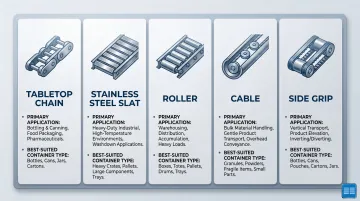
- The five most proven options are tabletop chain, stainless steel slat, roller, cable, and side grip conveyors
- Key selection factors: container type and weight, sanitation requirements, line speed, facility layout, and system integration
- Material compliance is non-negotiable—stainless steel and FDA-approved plastics are required for beverage and pharmaceutical lines
- Working with a knowledgeable distributor prevents costly mismatches before equipment is ever installed
Overview of Conveyors in the Bottling Industry
A bottling plant conveyor system is a network of powered transport mechanisms moving containers through sequential production stations—rinsing, filling, capping, labeling, inspection, and packaging—with minimal manual handling. These systems are the connective tissue holding beverage, pharmaceutical, and specialty food bottling facilities together.
When a single conveyor fails, the impact doesn't stop at that station—it cascades across the entire production run. Unplanned downtime costs food and beverage manufacturers approximately $227 billion annually, with equipment malfunction accounting for 42% of unscheduled downtime causes.
A failed roller or broken belt triggers bottlenecks that ripple downstream, forcing entire lines offline and disrupting supply chains well beyond the plant floor.
With multiple conveyor technologies available for bottling applications, selecting the right system becomes critical. The sections below break down the top five options based on four factors: real-world performance, sanitation capability, integration flexibility, and reliability—evaluated across beverage, pharmaceutical, and specialty food bottling environments.
Best Conveyors for Bottling Plants
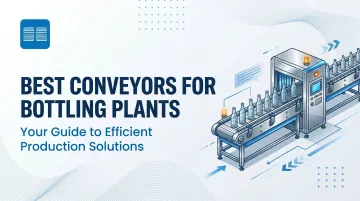
These five conveyor systems cover the most widely deployed options across bottling operations of all scales — selected based on throughput capability, food-grade compliance, integration ease, and operational reliability.
Tabletop Chain Conveyor
Tabletop chain conveyors are the most widely used conveyor type in automated bottling lines globally. They feature interlocking plastic or stainless-steel slat chains riding along a supporting track, handling everything from 1-oz containers to gallon jugs across straight, curved, incline, and decline configurations.
Key reasons tabletop chain is the go-to choice:
- Modular design enables easy reconfiguration when container sizes change
- Compatibility with accumulation systems and gap transfers prevents back pressure
- Adjustable speed via variable frequency drives matches upstream and downstream equipment
- Curve support (45°, 90°, 180°) maximizes floor space in any facility layout
Tabletop Chain Conveyor Specifications:
| Feature | Details |
|---|---|
| Key Applications | Filling, capping, labeling, and secondary packaging stations on continuous or intermittent bottling lines |
| Material Options | Acetal (Delrin), polypropylene, or 304/316 stainless steel chains; aluminum or stainless steel frame |
| Best Suited For | High-speed beverage, personal care, and pharmaceutical bottling lines with varied container sizes |
Stainless Steel Slat / Flat Top Chain Conveyor
Stainless steel flat top conveyors are the preferred choice for bottling plants with strict sanitation requirements. Built with 304 stainless steel frames, welded fasteners, and FDA-approved chain belting, these systems withstand high-pressure washdowns, steam cleaning, and harsh chemical sanitizers while remaining FSMA compliant.
The hygiene-focused design delivers several practical advantages:
- Open-frame construction eliminates bacterial harborage points
- Corrosion resistance handles product spills in breweries, juice, and dairy operations
- Curve-compatible sections support complex floor layouts without sanitation tradeoffs
Per 21 CFR 117.40, all food-contact surfaces must be corrosion-resistant, nontoxic, and designed with smoothly bonded seams that minimize bacterial accumulation — requirements these conveyors are built to meet.
Stainless Steel Slat Conveyor Specifications:
| Feature | Details |
|---|---|
| Key Applications | Beverage bottling (water, juice, dairy, beer), pharmaceutical filling lines, any facility requiring frequent washdown |
| Sanitation Standard | FDA-approved chain; 304 SS frame designed to meet FSMA preventive controls for human food |
| Best Suited For | High-hygiene bottling environments where contamination prevention and fast sanitation turnaround are priorities |
Roller Conveyor
Roller conveyors — consisting of stainless steel or polymer rollers mounted in a frame — excel at handling heavy or large-format containers such as 1-gallon jugs, 5-gallon water cooler bottles, or bulk industrial containers where belt conveyors would experience excessive wear.
Where roller conveyors stand out:
- Low rolling friction reduces motor load and long-term wear
- Gravity-assisted zones lower power costs in accumulation areas
- Unpowered sections create practical buffer zones between line stages
They're less suitable for lightweight or unstable containers prone to tipping. Load capacity typically runs 250–800 lbs per linear foot, according to Global Industrial, depending on roller material and support center spacing.
Roller Conveyor Specifications:
| Feature | Details |
|---|---|
| Key Applications | End-of-line accumulation, heavy container transport, pallet-staging and outfeed sections |
| Load Capacity | 250-800 lbs per linear foot depending on roller material and spacing |
| Best Suited For | Large-format or heavy container bottling (water, juice gallons, chemical/cleaning product lines) |
Cable Conveyor
Cable conveyors use a flexible stainless-steel cable embedded with pucks or discs running through enclosed tubing — designed specifically for gentle, continuous movement of empty plastic bottles (PET, HDPE) that are too lightweight and unstable for standard belt or chain conveyors.
Cable conveyors are purpose-built for gentle handling:
- Minimal container-to-container contact reduces label scuffing and tipping
- Compact enclosed track supports vertical lifts and long runs with tight curves
- Few moving parts mean low maintenance overhead
- Best deployed at the empty bottle infeed section, before rinsing or filling
Cable Conveyor Specifications:
| Feature | Details |
|---|---|
| Key Applications | Empty bottle transport from depalletizer or unscrambler to rinser/filler infeed |
| Container Types | PET, HDPE, and other lightweight plastic bottles; not suited for filled/heavy containers |
| Best Suited For | Beverage and water bottling plants handling large volumes of empty lightweight plastic containers |
Side Grip Conveyor
Side grip conveyors use two parallel opposed belts or padded gripper chains to secure containers by their sides — enabling controlled vertical elevation or lowering of bottles between conveyors at different heights, or precision transfer between lines, without risk of tipping or spilling.
Where side grip conveyors earn their place on multi-level lines:
- Precise product orientation during transitions reduces misfeeds and jams
- Compact footprint compared to spiral conveyors saves floor space
- Can invert or rotate containers for inspection or coding applications
- Adjustable grip width accommodates plastic, glass, and aluminum bottles across diameter ranges
Side Grip Conveyor Specifications:
| Feature | Details |
|---|---|
| Key Applications | Vertical bottle elevation between floors or mezzanines, line-to-line transfers, container inversion for inspection |
| Container Compatibility | Adjustable grip width accommodates varying bottle diameters; suitable for glass, plastic, and aluminum containers |
| Best Suited For | Bottling plants with multi-level layouts or lines requiring elevation changes without a full spiral conveyor investment |
Key Features to Look for in a Bottling Plant Conveyor
Material construction sets the foundation for every other decision. Food and beverage bottling plants require stainless steel (304 or 316 grade) or FDA-approved food-grade plastics for all wetted and washdown-exposed components. There's a critical difference between "sanitary design" and merely "stainless steel" — poor fastener placement or hollow tubing can harbor bacteria even in stainless conveyors. True sanitary design requires surface finishes of Ra ≤ 0.8 micrometers, ground-flush welds, and drainage slopes of at least 3 degrees.
Line speed and throughput matching determine whether your conveyor becomes a bottleneck or a productivity asset. The conveyor's rated speed must align with the slowest machine on the line to prevent back pressure and jams. High-speed bottling lines can run 32,000 to 100,000 bottles per hour, while standard automatic 4-head fillers produce roughly 24 bottles per minute. Build in headroom above your baseline speed — surge capacity matters during peak production.
Layout flexibility and integration compatibility are equally critical. Conveyors must physically fit the production floor — accounting for curves, inclines, cross-transfers, and accumulation zones. They also need to communicate electronically with filling, capping, and labeling machines. Modern bottling lines use virtual master axis architectures with electronic gearing, requiring high-speed encoders (2,000–10,000 pulses per revolution) and protocols like EtherCAT or PROFINET IRT.
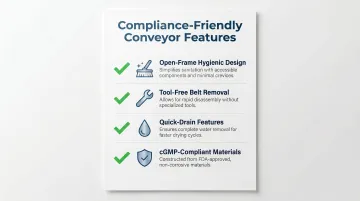
Regulatory compliance shapes conveyor selection more than many buyers anticipate. FSMA requires food and beverage facilities to document sanitation practices — conveyors with the right design features make that significantly easier. Key compliance-friendly features to look for:
- Open-frame hygienic design for unobstructed cleaning access
- Tool-free belt removal to speed up sanitation cycles
- Quick-drain features that prevent pooling and contamination risk
- cGMP-compliant materials for pharmaceutical lines governed by 21 CFR Part 211
How We Chose the Best Conveyors for Bottling Plants
Each conveyor type on this list was evaluated against criteria that matter in real bottling environments:
- Proven deployment in beverage, food, and pharmaceutical operations
- Compatibility with FSMA and food safety standards
- Throughput versatility across container sizes and line speeds
- Ease of integration with standard bottling equipment
- Total cost of ownership, including maintenance and spare parts availability
A common mistake buyers make: selecting a conveyor based purely on upfront price or brand familiarity, without accounting for sanitation design compliance, spare parts lead times, or whether the system can handle their full range of container sizes. This often results in a forced replacement or expensive retrofit within 2–3 years when the system proves incompatible with washdown procedures, fails frequent sanitation audits, or creates bottlenecks when container formats change.
Getting that configuration right from the start requires more than a product catalog. John Maye Company has worked with Midwest bottling and manufacturing operations for over 40 years, providing pre-sale guidance on system configuration and hands-on installation support. Their 2,500+ SKU parts inventory ships within 24 hours, keeping downtime short when components need replacement.
Conclusion
The right conveyor setup for a bottling plant is a system of matched technologies, each chosen for a specific job:
- Tabletop chain for the core production line
- Stainless slat for sanitation-critical zones
- Roller or cable for specific container handling needs
- Side grip for elevation changes
Selection comes down to container type, line speed, facility layout, and regulatory requirements.
Beyond spec sheets, evaluate long-term operational fit:
- Can the system scale as production volume grows?
- Can it be reconfigured when container sizes change?
- Does the supplier offer local service support to keep downtime minimal?
These questions are worth asking before you buy. John Maye Company works with food, beverage, and pharmaceutical bottling operations across the Midwest on conveyor selection and system design—with 40+ years of hands-on experience and factory-certified technicians who can help you get the configuration right from the start.
Frequently Asked Questions
How much does a conveyor for bottling cost?
Bottling conveyor costs vary based on type, length, material, and speed. Pre-engineered catalog sections cost less than custom systems; 304 stainless steel carries a premium over painted steel, and 316 stainless costs more still. Factor total cost of ownership — maintenance, spare parts availability, and downtime risk — alongside upfront price.
What are the main types of conveyors used in bottling?
The five primary types are tabletop chain, stainless slat/flat top, roller, cable, and side grip conveyors. Each addresses specific container types, facility layouts, and hygiene requirements — see the sections above for a full breakdown of when to use each.
What is a bottle hopper and how is it used?
A bottle hopper (also called a bulk bottle hopper or unscrambler hopper) is the infeed bin that feeds randomly oriented empty bottles into an unscrambler or orienter before they enter the conveyor line. It's a separate piece of equipment working upstream of the conveyor system to ensure a consistent, oriented bottle supply.
What materials are best for conveyors in food and beverage bottling plants?
304 or 316 stainless steel frames with FDA-approved chain belting are the industry standard for food and beverage bottling, due to corrosion resistance, washdown durability, and FSMA compliance. Food-grade acetal or polypropylene chain is acceptable in lower-hygiene zones away from direct product contact.
What is the difference between a tabletop chain conveyor and a slat conveyor?
Tabletop chain conveyors use flat, interlocking links forming a continuous smooth surface — ideal for high-speed single-file bottle transport. Slat conveyors use spaced flat plates with gaps for drainage, making them the better choice for high-washdown or heavy-duty applications.
How do I integrate a new conveyor into an existing bottling line?
Integration requires matching the new conveyor's speed, height, and control signals to adjacent equipment. Consulting a packaging equipment expert or manufacturer-trained technician before purchasing prevents mismatches in footprint, drive control, and PLC compatibility — a step that pays off quickly on modern high-speed lines.