Introduction
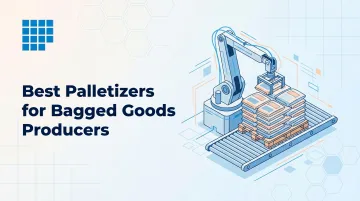
At the end of every bagging line, producers face a uniquely difficult challenge: palletizing flexible, inconsistently filled packages that come in paper, plastic, or woven materials. Unlike rigid cartons that stack cleanly, bags shift, compress, and deform under their own weight—making automated palletizing significantly more demanding than most other end-of-line applications.
The consequences of getting it wrong show up fast: crushed products, unstable pallet loads that fail in transit, repeated line stoppages, and labor costs that keep climbing. For producers in agriculture, pet food, building materials, and food ingredients, the wrong palletizer doesn't just slow you down—it erodes margins on every shift.
This guide covers the main palletizer types suited for bagged goods, what to look for when evaluating options, and how to match equipment to your specific line requirements.
Key Takeaways
- Bags rank among the most difficult formats to palletize due to flexibility, variable fill, and inconsistent geometry
- Conventional palletizers suit high-speed uniform bag runs; robotic and hybrid systems handle difficult or mixed bag types better
- Leading brands include Concetti, FANUC Robotics, Columbia Machine, Brenton, and Premier Tech
- Choose based on bag material, throughput targets, available floor space, and line integration requirements
- Work with an experienced packaging specialist to avoid costly mismatches
Palletizers for Bagged Goods: Why Bags Are Different
What Makes Bag Palletizing Complex
A bag palletizer automatically forms layers of filled bags and stacks them onto pallets in defined patterns to create stable, shippable loads. While this sounds straightforward, bags present challenges that rigid boxes simply don't.
According to Concetti's bag palletizing analysis, bags can be "stable, aerated, inconsistent, half-empty, or unstable," with contents that shift during movement. This unpredictability makes layer formation extremely difficult. TopTier confirms that bags are classified as "difficult" shapes and "nonrigid" packages, noting that conventional palletizers are "challenged" by bags and often require reinforcement to handle them effectively.
Three Core Palletizer Types
Those challenges point directly to three system types, each with a distinct trade-off between speed and handling flexibility:
- Conventional palletizers (high-level and low-level infeed) use mechanical row-forming to stack bags at high speed — best suited for stable, uniformly filled products, but they struggle with aerated or partially filled bags
- Robotic palletizers (articulated arm and gantry) use programmable arms to pick and place individual bags with precision — better at handling inconsistent or flexible bags, though throughput is typically lower
- Hybrid/combined systems mount robotic arms inside conventional frames — a practical middle ground for producers who need both speed and gentle handling
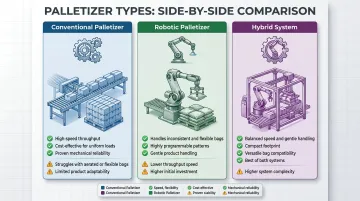
Your bag's material (paper, poly, or woven), fill consistency, product weight, and target line speed will determine which of these fits your operation.
Best Palletizers for Bagged Goods Producers
Each palletizer below was selected for its proven ability to handle flexible or partially filled bags, throughput capacity, format versatility, and track record across food, agriculture, pet food, and building materials operations.
Concetti
Concetti is an Italian packaging equipment manufacturer with decades of specialization in complete bagging and palletizing lines. The company offers one of the broadest ranges of bag palletizing systems available—from conventional high/low-level machines to robotic arm, gantry, and combined systems like the Lampo.
What sets Concetti apart is end-to-end bag handling expertise. Their systems handle stable, aerated, inconsistently filled, and partially filled bags across paper, polyethylene, and valve bag formats.
Every machine undergoes Factory Acceptance Testing (FAT) with the customer's own bags at Concetti's Italian headquarters before shipment—eliminating guesswork and ensuring performance matches real-world conditions.
| Technology Range | Throughput | Best For |
|---|---|---|
| Conventional (high/low-level), robotic (single-column, robot-arm, gantry), combined (Lampo, four-column) | Robotic arm: up to 1,000 bags/hr; Four-column: 1,200 bags/hr; Gantry: 1,400 bags/hr; Lampo: up to 2,000 bags/hr | Producers needing complete line integration (bagging + palletizing) or handling difficult-to-stack bags at varying fill levels |
FANUC Robotics (Integrated by Systems Integrators)
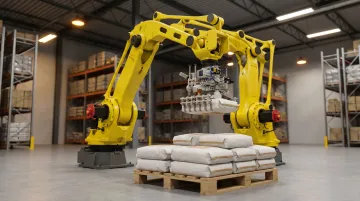
FANUC's M-410 series represents the most widely deployed robotic palletizing arm in industrial bagged goods applications. These systems are installed exclusively through FANUC's Authorized System Integrator (ASI) network, with integrators like Kaufman Engineered Systems designing complete bag palletizing cells.
The M-410iC/110 is specifically designed for bag palletizing, achieving 2,200 cycles per hour with a 110 kg payload. The M-410iB/140H delivers 1,900 cycles per hour with a 140 kg capacity. Key differentiators include:
- High payload capacity across multiple model configurations
- Vision-guided picking for consistent bag placement
- Minimal changeover time between bag formats
- Compatible with vacuum or clamp gripper end-of-arm tooling
- Extensive global service and parts network
| Typical Payload Capacity | Throughput | Best For |
|---|---|---|
| M-410iC/110: 110 kg; M-410iB/140H: 140 kg; M-410iC/185: 185 kg; up to M-410/800F-32C: 800 kg | M-410iC/110: 2,200 cycles/hr; M-410iB/140H: 1,900 cycles/hr | Operations running mixed bag formats (paper and plastic) or requiring fast changeover between multiple SKUs on the same line |
Columbia Machine
Columbia Machine is a major U.S.-based palletizer manufacturer headquartered in Vancouver, WA, with a long track record serving bagged goods producers in agriculture, food, and industrial sectors. The company manufactures complete bag lines—from filling through palletizing—providing single-source accountability.
Columbia's key differentiators:
- Strong domestic manufacturing and U.S.-based support infrastructure
- Configurable conventional designs optimized for high-speed uniform bag applications
- Full end-of-line integration with automatic pallet dispensers and stretch wrappers
Their palletizers are built for at least 25 years of service life.
| System Types Available | Speed Range | Best For |
|---|---|---|
| Floor-level, high-level, inline, robotic hybrid | Bag fillers: 4-12 bags/min (240-720 bags/hr); palletizer throughput varies by configuration | High-volume bagged goods producers in building materials and heavy industry looking for domestically manufactured and serviced conventional palletizing solutions |
Brenton (ProMach)
Brenton is a ProMach brand based in Alexandria, MN, producing both conventional and robotic end-of-line packaging systems with strong penetration in food, agricultural, and pet food bag palletizing applications. As part of the ProMach family, Brenton leverages a broad North American service network.
Key differentiators include:
- Flexible palletizing cells handling multi-wall, laminated BOPP, woven, and paper poly bags
- Stretch wrapper integration within a single cell footprint
- ProMach's extensive North American parts and technical support network
The RP1000 and MP1000 robotic models target bags weighing 15–50 lbs in pet food, animal feed, seed, and fertilizer applications.
| System Types Available | Throughput | Best For |
|---|---|---|
| RP1000 (robotic palletizer), MP1000 (bulk robotic palletizer), HL1000 (high-level conventional), RL1000 (robotic layer) | Not published; described as "high-speed" configurations | Food and agricultural bag producers needing scalable end-of-line cells with integrated stretch wrapping capability |
Premier Tech
Premier Tech (formerly Premier Tech Chronos) is a Canadian manufacturer specializing in both open-mouth and valve bag filling systems AND palletizing—making them the natural fit for producers who want one vendor handling coordinated bagging and palletizing lines, particularly in agriculture, fertilizers, and food ingredients.
Headquartered in Riviere-du-Loup, Quebec, with U.S. manufacturing in Montgomery, Alabama, Premier Tech brings deep expertise in granular and powder bag applications. Their flexible robotic palletizing cells handle varying bag sizes and materials, supported by a well-established North American service network.
| Bag Types Handled | Throughput | Best For |
|---|---|---|
| Open-mouth, valve bags, woven PP, paper, polyethylene | CHRONOS APC Series: up to 20 bags/min (1,200 bags/hr); Conventional: up to 40 bags/min (2,400 bags/hr) | Producers of granular or powder products (fertilizers, seeds, flour, food ingredients) looking for integrated bagging-to-palletizing line solutions |
How to Choose the Right Palletizer for Bagged Goods
Don't Choose on Price or Speed Alone
The most common mistake buyers make is selecting a palletizer based solely on price or published speed ratings, without accounting for bag-specific characteristics. Bag material (paper vs. poly vs. woven), fill level consistency, bag weight, and whether products are aerated or prone to shifting all directly affect performance.
Conventional palletizers perform best with stable, uniform bags at high speeds. Robotic systems become necessary for partially filled, aerated, or mixed-format bags that shift during handling. Hybrid systems offer robotic-level precision within a more compact footprint — useful when space and format variety are both constraints.
Key Operational Factors to Evaluate
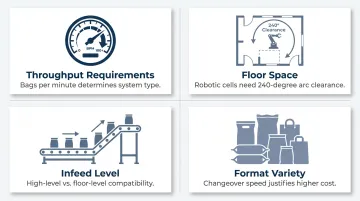
Before comparing specific systems, evaluate these four factors against your operation:
- Throughput requirements: Bags per minute determines whether a high-speed conventional system is necessary or a more flexible robotic cell is sufficient.
- Floor space: Robotic cells need additional clearance for the arm's 240-degree arc and safety enclosures; conventional units are typically more compact.
- Infeed level: High-level conventional palletizers require elevated infeed conveyors, while floor-level robotic systems fit more easily into existing layouts.
- Format variety: If you run multiple bag types, systems with fast changeover justify higher upfront cost through reduced downtime.
Work With an Equipment Specialist
Ergonomic risk is also worth factoring into your decision. According to the Bureau of Labor Statistics, laborers and freight movers suffered 25,110 musculoskeletal disorder cases in 2018, with a median of 12 days away from work per incident. That liability doesn't disappear by purchasing automation — it requires choosing the right system for how your bags actually behave.
Working with a manufacturer-trained packaging equipment specialist — like John Maye Company, which has 40+ years of sourcing and supporting packaging lines across the Midwest — helps producers avoid costly mismatches and simplify integration with existing bagging equipment. An experienced partner evaluates your specific bag characteristics, production requirements, and facility constraints to recommend the right palletizer architecture.
Conclusion
For bagged goods producers, the right palletizer depends on bag type, fill consistency, throughput requirements, floor constraints, and the need for format flexibility across multiple SKUs.
Evaluate total cost of ownership, not just the purchase price. Key factors include:
- Changeover time between SKUs and bag formats
- Maintenance requirements and parts availability
- Integration complexity with upstream bagging lines
- Downtime risk if the system can't handle aerated or inconsistent bags
A lower-priced conventional system that fails on your specific bag type will cost far more in downtime and damaged product than a properly matched robotic cell.
Midwest producers looking to source or upgrade a bag palletizing system can contact the John Maye Company team. With factory-certified technicians and 40+ years serving packaging operations across Wisconsin and the Midwest, they can match the right palletizer to your production requirements.
Frequently Asked Questions
How much does a palletizer cost?
Palletizer costs vary widely by type and configuration. Entry-level conventional systems typically cost less upfront than robotic cells, but total installed cost includes conveyors, end-of-arm tooling, safety guarding, and integration—so always compare turnkey quotes, not just equipment price.
What is a palletizer used for?
A palletizer automatically arranges and stacks filled bags (or other packages) onto a pallet in a defined pattern to create stable, shippable loads. This automation replaces or reduces manual labor at the end of a production line, improving consistency and throughput while reducing ergonomic injury risk.
What is manual palletizing?
Manual palletizing involves workers physically lifting and stacking filled bags onto pallets by hand. It works for low-volume operations but has real limits in speed, consistency, and scalability—and with heavy bags, the ergonomic injury risk is substantial.
What is palletized packaging?
Palletized packaging refers to goods stacked and secured on a pallet—typically with stretch wrap or strapping—for efficient storage, transport, and handling by forklifts or pallet jacks. Proper palletization ensures load stability during shipping and warehousing.
What type of palletizer works best for bags?
Robotic and hybrid palletizers work best for bags because they handle flexible, partially filled, or inconsistently shaped packages with precision. Conventional palletizers suit high-speed lines with stable, uniformly filled bags but struggle with aerated or shifting product.
What is the difference between a conventional and robotic palletizer?
Conventional palletizers use mechanical row-forming mechanisms to stack products at high speed and are best for uniform packages. Robotic palletizers use a programmable arm to pick and place individual packages with greater flexibility—at typically lower speeds but with higher adaptability to varied formats and difficult bag types.