Introduction
The U.S. pet food market reached $43.45 billion in 2024, growing at a steady 4.3% annual rate through 2030. End-of-line efficiency has shifted from a nice-to-have into a direct production differentiator. As volume demands increase and SKU counts multiply, manual palletizing creates measurable costs that directly impact profitability.
The real price of manual palletizing extends beyond hourly wages. Overexertion and repetitive motion injuries accounted for 946,290 lost-time cases in manufacturing during 2023-2024, with a median of 24 days away from work per incident—the highest of any injury category.
Inconsistent pallet loads, throughput bottlenecks, and shipping damage from unstable stacks compound those labor costs into a measurable drag on your bottom line.
Choosing the right palletizer eliminates those costs at the source. This guide covers the top options for pet food manufacturers, what sets each apart, and the key factors that should drive your decision.
Key Takeaways
- Palletizers automate stacking of filled bags, pouches, boxes, or cases onto pallets, replacing manual labor and reducing damage risk
- Pet food lines demand format flexibility, spanning stand-up pouches, pillow bags, and 50 lb multi-wall bags on a single system
- Key selection criteria: throughput speed, format compatibility, footprint, food-grade compliance, and ROI timeline
- Leading options include FANUC Robotics, Columbia Machine, Premier Tech, Brenton, and Bastian Solutions — each suited to different output scales
- Rental programs reduce capital barriers for testing systems or managing seasonal surges
Palletizers in the Pet Food Industry
An industrial palletizer collects filled, sealed packages from upstream equipment and builds them into stable, shippable pallet loads. In pet food manufacturing, this step is where production speed and shipping reliability either come together or fall apart—making equipment selection more consequential than in many other food categories.
The pet food sector presents unique palletizing challenges:
- Package formats range from 1 lb stand-up pouches to 50 lb multi-wall paper bags, each requiring a different gripper or layer pattern
- Kibble dust accumulates quickly, requiring IP-rated components and regular cleaning protocols to prevent downtime
- Sanitation design principles apply even at the secondary packaging level, especially in USDA-inspected facilities
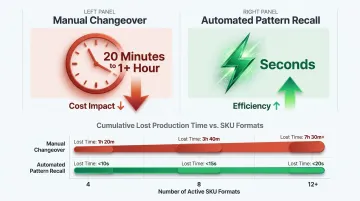
- SKU counts have grown sharply—facilities that once ran 4 formats now manage 12 or more, putting pressure on changeover speed
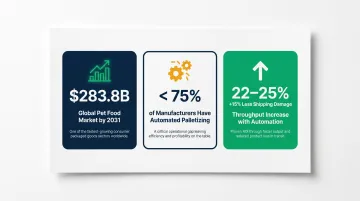
The global pet food market is projected to reach $283.8 billion by 2031, and that growth is pushing automation investment up across the supply chain. Yet current estimates suggest fewer than 75% of pet food manufacturers have automated palletizing—a gap that leaves real throughput on the table for operations still relying on manual stacking. Automated systems typically boost throughput by 22-25% and cut shipping damage by 15%, making the productivity case straightforward to build.
Best Palletizers for Pet Food Manufacturers
These selections reflect proven performance in food-grade environments, with each vendor evaluated on packaging format versatility, throughput capability, and documented deployments in pet food and animal feed operations. The right fit depends on your line configuration, SKU mix, and whether flexibility or raw speed is the priority.
FANUC Robotics (via Certified Integrators)
FANUC is the world's largest industrial robot manufacturer, widely deployed in pet food end-of-line systems through certified integrators. Their robotic palletizing arms handle bags, pouches, cases, and trays using custom end-of-arm tooling tailored to specific package types.
FANUC robots are a strong fit for multi-SKU operations. Pattern changes that require mechanical adjustments on conventional systems happen through software in seconds, and vision systems enable product orientation recognition — critical when running multiple bag types on the same line.
FANUC M-410 Series Specifications:
| Specification | Details |
|---|---|
| Speed/Throughput | Up to 2,200 cycles per hour (M-410iC/110 model); 70 trays per minute documented in dual-robot pet food deployment |
| Payload Capacity | Seven models spanning 110 kg to 800 kg (243 lbs to 1,764 lbs) |
| Key Differentiator | Multi-format flexibility, vision-guided placement, wide integrator ecosystem across Midwest and U.S. |
The M-410 series provides seven models covering virtually every pet food packaging weight, from small pouches to bulk bags. Bastian Solutions integrates FANUC CRX collaborative robots in its StackOrder system, while other regional integrators build custom cells around the M-410 platform.
Columbia Machine
Columbia Machine is a U.S.-based manufacturer with decades of experience producing conventional (layer-style) palletizers, widely adopted in food, beverage, and animal feed production. Their equipment is engineered for high-volume, single-SKU lines where mechanical simplicity and speed matter more than flexibility.
Their layer palletizers build consistent, dense pallet loads at high speeds without the complexity of robotic programming. For large-bag dry food operations running a single product for extended periods, conventional systems deliver 40-60% lower total cost of ownership over 15 years compared to robotic alternatives.
Columbia Machine Specifications:
| Specification | Details |
|---|---|
| Speed/Throughput | Over 150 cases per minute on high-speed inline models |
| System Type | Conventional layer palletizers (Floor Level, High Level, Inline, and Robotic Hybrid options) |
| Key Differentiator | High-speed single-SKU throughput, robust build quality, and 150+ systems deployed in animal feed industry |
Columbia/Okura documented a 25-30% productivity increase at Barrett Petfood Innovations, with one specific bag type seeing a 60% improvement after installing their robotic palletizer. For operations prioritizing speed over flexibility, Columbia's conventional systems remain the benchmark.
Premier Tech
Premier Tech (operating as PT Chronos) is an international packaging automation company specializing in bag and pouch palletizing for food, feed, and pet food industries. Their robotic and conventional systems are purpose-built for flexible bag handling across multiple formats.
Their systems handle the full range of pet food bag formats — open-mouth, valve, pillow, and stand-up pouches — without product damage. That matters when dealing with abrasive, shifting kibble in flexible packaging that can tear or burst under improper handling.
Premier Tech Specifications:
| Specification | Details |
|---|---|
| Packaging Formats | Open-mouth bags (single/dual spout), valve bags, form-fill-seal (FFS), stand-up pouches |
| Automation Levels | Entry-level robotic (manual pallet handling), fully automatic robotic (up to 840 units/hour), hybrid (conventional + robotic) |
| Key Differentiator | Bag-specific handling, gentle product placement, strong North American service network, documented Nestle Purina deployment |
The RPL-2111 fully automatic model handles up to 14 units per minute (840 per hour), positioning it in the mid-range robotic category. Premier Tech's hybrid APR-1150 combines conventional speed with robotic flexibility — ideal for operations transitioning from single-SKU to multi-format production.
Brenton (Pro Mach)
Brenton is a Pro Mach brand specializing in end-of-line packaging systems, including robotic and conventional palletizers, with documented deployments in food and pet food production environments. Their portfolio spans the complete packaging line, not just palletizing.
Their core advantage is full end-of-line integration. Brenton designs palletizing systems that connect directly with upstream case erectors, case sealers, and downstream stretch wrappers — all managed through a single HMI. For pet food plants upgrading their entire end-of-line, this eliminates the warranty gaps and communication mismatches that come with sourcing equipment from multiple vendors.
Brenton Specifications:
| Specification | Details |
|---|---|
| System Integration | Complete end-of-line portfolio including case packers, palletizers, depalletizers, corner board applicators, and stretch wrappers |
| Palletizer Types | RP1000 (robotic), MP1000 (bulk robotic), HL1000 (conventional high-level), RL1000 (robotic layer), MA-ST (robotic bag palletizer) |
| Key Differentiator | Turnkey end-of-line design with single-source support, reducing complexity for growing pet food operations |
The MA-ST Robotic Bag Palletizer includes integrated bag flattening to create uniform, symmetrical shapes before stacking — addressing a common pain point in pet food bag palletizing where inconsistent bag contents create unstable loads.
Bastian Solutions (Toyota Industries)
Bastian Solutions is a material handling and automation integrator owned by Toyota Industries, specializing in robotic palletizing systems for food and consumer goods manufacturers. Their approach centers on engineering-led system design rather than off-the-shelf equipment.
Bastian's engineering-first methodology means systems are designed around your specific floor layout, throughput targets, and package mix. This makes them a strong choice for pet food manufacturers with complex production environments or space constraints that standard configurations can't accommodate.
Bastian Solutions Specifications:
| Specification | Details |
|---|---|
| System Design Approach | Engineering-led, custom-configured systems built around facility layout and production requirements |
| Robot Platforms | FANUC robots (including CRX collaborative line) integrated into custom palletizing cells |
| Key Differentiator | Toyota Industries backing, strong engineering team, full-system design for complex or space-constrained pet food plants |
Bastian's StackOrder system uses FANUC CRX collaborative robots, enabling real-time pallet pattern visualization and editing. For operations requiring custom solutions beyond standard equipment specifications, Bastian's systems engineering capability delivers tailored results.
How We Chose the Best Palletizers for Pet Food
Core evaluation criteria included:
- Throughput capacity relative to actual production line speed, not theoretical maximum rates
- Packaging format versatility, which is critical in pet food due to mixed SKUs and growing product variety
- Food-grade compliance and sanitation design principles appropriate for pet food environments
- Total cost of ownership, including maintenance requirements and parts availability
- Integration capability with existing conveyor and wrapping equipment to avoid bottlenecks
The most common selection mistake is choosing based on peak throughput ratings alone, without accounting for changeover time between SKUs, floor space requirements, or upstream feed rate constraints. A palletizer rated for 100 bags per minute is irrelevant if your upstream bagger runs at 60 bags per minute, or if SKU changeovers consume 30-60 minutes of production time.
SKU changeover economics are often underestimated. Manual changeover takes 20 minutes to over an hour, while automated pattern recall happens in seconds. As facilities scale from 4 formats to 12 or more, that gap compounds into significant lost production time that erodes any theoretical throughput advantage.
That last point connects directly to total cost of ownership. John Maye Company's factory-certified technicians, 2,500+ SKU parts inventory, and 24-hour ship guarantee on stocked components reflect 40+ years of Midwest food and beverage experience — where long-term support matters as much as the initial equipment decision.
Conclusion
The best palletizer for your pet food operation is never a one-size-fits-all decision. It depends on your packaging format mix, throughput targets, available floor space, and long-term scalability needs. A 50 lb bag operation running two SKUs has fundamentally different requirements than a multi-format line handling pouches, pillow bags, and cases.
Assess not just upfront equipment cost but ongoing factors: parts availability, local service support, software update flexibility, and how well the system supports future line expansions. Payback periods of 18-24 months are typical when replacing manual palletizing—provided the equipment matches your actual production demands.
That's where working with an experienced distributor pays off. John Maye Company has supported Midwest manufacturers with packaging equipment selection and service since 1983. Their team brings hands-on knowledge of palletizer applications across pet food and adjacent food and beverage operations.
Key reasons pet food manufacturers work with them:
- 40+ years of packaging equipment experience across food, beverage, and manufacturing
- Rental fleet available for seasonal production surges or trial deployments
- 24-hour parts ship guarantee to minimize unplanned downtime
- Factory-certified technicians providing local service support across the Midwest
Reach their team at 1-800-441-6293 or info@johnmayecompany.com.
Frequently Asked Questions
Frequently Asked Questions
How much does a palletizer for pet food cost?
Entry-level robotic palletizing cells start around $175,000, mid-range systems run $275,000–$525,000, and high-speed or multi-line configurations exceed $500,000. Total cost of ownership—including installation, integration, and annual maintenance (roughly 2.5% of system cost annually)—drives the true cost well beyond sticker price and should anchor your purchasing decision.
What type of palletizer is best for pet food bags and pouches?
Robotic palletizers with flexible end-of-arm tooling are the preferred choice for multi-format bag and pouch lines because pattern changes happen through software in seconds rather than mechanical adjustments. Conventional layer palletizers suit high-volume single-format operations where throughput and lower total cost of ownership (40–60% less over 15 years) outweigh flexibility needs.
What is the difference between a robotic palletizer and a conventional layer palletizer?
Robotic systems use articulated arms for flexible, multi-SKU palletizing at moderate speeds (typically 720–1,680 bags per hour for industrial models). Conventional layer palletizers build full layers simultaneously for higher throughput (over 150 cases per minute) on uniform products, but require mechanical changeover when switching formats—making them best suited for single-SKU production runs.
How fast do automated palletizers run in pet food production?
Throughput ranges from 360–480 bags/hr for cobot systems, 720–1,680 bags/hr for industrial robotic systems, and 150+ cases per minute for conventional high-speed layer palletizers. Actual rates vary based on bag weight, pallet pattern complexity, and upstream feed speeds.
Do pet food palletizers need to meet food safety or sanitation standards?
Yes. While palletizers handle secondary/tertiary packaging rather than direct food contact, facilities must still comply with FDA CGMP requirements (21 CFR Part 117). Key design considerations include stainless steel construction, food-grade lubricants, and quick-disassembly features for cleaning—especially critical in dusty pet food environments.
Can I rent a palletizer instead of purchasing one outright?
Yes, rental and leasing programs are viable for managing seasonal volume spikes, testing a system before capital commitment, or bridging capacity gaps. MMCI Automation offers SmartLease programs with pay-for-usage, seasonal, and fixed lease structures, while subscription-based Robots-as-a-Service (RaaS) models are emerging as alternatives to traditional capital purchases.