The right palletizer directly impacts OEE, worker safety, and production continuity in dairy plants. Cold environments (35–40°F), mandatory washdown protocols, and fragile formats like half-gallon cartons create complexity beyond standard food applications. Typical end-of-line OEE in food operations runs 55–70%, trailing world-class benchmarks by 30+ points — capacity recovery is achievable without adding production lines.
This guide covers the best palletizers purpose-built or widely adopted for dairy operations, along with the key criteria dairy processors should use to evaluate them.
Key Takeaways
- Dairy palletizers must handle gallon jugs, cartons, crates, and cups — all while meeting USDA washdown standards
- Robotic palletizers suit confined facilities with frequent SKU changes; conventional systems win on throughput for high-volume single-format lines
- Prioritize washdown compliance, toolless changeover, cold-storage compatibility, and compact footprint when evaluating options
- Top options include Columbia Machine, Quest Industrial (Box Bot QB300), Scott Automation, Ska Fabricating, and Brenton Engineering
- Work with a manufacturer-trained regional distributor to speed installation and keep parts close at hand
Overview of Palletizers in the Dairy Industry
A palletizer automates the stacking of filled cases, crates, cartons, or trays onto shipping pallets at the end of the production line. Manual palletizing is unsustainable on two fronts. Ergonomic injury risk is high — dairy's DART rate of 3.0 exceeds the food manufacturing average by 30% — and 47% of food industry respondents cite lack of qualified candidates as their biggest hiring challenge, making labor-dependent end-of-line operations a real liability.
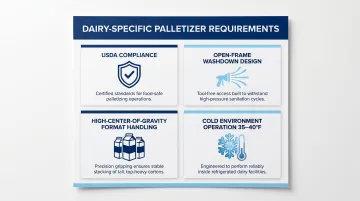
Dairy environments add layers of complexity that most standard palletizer specs don't address:
- USDA compliance for direct-food-contact zones
- Open-frame washdown-ready designs for sanitation protocols
- Handling high-center-of-gravity formats like half-gallon cartons without tipping
- Operation in cold environments (typically 35–40°F per USDA guidance)
Today's dairy processors integrate palletizers with conveyor systems and line control software to create unified, sensor-monitored end-of-line operations. Each palletizer below was evaluated on sanitation design, format flexibility, cold-environment performance, and proven deployment in dairy environments.
Best Palletizers for Dairy Processors
Columbia Machine
Founded in 1937, Columbia Machine builds conventional palletizers deployed across high-volume dairy lines. Their systems handle cases, gallon jugs in plastic crates, and diverse dairy formats — built around uptime and fast format changes.
Key features for dairy operations:
- Zero-time, toolless changeover between formats (cases to gallon jugs)
- Overhead blade pushers and close-centered rollers stabilize high-center-of-gravity cartons
- 98% uptime guarantee with OSHA-compliant minor servicing built in
- Speeds up to 100 CPM on the FLD6200; broader line exceeds 150 CPM
| Feature | Details |
|---|---|
| Palletizer Type | Conventional (high-level and low-level configurations available) |
| Key Dairy-Specific Features | Toolless zero-downtime changeover; overhead blade pusher for carton stability; OSHA-compliant minor servicing |
| Best For | High-volume dairy lines with multiple format types (cases, jugs, crates) |
Quest Industrial – Box Bot QB300
Quest Industrial, a ProMach brand and FANUC Authorized integrator, has documented deployments at dairy and cheese operations. The Box Bot QB300 features a USDA-compliant, washdown-ready design built for rigorous sanitation environments — making it a strong fit for facilities where floor space and changeover speed both matter.
Standout capabilities:
- Compact 8'x10' footprint for space-constrained dairy facilities
- Skid-based design enables fast setup and repositioning
- QBox Pallet Building Software lets operators build unlimited custom pallet patterns — no external programmers, 10 minutes of training required
- Vision system integration handles SKU flexibility on the fly
| Feature | Details |
|---|---|
| Palletizer Type | Robotic (FANUC robot-based, modular cell design) |
| Key Dairy-Specific Features | USDA-compliant washdown design; minimal footprint; operator-programmable pallet patterns via QBox software |
| Best For | Dairy facilities with limited floor space, frequent SKU changes, or transitioning from manual palletizing |
Scott Automation
Scott Automation designs multi-line palletizing systems with verified deployments in cheese and dairy specialty facilities. Their systems operate in cold environments as low as 6°C (43°F) — a critical spec for cooler and warehouse environments where most conventional systems struggle.
Built for dairy environments:
- Multi-line architecture links up to 4 production lines to a single palletizer
- High-entry design includes an intersheet applicator for layer separation
- Paternoster lifts (continuous-loop vertical conveyors) and accumulation tables manage product tilt — dairy cups cannot exceed 5 degrees of tilt in transit
- Throughput: Up to 76 trays/min infeed; 30 pallets/hr output
| Feature | Details |
|---|---|
| Palletizer Type | Conventional high-entry palletizer with multi-line infeed system |
| Key Dairy-Specific Features | Cold environment rated; multi-line accumulation management; intersheet applicator; pallet inspection and reject system |
| Best For | Mid-to-large dairy plants needing multi-line palletizing of cups, trays, or specialty cheese formats in cooler or warehouse environments |
Ska Fabricating
Ska Fabricating builds automated palletizing and conveying equipment with a specific focus on dairy and beverage lines. Their low-level configurations with side-grip elevator systems prioritize operator safety and sanitation — two areas where dairy processors face consistent pressure.
Why dairy processors choose it:
- Low-level design improves operator sight lines and reduces injury risk
- Side-grip elevator integrates with powered chain conveyor systems
- Open, washdown-compatible construction suits dairy sanitation protocols
- Fully integrated PLCs with intuitive screens and product presets cut changeover time
| Feature | Details |
|---|---|
| Palletizer Type | Low-level conventional palletizer with integrated conveyor system |
| Key Dairy-Specific Features | Side-grip elevator; open washdown-ready frame; low-level design for improved worker safety and visibility |
| Best For | Dairy processors prioritizing worker safety, sanitation simplicity, and mid-speed palletizing of standard case and carton formats |
Brenton Engineering
Brenton Engineering, also a ProMach brand, manufactures both conventional and robotic palletizers for food and dairy applications. With over 600 traditional and robotic case packing installations worldwide, Brenton is one of the more versatile options on this list — covering everything from standalone robotic cells to fully integrated end-of-line systems.
Standout capabilities:
- Product range spans conventional layer palletizers to robotic cells — matching system type to throughput requirements
- Sanitary construction integrates with upstream case packaging and conveyor lines
- Brenton rates its changeovers among the shortest in the industry
- Modular end-of-line systems combine case erector, case packer, sealer, and palletizer in a single compact frame
| Feature | Details |
|---|---|
| Palletizer Type | Conventional and robotic options (layer palletizers and robotic cells) |
| Key Dairy-Specific Features | Sanitary construction; range of throughput capacities; upstream integration with case packers |
| Best For | Dairy processors seeking a scalable conventional or robotic solution with strong integration support across the full end-of-line system |
How We Chose the Best Palletizers for Dairy
We assessed solutions on dairy-specific sanitation compliance (open-frame/washdown-ready design, USDA suitability), format flexibility (ability to handle gallon jugs, half-gallon cartons, cups, trays, and plastic crates without extended downtime), and proven deployment in food or dairy environments — not just general industrial use.
Two commonly overlooked selection mistakes:
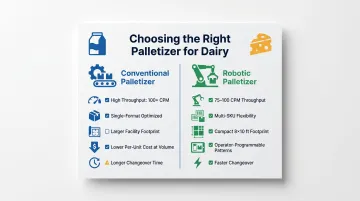
- Choosing a palletizer based on speed alone without accounting for changeover time between dairy SKUs, which can erode throughput gains. A 100 CPM palletizer that requires 45 minutes to switch from cases to jugs delivers lower effective throughput than a 75 CPM system with toolless changeover and no downtime between formats.
- Underestimating the cost of a poor footprint fit in tight dairy facilities where cooler space and production flow paths are fixed constraints. An 8'x10' robotic cell may outperform a larger conventional palletizer simply by fitting the available floor space.
We weighted cold-environment operability, integration capability with existing conveyor and line control systems, and availability of local service and parts support heavily — unplanned downtime in a dairy plant carries perishability risk that other industries don't face.
That perishability risk is also why distributor selection matters as much as equipment selection. For Midwest dairy processors, working with a regional partner like John Maye Company — with factory-certified technicians, a 24-hour parts ship guarantee, and 2,500+ SKUs in inventory — can reduce implementation risk and keep lines running after installation.
Conclusion
The right palletizer for a dairy processor comes down to your specific product formats, throughput targets, floor space, sanitation standards, and whether robotic or conventional architecture fits your operation. There's no universal answer — the best system is the one matched to your actual production reality.
Before committing, evaluate beyond the sticker price. Key factors to weigh:
- Total cost of ownership — changeover time, maintenance burden, and parts availability
- Scalability — can the system handle SKU growth and higher volumes as your operation expands?
- Labor context — Mordor Intelligence's palletizer market report projects robotic payback periods dropping below 18 months in facilities facing labor shortages, which applies to many mid-size dairy processors today
If you're working through that evaluation, John Maye Company has supported dairy and food processors across Wisconsin and the Midwest since 1983. Their factory-certified technicians can help you select, source, and commission the right palletizing system — reach out at info@johnmayecompany.com or call 1-800-441-6293.
Frequently Asked Questions
What are the different types of palletizers?
There are two primary categories: conventional (high-level and low-level) and robotic (articulated arm/cell-based). Conventional palletizers excel in high-speed, single-format applications, while robotic systems offer greater flexibility for multi-SKU dairy operations and are better suited to space-constrained facilities.
How much does a pallet moving robot cost?
Robotic palletizer costs vary widely based on configuration, throughput, and integration complexity. Entry-level systems start around $5,000 per month on Robots-as-a-Service (RaaS) leasing models. ROI timelines for dairy applications typically factor in labor savings and reduced injury costs, with payback periods dropping below 18 months due to current labor shortages.
What equipment do dairy producers use?
Dairy end-of-line operations use filling and capping lines, conveyors, case packers, palletizers, and stretch wrappers. Palletizers serve as the critical final step before warehouse dispatch, ensuring products are securely stacked and ready for shipment.
What is the difference between robotic and conventional palletizers for dairy?
The core trade-off is speed versus flexibility. Conventional palletizers handle single-format, high-volume lines at over 100 cases per minute. Robotic systems suit multi-SKU dairy operations better, allowing pallet pattern changes through an operator interface without programmer involvement.
Do dairy palletizers need to be USDA-compliant or washdown-rated?
Yes. Direct-contact dairy zones require USDA design standards, and open-frame washdown-ready construction is strongly recommended even in non-contact areas. FSMA Preventive Controls (21 CFR Part 117) mandate equipment be "adequately cleanable and properly maintained" given dairy sanitation demands.
How do I choose a palletizer for a cold storage dairy environment?
Cold-environment palletizers (35–40°F or below) need low-temperature-rated components, stainless steel construction, and condensation-tolerant design. Where you install the system — production hall versus cooler warehouse — largely determines the architecture. Multi-line systems have operated successfully in 43°F chilled warehouses using paternoster lifts to prevent product tilt.