A failed or undersized case erector doesn't just slow the line; it creates backups that ripple upstream to fillers and sealers, forcing entire production shutdowns in facilities where product shelf life is measured in days, not weeks.
This guide covers the top case erectors purpose-built for dairy environments, the selection criteria that separate robust machines from liabilities, and how to partner with distributors who keep lines running when stakes are highest.
Key Takeaways
- Case erectors automate forming and bottom-sealing, eliminating manual bottlenecks
- Dairy processors need machines rated for high humidity, rapid SKU changeover, and diverse formats
- Leading manufacturers include A-B-C Packaging, Massman, Endoline, Eagle, and Schneider
- Evaluate throughput (CPM), sealing method, changeover speed, and washdown-rated construction before buying
- Partner with distributors offering factory-trained service and guaranteed parts availability
Overview of Case Erectors in the Dairy Processing Industry
A case erector automatically pulls flat, knocked-down corrugated blanks from a magazine, forms them into open boxes, and seals the bottom flaps with tape or hot melt glue — ready for product loading. On dairy lines where speed and consistency are non-negotiable, automation eliminates the variability and ergonomic strain of manual case forming.
Dairy environments add a layer of complexity that standard end-of-line equipment isn't always built for:
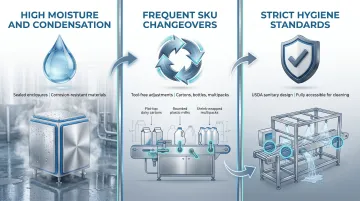
- High moisture and condensation from refrigerated products require sealed electrical enclosures and corrosion-resistant materials
- Frequent SKU changeovers between milk cartons, yogurt multipacks, cheese blocks, and ice cream containers demand tool-free adjustments
- Strict hygiene expectations align with USDA sanitary design guidelines, influencing material specs and accessibility for cleaning
Together, these factors determine which machines can sustain reliable output on a dairy floor — and which ones become a maintenance liability within months.
Best Case Erectors for Dairy Processors
The vendors below were evaluated on throughput reliability, dairy-sector track record, format flexibility, sealing method options, and ease of maintenance in cold or humid production environments. Each entry highlights what sets the machine apart for dairy-specific applications.
A-B-C Packaging Machine Corp.
A-B-C Packaging, headquartered in Tarpon Springs, Florida, has manufactured end-of-line equipment since 1940. Their Model 330T and related models appear frequently in dairy industry installations for high-speed performance.
- Heavy-duty channel steel frame built for continuous production duty cycles
- Walking beam case transfer system squares each case before tape sealing, ensuring consistent, pallet-ready cases
- Forgiving case-opening module handles warped blanks or poor manufacturer's joints — common in high-volume dairy environments
- No-tools changeover for extended case size range
- PLC touchscreen controls for operator-friendly setup
| Feature | Specification |
|---|---|
| Speed/Throughput | Model 330T: 35 cases/minute; Model 300: 25 CPM |
| Sealing Method | Bottom tape sealing standard; hot melt glue variants available |
| Key Dairy Feature | Extended case magazine with auto-indexing minimizes operator attention on high-output lines |
Massman Automation
Massman Automation, based in Villard, Minnesota, has served dairy, beverage, and food processors since 1978. Their portfolio spans case erectors, sealers, packers, and palletizers — positioning them as a single-source supplier for integrated end-of-line systems.
- Full end-of-line integration capability (erector + packer + sealer + palletizer) under one service relationship
- Strong regional service presence in the Midwest
- Explicit dairy and cheese specialization with documented installations
- Wide variety of case sizes and product types handled
| Feature | Specification |
|---|---|
| Speed/Throughput | Elliott MS-30T: 30 cases/minute |
| Sealing Method | Hot melt glue and tape options available |
| Key Dairy Feature | Full end-of-line integration reduces handoff points and downtime risk on high-speed dairy lines |
Endoline Automation
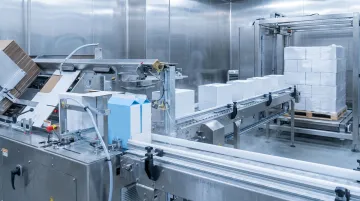
Endoline Automation, a UK-based manufacturer with 40+ years of experience and 11,000+ machines installed globally, developed a dedicated compact case packing system specifically for dairy industry demand.
- All-in-one design (erecting + loading + sealing) cuts floor footprint — critical in space-constrained dairy plants
- Handles PET bottles, cartons, glass bottles, and flat-bottomed bags
- Industry 4.0 compatible controls allow live production data capture for uptime monitoring
- Reprogrammable for different product formats and quantities without machine swap
- Servo-driven product placement for precision
| Feature | Specification |
|---|---|
| Speed/Throughput | Up to 12 cases/minute (combined erector/packer/sealer system) |
| Sealing Method | Tape sealing standard; glue options on standalone erector range |
| Key Dairy Feature | Engineered specifically for PET bottle handling and compact dairy plant footprints; Industry 4.0 data integration |
Eagle Packaging Machinery (EndFlex)
Eagle Packaging's BOXXER system combines case erecting, loading, and sealing in a single machine — reducing labor costs and increasing productivity by eliminating three separate machines. This aligns directly with labor constraints facing dairy processors.
- Servo-driven loading mechanism supports multiple configurable pack patterns
- Operator-selectable glue or tape sealing provides choice based on line requirements
- Integrated infeed-to-exit design simplifies line layout and reduces maintenance touch points
- Single-machine footprint simplifies hygienic cleaning protocols
- Carbon footprint reduction relevant for dairy brands with sustainability targets
| Feature | Specification |
|---|---|
| Speed/Throughput | Glue version: up to 35 cases/minute; tape models: T-12/T-18/T-XL variants |
| Sealing Method | Operator-selectable: hot melt glue or tape |
| Key Dairy Feature | Single-machine footprint simplifies hygienic cleaning across diverse dairy SKUs |
Schneider Packaging Equipment (A Pacteon Company)
Schneider Packaging Equipment, part of the PACTEON group, brings 50+ years of experience with strong installed base across food, beverage, and CPG operations. Their portfolio includes robotic, horizontal, high-speed, bottom-loading, and gable-top case packing models — a direct fit for dairy processors handling gable-top cartons.
- Explicit gable-top model availability for milk and juice-style carton packaging
- Robotic and high-speed layer palletizing options integrate downstream of the case erector
- PACTEON backing provides parts depth and nationwide service coverage
- Stainless steel washdown construction
- FANUC robotics integration
| Feature | Specification |
|---|---|
| Speed/Throughput | Gable Top Case Packer: 39+ cases/minute |
| Sealing Method | Hot melt glue standard on most models; tape options available |
| Key Dairy Feature | Dedicated gable-top case packing model addresses the most common fluid dairy carton format; integrated palletizing reduces end-of-line labor |
What to Look for in a Case Erector for Dairy Applications
Dairy environments impose conditions most general-purpose case erectors aren't optimized for:
- Ambient moisture and condensation from cold product requires stainless steel components and sealed electrical enclosures rated IP69K for high-pressure, high-temperature washdown
- Frequent washdown requirements demand accessible design and corrosion-resistant materials
- Mixed formats (rigid bottles/cartons and flexible bags/pouches) require adjustable guides and gentle handling
Beyond environmental durability, the machine must also match your line's pace and flexibility.
Throughput-to-Line-Speed Matching
The case erector must be rated at or above upstream filler/sealer output to prevent backups. A 25 CPM filler paired with a 20 CPM erector creates bottlenecks.
Changeover Speed
Dairy processors running multiple SKUs per shift need changeover measured in minutes, not hours. Look for tool-free adjustments and digital recipe storage.
Sealing Method Trade-Offs
- Tape sealing: Lower maintenance, performs well in chilled/ambient conditions, no heated components
- Hot melt glue: Stronger, tamper-evident seals for heavier cases; requires nozzle maintenance and consistent ambient temperature
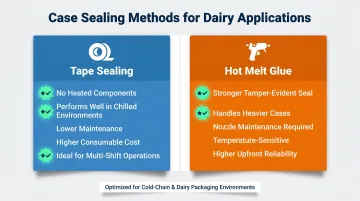
For multi-shift operations, tape often reduces total cost of ownership despite higher per-roll consumable costs.
How We Chose the Best Case Erectors
Machines were assessed on:
- Documented dairy/food-industry track record
- Throughput and changeover specifications
- Sealing flexibility (tape vs. glue)
- Construction quality relevant to cold/humid environments
- Manufacturer support infrastructure (parts availability, service network)
- Product format versatility covering main dairy packaging types
Common buyer mistake: Selecting based on price or brand name alone without verifying that rated speed matches actual line output — or that the manufacturer has service technicians accessible in their region.
That gap between spec sheet and shop floor is where distributor relationships earn their value. For Midwest dairy processors, John Maye Company (40+ years of packaging expertise, factory-certified technicians, 24-hour parts ship guarantee) provides local service response and access to rental units for line validation before any capital commitment — factors that often matter more than the machine brand itself.
Critical criteria:
- Certifications (NSF/ANSI 2-2025 for food equipment)
- Sanitary construction options
- Availability of rental/demo units to validate performance before purchase
Vendors who check all three boxes are positioned to support your line over years — not just the initial sale.
Conclusion
For dairy processors, a case erector isn't a commodity purchase. The right machine must match line speed, handle specific packaging formats, withstand cold and moist environments, and be backed by accessible parts and service to prevent costly downtime.
Go beyond spec sheets: assess the manufacturer's or distributor's service response time, parts inventory depth, and willingness to support changeover and integration — especially for operations running multiple SKUs or planning to scale.
Midwest dairy processors looking for guidance on case erector selection, sourcing, or service support can contact John Maye Company — a Waukesha, Wisconsin-based packaging equipment distributor with 40+ years serving Midwest food and beverage operations — for expert consultation and access to a broad portfolio of proven solutions. Factory-certified technicians, a 24-hour ship guarantee on 2,500+ SKUs, and an extensive rental fleet make them a practical partner for dairy lines where cold environments, SKU complexity, and uptime pressure leave little margin for error.
Frequently Asked Questions
What is a dairy processing plant?
A dairy processing plant is a facility that receives raw milk and transforms it into consumer products such as pasteurized milk, cheese, yogurt, butter, and ice cream through heat treatment, separation, fermentation, and packaging. According to USDA data, the U.S. operates approximately 1,183 dairy processing facilities nationwide.
What is a case erector and how does it work in dairy packaging?
A case erector automatically pulls flat corrugated blanks from a magazine, folds and squares them into open-top boxes, and seals the bottom flaps with tape or hot melt glue. The finished cases are ready to receive dairy products from an upstream filler or packer, eliminating manual forming and ensuring consistent, pallet-ready output at line speed.
How many cases per minute do dairy processors typically need?
Throughput requirements vary by operation. High-speed dairy lines often require case erectors rated at 20–40+ cases per minute; smaller or mid-volume processors may work effectively with machines in the 10–20 CPM range. Always size the erector to match or exceed the upstream filler speed to prevent bottlenecks.
What is the difference between tape and hot melt glue sealing for dairy applications?
Tape sealing requires no heated components, performs well in chilled environments, and carries lower total cost of ownership for multi-shift operations. Hot melt glue delivers stronger, tamper-evident seals for heavier cases but requires nozzle maintenance and stable ambient temperatures to function reliably.
Can a single case erector handle multiple dairy packaging formats?
Yes. Most modern case erectors offer tool-free or quick-release changeover systems that let operators switch between case sizes and formats — cartons, bottles, gable-tops — in minutes. Confirm the machine's case size range and changeover time specs match your SKU mix before purchasing.
How do you maintain a case erector in a high-humidity dairy environment?
Key maintenance tasks include:
- Inspecting and lubricating mechanical drives on schedule
- Checking tape or glue components for moisture ingress
- Verifying electrical enclosures stay sealed (IP69K-rated units hold up best)
- Following the manufacturer's recommended service intervals
Access to a local service technician is critical for minimizing downtime during peak production.