Introduction
Every year, manufacturers lose significant time, product, and money due to inadequate pallet load containment. According to Lantech's research, ineffective stretch wrapping causes approximately 50% of in-transit product damage, costing billions of dollars annually. The stretch wrapper your facility chooses plays a bigger role in those outcomes than most buyers realize.
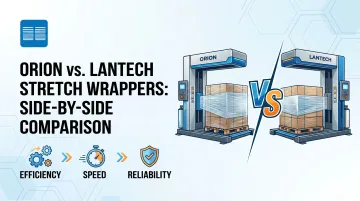
Orion and Lantech are two of the most frequently evaluated stretch wrapper brands in North American manufacturing. Both are respected, widely distributed, and U.S.-manufactured. Where they diverge is in engineering priorities — and that gap directly affects your film costs, throughput, and long-term maintenance budget.
This article provides a feature-by-feature comparison of both brands, identifies their ideal use cases, and offers a practical framework for making the right decision based on your operation's volume, load type, and automation needs.
Key Takeaways
- Orion Packaging Systems delivers 260% powered pre-stretch and scalable automation, making it a strong fit for operations focused on reducing film costs
- Lantech invented the stretch wrapper in 1972 and leads in load containment measurement with proprietary CFT-6 tools
- Both offer turntable, rotary arm, and fully automatic configurations—key differences lie in pre-stretch mechanisms, containment force measurement, and service infrastructure
- High-volume operations in food & beverage and pharmaceuticals should evaluate total cost of ownership, not just upfront price
- A manufacturer-trained distributor helps match the right machine to your application and keeps it running after installation
Orion vs. Lantech: Quick Comparison
| Feature | Orion Packaging Systems | Lantech |
|---|---|---|
| Headquarters | Alexandria, Minnesota | Louisville, Kentucky |
| Parent Company | ProMach product brand | Independent (founded 1972) |
| Pre-Stretch Capability | 260% powered (S-Carriage standard) | 200% standard (metered film delivery available) |
| Machine Types | Turntable (Sentry), rotary tower (Flex), orbital (Constellation), fully automatic | Turntable (Q Series), rotary arm (S Series), horizontal ring (LanRinger), fully automatic |
| Automation Levels | Semi-automatic to fully automatic (20-120 loads/hour) | Semi-automatic to fully automatic (up to 45 loads/hour) |
| Entry-Level Weight Capacity | 4,000 lbs (Sentry LP/HP) | 4,000 lbs (Q300) |
| Film Efficiency | Up to 260% pre-stretch reduces film consumption per load | Metered film delivery system: 25% film reduction claimed by Lantech |
| Load Containment Measurement | Not specified | CFT-6 tool and Load Guardian measure containment force |
| Typical Starting Price Range | Not publicly available (distributor quotes required) | Not publicly available (distributor quotes required) |
| Advertised Lead Time | Three weeks or less | Reportedly shorter lead times following 2025 Louisville expansion |
| Primary Industry Focus | Manufacturing, food & beverage, consumer goods, building materials | Consumer packaged goods, pharmaceuticals, food processing, high-stakes shipping |
What is Orion Packaging Systems?
Orion Packaging Systems, headquartered in Alexandria, Minnesota, operates as a ProMach product brand. The company's core engineering focus centers on maximizing pre-stretch efficiency. Their powered S-Carriage InstaThread system delivers 260% pre-stretch standard, with options to go higher or lower—substantially exceeding the 200% found on entry-level models from both brands. That efficiency gap translates to measurable film savings per pallet.
Orion's product lineup spans four categories:
- Semi-automatic stretch wrappers: Sentry series (LP and HP models) and Flex series (RTD, HPD, LPD, Legion, RTA, HPA, LPA)
- Fully automatic stretch wrappers: MA, FA, CTS, RTC, and MADX systems
- Specialty wrapping systems: Orbital Constellation for long loads like pipes and lumber
- Orbital/horizontal systems: For products that can't be wrapped on conventional turntables
This breadth allows facilities to scale from manual-assist wrapping to fully integrated line automation without switching brands.
Key Technical Advantages
Three engineering decisions drive Orion's operational advantages:
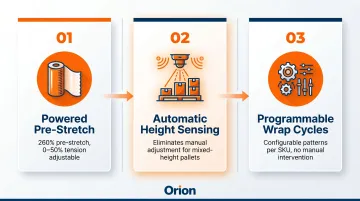
- Powered pre-stretch: The S-Carriage achieves over 180 degrees of film-to-roller contact, reducing neckdown and improving film yield. Tension is adjustable from 0% to 50%, maintaining consistent 260% pre-stretch across varying load types.
- Automatic height sensing: Load height detection eliminates manual adjustment for mixed-height pallets, cutting cycle time variability and operator error.
- Programmable wrap cycles: Configurable wrap patterns let facilities optimize film placement for different SKUs without manual intervention between runs.
Orion maintains a distributor network across North America and hosts training seminars at its Minnesota headquarters for distributor and customer personnel. For Midwest-based operations, proximity to the Alexandria facility shortens parts lead times and service response windows — a practical advantage for facilities in Wisconsin, Illinois, and Minnesota.
Use Cases of Orion
Those technical capabilities translate into clear operational fits:
- Mid-to-high volume manufacturing: Facilities wrapping 50–150 pallets per day see measurable ROI from the 260% pre-stretch advantage. Mixed-height pallet lines benefit most from automatic height sensing, which removes manual adjustments between SKUs.
- Scalable operations: Start with a Sentry semi-automatic model, then upgrade to an MA or FA fully automatic system later. The consistent interface reduces retraining time when you expand.
- Film-cost-sensitive industries: Orion has deep penetration in food & beverage, consumer goods, building materials, and warehousing — sectors where per-unit film cost and wrapping consistency directly affect margin.
What is Lantech?
Lantech invented the stretch wrapper in 1972. Founders Pat and Bill Lancaster introduced the first stretch wrapper at the 1973 Packaging Machinery Manufacturer's trade show.
Headquartered in Louisville, Kentucky, Lantech manufactures stretch wrappers in the U.S. On November 4, 2025, the company expanded its Louisville facility to include CS300 and CS1000 case sealer production, previously manufactured in the Netherlands. The first Louisville-built case sealer shipped October 13, 2025. This expansion adds North American manufacturing capacity and reduces lead times for U.S. buyers. CEO Jim Lancaster noted that "customers can expect not only faster access to the machines and parts they need."
Lantech positions itself as a fuller end-of-line solution provider, offering both pallet wrapping and case/tray handling from a single manufacturer.
Core Product Lines
Lantech's stretch wrapper lineup includes:
- Q Series semi-automatic: QL400XT, QL400, Q300XT, Q300, Q300XT Plus, Q250 (turntable, up to 30-40 loads/hour)
- S Series semi-automatic: SL400LT, SL400, S300XT, S300 (rotary arm, up to 40 loads/hour)
- G Series semi-automatic: Entry-level turntable models
- Automatic systems: QL Automatic, Q Automatic, SL Automatic High Speed, SL Automatic, S Automatic, RL Automatic
- LanRinger: Rotating horizontal ring automatic wrapper designed for heavy loads
The Q Series is Lantech's most recognized semi-auto platform and has long set benchmarks for load containment measurement and consistency.
Differentiating Technology
Lantech's proprietary CFT-6 tool (Containment Force Tool) lets operators measure and maintain containment force on wrapped loads. The Load Guardian feature works in tandem, providing data-driven verification that loads meet wrap specification—reducing shipping damage in high-stakes industries like pharmaceuticals and consumer packaged goods.
Lantech states that effective load containment requires three things:
- Applying proper containment force across the entire load
- Locking the load to the pallet with a film cable
- Eliminating long or dragging film tails
The CFT-6 tool measures the force applied by stretch film directly, turning load containment from a subjective judgment into a repeatable quality control checkpoint.
Use Cases of Lantech
Lantech is most commonly the preferred solution in specific environments:
High-volume operations in consumer packaged goods, food processing, and pharmaceutical sectors where load containment consistency and shipping damage reduction are measurable priorities. Facilities shipping via LTL carriers (which see 2-5% damage rates due to increased handling) benefit most from Lantech's measurement-driven approach.
Operations that want a single supplier for both stretch wrapping and case handling can source end-of-line equipment entirely from Lantech following the Louisville case sealer expansion.
A published Lantech case study shows a food and beverage customer reduced film consumption by 25% using the Metered Film Delivery System, saving $54,750 annually while wrapping over 350,000 loads per year. This represents approximately $0.16 in film savings per load from the metered film delivery upgrade alone.
Orion vs. Lantech: Which Is the Right Fit for Your Operation?
The right stretch wrapper depends on five primary factors:
Decision Framework
1. Wrapping Volume and Throughput Requirements
- Fewer than 10 loads/day: Manual wrapping may suffice
- 20-300 loads/day: Semi-automatic systems from either brand
- 30-120 loads/hour: Fully automatic systems required
2. Load Variability
- Mixed-height pallets: Orion's automatic height sensing eliminates manual adjustments
- Heavy or unstable loads (over 4,000 lbs): Both brands offer rotary arm/tower configurations; Lantech's LanRinger handles very heavy loads
3. Film Efficiency vs. Load Containment Precision
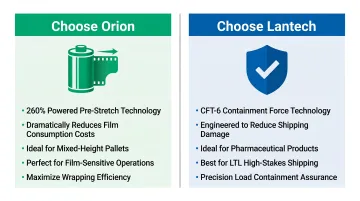
- Choose Orion if your priority is reducing film cost through powered pre-stretch (260% vs. 200%)
- Choose Lantech if your priority is measurable containment force and shipping damage reduction (CFT-6 measurement)
4. Level of Automation Desired
- Entry-level semi-automatic: Both brands offer 4,000 lb capacity turntable models at comparable specs
- Scalable automation: Both support semi-auto to fully automatic progression within brand family
5. Budget: Upfront Cost vs. Total Cost of Ownership
Neither manufacturer publishes pricing. Upfront machine price is only part of the calculation—film consumption per pallet, service contract costs, parts availability, and operator training all factor into real-world ROI.
Situational Guidance
Choose Orion if:
- You prioritize film cost reduction through powered pre-stretch
- You wrap high volumes of mixed-height pallets
- You want a feature-rich semi-auto or scalable automatic system at a competitive price point
- Your facility is in the upper Midwest, within reach of Orion's Alexandria, MN support infrastructure
Choose Lantech if:
- You demand precision load containment measurement (CFT-6 tool)
- You operate in a high-stakes shipping environment (pharmaceuticals, fragile goods, LTL shipping)
- You require an integrated pallet wrapping and case handling solution from a single manufacturer
- Documented damage reduction metrics justify the containment measurement investment
Total Cost of Ownership Example
Consider a facility wrapping 100 pallets per day, 250 working days per year (25,000 loads annually):
Scenario 1: Upgrading from 200% to 260% pre-stretch
- A 260% pre-stretch system yields approximately 30% more film coverage per roll than a 200% system
- If film costs $0.50 per load at 200% pre-stretch, upgrading to 260% could reduce film cost to approximately $0.38 per load
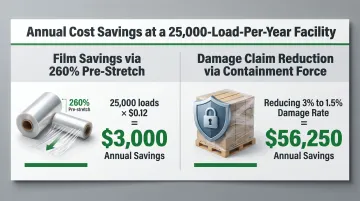
- Annual film savings: 25,000 loads × $0.12 = $3,000
Scenario 2: Reducing shipping damage claims
- If current damage claim rate is 3% (LTL shipping average) at $150 average claim cost
- 25,000 loads × 3% × $150 = $112,500 annual damage costs
- Reducing damage rate to 1.5% through improved containment force saves $56,250 annually
The right choice hinges on which cost driver hits your operation harder: film spend or damage claims. That's where distributor expertise becomes as valuable as the spec sheet.
The Distributor's Role
Both Orion and Lantech are sold through regional distributors. The quality of that relationship—application assessment, live demos, and post-installation support—can matter as much as the brand itself.
John Maye Company has distributed and serviced packaging equipment across Wisconsin and the Midwest since 1983. Their factory-certified technicians offer 24-hour service response, so a wrapper problem doesn't become a production stoppage.
When Neither Semi-Auto Option Is Ideal
Some situations fall outside the semi-automatic range entirely:
- Under 10 loads/day: Hand wrapping is likely sufficient; the equipment ROI won't pencil out
- Over 120 loads/hour: Fully automatic inline systems from either brand are more appropriate
- Over 6,000 lbs or non-rotatable loads: Rotary arm or horizontal ring configurations are required — consult a distributor for proper specification
Conclusion
Orion and Lantech are both proven, North American-manufactured stretch wrapper brands with genuinely different engineering priorities. Orion's 260% powered pre-stretch stands out for operations focused on reducing film costs. Lantech leads on load containment precision and end-of-line automation, backed by proprietary measurement tools that put a number on wrap quality.
The distinction comes down to where your operation feels the most pressure. If film spend is the headline concern, Orion delivers a clear cost-per-load advantage. If shipping damage claims are eating into margins, Lantech's containment force measurement gives you the data to address the root cause — not just the symptom.
John Maye Company has been matching Midwest manufacturers and warehouses with the right wrapping equipment since 1983. Their team can run an application assessment, set up equipment demos, and model total cost of ownership for both brands. Call 1-800-441-6293 or email info@johnmayecompany.com to find the right fit for your operation.
Frequently Asked Questions
Which stretch wrapper brand is better for high-volume manufacturing — Orion or Lantech?
Both brands perform well at high volumes. Orion is often favored for operations prioritizing film savings through 260% powered pre-stretch, while Lantech's CFT-6 containment force measurement makes it a strong choice for facilities where shipping damage reduction is the primary goal.
What is the typical price range for Orion vs. Lantech stretch wrappers?
Neither manufacturer publishes pricing publicly — entry-level semi-automatic models from both brands require distributor quotes. Total cost of ownership — film consumption, maintenance, and service costs — matters more than the sticker price when evaluating long-term value.
What does pre-stretch mean and why does it matter when comparing these brands?
Pre-stretch is the percentage a film is stretched before being applied to the pallet. Higher powered pre-stretch — 260% on Orion's S-Carriage vs. 200% standard — means more film yield per roll, cutting per-load film costs and adding up to real annual savings for high-volume operations.
Are parts and service readily available for both Orion and Lantech machines?
Both brands distribute through regional dealer networks across North America, so service and parts access is generally strong. However, the responsiveness of your local distributor and their technician training level is the most important factor for minimizing downtime.
Can Orion and Lantech stretch wrappers handle heavy or irregularly shaped loads?
Both brands offer models capable of handling loads up to 4,000–5,000 lbs on turntable systems. For heavier or unstable loads that can't rotate, rotary arm models (Lantech S Series) and horizontal ring systems (Lantech LanRinger, Orion Orbital) are the right fit.
Which brand is better suited for food and beverage or pharmaceutical packaging lines?
Both brands serve these industries extensively. Lantech's CFT-6 containment measurement is popular in pharmaceutical applications where damage claims are costly, while Orion is widely used in food & beverage where film efficiency and throughput come first.