Introduction
Warehouse managers face a familiar dilemma: dozens of stretch wrapper options, competing vendor claims, and tight capital budgets that demand justifiable ROI. With equipment investments ranging from $15,000 to $50,000+, choosing the wrong wrapper can mean years of inefficient film consumption, unnecessary labor costs, and damaged loads.
This review delivers a straightforward assessment of Orion stretch wrappers — what works, what doesn't, and whether the ROI holds up in real operations. Orion Packaging Systems, a ProMach brand based in Alexandria, Minnesota, has built a reputation around its Flex product line for mid-to-high-volume pallet wrapping.
But does the premium price hold up under scrutiny?
TLDR: What You Need to Know About Orion Stretch Wrappers
- Orion makes semi-automatic and automatic stretch wrappers in Alexandria, Minnesota — spanning entry-level to high-throughput applications
- Core strengths include patented S-Carriage film technology, pre-stretch ratios up to 260%, and US-based manufacturing with shorter lead times
- Premium pricing and varying regional service availability represent the main limitations
- Mid-volume operations (20+ pallets/shift) typically see payback within 12–24 months through film savings and labor reduction
- Best suited for distribution centers and manufacturers prioritizing load containment reliability and long-term durability
Orion Stretch Wrapper Product Line: Models and Key Specs
Orion's Flex series spans three primary tiers, all manufactured at their 250,000+ square foot Alexandria facility:
Entry-Level: Flex Legion
The newest addition (launched 2026) brings US manufacturing to Orion's entry segment. Variable 15 RPM speed with soft start reduces load shifting during wrap cycles.
Key specs:
- 200% powered pre-stretch
- 4,000 lb maximum load capacity
- 60" turntable
- 4" Allen-Bradley HD touchscreen
Mid-Range Automatic: Flex HPA
This portable automatic system handles loads up to 6,000 lbs on a 48" x 48" octagonal turntable. The S-Carriage InstaThread delivers 260% pre-stretch standard. Automatic film attach, cut, and wipe cycles eliminate operator intervention between loads.
High-Throughput Automatic: Flex RTA
The rotary tower configuration keeps loads stationary while the film carriage rotates around them — ideal for unstable, heavy, or fragile pallets. Key features:
- Ring bearing drive systems for smooth rotation
- Tower-mounted obstacle sensing
- Automatic film handling
Differentiating Technologies
Two technologies set the Flex series apart from standard stretch wrappers:
InstaThread Powered Pre-Stretch Carriage — Standard across all Flex models. Operators thread new film rolls in seconds without manual roller routing. The polyurethane rollers carry a limited lifetime warranty.
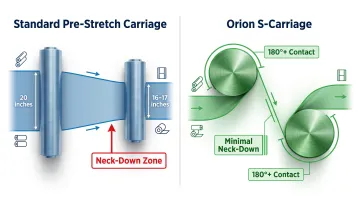
Patented S-Carriage — Available on select models. Film routes in an S-pattern between rollers, increasing contact to over 180 degrees. This reduces neck-down (film width reduction during stretch) and enables compatibility with one-sided cling films, which typically cost less than two-sided alternatives.
Warranty Structure
Orion's Flex series warranty (effective January 2020) includes:
- 5-year coverage: Structural components (base weldment, tower, carriage backplate), unlimited cycles
- 1-year coverage: Mechanical and electrical components (or manufacturer warranty, whichever is greater)
- Limited lifetime: Polyurethane pre-stretch rollers
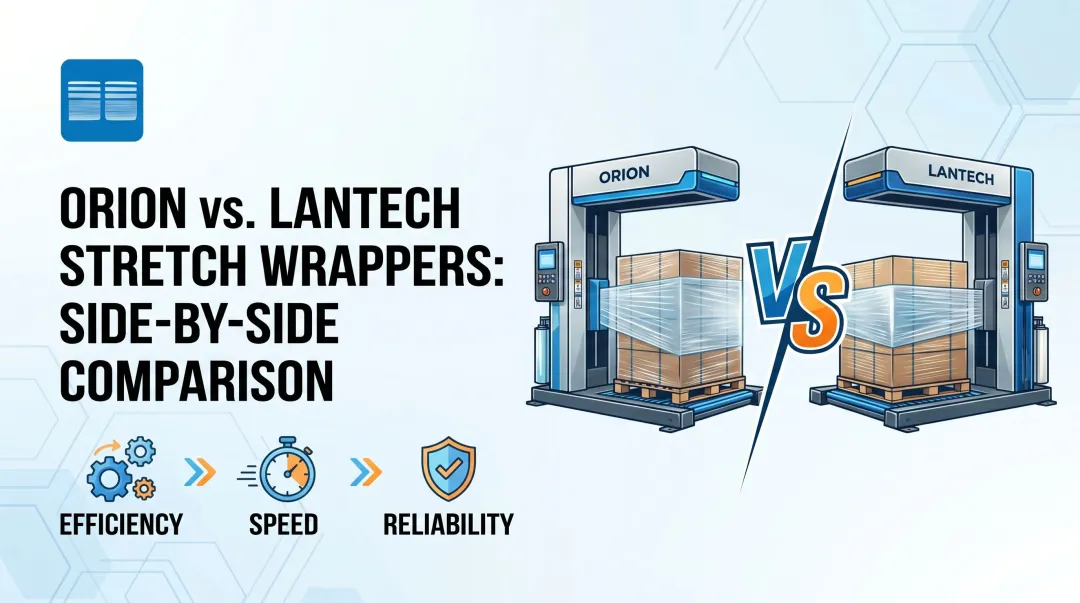
Note that warranty excludes labor, travel, and downtime costs. Compared to competitors like Lantech's 5-year bumper-to-bumper Q-series warranty (no exclusions, unlimited cycles), Orion's coverage is more limited on mechanical components.
Orion Stretch Wrapper Strengths
Film Efficiency That Directly Impacts Your Bottom Line
Orion's 200–260% pre-stretch ratios deliver measurable film savings that manual wrapping simply can't match. Hand wrapping typically achieves 80–100% stretch, meaning a 5,000-foot roll wraps approximately 80–100 pallets. A machine applying 250% pre-stretch can wrap 200+ pallets from the same roll.
Research from Robopac USA confirms that industrial stretch wrap machines use 30–50% less material than manual wrapping, with manual methods consuming up to 50% more film due to inconsistent tension and unnecessary wrap passes.
Patented S-Carriage Technology
Standard pre-stretch carriages stretch film between two rollers positioned several inches apart—the gap where stretching occurs also creates neck-down, narrowing a 20-inch roll to 16–17 inches of actual coverage. Orion's S-Carriage routes film in an S-pattern around the back of the first roller, then around the front of the second, dramatically reducing the stretching distance.
Benefits include:
- Reduced neck-down preserves more usable film width
- Fewer wrap passes needed for equivalent coverage
- Compatibility with lower-cost one-sided cling films (cling side contacts both rollers and the load)
- Adjustable dancer bar for precise tension control
- Automatic corner compensation reduces film breaks on sharp pallet edges
US-Based Manufacturing and Supply Chain Reliability
All Orion equipment ships from Alexandria, Minnesota, a meaningful edge in an industry where many competitors import components or entire machines. Modern Materials Handling reported that Orion's 250,000+ square foot facility shares cross-trained production teams with sister brand Brenton, enabling faster service response and parts fulfillment.
Practical advantages:
- More predictable lead times (typically 4–8 weeks versus 12–16 for imported equipment)
- Reduced tariff exposure on imported machinery
- Faster warranty service through domestic parts inventory
- Easier technician access for complex installations or troubleshooting
Load Containment and Safety
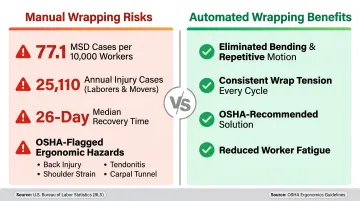
Automated pre-stretch delivers consistent wrap force load after load. Hand wrapping can't match this: tension degrades as worker fatigue sets in over an 8-hour shift, creating both safety and containment problems.
The worker safety case is well-documented:
- BLS data shows 77.1 MSD cases per 10,000 full-time workers in transportation and warehousing (2018), with 25,110 cases among laborers and material movers
- Median recovery time runs 26 days away from work per injury
- OSHA's grocery warehousing guidelines flag manual pallet wrapping as an ergonomic hazard, citing back injuries, shoulder strain, tendonitis, and carpal tunnel syndrome from "bending at the waist while supporting a heavy plastic dispenser"
- OSHA's recommended fix: automated wrapping machines with turntables
Consistent wrap tension also cuts in-transit damage. Flock Freight's 2024 research found LTL shipments damaged at a 1.94% rate (1 in 51 shipments), with average claims of $3,777 per shipment. Enterprise shippers absorbed up to $6.3 million annually in damage and loss in 2023.
Strong Warranty and Long-Term Durability
For high-volume operations wrapping 30+ loads per shift, a machine can cycle 60,000–80,000 times annually. Orion's warranty terms reflect that reality:
- 5-year structural warranty with unlimited cycles
- Lifetime warranty on InstaThread rollers, one of the highest-wear components in pre-stretch systems
- Domestic parts inventory supports faster warranty service versus imported equipment
That coverage matters when downtime directly disrupts shipping schedules.
Orion Stretch Wrapper Weaknesses and Limitations
Higher Upfront Investment
Orion's mid-range and automatic models command premium pricing. One distributor lists the Flex HPA at $23,987, while entry-level semi-automatic turntable wrappers from competitors start around $8,000–$12,000. For small operations wrapping fewer than 15 pallets per shift, the higher upfront cost may extend payback beyond 36 months—a difficult justification when lower-cost alternatives exist.
The RTA rotary tower systems represent an even larger investment, typically starting above $35,000 before integration costs. Floor space planning and electrical infrastructure add further to the total project budget before the first pallet is wrapped.
Entry-Level Options Were Previously Limited
The cost gap used to be compounded by a product line gap. Until the February 2026 launch of the Flex Legion, Orion's entry-level offering was an imported model that didn't carry the same build quality as their mid-tier machines. Buyers evaluating used equipment or older inventory should verify whether they're purchasing a US-manufactured unit or an earlier imported model—the difference significantly impacts parts availability and long-term serviceability.
Service and Parts Availability Can Vary by Region
While Orion's Minnesota facility provides aftermarket support, response time depends heavily on local dealer networks. Operations in the upper Midwest (Wisconsin, Minnesota, Illinois, Michigan) typically receive faster service than facilities in the Southeast or Mountain West. Before purchasing, verify:
- Local authorized distributor presence
- Average technician response time for service calls
- Nearest parts inventory location
- Whether your distributor maintains rental equipment for emergency swaps during major repairs
Complexity of Advanced Models
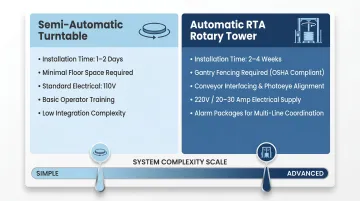
The RTA automatic rotary tower systems require more operator training and floor space than basic turntable wrappers. Integration considerations include:
- Gantry frame fencing for OSHA compliance
- Conveyor interfacing and photoeye alignment
- Alarm packages for multi-line coordination
- Electrical requirements (typically 220V, 20–30 amp circuits)
Budget 2–4 weeks for installation and operator training on automatic systems, versus 1–2 days for semi-automatic turntables.
Orion Stretch Wrapper ROI: Breaking Down the Numbers
Stretch wrapper ROI depends on three cost drivers: film consumption, labor costs, and damage prevention.
Film Cost Savings
Consider a mid-volume operation wrapping 30 pallets per shift, 250 shifts per year (7,500 pallets annually):
Hand wrapping scenario (100% stretch):
- Film consumption: Approximately 1 roll per 80 pallets
- Annual film rolls needed: ~94 rolls
- Inconsistent tension leads to extra wrap passes: +20% waste = 113 rolls
Orion machine (250% pre-stretch):
- Film consumption: Approximately 1 roll per 200 pallets
- Annual film rolls needed: ~38 rolls
- Consistent tension eliminates extra passes: minimal waste
Film savings: 75 fewer rolls annually. At $80–$120 per machine-grade roll, that's $6,000–$9,000 in annual material savings.
Labor Cost Reduction
Robopac USA benchmarks show manual wrapping requires 5–10 minutes per pallet, while machine wrapping takes 1–2 minutes—a 70–80% time reduction.
Using the same 30 pallets/shift example:
- Manual wrapping: 30 pallets × 7.5 minutes = 225 minutes (3.75 hours) per shift
- Machine wrapping: 30 pallets × 1.5 minutes = 45 minutes (0.75 hours) per shift
- Time savings: 3 hours per shift
At 250 shifts annually, that's 750 hours saved. With BLS warehouse labor costs averaging $21.23/hour (median wage for laborers/material movers), labor savings total approximately $15,920 annually.
Damage and Return Cost Avoidance
Consistent automated wrapping reduces load shifting during transit. If improved load containment prevents 3 damaged shipments per year at the $3,777 average LTL claim cost, that's $11,331 in avoided losses.
Typical Payback Period
Combining savings:
- Film: $7,500 (conservative mid-point)
- Labor: $15,920
- Damage prevention: $11,331 (3 prevented claims)
- Total annual savings: $34,751
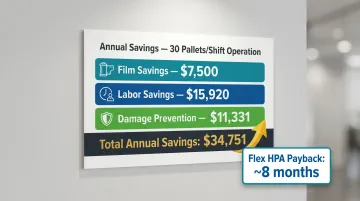
For a $24,000 Flex HPA investment, payback occurs in roughly 8 months. Mid-volume operations (20–50 pallets/shift) typically see 12–24 month ROI, while high-volume operations with RTA systems can achieve payback under 12 months running two or more shifts daily.
Who Should (and Shouldn't) Buy an Orion Stretch Wrapper
Best Fit: Operations That Benefit Most
Mid-to-Large Distribution Centers:
- Wrapping 20+ pallets per shift where labor and film savings compound quickly
- Mixed SKU operations requiring consistent load containment across varying pallet configurations
- Facilities prioritizing US-made equipment to minimize tariff exposure and ensure parts availability
Manufacturers with Quality Control Requirements:
- Operations where load failure results in production delays or customer chargebacks
- Industries shipping to retailers with strict packaging standards (automotive, consumer goods, food & beverage)
- Facilities needing documented wrap force and film usage for quality audits
3PL Providers:
- High-throughput operations where the RTA series handles 30+ loads per hour
- Seasonal operations that can leverage rental programs during peak periods (if available through distributors like John Maye Company)
- Multi-client facilities where consistent wrapping quality protects against damage claims
Not the Best Fit: When to Consider Alternatives
Low-Volume Operations:
- Wrapping fewer than 10–15 pallets per shift where payback extends beyond 30 months
- Seasonal businesses with inconsistent wrapping demands (unless renting equipment)
- Operations with extremely tight capital budgets unable to finance $20,000+ equipment purchases
Facilities with Space Constraints:
- Very low-ceiling environments where even the low-profile models may not fit
- Operations without dedicated wrapping zones where portable solutions make more sense
Getting Expert Help Before You Buy
A hands-on equipment evaluation beats spec sheet comparisons. John Maye Company offers end-of-line audits that assess your current wrapping process, identify inefficiencies, and recommend right-sized solutions.
Their service covers Wisconsin, Ohio, and the broader Midwest, with:
- Factory-certified technicians trained on Orion equipment
- Rental fleet options for trial periods before full purchase
- On-site audits at no obligation to buy
The goal is a machine that fits your actual throughput today — with room to grow if volume increases. Contact John Maye Company to schedule an audit before committing to a model.
Frequently Asked Questions
When should you use stretch wrap?
Stretch wrap should be used whenever palletized loads need stabilization for storage, transport, or shipment—particularly when products are stacked, contain mixed SKUs, or face shifting risks during transit. It's the standard solution for securing unitized loads in warehousing and distribution.
Does stretch wrap shrink?
No. Stretch wrap works by being stretched under mechanical tension and clinging to the load through elastic recovery. Unlike shrink wrap, it requires no heat application and does not undergo heat-activated shrinkage.
What material is stretch wrap made of?
Most stretch wrap is manufactured from linear low-density polyethylene (LLDPE), which provides the elastic properties needed to stretch around loads and maintain cling tension without tearing. LLDPE offers higher tensile strength and puncture resistance than standard LDPE, making it ideal for pallet wrapping applications.
How long does an Orion stretch wrapper last?
Orion machines are built for 10+ years of high-cycle use with proper maintenance. The 5-year structural warranty and lifetime warranty on InstaThread rollers back that durability expectation. Routine upkeep—film carriage cleaning, bearing lubrication, and photoeye alignment—keeps lifespan on track.
What is the ROI on a stretch wrapper?
ROI depends on your current labor costs, film usage, and damage rates, but most mid-volume operations (20–50 pallets per shift) report payback within 12–24 months. The primary savings come from film efficiency (30–50% material reduction) and labor hour reduction (70–80% less wrapping time per pallet).
How does Orion compare to other stretch wrapper brands?
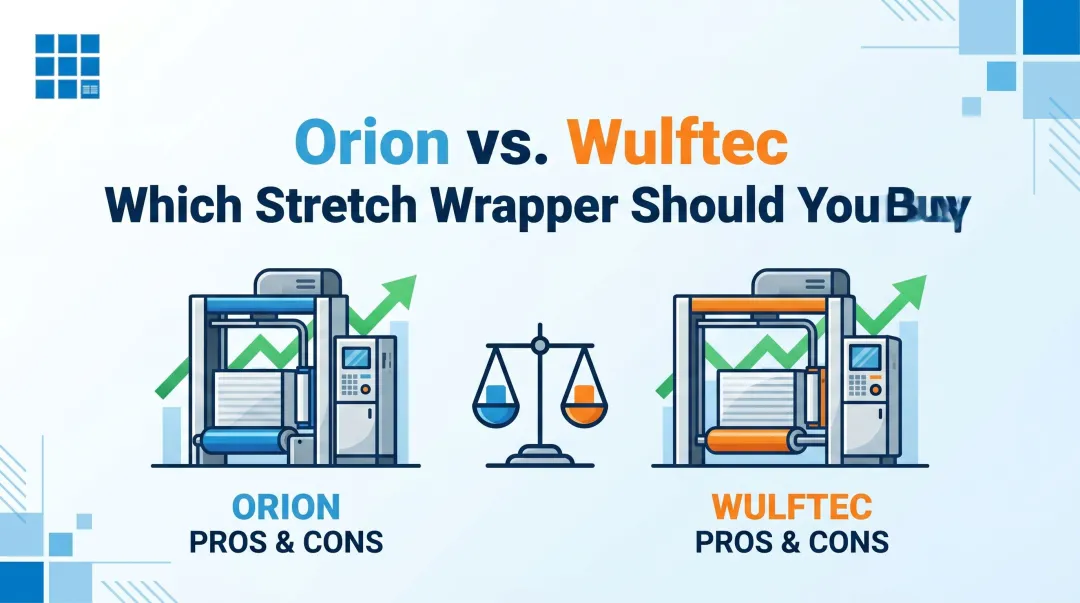
Orion sits in the mid-to-high-tier segment alongside Lantech and Robopac. It stands out through patented S-Carriage technology, US manufacturing in Alexandria, Minnesota, and a 5-year structural warranty. Budget brands like Highlight or Cousins offer lower upfront costs but typically rely on imported components with longer lead times.
Bottom Line: Orion stretch wrappers deliver on their core strengths: efficient film usage, consistent load containment, and durable US-built construction. The premium pricing makes sense for mid-to-high-volume operations where film savings and labor reduction drive ROI within 12–24 months. Smaller operations with inconsistent volumes may find better value elsewhere, but for distribution centers wrapping 20+ pallets per shift, the Flex series is a solid long-term investment.