The decision between Phoenix and Orion isn't about finding the "better" machine — it's about matching each brand's design philosophy to your specific operational reality. Phoenix positions itself as the durability champion with heavy-duty construction for harsh industrial environments, while Orion emphasizes film efficiency and automation scalability under the ProMach umbrella. This comparison breaks down the key differences in build philosophy, pre-stretch performance, automation options, and service support so you can make a clear, confident decision based on your load profile, throughput requirements, and total cost of ownership.
Key Takeaways
- Phoenix wrappers deliver rugged durability for harsh industrial environments, featuring all-steel construction and a lifetime pre-stretch roller warranty
- Orion stands out for film efficiency and automation scalability — 260% pre-stretch on automatic models, backed by full ProMach ecosystem integration
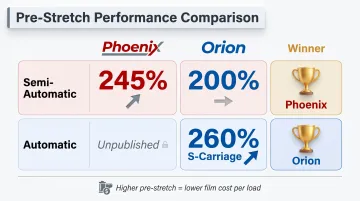
- At the semi-automatic tier, Phoenix outpaces Orion on pre-stretch (245% vs. 200%); Orion takes the lead at the automatic tier (260% vs. unpublished Phoenix specs)
- Choose Phoenix for heavy-load industrial applications where machine longevity is paramount; choose Orion for high-volume operations where film savings reduce operating costs
- The right choice comes down to load type, annual volume, and total cost of ownership — sticker price alone won't tell the full story
Phoenix vs. Orion: Quick Comparison
Cost
Phoenix: Entry-level semi-automatic models range from $12,355 to $13,495 depending on load capacity. The PLP-2100 (4,000 lbs) starts around $12,495, while the 5,000-lb PLP-2150 lists at $13,495. Fully automatic configurations require formal quotes.
Orion: The Sentry LP semi-automatic starts at $10,487 — approximately $1,800-$2,000 below Phoenix's entry point. The Flex HPA portable automatic is listed at $23,987. Fully automatic inline and rotary systems are quote-based only.
Neither manufacturer publishes MSRP on official websites. Final pricing varies based on pre-stretch carriage type, control packages, conveyor integration, safety ratings, and installation requirements.
Pre-Stretch Capability
Phoenix: Delivers 245% powered pre-stretch as standard across semi-automatic turntable models (PLP/PHP series). Pre-stretch specifications for automatic models are not published on available spec sheets.
Orion: Entry-level Sentry models provide 200% powered pre-stretch. Automatic models equipped with the S-Carriage deliver 260% powered pre-stretch with 180-degree film contact to reduce slippage. That's a 60-percentage-point spread across Orion's product ladder.
At the semi-auto tier, Phoenix leads with 245% vs. Orion's 200%. At the automatic tier, Orion's S-Carriage delivers the industry's highest published pre-stretch at 260%.
Load Capacity
Phoenix:
- PLP-2100/PHP-2100: 4,000 lbs max, 52" × 52" load size
- PLP-2150/PHP-2150: 5,000 lbs max, 56" × 56" load size
- PRRA-4000 rotary ring: Load weight not published
Orion:
- Sentry LP: 4,000 lbs max, 55" × 55" load size
- Sentry HP: 5,000 lbs max, 56" × 56" load size
- Flex HPA: 6,000 lbs max, 50" × 50" load size
The Orion Flex HPA offers 50% more capacity than entry-level models from both brands, giving it a clear capacity advantage for heavy palletized loads in beverage, building materials, or dense consumer goods applications.
Machine Configurations Available
Phoenix: Semi-automatic rotary turntable (PLP/PHP), fully automatic rotary arm (PRTA), rotary ring (PRRA), conveyorized turntable (PCTA), and custom builds designed for 24/7 harsh-environment operation.
Orion: Semi-automatic turntable (Sentry LP/HP), portable automatic (Flex LPA/HPA), fully automatic turntable (FA), rotary tower (MA/RTC), conveyorized twin station (CTS), and orbital systems (Constellation) for long or irregularly shaped loads.
Orion covers more specialty configurations — orbital wrapping in particular is an Orion-only option not found in Phoenix's current lineup.
Brand Ownership & Support Infrastructure
- Phoenix — Owned by Pacteon Group (GenNx360 Capital Partners, since 2021). Service and parts delivered through factory-trained distributors across North America.
- Orion — Operates under ProMach Inc. (Cincinnati, OH), with manufacturing in the USA, Canada, Mexico, Brazil, Europe, UAE, and China. ProMach's 46-brand network across 9 business lines supports ongoing distributor training.
What is a Phoenix Stretch Wrapper?
Phoenix Wrappers is a North American manufacturer known for producing rugged, long-lifecycle stretch wrapping equipment. Founded in 1994 and acquired by Pacteon Group in 2021, Phoenix has built its reputation on machines that live up to the "built like tanks" label. Within the Pacteon portfolio, Phoenix sits alongside Schneider (palletizers), ESS Technologies (cartoners), and Descon (conveyor systems), providing integrated end-of-line solutions.
Phoenix's core design philosophy prioritizes mechanical durability through heavy-duty steel construction and low-maintenance operation. The all-steel frames feature two-part epoxy paint designed to resist wear and corrosion in dusty, high-vibration, or 24/7 manufacturing environments — a strong fit for demanding load profiles or challenging floor conditions.
Key Performance Specifications
Phoenix PLP-2100 (Semi-Automatic):
- Pre-stretch: 245% powered, chain-drive system (10 inches off the roll = 34 inches on the load)
- Max load: 4,000 lbs, 52" × 52" (74" diagonal)
- Turntable: 58" diameter, roller bearing supports, chain drive with auto tensioner
- Throughput: 45 loads per hour
- Controls: Pre-programmable wrap cycles, variable speed, one-touch start
- Warranty: 5-year full parts, lifetime pre-stretch roller warranty
Phoenix PRRA-4000 (Fully Automatic Rotary Ring):
- Throughput: 90-120 loads per hour at 40 RPM
- Max load size: 48"W × 50"L
- Film savings: Cuts film use by 30+ feet per load
- Design: Low-mass ring rotation (only carriage rotates), compact footprint for 24/7 performance
- Ideal for: Automatic palletizer integration, beverage/dairy operations
Phoenix's proprietary features include no-lube components and modular upgrade paths that reduce long-term maintenance costs. The "Clearview" carriage door with dual-stage electrical interlock provides operator safety while maintaining production visibility.
Use Cases of Phoenix Stretch Wrappers
Phoenix machines are most commonly deployed in four sectors, with the brand's heavy-duty positioning making them most effective in high-demand environments:
- Heavy industrial manufacturing — construction materials, metal fabrication, and brick/block production with dense, irregular, or oversized loads
- Beverage and dairy — the PRRA-4000 rotary ring handles high-speed wrapping of heavy pallets at throughput rates few competitors match
- Automotive parts — mixed-SKU pallets requiring consistent containment in dusty or high-vibration environments
- 24/7 operations — facilities where uptime and mechanical longevity outweigh upfront equipment cost
Understanding what Phoenix does well sets the baseline for a fair comparison — next, we'll look at where Orion's design takes a different approach.
What is an Orion Stretch Wrapper?
Orion Packaging Systems operates as a product brand of ProMach Inc., headquartered in Alexandria, Minnesota, with ProMach's corporate offices near Cincinnati, Ohio. With a 30+ year history, Orion emphasizes innovation in pre-stretch technology and automation capabilities for high-throughput packaging lines.
Orion's core design philosophy centers on film efficiency and throughput consistency. Their machines are engineered around advanced pre-stretch systems that reduce film consumption per load, directly lowering operating costs over time. The company states, "Orion innovation is built into every model we make, distinguishing us from competitive equipment on every level."
Key Performance Specifications
Orion Sentry LP/HP (Semi-Automatic):
- Pre-stretch: 200% powered, InsaThread carriage with automatic film force-to-load control
- Max load: LP 4,000 lbs (55″ × 55″), HP 5,000 lbs (56″ × 56″)
- Turntable speed: 12 RPM max, adjustable
- Controls: IntelleVue 7″ color touchscreen (English/Spanish), B&R C70 PLC, pre-programmed recipes
- Technology: RevoLogic — precisely counts turntable revolutions and stops in the same position after each cycle
- Safety: E-stop, carriage-down obstacle detection, password-protected controls
- Warranty: 5-year structural frame, 1-year components
Orion Flex HPA (Portable Automatic):
- Pre-stretch: 260% powered (S-Carriage InstaThread)
- Max load: 6,000 lbs, 50″ × 50″ max
- Automation: Fully automatic cycle with automatic film attach/detach/cut
- Controls: IntelleVue HMI, RevoLogic technology
- Start: Lanyard switch or remote control
- Portability: Forklift portable from front and rear
Automation Depth and Product Ladder
Orion's product lineup allows operations to scale wrapping automation as volume grows:
- Sentry LP/HP: Semi-automatic entry point
- Flex LPA/HPA: Portable automatic
- FA: Turntable automatic with Allen Bradley PLC and CAT-3 safety
- MA: Fully automatic rotary
- RTC: Rotary tower with conveyance (18″ pass height)
- CTS: Conveyorized twin station with integrated scale
- Orbital Constellation: Long/irregularly shaped loads
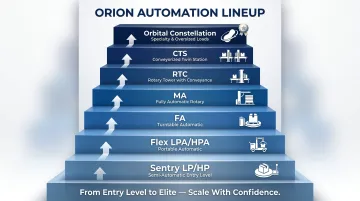
Facilities can move up this ladder without retraining operators on new control systems or changing vendors — each tier shares a common HMI interface.
Use Cases of Orion Stretch Wrappers
Orion targets a broad range of industries: food & beverage, bakery, dairy, pharmaceutical, personal care, household goods, industrial goods, chemicals, and distribution/fulfillment. The brand delivers the most value in:
- High-volume consumer goods warehouses where film cost reduction is a measurable KPI
- E-commerce fulfillment operations requiring touchscreen controls and minimal operator intervention
- Food and beverage production lines integrating with broader ProMach automation
- Electronics packaging applications needing precise film tension and HMI documentation
The ProMach Ecosystem Advantage
Orion sits within ProMach's Robotics & End of Line business line alongside nine sister brands. ProMach operates 46 total brands across 9 business lines, creating integration opportunities competitors can't match:
- Brenton: Case packers and robotics
- Currie: Palletizers
- Dekka: Tape heads
- ID Technology: Labeling and coding
- Wexxar Bel: Case erecting
- Edson: Case and tray packing
Orion also supports integration with AGVs, AMRs, and industrial autonomous vehicles for automated pallet delivery. For facilities that want one vendor handling their entire end-of-line, that breadth is difficult to replicate elsewhere.
Phoenix vs. Orion: Which Should You Choose?
The choice between Phoenix and Orion comes down to four key operational factors: application environment, load profile, volume/throughput requirements, and total cost of ownership — not just machine price.
Durability vs. Efficiency Trade-off
Phoenix machines are optimized for longevity in harsh conditions. Heavy loads, dusty environments, high-vibration facilities, or operations with limited maintenance staff benefit most from Phoenix's all-steel construction and lifetime pre-stretch roller warranty. The design priority is mechanical uptime over multi-year service lives.
Orion machines are optimized for efficiency and film savings in consistent, high-volume throughput scenarios. The 260% S-Carriage pre-stretch, IntelleVue touchscreen controls, and RevoLogic positioning technology deliver measurable cost reductions in clean, climate-controlled distribution centers or food production facilities where film consumption is tracked as a key performance indicator.
Film Cost Impact
Pre-stretch capability directly affects per-load film cost and annual operating expenses:
Cost Reduction from Pre-Stretch:
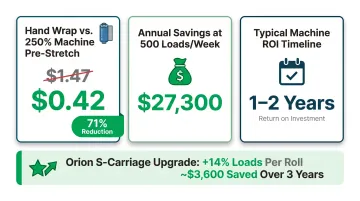
- Moving from hand wrap to 250% machine pre-stretch reduces per-load film cost from $1.47 to $0.42 (a 71% reduction)
- At 500 loads per week, this yields approximately $27,300 in annual savings
- Typical machine ROI: 1-2 years
Orion S-Carriage Advantage:
- Increases loads wrapped per roll from 135 to 154 (14% improvement)
- Saves approximately $3,600 in film cost over three years
- The gap from 200% (Sentry) to 260% (S-Carriage) creates a strong upgrade incentive within Orion's product ladder
Phoenix Semi-Auto Advantage:
- At 245% pre-stretch, Phoenix semi-auto models deliver better film efficiency than Orion's 200% Sentry
- For facilities starting with semi-automatic equipment and prioritizing immediate film savings, Phoenix offers a TCO advantage at the entry tier
The 60-percentage-point gap between Orion's entry (200%) and automatic (260%) tiers is larger than the 45-point gap between Phoenix (245%) and Orion Sentry (200%) at the semi-auto level.
Evaluate your automation timeline: if you're buying semi-auto today but scaling to automatic within 3 years, Orion's product ladder is the stronger long-term investment despite the lower entry-level pre-stretch.
Automation & Scalability
Orion's place within the ProMach ecosystem is a meaningful advantage if you're planning a fully automated end-of-line. Case packers, palletizers, labelers, and stretch wrappers can be sourced, installed, and supported through one vendor with coordinated project management — a simpler path than managing multiple supplier relationships.
Phoenix is the better fit for standalone deployments. Mechanical simplicity and minimal operator training requirements make it reliable across multiple shifts with varying skill levels — even when dedicated maintenance staff isn't available.
For operations exceeding 60 loads per hour , Phoenix's PRRA-4000 rotary ring at 90-120 loads per hour may be the only viable option .
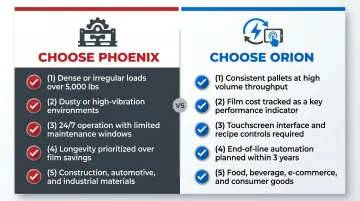
Situational Decision Guide
Choose Phoenix if:
- Your loads are dense, irregular, or exceed 5,000 lbs regularly
- Your environment is dusty, high-vibration, or outdoor
- Machine longevity and uptime are more critical than film savings
- You operate 24/7 with limited maintenance windows
- You're wrapping construction materials, lumber, brick, metal fabrication, or automotive parts
Choose Orion if:
- You wrap consistent pallet dimensions in high volume (100+ loads per day)
- Film cost is a tracked KPI in your operation
- You need touchscreen controls, automated height sensing, or recipe management
- You're planning broader end-of-line automation within 3 years
- You operate in food & beverage, e-commerce fulfillment, or consumer goods distribution
John Maye Company works with both brands and can help you assess which machine fits your floor layout, load profile, and production goals. Contact their team for an application-specific recommendation.
Conclusion
Both Phoenix and Orion are strong, proven stretch wrappers with distinct design strengths. Phoenix delivers unmatched durability for demanding industrial environments where machine longevity justifies the investment. Orion excels in film efficiency and automation scalability for high-volume throughput settings where operating cost reduction drives ROI.
The right choice comes down to matching each brand's design philosophy to your operational reality. Choosing well reduces film waste by up to 71%, minimizes unplanned downtime, and lifts overall production efficiency.
Before committing, evaluate your priorities:
- Load weight and pallet configuration
- Daily cycle volume and throughput targets
- In-house maintenance capacity
- Long-term automation roadmap
Then take these steps before signing anything:
- Request on-site demonstrations using your actual pallet loads
- Run a film consumption audit at your current pre-stretch level
- Model total cost of ownership over a 5-year horizon
The $1,800 entry-price difference is dwarfed by the multi-year film cost implications of even a 15-percentage-point pre-stretch gap at scale.
Frequently Asked Questions
What is a Phoenix wrap?
A Phoenix wrap is a stretch-wrapped pallet load produced by a Phoenix Wrappers machine. Phoenix is a North American manufacturer known for heavy-duty stretch wrappers built for industrial environments where rugged construction and long service life are priorities.
What are the different types of stretch wrappers?
The main categories include semi-automatic turntable, rotary arm, fully automatic inline, rotary ring, and orbital/specialty wrappers. Both Phoenix and Orion offer multiple types across this spectrum, from entry-level semi-automatic turntables to high-speed rotary systems capable of 90-120 loads per hour.
How much does a Phoenix or Orion stretch wrapper cost?
Entry-level semi-automatic models range from $10,487 (Orion Sentry LP) to $13,495 (Phoenix PLP-2150). The Orion Flex HPA portable automatic lists at $23,987. Fully automatic, conveyorized, and high-speed configurations require formal quotes. Final pricing varies based on pre-stretch carriage type, control packages, conveyor integration, safety ratings, and site-specific installation requirements.
What is the pre-stretch capability difference between Phoenix and Orion wrappers?
Phoenix delivers 245% powered pre-stretch on semi-automatic models; Orion's Sentry provides 200%. Orion's automatic models with the S-Carriage reach 260% — the industry's highest published figure — increasing loads per roll from 135 to 154 and saving approximately $3,600 over three years. Higher pre-stretch directly lowers per-load film cost.
Which stretch wrapper is better for high-volume operations?
Orion's S-Carriage pre-stretch (260%), IntelleVue touchscreen controls, and scalable automation make it the stronger choice for high-cycle environments where film cost is a tracked priority. Phoenix leads on raw throughput: the PRRA-4000 rotary ring hits 90-120 loads per hour — a speed tier Orion doesn't match with published specifications.
How do I choose the right stretch wrapper for my facility?
Evaluate load weight and dimensions, annual wrapping volume, floor space, automation goals, and maintenance capabilities. Request on-site demonstrations with your actual pallet loads and conduct a film consumption audit at your current pre-stretch level. Contact John Maye Company for an application-specific recommendation tailored to your facility's requirements. Reach them at 1-800-441-6293 or info@johnmayecompany.com.