
Introduction
Electronics manufacturers face a familiar problem: shipping fragile, high-value components and finished devices demands packaging lines that are both fast and precise. The wrong case sealer creates a cascade of costly problems—damaged circuit boards, line stoppages during peak production, and inconsistent seals that lead to contamination or customer returns.
Case sealers are a critical but often under-optimized piece of the electronics packaging line. They directly affect throughput, product protection, and downstream logistics costs. U.S. electronics manufacturing generates nearly $1.8 trillion in output annually, supporting 5.2 million jobs. At that scale, inconsistent sealing isn't just a quality issue — it's a production risk.
This guide covers the top case sealer options specifically suited to electronics manufacturing environments, what to look for when evaluating them, and the key tradeoffs — from box size variability and static sensitivity to speed requirements and tape vs. glue sealing — that determine whether a machine fits your line or fights it.
Key Takeaways
- Electronics manufacturers need sealers that handle variable box sizes, hold consistent seal quality, and keep pace with high-throughput lines
- Top options include semi-automatic tape sealers for low-volume lines and fully automated random sealers for mixed-SKU production
- Leading brands include 3M Matic, Wexxar Bel, SOCO System (supported by John Maye Company in the Midwest), Combi Packaging Systems, and Pearson Packaging Systems
- Key selection factors: automation level, sealing method (tape vs. hot melt), box size range, and line integration
- Partnering with an experienced distributor reduces selection risk and cuts integration time
Why Case Sealers Are a Critical Link in Electronics Packaging Lines
A case sealer applies tape or adhesive to seal the top and bottom flaps of corrugated boxes as they exit the packaging line. For electronics manufacturers, that function matters more than it might seem. Unlike food or consumer goods, electronics shipments involve fragile components, ESD-sensitive boards, and high unit values where box integrity directly impacts damage rates and customer returns.
Case sealers fall into two primary categories relevant to electronics manufacturers:
- Semi-automatic: Operator-assisted, typically used for lower-volume operations or single-SKU lines
- Fully automatic: No operator required, designed for higher throughput and continuous operation
Electronics lines often require random-style sealers—machines that automatically adjust to different box heights and widths without manual changeover. This capability is essential when the same line ships small component packages one hour and large assembled units the next.
The business stakes are real. U.S. electronics manufacturing contributes $853 billion to GDP across 1.3 million direct jobs. At that production volume, a pattern of weak seals or line stoppages compounds quickly—adding up in returns, rework, and reputation.
Top Case Sealers for Electronics Manufacturers
These models were selected based on sealing reliability, adaptability to variable box sizes, ease of integration into electronics production environments, and market presence among mid-to-large scale manufacturers.
3M Matic Series (including 700r3 and 7000r Pro)
3M Matic represents one of the most widely deployed case sealer lines in industrial packaging, with a strong track record across electronics, consumer goods, and industrial sectors. The brand is known for uniform tape application and consistent performance in demanding environments.
Why it stands out for electronics manufacturers:
The random-style variants like the 7000r Pro automatically adjust to different box heights and widths without operator intervention, reducing changeover time on mixed-SKU electronics lines. Processing up to 24 random-sized cases per minute, the system uses photo eye detection for automatic width centering and electro-mechanical height adjustment.
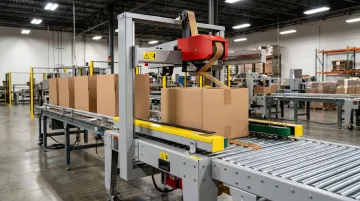
Tape-based sealing eliminates the heat and fumes associated with hot melt systems—a significant advantage in clean or ESD-sensitive environments common in electronics manufacturing.
| Specification | Details |
|---|---|
| Sealing Method | Pressure-sensitive tape (2" or 3" widths standard) |
| Automation Level | Semi-automatic (700r series) and fully automatic (7000r Pro) variants; random and uniform box size models available |
| Box Size Range | Length: 6" to unlimited; Width: 6.5" to 26.5"; Height: 2.25" to 36" (depending on configuration) |
| Best For | Mid-to-high volume electronics lines with mixed box sizes requiring consistent, clean tape seals |
Wexxar Bel BEL Series
Wexxar Bel, a ProMach subsidiary designed and built in Canada, leads North American case sealing automation. The BEL Series is engineered for continuous, high-speed production environments in electronics, e-commerce, and industrial manufacturing.
Key differentiators:
The BEL 252 uses a Uni-Drive belt system with Snap Folder flap folding technology that provides gentle, consistent pressure—ideal for boxes containing fragile electronics. The system connects directly with upstream conveyors and downstream labelers, while tool-free size changeovers reduce downtime on lines with frequent product switches.
Construction features premium welded frame with corrosion-resistant anodized aluminum and stainless steel, plus optional locking casters for plant mobility.
| Specification | Details |
|---|---|
| Sealing Method | Pressure-sensitive tape (DEKKA SE-22 head standard); hot melt adhesive option available on select models like BEL 270 |
| Automation Level | Fully automatic; designed for continuous, unattended operation up to 25 CPM |
| Box Size Range | Varies by model; BEL 300 offers random adjustment for multiple case sizes |
| Best For | High-volume electronics manufacturers needing gentle, consistent sealing with upstream/downstream line integration |
SOCO System
SOCO System is a global packaging machinery manufacturer with over 50 years of experience, headquartered in Denmark with U.S. presence. John Maye Company serves as the authorized regional distributor and service provider for SOCO in the Midwest, offering factory-certified installation, training, and parts support from their Wisconsin facility.
Why it works for electronics manufacturers:
SOCO's case sealers are designed for flexibility and speed within compact footprints, making them well-suited for electronics facilities with space-constrained production floors. The manufacturer claims "smallest external dimensions on the market" relative to capacity.
Modular configurations allow integration with labeling, printing, and quality inspection systems common in electronics packaging workflows.
The T-602 handles random case sizes from 11¾" x 4¾" x 5⅛" minimum to 23⅝" x 18⅛" x 30⅛" maximum, with throughput up to 8 CPM.
| Specification | Details |
|---|---|
| Sealing Method | Tape-based sealing standard (1.5"-2" tape widths); configurable for multiple sealing formats |
| Automation Level | Semi-automatic and fully automatic configurations available |
| Box Size Range | Minimum: 11¾" L x 4¾" W x 5⅛" H; Maximum: 23⅝" L x 18⅛" W x 30⅛" H (varies by model) |
| Best For | Electronics manufacturers in the Midwest seeking locally-supported, flexible automated sealing with fast parts availability through John Maye Company's 24-hour ship guarantee |
Combi Packaging Systems
Combi, based in North Canton, Ohio, is a U.S. manufacturer specializing in integrated case forming, packing, and sealing systems. The company explicitly lists Consumer Electronics among its 10 target markets, demonstrating relevant industry experience.
Key advantages:
Combi's combination systems (erector + sealer in one unit) reduce floor space requirements and eliminate the conveyor gap between case forming and sealing. This design lowers the risk of box misalignment that can cause seal failures on electronics lines. The 2-EZ HS Series features precision servo motor technology with HMI controls (PanelView+ 7.7" screen) for easy operator programming of new box sizes.
The series offers three throughput options: 20, 25, and 30 cases per minute, all using 3M NPH+ 2" tape heads for bottom sealing.
| Specification | Details |
|---|---|
| Sealing Method | Pressure-sensitive tape (3M NPH+ 2" tape head standard); hot melt options available depending on model |
| Automation Level | Fully automatic; available as standalone sealers or integrated erector-sealer combos |
| Box Size Range | Minimum: 8" L x 6" W x 5" H; Maximum: 24" L x 16" W x 18" H (20/25 CPM models) |
| Best For | Electronics manufacturers looking to consolidate case forming and sealing into a single, space-efficient automated cell with domestic manufacturing support |
Pearson Packaging Systems
Pearson Packaging Systems, headquartered in Spokane, Washington, builds high-performance packaging automation for demanding, high-throughput environments including electronics, beverage, and consumer goods manufacturing.
What sets it apart:
Pearson's sealers are engineered for high-speed continuous operation with minimal maintenance interruptions—valuable for electronics manufacturers running multi-shift operations. The CS40 delivers 40-67 CPM, the highest verified throughput among models researched.
Systems support integration with robotic case loading and vision-based inspection, supporting fully automated, inspectable packaging lines.
All models feature Allen-Bradley CompactLogix PLC and OptixPanel 2800 Color HMI (PackML Compliant), plus secure VPN remote access for troubleshooting.
| Specification | Details |
|---|---|
| Sealing Method | Pressure-sensitive tape or hot melt adhesive (model-dependent) |
| Automation Level | Fully automatic; high-speed continuous operation with servo controls |
| Box Size Range | CS25/CS40: 8" L x 5" W x 4.75" H minimum to 24" L x 16" W x 18.5" H maximum; CS30-RT: 8" L x 8" W x 3" H minimum (random) |
| Best For | Large-scale electronics manufacturers running multi-shift, high-throughput lines requiring robust, low-maintenance sealing automation with advanced integration capabilities |
Key Features to Evaluate When Choosing a Case Sealer for Electronics
Automation Level vs. Production Volume
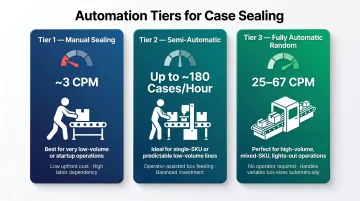
Manual tape sealing achieves approximately 3 cases per minute, while fully automatic sealers reach 30+ CPM. The breakpoint matters:
- Semi-automatic sealers work best when the operator is positioned close to the sealer and volumes stay under 180 cases per hour
- Fully automatic random sealers become essential when packing stations are distant from sealing equipment or volumes exceed manual capacity
- High-speed models (like Pearson's CS40 at 40-67 CPM) suit multi-shift operations with sustained high throughput
Electronics manufacturers with mixed product runs almost always benefit from fully automatic random sealers that eliminate manual box feeding and size adjustment.
Sealing Method Compatibility
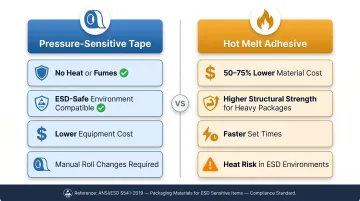
Tape sealing (pressure-sensitive or water-activated):
- No heat or fumes—preferred for clean rooms and ESD-sensitive environments
- Complete seal of flap seams from environmental contamination
- Hot melt adhesive material costs 50-75% less than tape, but equipment purchase price is higher
- Tape requires manual roll changes every 1,200-2,000 feet
Hot melt adhesive sealing:
- Higher structural strength for heavy packages
- Faster set times enable higher speeds
- Potential safety risk for operators (heated material)
- Better for tamper-evident applications
For electronics packaging, ANSI/ESD S541-2019 requires that packaging outside an EPA must be low-charge-generating and not compromise ESD protective properties. Tape sealing generally meets these requirements more easily than hot melt.
Box Size Range and Changeover
Electronics manufacturers often ship everything from small component boxes to large assembled units. Random case sealers that auto-adjust to box dimensions without tooling changes cut changeover time to near zero.
Size range comparison:
- 3M-Matic 7000r Pro: 6" to unlimited length; 6.5" to 26.5" width; 2.25" to 36" height (depending on configuration)
- SOCO T-602: 11¾" to 23⅝" length; 4¾" to 18⅛" width; 5⅛" to 30⅛" height
The 3M-Matic handles a significantly wider range, particularly for very small or unusually tall cases. Map your complete case-size matrix against equipment specs before selection—exclude any sealer that can't handle your smallest or largest box.
Line Integration and Conveyor Compatibility
A case sealer that can't communicate with upstream fillers or downstream labelers creates bottlenecks. Look for:
- Standard electrical interfaces (many use Allen-Bradley or Siemens PLCs)
- Adjustable infeed/outfeed conveyor heights
- PLC controls compatible with existing line systems
- PackML compliance for standardized communication (available on Pearson systems)
Lantech recommends integrating automatic sealers directly behind case erectors or fillers to ensure downstream processes run at the same pace.
Maintenance Access and Parts Availability
When evaluating any sealer, assess:
- Mean time between maintenance intervals
- Availability of spare parts (tape heads, belts, rollers)
- Distributor's parts inventory and ship times
3M recommends blade cleaning weekly, monthly taping head cleaning, and frame lubrication every 250 operating hours. Build these intervals into shift schedules to prevent downtime.
Parts availability varies widely by distributor. John Maye Company maintains 2,500+ SKUs in inventory with a 24-hour ship guarantee—a practical consideration when a worn tape head or drive belt is the only thing stopping a production line.
How We Chose the Best Case Sealers for Electronics Manufacturers
This evaluation prioritized machines with demonstrated track records in electronics or similarly demanding environments, where fragile products, variable box sizes, and high throughput are standard requirements.
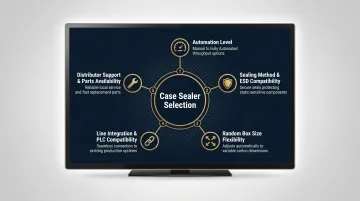
Key selection criteria:
- Automation level relative to production volume: Throughput capability (CPM) matched to actual line requirements
- Sealing method suitability: Tape-based systems preferred for ESD-sensitive environments
- Flexibility for mixed SKU lines: Random adjustment capability without manual changeover
- Ease of integration: Standard electrical interfaces and conveyor compatibility
- Quality of distributor/manufacturer support: Parts availability, service response time, factory-certified technicians
Common buyer mistakes avoided:
Selecting based on price alone without accounting for changeover time, seal consistency at speed, or total cost of ownership including parts and downtime.
A $15,000 sealer requiring 3 minutes of manual adjustment between SKUs will cost far more over its lifetime than a $35,000 random sealer that adjusts automatically—lost throughput adds up fast.
Brand reputation was weighed alongside practical factors like parts lead times, local service availability, and machine footprint. These factors often determine real-world performance more than spec sheets. For example, SOCO System's compact footprint pairs well with regional distributors like John Maye Company, who stock parts locally and can dispatch factory-certified technicians the same day for Midwest facilities.
Conclusion
The best case sealer for an electronics manufacturer is not the most expensive or the most automated—it's the one that aligns with specific production volume, box size variability, line integration requirements, and uptime standards of that facility.
When comparing options, evaluate total cost of ownership—not just purchase price. Key factors to weigh:
- Material costs: tape vs. adhesive, consumption rates, and waste
- Maintenance intervals: parts availability and service response time
- Changeover time: how long each box size adjustment takes on your line
- Scalability: whether the machine can handle higher throughput as production grows
Electronics lines leave little room for sealing failures or contamination—a misaligned seal or tape bleed can mean a rejected shipment. The right machine handles those demands without requiring constant operator attention or slowing your line down.
Ready to find the right case sealer for your electronics line? Contact John Maye Company at 1-800-441-6293 or info@johnmayecompany.com. With 40+ years of packaging expertise, extensive SOCO System support throughout the Midwest, and factory-certified technicians, we'll help you select and integrate the sealing solution that matches your exact requirements.
Frequently Asked Questions
What is the 3M Matic random case sealer 7000r Pro?
The 3M Matic 7000r Pro is a fully automatic random case sealer that automatically adjusts to varying box heights and widths without operator intervention, using pressure-sensitive tape for top and bottom sealing. It processes up to 24 cases per minute and is a common choice for electronics and e-commerce operations running mixed-SKU lines.
What is the difference between a semi-automatic and fully automatic case sealer?
Semi-automatic sealers need an operator to close flaps and feed each box manually. Fully automatic sealers handle both steps without operator involvement, making them the better fit for high-volume electronics lines where throughput and labor efficiency matter.
What sealing method is best for electronics packaging?
Pressure-sensitive tape is the preferred method for electronics — no heat or adhesive fumes means ESD-safe environments stay intact. Hot melt works for heavier shipments needing stronger seals or tamper evidence, but requires careful evaluation against your ESD requirements before use.
What is a random case sealer and when do I need one?
A random case sealer automatically adjusts to different box sizes without manual changeover, using sensors and servo controls to accommodate varying heights, widths, and lengths. It's the right choice for electronics manufacturers shipping multiple SKUs with varying carton dimensions on the same production line.
How do I calculate the right case sealer speed for my production line?
Match sealer throughput (cases per minute) to your line's peak output, factoring in upstream filler and downstream labeling or palletizing speeds. If your case packer runs at 20 CPM, select a sealer rated for at least 25 CPM to avoid a bottleneck at the sealing station.
How often do industrial case sealers require maintenance?
Maintenance frequency depends on volume and model, but most tape-based case sealers require weekly blade cleaning, monthly taping head cleaning and lubrication, and frame lubrication every 250 operating hours. Fast parts availability from a distributor like John Maye Company reduces unplanned downtime when issues do arise.