Introduction
In pharmaceutical manufacturing, a single failed seal isn't a shipping inconvenience — it's a potential patient safety event. Failed seals trigger product recalls, FDA enforcement actions, and sterility breaches that can cost millions. That's why case sealer selection carries a different weight in pharma than in virtually any other industry.
Pharmaceutical manufacturers face packaging challenges that set them apart: strict GMP/cGMP protocols, cleanroom environmental controls, serialization integration requirements, and frequent changeovers between multiple SKUs. A case sealer that performs well in food processing or e-commerce can introduce compliance gaps, contamination risk, or validation failures under pharma's requirements.
This guide covers the case sealers best suited for pharmaceutical operations — and the selection criteria that drive the decision: regulatory compliance capability, cleanability, changeover flexibility, and total cost of ownership.
Key Takeaways
- GMP-compliant case sealers require stainless steel construction, tool-less cleaning access, and audit trail capability
- Pharma-suitable brands include 3M-Matic, Combi Packaging, SOCO System, Wexxar/BEL, and A-B-C Packaging
- Random case sealers eliminate manual changeover for multi-SKU pharma lines; uniform sealers maximize speed for single-product runs
- Pressure-sensitive tape offers validation advantages over hot melt adhesive for temperature-sensitive products
- Distributor support with a 24-hour parts guarantee and factory-certified technicians reduces costly validation delays
Why Pharma Packaging Demands a Specialized Case Sealer
Regulatory Requirements Apply Directly to Packing Equipment
21 CFR Part 211 Subpart D explicitly governs equipment used in pharmaceutical "packing" operations, including case sealers. Section 211.63 requires equipment to be "of appropriate design, adequate size, and suitably located to facilitate operations for its intended use and for its cleaning and maintenance." This means your case sealer must satisfy the same IQ/OQ/PQ qualification protocols as upstream processing equipment.
WHO data shows proper IQ/OQ/PQ validation reduces manufacturing errors by approximately 40%, translating directly to fewer batch rejections and cleaner audit outcomes.
Environmental and Material Constraints
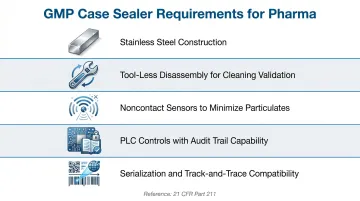
Pharmaceutical facilities impose specific equipment requirements:
- Built from stainless steel for cleanability and contamination control
- Designed for tool-less disassembly to support cleaning validation
- Equipped with noncontact sensors to minimize particulate generation
- Controlled by PLCs with audit trail capability for electronic batch records
- Compatible with serialization and track-and-trace systems
Section 211.65 prohibits materials that are "reactive, additive, or absorptive" near product contact zones, constraining component choices for case sealers handling primary or secondary packaging.
Multi-SKU Complexity Drives Format Flexibility Needs
Beyond material compliance, the operational reality of pharma lines adds another layer of complexity. Most facilities run diverse product SKUs—varying case sizes, weights, and packaging formats—often within a single shift.
Manual changeover between formats eats into production time and introduces error risk. Random-format capability and fast changeover features matter far more here than in single-SKU manufacturing environments.
Best Case Sealers for Pharma Manufacturers
The following machines were selected based on GMP compatibility, sealing reliability, format flexibility, and documented track records in pharmaceutical or regulated manufacturing environments.
A-B-C Packaging Machine Corp. — Model 536
A-B-C Packaging brings decades of U.S.-based manufacturing expertise to industrial case sealing. The Model 536 is a high-speed, all-mechanical RSC case sealer designed for continuous operation in demanding environments.
Key pharma-relevant features:
- PLC-controlled operation with noncontact sensors for precision
- Stainless steel frame supporting cleaning protocols
- Electronically interlocked gull-wing doors that halt operation when opened, meeting safety requirements
- Touchscreen HMI for operator interface and documentation
- Rated speed up to 100 cases per minute for high-volume production
| Feature | Specification |
|---|---|
| Speed / Throughput | Up to 100 cases/min for high-volume pharma lines |
| Construction / Compliance Features | Stainless steel frame, PLC controls, noncontact sensors, electronically interlocked doors |
| Best For | High-speed, continuous RSC case sealing in regulated environments |
Note: Verify current model availability directly with the manufacturer, as this specification appeared in 2014 product documentation.
SOCO System
SOCO System specializes in semi-automatic and automatic case sealing equipment with durable construction and adaptability across industries including pharmaceutical manufacturing. John Maye Company is the regional leader for SOCO System in the Midwest — providing local parts support and factory-certified technical service to Wisconsin and surrounding states.
Key pharma-relevant features:
- Modular design accommodating line changes without major reconfiguration
- Available in electro-galvanized or stainless steel finishes for hygiene-critical environments
- Both hot melt adhesive and pressure-sensitive tape configurations
- T-55 random sealer with automatic height and width adjustment
- Stainless steel bearings suitable for humid or hygiene-critical pharmaceutical applications
| Feature | Specification |
|---|---|
| Sealing Method Options | Pressure-sensitive tape (T-series) and hot melt adhesive configurations available |
| Construction / GMP Features | Stainless steel finish options, tool-less maintenance access, stainless steel bearings for humid environments |
| Best For | Midwest pharma manufacturers seeking locally supported, flexible case sealing with quick parts availability |
For smaller-format pharmaceutical cartons, SOCO's T-100 Mini model is engineered for cleanroom compatibility and gentle tape closure — useful where product protection during sealing is a priority.
3M-Matic Case Sealers
3M-Matic offers one of the most widely recognized case sealer lines globally, with 20 models explicitly categorized for Medical/Healthcare applications. The breadth of the product line and established service network make 3M-Matic a common choice in pharmaceutical facilities.
Key pharma-relevant features:
- Broad model range from benchtop to high-speed fully automatic systems
- Model 700a-s features stainless steel construction for washdown and corrosive environments
- Exclusive use of Scotch pressure-sensitive tape eliminates hot melt adhesive temperature variables
- Parts availability documented through Combi Packaging Systems' distributor network (CSPD program)
- AccuGlide taping heads provide low-impact application protecting lightweight pharmaceutical cartons
| Feature | Specification |
|---|---|
| Model Range | 20+ models for medical/healthcare; includes adjustable (uniform) and random sealers; Model 700a-s offers stainless steel construction |
| Sealing Method | Pressure-sensitive tape exclusively — eliminates heat variables and provides tamper-evident sealing |
| Best For | Pharma facilities requiring proven equipment with extensive service network and parts availability |
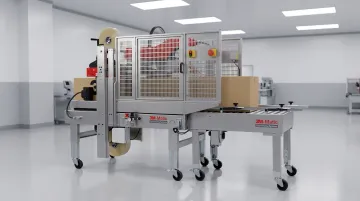
3M claims tape quality such that "the tape can wrap around the world 3.5 times before a defect is found." For pharma validation teams, that consistency reduces material-related failure events during qualification runs.
Wexxar/BEL (ProMach)
Wexxar/BEL, part of ProMach's packaging portfolio, manufactures case erecting and sealing equipment with documented pharmaceutical applications. The company has been designing packaging machinery since 1977.
Key pharma-relevant features:
- Integrated case erector-sealer systems reducing footprint and labor
- Auto Adjust system on BEL 300 eliminates manual changeover for varying case sizes
- Snap Folder system provides safe flap folding without overhead arms
- Touch screen controls and SKU management with pre-set box recipes
- Safe Logic safety guarding system
| Feature | Specification |
|---|---|
| System Type | Standalone sealers (BEL 250, 252, 270, 290, 300) and integrated erector/sealer combinations available |
| Changeover Features | Auto Adjust on BEL 300 for random case sizes; pre-set SKU recipes for quick format changes |
| Best For | Pharma lines needing integrated erect-and-seal functionality to reduce floor space and manual handling |
Wexxar maintains a dedicated pharmaceutical page highlighting operations monitoring and touch screen controls. Confirm IP69K or specific washdown ratings with the manufacturer before specifying for wet-clean environments.
Combi Packaging Systems
Combi Packaging Systems is a U.S.-based manufacturer with documented pharmaceutical clients including Johnson & Johnson, AstraZeneca, Merck, and Thermo Fisher. That client list puts Combi in a different category from general-industrial equipment suppliers when it comes to pharma-specific design requirements.
Key pharma-relevant features:
- Random-size capability in TBS-100R models handling varying case dimensions without manual reconfiguration
- U.S.-manufactured stainless steel construction with NEMA-compliant washdown components available
- Dedicated sanitary washdown design with tool-free disassembly for cleaning
- Water-shedding self-draining surfaces and smooth welds with rounded edges
- Both tape and hot melt adhesive configurations (hot melt designated with "G" suffix)
| Feature | Specification |
|---|---|
| Format Flexibility | TBS-100R models handle 5" x 5" x 4" minimum to 24" x 20" x 24" maximum without reconfiguration |
| Sealing Configuration | Standard pressure-sensitive tape; hot melt available on select models (TBS-100 XL G, TBS-100 XL HS G) |
| Best For | Mid-size pharma manufacturers running mixed case formats requiring compact, sanitary-design equipment |
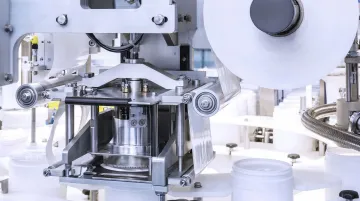
Combi's PDA (Parenteral Drug Association) membership is referenced in their sanitary design documentation — a credible signal of pharmaceutical industry alignment for procurement teams evaluating vendor qualifications.
How to Choose the Right Case Sealer for Pharma Operations
Many pharmaceutical buyers select case sealers based on throughput specs or purchase price alone. That approach overlooks the real costs of non-compliant equipment:
- Audit findings that require expensive retrofits
- Cleaning validation failures that delay production
- Unplanned downtime when replacement parts aren't available
Four Critical Selection Criteria
1. Regulatory and Material Compliance
Your case sealer must support equipment qualification protocols under 21 CFR 211. Essential features include:
- Stainless steel or easily cleanable construction materials
- Tool-less disassembly enabling cleaning validation
- PLC controls with data logging capability for electronic batch records
- Documentation packages supporting IQ/OQ/PQ validation
2. Sealing Method: Tape vs. Hot Melt Adhesive
| Consideration | Pressure-Sensitive Tape | Hot Melt Adhesive |
|---|---|---|
| Temperature control | No heat required | Operates at 300-350°F requiring temperature validation |
| Material cost | Higher per case | Approximately 1/2 to 1/3 the cost of tape |
| Environmental seal | Complete flap seam closure | Flap seams more exposed |
| Tamper evidence | Built-in with proper tape selection | Requires additional measures |
| Operator safety | Minimal risk | Burn hazard requiring safeguarding |
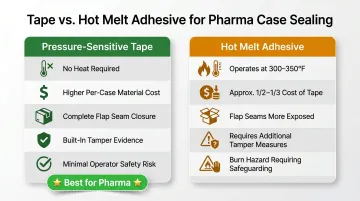
For temperature-sensitive pharmaceutical products or those requiring tamper-evident seals, pressure-sensitive tape simplifies validation and eliminates temperature-dependent variables.
3. Format Flexibility: Random vs. Uniform
Uniform case sealers are manually adjusted for fixed case dimensions, maximizing speed for long single-SKU runs. Random case sealers automatically adjust to varying dimensions, eliminating changeover time for multi-SKU operations.
Pharma lines running multiple product formats in short batches benefit significantly from random sealers, while dedicated high-volume lines for a single product format achieve higher throughput with uniform sealers.
4. Total Cost of Ownership
With pharmaceutical downtime costing $1.4 million to $6.8 million per hour (industry estimates vary by facility size and product line), equipment reliability and service response time directly impact your bottom line.
Critical TCO factors:
- Parts availability and shipping speed
- Service response time commitments
- Technician training and certification levels
- Changeover labor requirements for multi-SKU operations
- Validation documentation support from the OEM
For Midwest pharma facilities, local parts availability is a practical factor worth weighing early. John Maye Company maintains a 2,500+ SKU inventory with a 24-hour ship guarantee, which reduces both validation delays and unplanned service downtime when a line goes down.
Conclusion
For pharmaceutical manufacturers, case sealer selection demands the same rigor applied to upstream packaging machinery. The equipment must not only seal cases—it must do so in a way that satisfies regulatory requirements, supports cleaning validation, integrates with serialization systems, and maintains uptime in high-stakes production environments.
Assess scalability, changeover requirements, total service costs, and regulatory fit before making your final decision. Look beyond brand recognition to evaluate real-world support infrastructure:
- Can the supplier provide validation documentation?
- Are factory-certified technicians available locally?
- Can you get replacement parts within 24 hours, not 5–7 business days?
If you're still weighing your options, working with a distributor who understands both the equipment and the compliance context makes a real difference. Midwest pharmaceutical manufacturers can reach out to John Maye Company for guidance on case sealer selection, integration, and ongoing service. With 40+ years of packaging expertise, factory-certified technicians, a 2,500+ SKU parts inventory, and a 24-hour ship guarantee, they're built to support the responsiveness your facility needs.
Frequently Asked Questions
What is a case sealer?
A case sealer is an automated or semi-automated machine that closes and seals the top and/or bottom flaps of corrugated shipping cases using tape, hot melt adhesive, or staples. It serves as a critical end-of-line packaging component ensuring product protection during storage and shipment.
What is a random case sealer?
A random case sealer automatically adjusts to varying case dimensions without manual reconfiguration, using sensors to detect case height and width. This makes it ideal for pharmaceutical operations running multiple SKUs or case sizes on the same packaging line.
What is the difference between a uniform and a random case sealer?
Uniform case sealers are manually set to one fixed case size, optimizing speed for high-volume single-SKU runs. Random sealers auto-adjust using sensors, making them the better fit for pharma lines with multiple product formats and frequent changeovers.
How do case sealers meet GMP compliance requirements in pharma facilities?
GMP-compliant case sealers include stainless steel construction, PLC controls with audit trail capability, tool-less disassembly for sanitation, and noncontact sensors. All equipment must complete IQ/OQ/PQ qualification per 21 CFR Part 211 before use in production.
What is the difference between tape and hot melt adhesive case sealing for pharma?
Pressure-sensitive tape offers consistent sealing without temperature variables, simplifying validation and eliminating burn hazards for operators. Hot melt adhesive provides stronger bonds at higher speeds but operates at 300-350°F, introducing temperature validation requirements. Tape provides complete flap seam closure important for tamper evidence and environmental protection.
How often should case sealers be serviced in a pharmaceutical facility?
21 CFR 211.67 requires maintenance at appropriate intervals to prevent malfunctions or contamination. Schedule preventive maintenance based on manufacturer guidelines and actual throughput volumes, and document all service activity to support equipment qualification records.