Introduction
A single failed case seal during pharmaceutical production doesn't just slow the line—it triggers a cascade of risks: product contamination, batch rejection, audit failures, and potential regulatory penalties. In an industry where pharmaceutical manufacturing downtime exceeds $500,000 per hour, inconsistent case formation becomes a direct compliance and cost liability.
Case erectors have evolved from convenience tools to essential automation infrastructure for pharmaceutical manufacturers. Today's pharma-grade equipment supports GMP-compliant secondary packaging, reduces human contact points that introduce contamination risk, and integrates with the serialization systems now mandated by federal law.
Not all case erectors meet these demands. Equipment built for general industrial use rather than validated pharmaceutical environments creates a costly gap between compliance requirements and operational reality.
Key Takeaways
- Case erectors replace error-prone manual assembly with consistent, GMP-compliant corrugated case forming
- Pharma case erectors must meet FDA compliance, contamination control, serialization integration, and validated changeover requirements
- The best pharma case erectors balance throughput with sealing precision, cleanroom compatibility, and end-of-line integration
- Leading manufacturers include A-B-C Packaging, Wexxar/BEL, Pearson Packaging Systems, Adco Manufacturing, and Endoline Machinery
- The right distributor partner (manufacturer-trained technicians, rapid parts availability, validation support) directly impacts long-term performance
Why Pharma Manufacturers Need Specialized Case Erectors
Case erectors automatically transform flat corrugated blanks into square, sealed cases ready for product loading. In pharmaceutical secondary packaging, this function matters far beyond basic throughput. Inconsistent case geometry disrupts downstream palletizing, misaligns serialization label placement, and creates shipment integrity failures that expose high-value products to damage during transit.
Regulatory pressure separates pharma from other industries. 21 CFR Part 211, Subpart G mandates that packaging equipment be routinely calibrated, inspected, and documented. Three specific obligations shape equipment decisions:
- Section 211.130 requires examining equipment for suitability and cleanliness before each use
- Section 211.68 demands written records for all automated equipment operations
- Batch-level documentation must capture operator contact points and process deviations
Taken together, these requirements make fully automatic case erectors nearly mandatory for mid-to-high volume pharmaceutical operations.
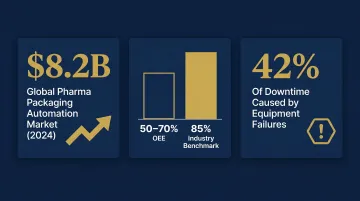
The global pharmaceutical packaging automation market reached $8.2 billion in 2024, driven by manufacturers seeking to reduce contamination risk and improve audit readiness. Pharmaceutical packaging lines typically achieve 50-70% OEE—below the 85% benchmark seen in other manufacturing sectors. Equipment failures account for 42% of unplanned downtime incidents, making reliability-focused equipment selection critical.
The case erectors below were evaluated on pharmaceutical-specific criteria: GMP construction standards, sealing consistency under regulated conditions, serialization compatibility, and validated deployment in pharmaceutical facilities—not just output rate.
Best Case Erectors for Pharma Manufacturers
These machines were selected based on GMP compliance features, sealing reliability, track-and-trace integration, changeover capability, and manufacturer reputation in regulated industries.
A-B-C Packaging Machine Corp. — Model 330HS / 400 Series
A-B-C Packaging, headquartered in Tarpon Springs, Florida, has delivered packaging equipment for over 80 years. The company serves pharmaceutical and medical device manufacturers with stainless steel construction options and washdown-capable designs engineered for GMP environments.
The 330HS uses pneumatic case feed and erecting mechanisms specifically designed to handle warped or band-marked cases—a reliability feature critical in high-throughput pharma facilities where case reject rates directly impact OEE. The servo-operated compression-sealing ram ensures precision squaring and consistent case geometry for downstream serialization and palletizing accuracy.
| Feature | Specification |
|---|---|
| Speed / Throughput | Up to 40 cases per minute (330HS hot melt configuration); 30-40 cpm across 400 Series models |
| Pharma Compliance Features | Stainless steel construction available; CAT 3 Safety Circuits PL(d) or PL(e); touchscreen PLC with fault alarm history; sealed bearings and self-lubricating cylinders for low-maintenance operation |
| Key Differentiator | Walking beam case transfer for precise downstream indexing; handles imperfect case stock without jams; 5-minute manual changeover or optional one-touch servo Auto Changeover Package |
Wexxar/BEL (ProMach)
Wexxar/BEL, part of the ProMach group, is widely deployed in regulated industries including pharmaceutical and nutraceutical packaging. Their flagship WF20 and WF30 S models feature anodized aluminum and stainless steel construction designed to prevent particulate contamination in cleanroom environments.
Tool-less, servo-driven changeover operates via pre-set box recipes. The WF30 S Auto Adjust system enables fully automatic size changes, cutting changeover time from 15-20 minutes down to approximately 7 minutes—a meaningful advantage for pharma lines running multiple SKU formats. The mechanical Pin & Dome case opening system—unlike vacuum-based alternatives—operates reliably in dusty or variable air quality environments common to pharmaceutical facilities.
| Feature | Specification |
|---|---|
| Speed / Throughput | Up to 20 cases per minute (WF20); higher throughput models available |
| Pharma Compliance Features | Anodized aluminum and stainless steel, paint-free construction; touch screen HMI with operations monitoring; fully interlocked safety guarding; premium Dekka SE-22 stainless steel tape head |
| Key Differentiator | 7-minute tool-less servo changeover; Auto Adjust pre-set recipes; Remote Demand case forming (adapts to downstream line speed); strong integration with ProMach's broader end-of-line ecosystem |
Pearson Packaging Systems
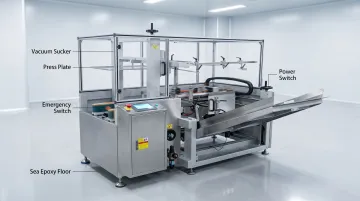
Pearson Packaging Systems (Spokane, WA) brings over 70 years of box forming automation experience to pharmaceutical secondary packaging. They specialize in integration-forward designs that pair case erectors with robotic case loading and palletizing—a full end-of-line approach suited to pharma manufacturers building fully automated lines from erecting through palletizing.
The CE50 high-speed case erector delivers up to 50 cases per minute with stainless steel and low-pressure washdown construction options. Pearson's RRCE (Random Robotic Case Erector) handles up to 6 different case sizes in a single cell, addressing SKU proliferation challenges common in pharmaceutical plants. The RRCE integrates directly with labeling systems for on-demand case marking and serialization compliance.
| Feature | Specification |
|---|---|
| Speed / Throughput | Up to 50 cases per minute (CE50); 10 cpm (RRCE multi-size robotic); 15 cpm (CE35-XL large-format cases) |
| Pharma Compliance Features | Stainless steel construction; low-pressure washdown options; 24/7 live service support; user-centric HMI with interactive guides and live sensor maps |
| Key Differentiator | Robotic RRCE handles 6 case sizes without changeover; integrated labeling capability for serialization; remote troubleshooting and diagnostics reduce service downtime |
Adco Manufacturing
Adco Manufacturing (Sanger, CA) is part of the Massman Companies group and has over 60 years of experience serving pharmaceutical, nutraceutical, and personal care industries. Their EV 350 (ME 25-G) case erector is frequently cited for its compact footprint and validation-ready design—both priorities in pharma facilities where floor space is tight and FDA documentation is non-negotiable.
The "No Lube" design eliminates lubrication points that can introduce contamination in pharmaceutical environments. The Category 3 Electrical Safety System and NEMA Type 12 electrical enclosures meet stringent pharma safety standards. Adco's pharmaceutical solutions also support:
- Serialization and product traceability integration
- Vision inspection system compatibility
- Tamper-evident and child-resistant packaging formats
| Feature | Specification |
|---|---|
| Speed / Throughput | Up to 35 cases per minute (variable speed configurations available) |
| Pharma Compliance Features | "No Lube" contamination-prevention design; NEMA Type 12 enclosures; Category 3 Safety System; integrated PLC, Servo, and Motion Controller with Touch Screen HMI |
| Key Differentiator | Compact footprint ideal for space-constrained pharma facilities; no-tool changeover under 5 minutes; strong nutraceutical/pharma track record with serialization integration |
Endoline Machinery
Endoline Machinery (UK-headquartered) manufactures fully automatic case erectors with a growing presence in pharmaceutical and cleanroom packaging environments. While the company serves US customers through an international distributor network rather than a dedicated US office, their European pharma pedigree brings cleanroom-compatible design standards to North American facilities.
Endoline case erectors are available with stainless steel construction as standard and operate at throughputs between 10 and 30 cases per minute. The dual opposing vacuum case opening system and low-maintenance servo architecture reduce service intervals—important in pharmaceutical facilities where unplanned downtime carries high regulatory risk. Changeover adjustments complete in 1 to 5 minutes across the fully automatic range.
| Feature | Specification |
|---|---|
| Speed / Throughput | 10-30 cases per minute depending on model; Model 2218 (long-case specialist) up to 14 cpm |
| Pharma Compliance Features | Stainless steel construction standard; white powder-coated finish (RAL 9010) or custom colors; compact design for tight production halls; 24/7 operation rating |
| Key Differentiator | Cleanroom-compatible stainless steel options; low-maintenance servo-driven architecture; dual opposing vacuum for reliable case opening; European pharma design standards with US distribution availability |
Key Features to Look for in a Pharma Case Erector
GMP and FDA Compliance Readiness
Pharma-grade case erectors must use materials that minimize particulate generation and allow thorough cleaning. Stainless steel 304/316L is preferred for product-contact and exposed surfaces. Sensors and HMI systems should support batch-level documentation and traceability. Where electronic records are required, equipment should align with 21 CFR Part 11 requirements for audit trails, user authentication, and record integrity. Suppliers offering IQ/OQ/PQ validation documentation packages reduce time-to-validation for pharmaceutical operations.
Sealing Consistency and Quality Control
In pharmaceutical environments, bottom sealing (hot-melt glue or tape) must achieve 100% consistency to prevent case failures during transport of high-value products. Vision systems and in-line seal verification detect defects in real time, preventing downstream failures that could compromise product integrity. Stainless steel tape heads — such as the Dekka SE-22 used in Wexxar systems — deliver measurably longer service life and tighter seal consistency than standard industrial tape applicators.
Integration with Serialization and Track-and-Trace Systems
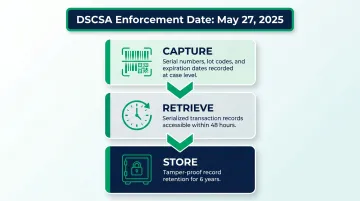
The Drug Supply Chain Security Act (DSCSA) enforcement began May 27, 2025, requiring serialized transaction data exchange via EPCIS standard. Case erectors that synchronize with upstream labeling and barcode verification systems reduce compliance gaps. Modern fully automatic case erectors can interface with HMI systems to capture key case-level data for FDA audit readiness:
- Serial numbers, lot codes, and expiration dates at the case level
- Serialized transaction records retrievable within 48 hours
- Tamper-proof storage for 6 years per DSCSA requirements
Multi-SKU Flexibility and Changeover Speed
Pharmaceutical manufacturers often produce dozens of SKUs. Servo-driven, recipe-based changeover systems reduce downtime between runs from 15–20 minutes to under 5 minutes. That time savings compounds across shifts. Packaging lines running at 60% OEE lose 40% of production capacity to changeovers, micro-stops, and quality issues — so cutting changeover time directly moves the OEE needle. Quick changeover also supports just-in-time production schedules that minimize finished goods inventory and reduce capital tied up in stock.
How We Chose the Best Case Erectors for Pharma
Machines were assessed on pharma-specific criteria rather than generic packaging performance. Common mistakes pharma buyers make include prioritizing speed over compliance readiness or selecting general-purpose equipment not designed for cleanroom use.
Evaluation factors included:
- GMP construction standards and material specifications
- Sealing reliability under regulated conditions
- Ease of validation and documentation capability
- Documented deployment in pharmaceutical facilities
- Contamination controls not typically found in food or consumer goods equipment
Manufacturer reputation and aftermarket support were weighted heavily in this evaluation. PMMI's 2025 Aftermarket Parts & Services report identifies "gaps in lead times" as a critical concern influencing equipment purchasing decisions. In pharma, unplanned downtime doesn't just halt production—it can trigger batch holds, regulatory investigations, and supply chain disruptions with direct patient safety implications.

Working with an experienced distributor helps pharma manufacturers avoid costly trial-and-error when selecting compliant equipment. John Maye Company has served the Midwest for over 40 years, with manufacturer-trained technicians, a 24-hour ship guarantee on parts from 2,500+ SKUs, and on-site installation and validation support. For pharmaceutical facilities, that depth of service infrastructure matters as much as the equipment itself.
Conclusion
In pharmaceutical manufacturing, the case erector is not a commodity purchase. The right machine directly impacts GMP compliance, line efficiency, product integrity, and regulatory audit readiness. Choosing based on pharma-specific requirements—contamination control, validation readiness, serialization integration, and aftermarket support quality—will outperform a price-first decision every time.
Evaluate total cost of ownership: factor in changeover time, spare parts lead times, validation support availability, and integration complexity. A $15,000 machine with 20-minute changeovers and 3-week parts lead times costs far more over its lifecycle than a $25,000 machine with 5-minute changeovers, 24-hour parts availability, and included IQ/OQ documentation.
Those parts availability and validation support factors matter especially for Midwest pharma operations. John Maye Company has supported packaging lines across the region since 1983, with factory-certified technicians, a 24-hour ship guarantee on parts, and 2,500+ SKUs in inventory. Reach them at 1-800-441-6293 or info@johnmayecompany.com to discuss your specific requirements.
Frequently Asked Questions
What are the different types of packaging machines?
Pharmaceutical manufacturing uses three packaging categories: primary (fillers, cappers, blister machines that contact product directly), secondary (case erectors, cartoners, sealers that group primary packages), and tertiary (palletizers, stretch wrappers for bulk transport). Case erectors operate at the secondary level.
What are the secondary packaging materials in the pharmaceutical industry?
Secondary pharmaceutical packaging includes corrugated cases, folding cartons, blister card carriers, and shrink wrap. Unlike primary packaging (vials, bottles, blisters) that contacts the product, secondary materials provide protection, grouping, and regulatory labeling for distribution.
What should pharma manufacturers look for when choosing a case erector?
Prioritize GMP-compliant construction (stainless steel, minimal lubrication points), sealing consistency with in-line verification, multi-SKU changeover capability under 5 minutes, serialization system integration, and aftermarket support quality including parts availability and validation documentation.
How do case erectors support GMP and FDA compliance in pharma packaging?
GMP-compliant case erectors minimize human contact (reducing contamination risk), deliver documented and repeatable processes via PLC/HMI systems, and support batch traceability through integration with serialization platforms. They also meet 21 CFR Part 211 equipment calibration and documentation requirements.
What is the difference between semi-automatic and fully automatic case erectors for pharma?
Semi-automatic models require operators to manually load each flat case blank for forming and sealing. Fully automatic machines pull blanks from a magazine and complete the process without operator intervention. For high-volume pharma lines, fully automatic is the standard — human contact increases both contamination risk and documentation burden.
Can case erectors be integrated with serialization and track-and-trace systems?
Yes. Modern fully automatic case erectors synchronize with upstream labeling, barcode verification, and vision inspection systems via PLC/HMI interfaces. This integration supports DSCSA compliance, including case-level serial number capture, 48-hour data retrieval, and 6-year tamper-proof record storage.