Introduction
Pharmaceutical cleanrooms operate under the strictest equipment standards in industrial manufacturing. A single contamination event from a poorly specified lift table can invalidate an entire production batch, trigger FDA observations, and compromise drug product integrity—potentially leading to regulatory action under 21 CFR Part 211 that halts operations entirely.
Lift tables are essential material handling tools in pharma environments, enabling ergonomic positioning of drums, totes, and containers during filling, inspection, and packaging. Not all of them belong in a cleanroom. Standard industrial models introduce particles through exposed mechanisms, harbor bacteria in crevice-prone welds, and risk hydraulic fluid contamination—all in conflict with cGMP requirements.
This guide identifies the best lift tables purpose-built for pharmaceutical cleanrooms, breaks down the critical features that distinguish compliant units from industrial look-alikes, and provides a framework for evaluating equipment against ISO cleanroom classifications and regulatory expectations.
Key Takeaways
- Compliant units must meet ISO 14644-1 classifications and FDA cGMP material and design standards
- Key criteria: 304/316L stainless steel, electropolished surfaces, sealed mechanisms, non-particle-generating components
- Pneumatic actuation eliminates hydraulic fluid risk—a direct 21 CFR 211.65(b) compliance advantage
- Purpose-built cleanroom models consistently outperform standard industrial units with aftermarket upgrades
Overview of Lift Tables in Pharmaceutical Cleanrooms
Cleanroom lift tables are hydraulic or pneumatic scissor-lift platforms specifically engineered to operate inside ISO-classified environments without contributing to particulate, microbial, or chemical contamination. Unlike standard industrial lift tables, these units feature enclosed mechanisms, smooth crevice-free surfaces, and materials that withstand aggressive disinfection protocols.
Pharmaceutical manufacturers operating under FDA 21 CFR Part 211 (cGMP) and EU GMP Annex 1 must use equipment that does not contaminate products or environments. Three specific provisions drive lift table selection:
- Section 211.63: Equipment must be "of appropriate design" and "suitably located to facilitate operations for its intended use and for its cleaning and maintenance"
- Section 211.65: Surfaces contacting components or in-process materials "shall not be reactive, additive, or absorptive"
- Section 211.65(b): Lubricants "shall not come into contact with components, drug product containers, closures, in-process materials, or drug products"
EU GMP Annex 1 (revised August 2022, effective August 2023) reinforces these requirements, stating in Paragraph 4.5 that "all exposed surfaces should be smooth, impervious and unbroken in order to minimize the shedding or accumulation of particles or micro-organisms."
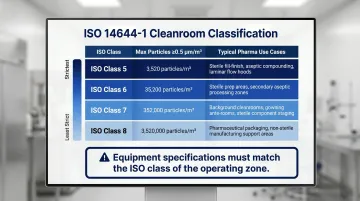
These requirements translate directly into equipment specifications, because pharma facilities operate across a wide range of ISO classifications — from ISO Class 5 sterile fill-finish suites (allowing only 3,520 particles ≥0.5 µm per m³) to ISO Class 8 packaging areas (allowing 3,520,000 particles per m³). The lift table spec that passes validation in a Class 8 area may not be appropriate twenty feet away in a Class 5 suite.
Best Lift Tables for Pharma Cleanrooms
These lift tables are selected based on cleanroom-compatible construction, documented pharma/life sciences use cases, load handling capabilities, ease of sanitization, and manufacturer reputation.
Southworth Clean Room Lift Tables
Southworth Products (Portland, ME) has manufactured ergonomic lift equipment for over 100 years. Their dedicated cleanroom line is widely specified across pharmaceutical, biotech, and medical device facilities, featuring 304 stainless steel construction, fully enclosed scissor mechanisms, and smooth weld-finished platforms.
Key specifications:
| Attribute | Details |
|---|---|
| Construction Material | 304 Stainless Steel platform and frame |
| Cleanroom Features | Enclosed scissors, sealed hydraulics, crevice-free welds |
| Load Capacity Range | 500 – 4,000 lbs across model variants |
The enclosed scissor design prevents particle generation during operation, which matters in ISO Class 5-7 environments where moving parts become contamination sources. CE marking and ISO cleanroom standards compliance provide documentation support for GMP audits.
Presto Lifts Cleanroom Series
Presto Lifts offers a purpose-built cleanroom series engineered for pharmaceutical and biotech environments with strict contamination limits. Their differentiator is electropolished stainless steel surfaces, which achieve the ASME BPE SF4 standard (Ra max 0.38 µm) that resists protein adhesion and enables CIP/SIP sterilization protocols.
Key specifications:
- Construction Material: Electropolished 304 Stainless Steel
- Actuation Options: Pneumatic or electric (hydraulic-free models available)
- Platform Configurations: Stationary, mobile, and turntable variants
Pneumatic actuation eliminates hydraulic fluid contamination risk, addressing the fluid contamination requirements under FDA 21 CFR 211.65(b). The low-profile closed-form platform edges prevent liquid pooling and facilitate wash-down cleaning. Mobile configurations accommodate flexible cleanroom workflows without compromising particle control.
Pentalift Cleanroom Lift Tables
Pentalift Equipment Corporation (Guelph/Puslinch, Ontario) produces a broad range of scissor lifts with a documented cleanroom product line used in pharmaceutical and laboratory environments across North America. Their stainless steel double scissor lift table meets applicable sanitary regulations for food and pharmaceutical production facilities, with capacities up to 4,000 lbs.
Key specifications:
| Attribute | Details |
|---|---|
| Construction Material | Stainless Steel with optional epoxy-coated frame |
| Custom Engineering | Made-to-order dimensions, travel height, and capacity |
| Optional Add-ons | Sanitary drip pan, stainless toe guards, cleanroom-rated casters |
The sanitary drip pan beneath the scissor mechanism provides secondary contamination protection if seals degrade. Engineered-to-order builds accommodate non-standard cleanroom footprints or weight requirements, which is particularly useful for retrofit installations in existing facilities.
Stainless Steel Lift Tables for Pharmaceutical Use
Specialized stainless steel lifting equipment serves pharmaceutical, food-grade, and biotech cleanroom environments with all-welded 304 or 316L stainless steel construction. The 316L grade offers superior resistance to chloride-based cleaning agents due to its 2-3% molybdenum content, making it the preferred choice for high-humidity or frequently sanitized environments such as sterile fill-finish suites.
Key specifications:
| Attribute | Details |
|---|---|
| Stainless Steel Grade Options | 304 standard; 316L available for aggressive chemical exposure |
| Ingress Protection | IP-rated controls and motors for wash-down environments |
| Typical Pharma Use Cases | Drum tipping, IBC positioning, filling line ergonomics |
IP65-rated electrical components (dust-tight plus protection against water jets from any direction per IEC 60529) enable full wash-down compatibility. Robust load ratings accommodate drum or IBC handling. For reference: a filled 55-gallon drum reaches 400–600 lbs, and a loaded 275-gallon IBC tote exceeds 2,400 lbs.
Custom Cleanroom Lift Solutions
Some manufacturers offer modular design platforms that allow cleanroom-specific material and finish upgrades on standard lift table platforms. This approach provides custom stainless steel options and engineering support for load-in-floor or pit-mounted configurations that minimize above-floor footprint in space-constrained cleanrooms.
Key specifications:
- Key Differentiator: Modular platform with cleanroom upgrade packages
- Mounting Options: Surface, pit-mounted, and in-floor configurations
- Engineering Support: In-house custom engineering for non-standard applications
Pit-mounted configurations create flush-floor ergonomics that eliminate trip hazards and simplify floor cleaning around the equipment. For sterile manufacturing zones where validated cleaning procedures cover every horizontal surface, this mounting approach reduces the total area requiring documentation.
Key Features to Look for in a Cleanroom Lift Table
Material and Surface Finish Requirements
Pharmaceutical cleanrooms demand 304 or 316L stainless steel with specific surface treatments. The difference matters: 304 suits most pharmaceutical cleanrooms, while 316L's molybdenum content provides critical resistance to chloride-based disinfectants like bleach and vaporized hydrogen peroxide (VHP).
Surface finish requirements go beyond visual appearance:
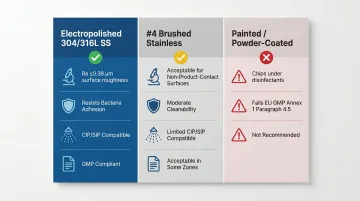
- Electropolished surfaces (ASME BPE SF4 standard, Ra max 0.38 µm) resist bacteria adhesion and withstand repeated cleaning with IPA, hydrogen peroxide, or bleach-based agents
- Smooth, crevice-free welds prevent particle entrapment and microbial harborage
- #4 brushed finishes provide acceptable cleanability for non-product-contact surfaces
Painted or powder-coated surfaces are unsuitable. Chipping releases particulates, aggressive disinfectants cause coatings to delaminate, and degraded coatings expose underlying substrates to corrosion. EU GMP Annex 1 Paragraph 4.5's requirement for "smooth, impervious and unbroken" surfaces precludes coatings that degrade under cleaning cycles.
Mechanism and Actuation Design
Hydraulic units pose a contamination risk if seals fail. FDA 21 CFR 211.65(b) explicitly prohibits lubricants from contacting "components, drug product containers, closures, in-process materials, or drug products." Pneumatic actuation eliminates this risk entirely: compressed air systems have no fluid to leak.
For facilities that prefer hydraulic actuation:
- Specify enclosed-hydraulic systems with leak containment
- Require dual seals on hydraulic cylinders
- Add sanitary drip pans beneath the platform as secondary protection
Beyond the actuation fluid, mechanical components need equal attention. Scissor arms must be fully enclosed or shielded, since exposed pivot points generate metal particulates during operation — a direct contamination risk in ISO Class 5-7 environments. All moving parts should be sealed or protected from product zones.
Electrical and Control Components
Control panels, pushbuttons, and cables require IP54 minimum rating (dust protected, splash water resistant) for general cleanroom areas. Wash-down environments demand IP65 (dust-tight, water jet resistant).
Pendant controls should feature:
- Smooth, wipe-clean housing without recesses
- Sealed membrane switches
- Stainless steel cable strain reliefs
Avoid exposed conduit runs that trap particulates. Flush-mounted conduit or internal cable routing maintains the "smooth, impervious and unbroken" surface requirement.
Mobility vs. Fixed Installation
Mobile cleanroom lift tables need cleanroom-rated non-marking casters with stainless steel frames. Standard industrial casters shed rubber particles and corrode under disinfectant exposure. Look for polyurethane wheels with stainless steel bearings and sealed raceways.
Fixed units may require pit mounting for flush-floor ergonomics. Benefits include:
- Elimination of trip hazards around the platform perimeter
- Easier cleaning of surrounding floor areas (no gaps or ledges)
- Reduced above-floor footprint in space-constrained cleanrooms
- Potential GMP advantage by removing a mobile contamination vector
How We Chose the Best Lift Tables
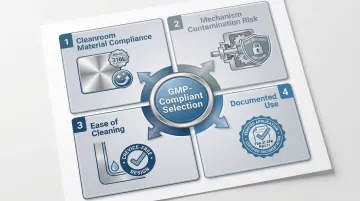
Units were assessed against four primary criteria:
- Cleanroom material compliance — stainless steel grade and surface finish
- Mechanism contamination risk — actuation type and seal integrity
- Ease of cleaning — weld quality, absence of crevices and horizontal ledges
- Documented use — verified pharmaceutical or life sciences applications
Common mistakes buyers make include selecting a standard industrial lift table and assuming it is suitable for cleanroom use. Standard units feature painted surfaces that chip, exposed mechanisms that generate particles, and hydraulic systems without secondary containment. Retrofitting these units after purchase rarely achieves the weld quality, surface finish, or documentation traceability required for GMP compliance.
Actuation method is equally easy to overlook. A hydraulic system without sealed cylinders and a drip pan creates a direct path for lubricant contamination — a violation of FDA 21 CFR 211.65(b) that often surfaces only during regulatory inspection.
John Maye Company has helped Midwest pharmaceutical facilities source and specify cleanroom-rated lift tables since 1983. For consultation on material certifications and GMP compliance documentation, call 1-800-441-6293.
Conclusion
Selecting a lift table for a pharmaceutical cleanroom is a compliance decision as much as an equipment decision. The right unit protects product integrity, supports GMP audit readiness, and reduces ergonomic risk for operators in regulated environments. The wrong unit introduces contamination vectors, creates audit observations, and potentially jeopardizes batch release.
Before finalizing any purchase, procurement teams should request:
- Material certifications and traceability documentation
- Cleanroom suitability documentation specific to your ISO classification
- Declarations of Conformity for equipment qualification under 21 CFR Part 211 Subpart D
- Sanitation protocol guidance from the supplier
Most importantly, work with a distributor who understands both the equipment and the regulatory context. Technical requirements for pharmaceutical cleanroom lift tables differ significantly from standard industrial specs—a partner without experience in regulated environments won't know what questions to ask before the purchase, let alone during qualification. John Maye Company has served pharmaceutical and manufacturing clients across the Midwest for 40+ years, with manufacturer-trained expertise to match the right lift table to your cleanroom's specific compliance requirements.
Frequently Asked Questions
What makes a lift table suitable for pharmaceutical cleanrooms?
Material selection is the starting point — 304 or 316L stainless steel with an electropolished or passivated finish. Beyond that, sealed mechanisms must prevent particle generation during operation, and the overall design should support cleaning and disinfection without crevices or horizontal ledges that trap contamination.
What ISO cleanroom class do most pharmaceutical manufacturing environments fall under?
Most sterile drug manufacturing zones operate at ISO Class 5–7 (equivalent to older Federal Standard 209E Class 100–10,000 designations). Packaging and secondary processing areas typically fall within ISO Class 7 or 8.
Is there a difference between 304 and 316L stainless steel for cleanroom lift tables?
Yes. 304 stainless steel suits most pharmaceutical cleanrooms, while 316L offers superior resistance to chloride-based cleaning agents due to its 2–3% molybdenum content. 316L is the better choice for high-humidity environments or frequently sanitized areas like sterile fill-finish suites. If bleach, VHP, or other aggressive disinfectants are part of your cleaning protocol, 316L is worth the added cost.
Can standard scissor lift tables be modified for cleanroom use?
Standard units are not recommended for validated cleanrooms. Post-manufacture modifications rarely achieve the weld quality, surface finish, or documentation traceability required for GMP compliance. Purpose-built cleanroom models provide the correct material specifications, sealed mechanisms, and manufacturer documentation from the start—eliminating qualification risks.
How often should cleanroom lift tables be cleaned and recertified?
Cleaning frequency follows the facility's validated cleaning SOP, often daily or between batches depending on product exposure level. Mechanical inspection intervals depend on usage intensity and the manufacturer's recommended schedule — typically annually or after a defined number of operating cycles.
What load capacities are typically available in cleanroom lift tables?
Cleanroom lift tables range from 500 lbs to 4,000+ lbs capacity. Pharmaceutical applications commonly require 1,000–2,000 lb capacity for drum handling (a filled 55-gallon drum weighs 400–600 lbs) and 3,000–4,000 lb capacity for IBC tote positioning (a loaded 275-gallon tote exceeds 2,400 lbs).