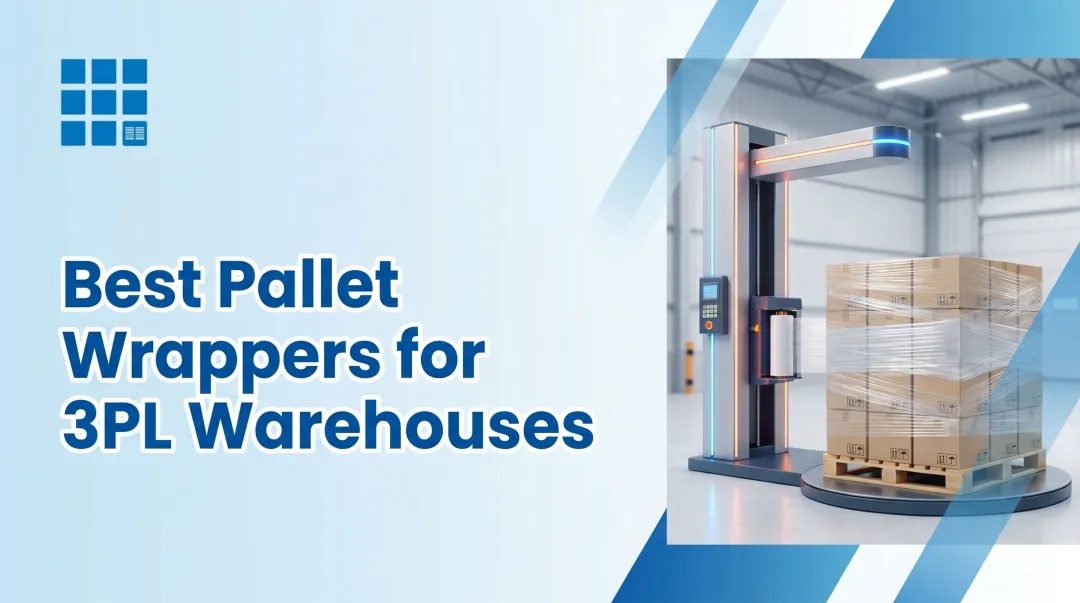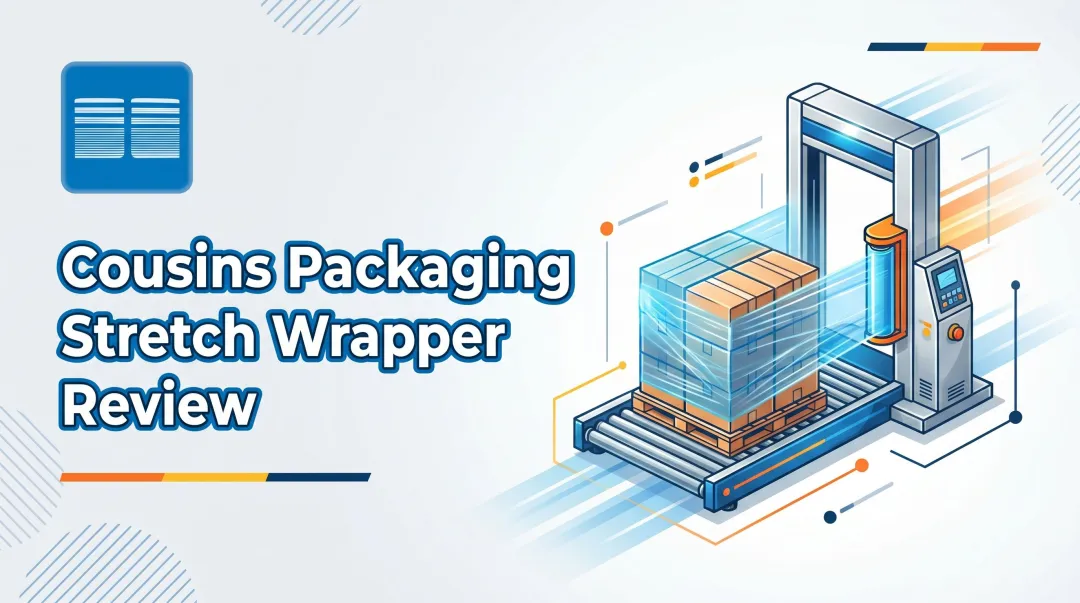
Phoenix Wrappers, founded in 1994 and now part of the Pacteon Group, has built a reputation as a mid-to-high tier option emphasizing rugged, all-steel construction and harsh-environment durability. The company consistently appears on equipment shortlists alongside established brands like Lantech, Orion, and Robopac. This review covers Phoenix's lineup, technical specifications in context, floor performance, and operational fit for different facility types.
Key Takeaways:
- Phoenix machines are engineered for harsh industrial environments with heavy-duty steel construction and sealed components
- Flagship semi-automatic models handle up to 5,000 lbs with 245% power pre-stretch and PLC controls
- Film savings potential of $13,000-$26,000 annually compared to low pre-stretch machines at typical volumes
- Modular architecture allows future upgrades without replacing the entire system
- Best fit for mid-to-high volume operations (50+ pallets/shift) in manufacturing, food & beverage, and construction materials distribution
Phoenix Stretch Wrapper Lineup: Which Models Are We Talking About?
Phoenix covers a wide operational range, from standalone semi-automatic turntables to fully integrated automatic systems. Here's how the lineup breaks down:
Semi-Automatic Turntable Models:
- PLP Series (Low-Profile): Designed for pallet-jack accessibility, eliminating the need for forklift loading on every cycle
- PHP Series (High-Profile): Forklift-loaded configuration for operations with dedicated material handling equipment
Automatic Systems:
- PLPA Series (Non-Conveyorized Automatic): Eliminates manual film attachment and cutting while maintaining a standalone footprint
- PCTA Series (Conveyorized Turntable Automatic): Integrates into production lines for high-throughput operations
- PRTA Series (Rotary Arm Automatic): Load remains stationary while the film carriage rotates, making it ideal for unstable or extremely heavy loads
- PRRA Series (Rotary Ring Automatic): High-speed ring-based carriage rotation for maximum throughput in automated environments
Note on the PLP-2150: While this model has been Phoenix's flagship semi-automatic low-profile turntable wrapper, some distributors indicate it has been discontinued as Phoenix streamlines operations to focus on fully automated systems. Confirm current availability directly with an authorized Phoenix distributor or Pacteon before purchasing.
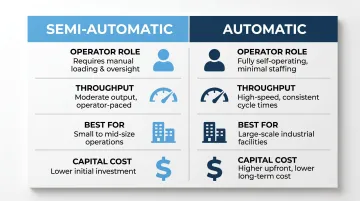
Semi-Automatic vs. Automatic: What It Means for Your Operation
Choosing between the two comes down to volume, labor, and how your facility is set up.
| Semi-Automatic | Automatic | |
|---|---|---|
| Operator Role | Positions load, attaches film, cuts after cycle | No manual intervention required |
| Throughput | Up to 40–45 loads/hour | Higher; scales with line speed |
| Best For | Lower-volume ops, multi-location staging | Integrated production lines |
| Capital Cost | Lower upfront | Higher upfront, lower labor cost |
Lantech's industry data confirms that 9 out of 10 semi-automatic wrappers sold are turntable style, reflecting their versatility and cost-effectiveness across a range of operations.
Key Technical Specs Decoded: What the Numbers Actually Mean
Phoenix's specs aren't just numbers on a sheet—here's what they translate to on the floor.
5,000 lb Load Capacity in Practice
Phoenix's semi-automatic turntable models handle loads up to 5,000 lbs—meaningfully higher than many entry-level competitors capped at 2,500-3,000 lbs. This capacity stems from:
- Heavy-gauge steel turntable construction with roller bearing supports that distribute weight evenly and resist deflection under eccentric loads
- Chain drive system that delivers consistent rotational torque even with dense, irregularly stacked pallets common in construction materials and food & beverage operations
- 58-inch diameter turntable (on the PLP-2150) accommodating 56" x 56" loads with 80-inch diagonal capacity
For operations running inconsistent load configurations—mixed SKUs, partial pallets, or top-heavy builds—this robust foundation prevents turntable wobble and film breaks that plague lighter-duty machines.
245% Power Pre-Stretch: What Film Savings Actually Look Like
Pre-stretch percentage represents the ratio of film output to film input. At 245% pre-stretch, one foot of film from the roll yields approximately 3.45 feet of stretched film applied to the load. This matters significantly more than spec sheets suggest.
Film Consumption Comparison: Using a standard 6,000-foot roll:
- 150% pre-stretch: Yields 15,000 feet of applied film
- 245% pre-stretch: Yields approximately 20,700 feet—38% more film per roll
Annual Savings at Realistic Volumes: Industry data shows the following annual film cost reductions when moving from non-pre-stretch or low pre-stretch (150%) machines to 245-250% systems:
- 50 pallets/day: $13,000/year
- 100 pallets/day: $26,000/year
- 200 pallets/day: $52,000+/year
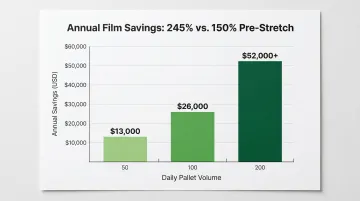
These savings often pay back the machine investment within 12-24 months at moderate volumes.
PLC Controls and Wrap Program Storage
PLC-based control systems allow operators to store and recall wrap programs for different SKU or pallet configurations. Instead of manually adjusting wrap counts, tension, and turntable speed for each product type, operators select the appropriate program with a single button press.
Operational Benefits:
- Eliminates setup variability and operator error when switching between product lines
- Reduces changeover time in mixed-SKU operations
- Ensures consistent containment force across shifts and operators
- Creates knowable, predictable film costs for each product type
On Phoenix units, stored wrap profiles mean a new operator on the night shift applies the same containment force as a veteran running days—no guesswork, no film waste from misconfigured settings.
Modular Design for Future Upgrades
Phoenix's modular architecture allows businesses to start with a base semi-automatic unit and add capabilities later:
- Automatic film cut-and-clamp systems
- Conveyorization for inline integration
- Advanced film carriages with higher pre-stretch capability
- Remote monitoring and IoT connectivity
Starting with a base unit keeps initial costs down. As throughput increases, each upgrade builds on the existing frame rather than requiring a full equipment replacement.
Real-World Performance: What Operators Experience on the Floor
Throughput and Wrap Cycle Time
Phoenix's semi-automatic models are rated at 45 loads per hour—slightly above the industry standard of 40 loads/hour for turntable wrappers. At realistic production volumes:
- 50 pallets/shift (8 hours): Requires approximately 6.25 pallets/hour—well within capacity with time for breaks and load staging
- 100 pallets/shift: Requires 12.5 pallets/hour—comfortable throughput with minimal operator rush
- 200 pallets/shift: Requires 25 pallets/hour—approaching capacity limits; may benefit from a second machine or automatic system
Turntable rotation speeds typically run 12-15 RPM with standard wrap heights of 80 inches. Actual cycle time depends on wrap program settings: more top/bottom wraps, tighter overlap, or higher containment force all extend cycle duration but improve load stability.
Load Stability and Containment Force
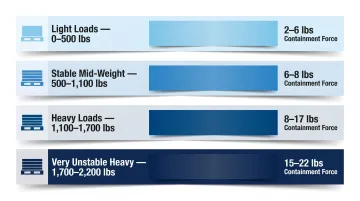
Wrap quality isn't just about speed—Wrap quality isn't just about speed. Containment force directly determines whether a load survives transit, and the right tension varies by load weight. Industry-standard containment force recommendations:
- Light loads (0-500 lbs): 2-6 lbs of force
- Stable mid-weight loads (500-1,100 lbs): 6-8 lbs of force
- Heavy loads (1,100-1,700 lbs): 8-17 lbs of force
- Very unstable heavy loads (1,700-2,200 lbs): 15-22 lbs of force
Phoenix's power pre-stretch carriage and tension controls maintain consistent film delivery throughout the wrap cycle, eliminating the hot spots and weak zones common in hand wrapping or low-quality machines. Research from the USDA Forest Service found that increased containment force can improve unit-load deflection by as much as 81%.
Performance in Harsh Environments
Phoenix machines are built to run in conditions that would degrade lower-grade equipment. Key durability features include:
- All-steel construction with two-part epoxy paint finish for corrosion resistance
- Sealed electrical components protecting against dust, moisture, and temperature variation
- Heavy-duty roller bearings with accessible grease fittings for extended service life
- Drive and control components rated for continuous-duty production cycles
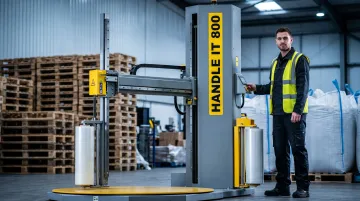
These features matter in food processing facilities with washdown requirements, dusty construction materials warehouses, or outdoor loading docks experiencing temperature extremes. Operations in climate-controlled, clean environments may not need this level of ruggedness—but facilities facing harsh conditions benefit from Phoenix's over-built approach.
Ease of Operation and Learning Curve
New operators experience varying learning curves depending on control complexity. PLC touchscreen interfaces with stored programs significantly reduce training time compared to manual-adjustment machines. Key usability factors:
- Film threading process: How easily can operators load new film rolls?
- Program recall: Can operators select the right wrap pattern without supervisor intervention?
- Error recovery: What happens when film breaks mid-cycle or loads shift?
For operations with high turnover, PLC-based controls with stored wrap programs reduce onboarding time and minimize wrap inconsistency between operators—two problems that mechanical dial systems don't solve well.
Uptime and Reliability Track Record
Phoenix's design choices directly reduce unplanned downtime:
- Chain drive systems (when properly lubricated or using no-lube designs) extend service intervals compared to belt-drive alternatives
- Robust construction reduces vibration-related failures and component wear
- Accessible maintenance points simplify routine service tasks
Industry rankings recognize Phoenix for delivering "rugged and reliable machines" that maintain performance in continuous-use industrial environments. The accessible maintenance design means those service tasks—film carriage cleaning, turntable bearing inspection, sensor calibration—take less time and require less specialized skill to complete.
Film Efficiency and Wrap Quality Outcomes
Quantifying Film Savings
Moving from hand wrapping (10-30% stretch) to Phoenix's 245% power pre-stretch delivers substantial cost reductions. At 50 loads per day, upgrading saves $30,000 or more over five years in film costs alone—not counting labor time savings.
ROI Example at 75 Pallets/Day:
- Annual film cost reduction: ~$19,500
- Labor time savings: 5-8 minutes per pallet = 375-600 minutes/day saved
- Reduced product damage: Estimated 50% reduction in transit claims
For procurement managers evaluating capital equipment purchases, these savings typically justify machine investment within 18-24 months.
Wrap Consistency and Load Protection
Machine wrapping with programmed settings eliminates human variability. Every pallet receives identical wrap counts, tension, and overlap—regardless of operator fatigue, shift changes, or training levels.
Industry data confirms approximately 50% of in-transit damages stem from ineffective stretch wrapping. Manual wrapping consumes up to 50% more film than calibrated machines while delivering inconsistent protection. The downstream benefit: fewer insurance claims, reduced customer complaints, and improved delivery reputation.
Film Type Compatibility
Achieving that consistency starts with matching the right film to your load type. Phoenix machines work with both cast and blown LLDPE (linear low-density polyethylene) stretch films, though cast film accounts for 70-80% of the market due to its consistent thickness, quiet unwinding, and smooth cling during high-speed mechanical application.
Film Selection Considerations:
- Cast film works best for standard applications — consistent thickness and better optical clarity support reliable barcode scanning
- Blown film handles sharp-edged or irregular loads where puncture and tear resistance matter more
- Most semi-automatic applications call for 80+ gauge, 20-inch width, 5,000-6,000 ft rolls
Sourcing film through a distributor familiar with Phoenix equipment — rather than generic suppliers — reduces compatibility guesswork and keeps machine performance dialed in from day one.
Who Should (and Shouldn't) Buy a Phoenix Stretch Wrapper
Best-Fit Operations
Phoenix machines make the strongest case for:
Volume Thresholds:
- Operations wrapping 50+ pallets per shift where film efficiency and labor savings justify capital investment
- Facilities running multiple shifts or seasonal surges requiring durable, continuous-duty equipment
Demanding Environments:
- Food & beverage facilities with washdown requirements and temperature variation
- Construction materials distribution centers with dust, heavy loads, and harsh conditions
- Manufacturing operations requiring consistent uptime under continuous production cycles
Operational Flexibility Needs:
- Businesses wrapping varied load configurations benefiting from programmable PLC settings
- Operations planning future automation upgrades who value modular architecture
- Facilities prioritizing long equipment life and low total cost of ownership over lowest upfront price
One detail worth calling out: Phoenix turntables support loads up to 5,000 lbs, which makes a meaningful difference for dense manufacturing and construction materials pallets.
When Phoenix May Not Be the Right Fit
Phoenix is a capable machine, but it's not the right tool for every operation. Skip it if any of these apply:
- Under 20 pallets/day — Entry-level machines deliver adequate ROI at low volumes; Phoenix's durability features won't pay for themselves
- 100+ pallets/hour with full conveyor integration — Purpose-built automatic systems from Lantech or high-speed specialty brands handle that throughput more efficiently
- Unconventional load shapes or tight floor space — Long panels, circular products, or constrained layouts fit rotary arm, orbital, or robotic configurations better than a turntable design
Getting a Phoenix Stretch Wrapper in the Midwest: What to Know Before You Buy
Purchasing industrial packaging equipment differs fundamentally from buying consumer products online. Before committing to a stretch wrapper, four factors separate a smart buy from a costly mistake:
- See it run with your loads — generic demos won't reveal compatibility issues that show up with your actual pallet profiles and film types
- Get a proper sizing consultation — production volume, load dimensions, facility constraints, and growth plans all affect which model fits your operation
- Plan for installation support — factory-certified technicians handle electrical hookup, safety verification, and initial calibration, which matters for warranty coverage
- Factor in post-purchase service — local distributor relationships mean faster parts fulfillment, preventative maintenance, and emergency repair response that online purchases can't provide
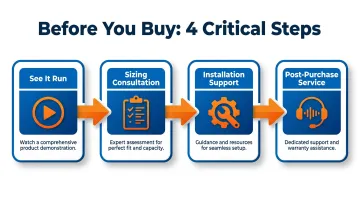
Those four factors are where a regional distributor earns its value. For Midwest operations, that means John Maye Company.
John Maye Company has served Wisconsin and Midwest packaging operations for over 40 years. Their manufacturer-trained technicians, 2,500+ SKU parts inventory, and hands-on product showroom let buyers evaluate stretch wrapper options in person rather than guessing from spec sheets. Their consultation process examines load profiles, production volumes, and facility conditions to recommend equipment that actually fits your operation.
For Wisconsin and Midwest facilities evaluating Phoenix or competing stretch wrappers, call John Maye Company at 1-800-441-6293 to schedule a consultation or showroom visit.
Frequently Asked Questions
What material is pallet wrap made from?
Pallet wrap (stretch wrap) is manufactured from LLDPE (linear low-density polyethylene), a flexible plastic that stretches up to 300% of its original length. This material provides the cling and containment force needed to secure pallet loads during storage and transit.
What is the load capacity of Phoenix stretch wrappers?
Phoenix semi-automatic turntable models like the PLP-2150 handle loads up to 5,000 lbs. Load capacity varies across the Phoenix lineup depending on model configuration—automatic and rotary systems accommodate different weight ranges and load profiles.
How does Phoenix compare to Lantech or Orion stretch wrappers?
Phoenix leads in harsh-environment durability with heavy-gauge steel and sealed components. Lantech differentiates on automatic film handling (Metered Film Delivery, Load Guardian), while Orion's S-Carriage InstaThread targets pre-stretch efficiency at 260%+. Your best fit depends on environment, volume, and budget.
Is a Phoenix stretch wrapper suitable for harsh warehouse environments?
Yes. Phoenix specifically engineers machines for demanding industrial environments, featuring no-lube chain drive options, heavy-gauge steel construction, two-part epoxy corrosion-resistant finishes, and sealed electrical components. These design elements support reliable operation in facilities with dust, moisture, or temperature variation.
How much film can a Phoenix wrapper save compared to hand wrapping?
Phoenix's 245% pre-stretch covers far more area per roll than hand wrapping (typically 10–30% stretch). At 50 pallets per day, that translates to roughly $13,000 in annual film savings; at 100 pallets per day, savings approach $26,000.
What maintenance does a Phoenix stretch wrapper require?
Routine tasks cover cleaning pre-stretch rollers, inspecting the film carriage, checking turntable drive components, and recalibrating wrap tension. Preventative maintenance intervals typically run every 3–6 months. Phoenix's heavy-duty construction keeps unplanned downtime lower than lighter-duty alternatives.