Introduction
Choosing the wrong stretch wrapper model is an expensive mistake. Overshoot on automation and you tie up capital in equipment your line doesn't need. Undershoot and a single bottleneck eats into production capacity every shift.
Stretch wrappers are significant capital investments, and throughput mismatches compound over time through wasted labor, inefficient film use, and lost output.
Orion's three model families—the Flex, MA, and MA-X—are each built for different throughput bands and production settings. This guide maps each model to the scenarios where it performs best, so you can match equipment to your actual requirements and your 3-5 year growth trajectory.
Key Takeaways
- Flex Series: Semi-automatic, 20-40 loads/hour — best for moderate volumes with operator involvement
- MA Series: Fully automatic, 30-80+ loads/hour — designed for continuous end-of-line operation
- MA-X: High-speed automatic, 60-120 loads/hour — for ultra-high-throughput facilities
- Key selection variables: daily load volume, load characteristics, automation level, and total cost of ownership
- Throughput fit — including projected growth — matters more than upfront price
Understanding the Orion Stretch Wrapper Lineup
Orion Packaging Systems, a ProMach brand based in Alexandria, Minnesota, builds stretch wrappers across three core mechanisms: rotary turntable, rotary tower (rotary arm), and orbital configurations. The range runs from semi-automatic to fully automatic, so buyers can source entry-level wrappers through conveyor-integrated palletizing cells from a single OEM.
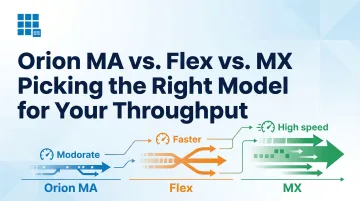
The MA, Flex, and MX are not competing products — they represent different rungs on the automation and throughput ladder. Each is optimized for a specific operational profile, and understanding where your facility sits on that ladder is the foundation of a sound equipment decision.
All Orion models share core engineering principles:
- InstaThread powered pre-stretch film carriages: Tool-free film loading in seconds
- 200-260% pre-stretch capability: Film is mechanically elongated before application, reducing consumption while increasing containment force
- Allen-Bradley HMI controls: Industry-standard interfaces with programmable wrap recipes
- All-steel welded frames: Designed for multi-shift industrial duty cycles
What does 260% pre-stretch mean? The film carriage uses differential-speed rollers to stretch film to 2.6 times its original length before it contacts the load. One foot of film from the roll becomes 3.6 feet of applied film. This reduces film cost per pallet and increases the elastic "snap-back" force that secures the load.
Orion's S-Carriage variant provides over 180 degrees of film-to-roller contact, reducing film neckdown (width reduction during stretching) by an additional 5-15% compared to standard pre-stretch systems.
Breaking Down Each Model: Specs, Strengths, and Sweet Spots
Orion Flex Series: Semi-Automatic Flexibility for Growing Operations
The Flex Series is Orion's semi-automatic turntable lineup, covering entry-level through mid-tier throughput requirements. All Flex models require the operator to manually attach film and initiate each wrap cycle, but they eliminate the physical labor of walking circles around the pallet with a roll of stretch film.
Key Flex Variants:
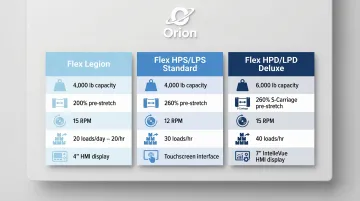
| Model | Load Capacity | Pre-Stretch | Max RPM | Throughput | HMI |
|---|---|---|---|---|---|
| Flex Legion | 4,000 lb | 200% | 15 | 20 loads/day to 20 loads/hr | 4″ Allen-Bradley touchscreen |
| Flex HPS/LPS (Standard) | 4,000 lb | 260% | 12 | Up to 30 loads/hr | Touchscreen |
| Flex HPD/LPD (Deluxe) | 6,000 lb | 260% (S-Carriage) | 15 | Up to 40 loads/hr | 7″ IntelleVue color HD |
Flex Legion: U.S.-Made Entry Point
Launched in February 2026, the Flex Legion is Orion's first 100% U.S.-designed and built entry-level turntable wrapper. It replaces a previously imported model, reducing tariff exposure and shortening lead times for Midwest buyers. The Legion is configurable from 20 loads per day up to 20 loads per hour, making it the right choice for small-scale manufacturers transitioning from hand wrapping or facilities with single-shift, low-volume operations.
Flex Standard (HPS/LPS): Mid-Tier Workhorse
The Standard models deliver up to 30 loads per hour with 260% InstaThread pre-stretch and 4,000 lb capacity at 12 RPM max turntable speed. This tier covers most single-shift distribution operations with stable, uniform pallet loads.
Flex Deluxe (HPD/LPD): Upgrade Path Protection
The Deluxe models offer 6,000 lb capacity, S-Carriage 260% pre-stretch, 15 RPM turntable speed, and a 7-inch IntelleVue HMI. The standout feature: the HPD/LPD can be field-retrofitted to automatic performance (HPA/LPA) without replacing the base unit. That upgrade path protects your capital investment as throughput scales from 30 loads/day to 100+, without a full equipment replacement cycle.
Ideal Operational Fit:
- Manufacturers transitioning from hand wrapping
- Facilities wrapping 15-40 loads per hour with moderate daily pallet counts
- Multi-SKU operations needing programmable wrap recipes for different product types
- Sites where forklift portability between wrapping zones matters — no fixed conveyor required
- Operations where floor space is limited and a compact footprint matters
Orion MA Series: Fully Automatic Rotary Tower for High-Volume End-of-Line Applications
The MA Series is Orion's flagship fully automatic rotary tower stretch wrapper. Unlike turntable systems that spin the load, the MA rotates the film-carrying arm around a stationary pallet.
That distinction matters most when handling heavy, unstable, or irregularly shaped loads that cannot safely rotate.
2023 Redesign: Modular Single-Frame Architecture
In August 2023, Orion introduced a redesigned MA platform where machines running 30 loads/hour and 80 loads/hour share the same modular frame. This standardization delivers two advantages:
- Faster deployment: Lead time reduced to approximately 22 weeks versus the industry average of 35 weeks
- Simplified parts management: Spare parts inventory is consistent across the MA range
Key MA Series Specifications:
- Throughput: 30-80 loads/hour standard; up to 100+ loads/hour with dual-carriage MA-DX2 configuration
- Pre-stretch: S-Carriage InstaThread at 260%
- Controls: Allen-Bradley 10-inch IntelleVue HMI
- Safety: CAT 3 electronics with separated high/low voltage cabinets, wire mesh guarding, interlocked doors, light curtains
- Frame: Four-legged stable design for high-speed operation
- Conveyor: 1x infeed, 1x wrap zone, 1x outfeed (Lo-Pro Drag Chain option for walkie/pallet jack loading)
- Load capacity: 30″W x 30″L x 15″H minimum, 48″W x 48″L x 80″H maximum (standard)
- Integration: AGV/AMR compatible, pairs with robotic palletizing cells
The MA is engineered for lights-out operation. Once configured, pallets enter on conveyor, receive film, and exit without operator intervention. For high-volume facilities running 100+ pallets per day, that labor elimination is the primary ROI driver.
Ideal Operational Fit:
- High-volume manufacturing and distribution operations running continuous or near-continuous end-of-line wrapping
- Lines handling heavy loads (5,000+ lb), top-heavy or irregular loads, or light loads where turntable rotation would cause shifting
- Operations where minimizing labor on the wrapping station is a direct cost objective
- Conveyor-integrated lines requiring seamless material flow from palletizing through wrapping to shipping
- Facilities with sufficient floor space and infrastructure for permanent installation
Clarification: The "MX" Designation and MA-X Configuration
Orion does not currently list a standalone model designated "MX" on its official product catalog. Orion's official site carries no product pages, press releases, or spec sheets for an "MX" model. Authorized distributors, however, do reference the MA-X — a high-speed MA variant positioned at the top of the rotary tower lineup.
MA-X Specifications (Distributor-Listed):
- Throughput: 60-75 loads/hour standard, up to 120 loads/hour optional
- Load capacity: 4,500 lb standard, 6,000 lb optional
- Rotary arm speed: 0-30 RPM standard, 36 RPM optional
- Pre-stretch: 260% InstaThread
- Controller: Allen-Bradley MicroLogix 1400 PLC
- Safety: CAT 2 standard, CAT 3 optional
- Conveyor speed: 50 FPM standard, 30-60 FPM optional
The MA-X appears to represent either a pre-2023-redesign configuration or a distributor-specific high-speed build. The current MA product page presents a unified, modular platform with no distinct sub-models listed, suggesting Orion consolidated the lineup after the 2023 redesign.
For purchasing decisions: Treat the MA-X as a high-throughput MA configuration, not a separate model family. If your operation demands 60+ loads/hour, specify the MA Series and work with your distributor to configure the appropriate speed, conveyor, and safety options.
Key Factors for Matching the Right Orion Model to Your Throughput
Throughput Volume: The Primary Filter
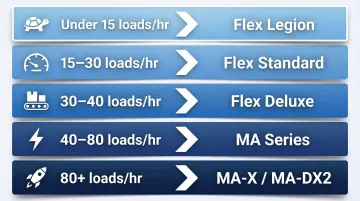
Daily wrapping volume is the first decision gate. Use this framework:
- Under 15 loads/hour: Flex Legion (entry-level semi-automatic)
- 15-30 loads/hour: Flex Standard (HPS/LPS)
- 30-40 loads/hour: Flex Deluxe (HPD/LPD) with upgrade path to automatic
- 40-80 loads/hour: MA Series (fully automatic rotary tower)
- 80+ loads/hour: MA-X or MA-DX2 high-speed configurations
Don't size equipment to today's average volume—size to peak demand and 3-5 year growth projections. If you're wrapping 25 loads/hour today but adding a second shift next year, the Flex Deluxe with automatic upgrade capability is likely more cost-effective than buying a Legion now and replacing it in 18 months.
Load Characteristics and Stability Requirements
When rotary tower (MA) is the right choice:
- Heavy loads: Pallets exceeding 5,000 lb—the floor supports the weight, not the machine
- Unstable loads: Top-heavy, fragile, or irregularly shaped loads that would shift or topple on a spinning turntable
- Very light loads: Products so light that turntable rotation creates movement or misalignment
- Irregular pallet dimensions: Non-standard sizes that benefit from stationary positioning
When turntable (Flex) works well:
- Standard 40" x 48" or 48" x 48" pallet footprints
- Stable, uniform loads under 6,000 lb
- Consistent product types with predictable center of gravity
Industry guidance confirms: rotary arm systems are preferred for loads that "cannot rotate safely" or might "fall apart if spun," and turntable systems are generally limited to 4,000-5,000 lb loads. For Midwest food/beverage and heavy goods facilities, the MA's rotary tower design is often the only viable option regardless of throughput volume.
Automation Level and Labor Cost Impact
Load characteristics determine machine type — automation level determines how many people you need. Here's how the two approaches compare:
- Semi-automatic (Flex): Operator attaches film, starts each cycle, then cuts and secures the tail. Cycle time runs 1-2 minutes, but the operator must stay nearby for every load.
- Fully automatic (MA): Operator stages pallets on the infeed conveyor; the machine handles film attachment, wrapping, tail cutting, and outfeed automatically. One person can supervise multiple stations simultaneously.
Labor ROI Benchmark:
Industry data indicates fully automatic stretch wrapping becomes cost-justified at approximately 100+ pallets per day, with estimated annual labor savings of around $73,000 versus three manual wrapping operators. At lower volumes, semi-automatic Flex models deliver film savings and load consistency without the capital investment of full automation.
Transit damage reduction: Machine-applied wrapping delivers uniform tension that eliminates human variables and weak spots, resulting in reduced product damage during shipping, decreased customer complaints, and minimized returns. These savings show up directly in fewer rejected loads and lower freight claims.
Floor Space, Installation, and Integration Constraints
Flex turntable advantages:
- Compact footprint (typically 6-8 feet square)
- Forklift portable—move between wrapping zones as needed
- No fixed conveyor required
- Suitable for facilities without dedicated wrapping stations
MA rotary tower requirements:
- Fixed installation with conveyor infeed/outfeed
- Larger footprint (12-15 feet with conveyor zones)
- Permanent floor anchoring for stability
- Electrical and pneumatic infrastructure (480V 3-phase, 80 PSI compressed air)
- Wire mesh guarding and safety zone clearances
If you need to wrap at multiple locations or can't dedicate floor space to a permanent cell, the Flex Series' portability wins. The MA makes sense when you can commit to a fixed wrapping station integrated into your material flow.
Total Cost of Ownership: Capital Investment vs. Long-Term Operational Savings
Upfront capital cost:
- Flex Series: $5,000-$20,000 (Legion at entry level, Deluxe at upper range)
- MA Series: Significantly higher, reflecting automatic operation and conveyor integration
Operational savings drivers:
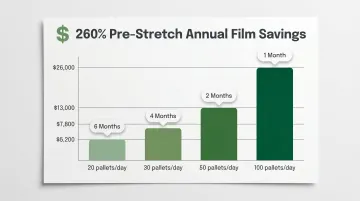
Film efficiency: Orion's 260% pre-stretch reduces film consumption by up to 50% versus hand wrapping. Annual film savings at various volumes:
| Daily Pallets | Annual Film Savings (vs. Non-Pre-Stretch) | Pre-Stretch Payback |
|---|---|---|
| 20 | $5,200 | 6 months |
| 30 | $7,800 | 4 months |
| 50 | $13,000 | 2 months |
| 100 | $26,000 | 1 month |
The S-Carriage on Flex Deluxe and MA models adds another 5-15% film savings through reduced neckdown. At 100 pallets/day, the difference between 200% (Legion) and 260% (MA) pre-stretch represents thousands of dollars annually.
At 100+ pallets/day, the MA's unattended operation eliminates dedicated wrapping labor — one operator manages staging and quality checks across multiple lines instead of standing at a wrapper for every cycle. Combined with film savings and reduced freight claims, most facilities at that volume see full payback within 18-24 months.
Below 50 pallets/day, the Flex Series delivers better total cost of ownership. The capital investment is lower, film savings still apply, and the labor trade-off isn't yet significant enough to justify full automation.
How John Maye Company Can Help You Choose
John Maye Company has been matching Midwest operations to the right Orion stretch wrapping equipment since 1983. Based in Waukesha, Wisconsin, their factory-certified technicians conduct structured application assessments to map your pallet volumes, load characteristics, and growth projections to the correct model before you commit to a purchase.
Application Assessment Process:
John Maye's specialists evaluate:
- Current and projected throughput (loads per hour, per shift, per day)
- Load characteristics (weight, dimensions, stability, product type)
- Existing infrastructure (floor space, electrical, compressed air)
- Integration requirements (conveyor, robotic palletizing, AGV/AMR)
- Budget parameters and total cost of ownership targets
This assessment prevents both under-investment (buying a Flex when you need an MA, creating a bottleneck) and over-specifying (specifying an MA when a Flex Deluxe with upgrade capability would suffice).
Once you know which model fits your operation, John Maye can also help you validate that decision before purchase.
Rental Fleet for Evaluation:
John Maye maintains a rental fleet of Orion stretch wrappers for throughput evaluation trials and seasonal surge management. If you're uncertain whether your operation justifies fully automatic wrapping, or if you face seasonal volume spikes, rental options let you test equipment before committing or bridge capacity gaps during peak periods.
Key Value-Adds for Orion Buyers:
- Parts ship within 24 hours from a 2,500+ SKU inventory
- Factory-certified technicians for faster diagnosis and correct installation
- On-site support across Wisconsin and surrounding Midwest states
- Full model range covered, from entry-level Flex Legion to high-throughput MA configurations
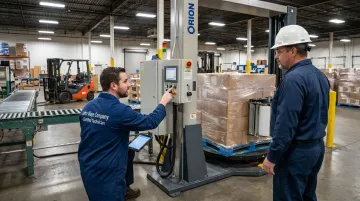
Contact John Maye Company at 1-800-441-6293 or info@johnmayecompany.com to schedule an application assessment.
Conclusion
The MA, Flex, and high-speed MA configurations are not interchangeable—each is optimized for a distinct throughput band and automation context. Selecting the wrong model creates a cost drag that compounds over time: wasted labor if you under-automate, underutilized capital if you over-engineer, or excess film consumption if you skip powered pre-stretch.
The right model today may not be the right model in three years. Production volume, SKU mix, and labor costs evolve. Periodic reassessment of wrapping system performance against throughput benchmarks is a sign of a well-run operation, not an admission of a past mistake. The Flex Deluxe's field-upgrade path to automatic operation is specifically designed for this reality—your equipment can scale with your business.
The clearest cases break down like this:
- 20–40 loads/hour, stable products, limited floor space: The Flex Series delivers film efficiency and load consistency without the capital commitment of full automation
- 80+ loads/hour, dedicated end-of-line cell, heavy or unstable products: The MA Series is the only viable solution
Between those extremes, weigh load characteristics, growth trajectory, and total cost of ownership before deciding.
Contact John Maye Company for a no-obligation application assessment. Their team can map your current throughput numbers and projected growth to the right model—before you commit capital to the wrong one.
Frequently Asked Questions
Frequently Asked Questions
How do you choose the right wrapping machine?
Start with daily volume, load characteristics (weight, stability, height), and automation level. Turntable systems handle stable loads under 6,000 lb; rotary towers suit heavy or unstable loads. Semi-automatic covers 15–40 loads/hour; fully automatic makes sense at 100+ pallets/day.
Are automatic pallet wrappers worth the investment?
Yes, at sufficient volume. The breakeven point is around 100+ pallets per day, where annual labor savings reach approximately $73,000 versus manual wrapping. Below that threshold, semi-automatic systems typically offer better total cost of ownership.
What is the difference between a rotary tower and a turntable stretch wrapper?
Turntable systems spin the pallet while the carriage travels vertically—suited for stable, uniform loads under 5,000 lb. Rotary towers keep the load stationary and rotate the arm around it, making them the right call for heavy, tall, or unstable loads. The MA Series uses rotary tower mechanics; the Flex Series uses turntables.
How many loads per hour can the Orion Flex Series handle?
Flex Standard models wrap up to 30 loads per hour, Flex Deluxe models reach up to 40 loads per hour, and the Flex Legion entry model is configurable from 20 loads per day to 20 loads per hour. Actual throughput depends on load size, wrap pattern, and operator efficiency.
What does 260% pre-stretch mean on an Orion stretch wrapper?
260% pre-stretch elongates film to 3.6× its original length before application, cutting consumption per pallet while maintaining containment force. Orion's S-Carriage extends that savings further by reducing film neckdown 5–15% through over 180 degrees of roller contact.
Can Orion stretch wrappers integrate with conveyor or robotic palletizing systems?
The MA Series is designed for conveyor integration and can be paired with robotic palletizing cells for fully automated end-of-line operations, including AGV/AMR compatibility. Flex Series models are semi-automatic and operator-dependent but can be positioned within a broader line layout; they do not require fixed conveyor infrastructure and offer forklift portability instead.