Introduction
Door and window manufacturers face a persistent operational challenge: their products are high-value, surface-sensitive, and awkwardly shaped—making them exceptionally vulnerable to transit damage. Every scratched frame, chipped corner, or moisture-damaged finish hits your margins and strains customer relationships. Packaging-related damage accounts for approximately 1-2% of gross sales across industries—a cost manufacturers can't afford to ignore.
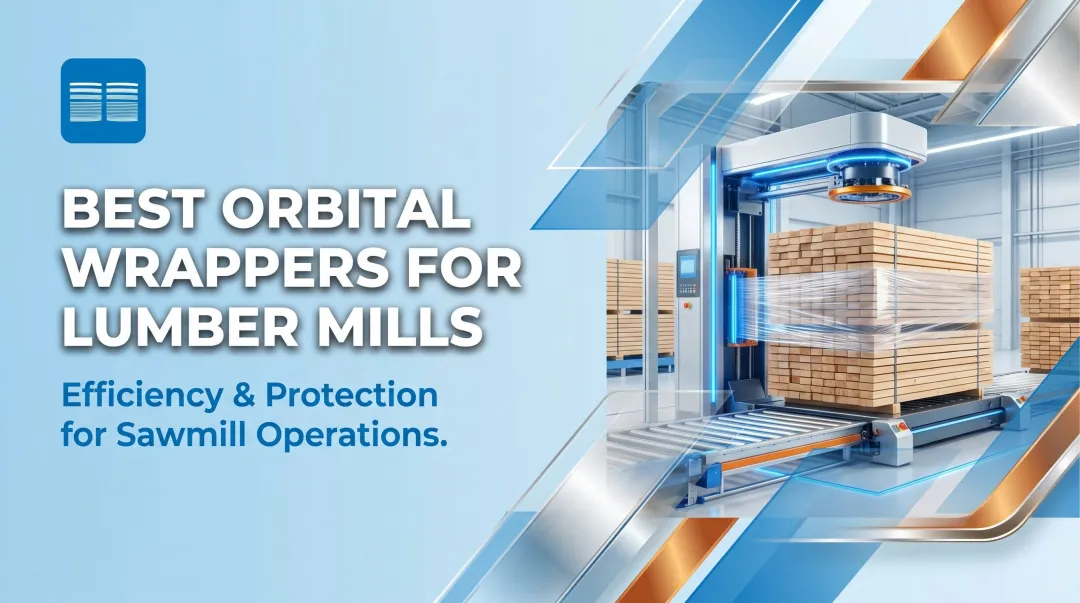
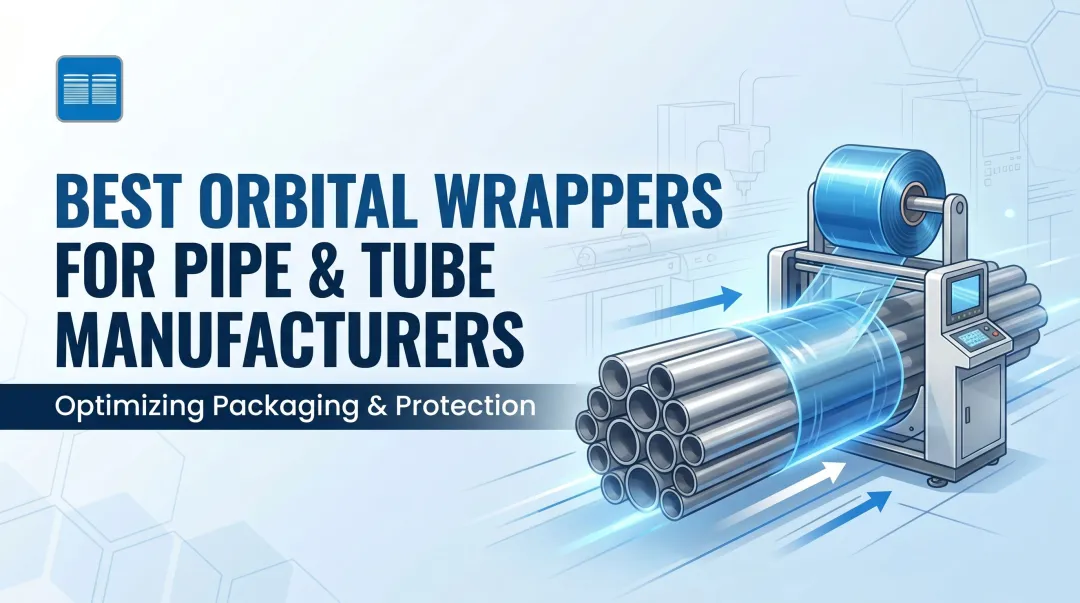
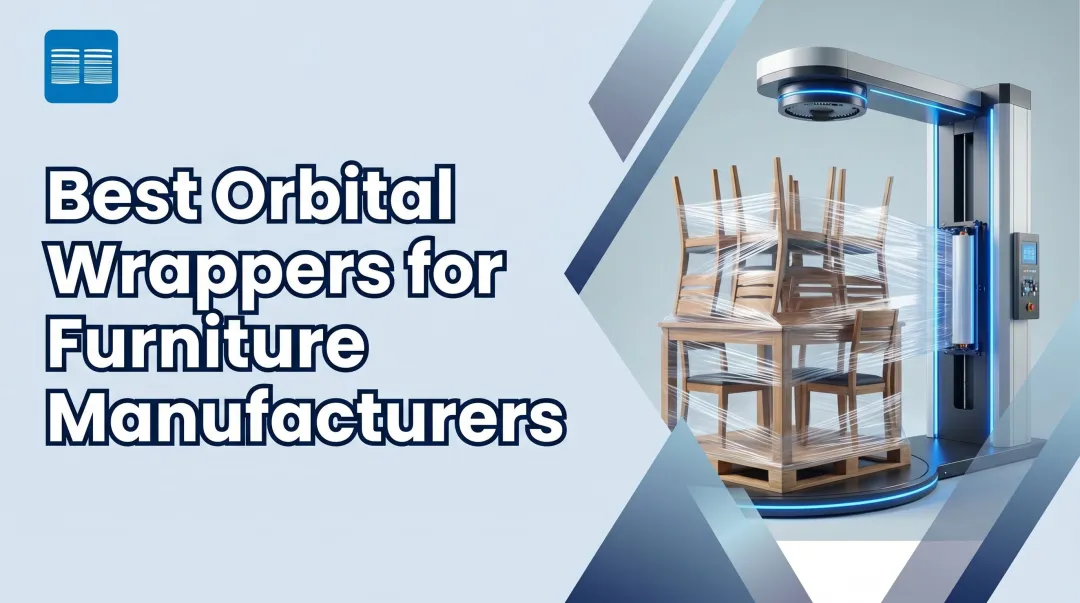
That's where orbital wrappers come in. Unlike traditional pallet wrappers that rotate the load, orbital wrappers pass film around a stationary product via a circular ring or rectangular chain mechanism. They're purpose-built for long, flat, and wide products—protecting delicate surfaces while securing doors and windows for safe storage and shipment.
Key Takeaways
- Orbital wrappers use a rotating ring to apply stretch film around the product, making them well-suited for long doors, window assemblies, and oversized profiles
- Key selection factors: product width, daily volume, automation level, and whether you're wrapping singles or stacked bundles
- Wide-format products exceeding standard ring diameters require chain-type orbital wrappers
- Top contenders: Handle-It, SOCO System, Lantech, Robopac Sistemi, and FHOPE
- A manufacturer-trained regional distributor helps match the right machine to your line and avoids costly integration mistakes
Why Door and Window Manufacturers Need Orbital Wrappers
The Real Cost of Transit Damage
Door and window products face specific vulnerabilities during handling and shipping:
- Surface scratches from product-to-product contact during stacking
- Corner impacts that crack glass, chip wood, or dent aluminum frames
- Moisture ingress leading to finish degradation, wood swelling, or seal failure
- Abrasion and pressure marks from strapping or manual wrapping methods
These aren't cosmetic issues—they're operational costs. According to industry research, packaging damage costs businesses approximately $15 billion annually. Every damaged unit requires rework, replacement, or expensive reverse logistics.
Why Orbital Wrapping Works Differently
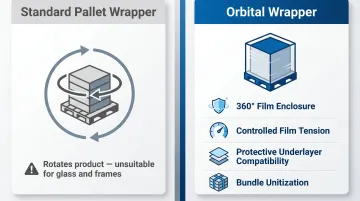
Standard pallet wrapping rotates the load—a non-starter for glass panels and finished door frames. Orbital wrappers thread film around a stationary product instead, which changes what's possible for protection:
- Complete film enclosure creates 360° protection without rotating fragile products
- Controlled film tension prevents surface pressure damage while securing the load
- Compatibility with protective underlayers like foam or bubble wrap before the stretch film pass
- Bundle unitization secures stacks of doors or windows for bulk shipment efficiency
Building products manufacturers are accelerating end-of-line automation, and orbital wrapping is a key part of that shift. Demand is rising as fabricators look to cut labor costs and reduce damage claims simultaneously.
Best Orbital Wrappers for Door and Window Manufacturers
These machines were selected based on their proven ability to handle door/window profiles, throughput capacity, automation flexibility, and market reliability in fenestration applications.
Handle-It (Milwaukee, WI)
Handle-It builds and assembles orbital wrappers in Milwaukee, Wisconsin — a practical advantage for Midwest door and window manufacturers who need short lead times and US-based technical support. With over 25 years of product development, their machine range covers semi-automatic to fully automatic configurations.
Key Differentiators:
- ISO 9001 certified with CE compliance for international quality standards
- Dual film reels with automatic clamp and cut on all models (standard, not optional)
- Fully enclosed ring design for operator safety with LED safety indicators
- Three-year warranty on semi-automatic equipment
- C-style wrapper option for pass-through wrapping of open frames and round products
Handle-It Model Range:
| Feature | Specifications |
|---|---|
| Machine Types Available | Semi-automatic (SA-50 to SA-250), Fully automatic (FA-50 to FA-250), C-style (C-Style 90) |
| Key Standard Features | Dual film reels, auto clamp and cut, enclosed ring, LED safety indicators, HMI touchscreen controls on SA-125+ |
| Ring Size Range | 50 cm (19.6") to 250 cm (98.4") opening |
| Certifications | ISO 9001, CE compliant; assembled and tested in Milwaukee, WI |
For most door and window lines, the SA-160 (63" opening) and SA-200 (78.7" opening) hit the right size range. High-volume shops or custom assembly operations should look at the FA-250, which handles oversized products up to 98.4" ring opening.
SOCO System
SOCO System's European-engineered orbital wrappers reach Midwest door and window manufacturers through John Maye Company, the regional distributor across Wisconsin, Illinois, Indiana, Michigan, Minnesota, Ohio, and Iowa. That local presence means manufacturer-trained support and fast parts fulfillment — not weeks-long waits for overseas service.
Key Differentiators:
- Modular system configurations scalable from semi-automatic to fully integrated automatic lines
- Seamless integration with upstream and downstream conveyors for complete line automation
- Ergonomic design options suited to mid-volume fenestration operations
- Regional support backed by factory-certified technicians
SOCO System Configuration Overview:
| Feature | Specifications |
|---|---|
| System Configuration | Modular; scalable from semi-automatic to fully integrated automatic lines |
| Regional Support (Midwest) | Available through John Maye Company — manufacturer-trained technicians, 2,500+ SKU parts inventory, 24-hour ship guarantee on parts |
| Best Fit Application | Mid-to-high volume door and window lines requiring customized ergonomic integration |
The modular design lets manufacturers start semi-automatic and add automation as volume grows — keeping upfront capital lower without locking out future upgrades.
Lantech
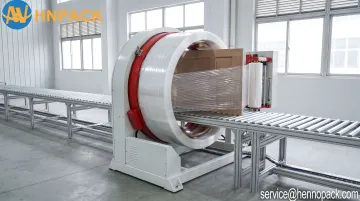
Lantech (Louisville, KY) has built stretch wrapping equipment for over 30 years, and their LanRinger horizontal orbital wrapper is the product of that experience applied directly to long, flat products — doors, window assemblies, and similar profiles.
Key Differentiators:
- Power Roller-Stretch film delivery system for consistent tension and full coverage across door/window profiles
- Patented Power-Thru Conveyor for smooth product transfer through the ring without manual intervention
- Dual Support Roll Carriage (exclusive design) for film stability
- Film Break Detection standard on all models
- Strong US service network with national coverage
- One-year unlimited cycles warranty
Real-World Application:
Lantech's case study with Pella Corporation — one of North America's largest window manufacturers — demonstrates the LanRinger's effectiveness in door and window applications. Pella replaced corrugated sleeve packaging with orbital wrapping, cutting packaging component parts from 110 down to just 14 while improving product protection.
Lantech LanRinger Overview:
| Feature | Specifications |
|---|---|
| Origin and Service Network | US-based manufacturer (Louisville, KY) with national service coverage |
| Notable Technology | Power Roller-Stretch film delivery, patented Power-Thru Conveyor, Film Break Detection |
| Automation Level | Fully automatic; conveyor-integrated with PLC and HMI controls |
| Max Load Size | 82" diagonal; up to 50 RPM ring speed |
Worth noting: the LanRinger is automatic-only. If you're not ready for full line integration, consider Handle-It or SOCO System for a semi-automatic entry point.
Robopac Sistemi
Robopac Sistemi (part of the Aetna Group) operates at significant scale — over 110,000 machine installations globally — which translates to a mature parts network and proven reliability in demanding production environments. Their Spiror BW line covers orbital wrapper configurations built for the door, window, and building materials sector.
Key Differentiators:
- Spiror BW 1800 designed for sliding doors, windows, and sectional garage doors
- Ring sizes from 1400 mm to 3500 mm accommodate products from standard windows to oversized custom assemblies
- Variable and fixed pre-stretch carriages reduce film consumption while maintaining load security
- R-Connect cloud monitoring for real-time machine performance tracking
- Global service network with North American distributor presence
Robopac Spiror BW Overview:
| Feature | Specifications |
|---|---|
| Ring Speed / Throughput | Model-specific; designed for high-volume production environments |
| Pre-Stretch Capability | Fixed and variable pre-stretch carriages; up to 100% fixed pre-stretch on Orbit 16 semi-auto model |
| Global Support | Worldwide service network through Robopac USA and authorized distributors |
The Orbit 16 semi-automatic model — with touchscreen controls, light curtain safety, and 100% fixed pre-stretch — is a strong fit for mid-volume door and window operations. The Spiror BW automatic range steps up for high-throughput lines requiring full conveyor integration.
FHOPE
Standard orbital ring wrappers have a hard size limit. FHOPE solves that problem with a chain-type orbital mechanism — a rectangular chain-drive track that replaces the circular ring and removes the diameter ceiling on what can be wrapped.
Key Differentiators:
- Chain-type orbital mechanism handles wide panels and doors that exceed standard ring diameter limits
- Enables wrapping of products up to 3500 mm wide — well beyond typical ring wrapper capacity
- Modular product line from compact semi-automatic (S-Series) to high-volume automatic (E-Series)
- CE certified and ISO 9001 compliant with Siemens PLC and HMI controls
- Two-year warranty standard
FHOPE Model Range and Throughput:
| Feature | Specifications |
|---|---|
| Key Technology Differentiator | Chain-type orbital mechanism for wide doors and panels exceeding standard ring diameter (up to 3500 mm) |
| Best Fit Application | Manufacturers of wide-format, custom, or oversized door/window assemblies |
| Automation Options | Semi-automatic (S100–S300, 10–15 units/hr) and automatic (E1000–E2400, 15–35 units/hr depending on model) |
The E1800 is the go-to model for patio doors, commercial storefront assemblies, and any custom product that simply won't fit through a standard ring wrapper.
Types of Orbital Wrappers: Which Configuration Fits Your Line
Semi-Automatic
Semi-automatic wrappers suit low-to-mid volume operations running 5–20 units/hour. The operator loads each product manually, starts the wrap cycle via foot pedal or push-button, then removes the finished unit. Floor space requirements are modest, and capital investment is relatively low — but throughput depends entirely on operator availability.
Key characteristics:
- Manual product loading and removal
- Foot pedal or push-button cycle initiation
- Lower upfront cost ($15,000–$40,000 range)
- Minimal integration complexity
Fully Automatic
Fully automatic systems are built for high-volume lines running 20–60+ units/hour. Conveyor-integrated with photo-eye or sensor triggers, they detect incoming products, wrap, and discharge without operator involvement. That means less labor per shift and faster cycle times — though they require more floor space and a higher capital commitment than semi-automatic setups.
Key characteristics:
- Full conveyor integration upstream and downstream
- Photo-eye or sensor-triggered operation
- Higher upfront cost ($60,000–$150,000+ depending on customization)
- Requires line integration planning and controls coordination
C-Style and Chain-Type
When standard ring diameters aren't wide enough — or your product is an open frame — C-style and chain-type wrappers fill the gap. C-style wrappers use an open "C" ring for pass-through wrapping of round or open products like window frames. Chain-type wrappers swap the circular ring for a rectangular chain-drive track, removing diameter restrictions entirely.
Key characteristics:
- C-style: ideal for window frames, round products
- Chain-type: handles wide doors and panels (up to 3500 mm width)
- Moderate to high cost depending on size
- Essential when product width exceeds largest available ring diameter (typically 98"–100")
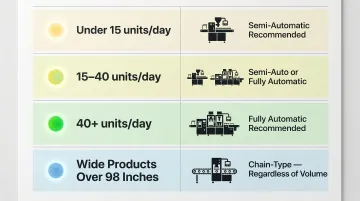
Not sure where your operation falls? This quick-reference guide covers the most common volume and product-size scenarios:
Decision Threshold Guide:
| Daily Volume | Recommended Configuration |
|---|---|
| <15 units/day | Semi-automatic |
| 15–40 units/day | Semi-automatic or fully automatic (depending on labor cost goals) |
| 40+ units/day | Fully automatic |
| Wide products >98" | Chain-type regardless of volume |
How to Choose the Right Orbital Wrapper for Your Facility
Common Evaluation Mistakes
Manufacturers often buy on ring speed specifications alone without accounting for:
- Product size variation across the production mix (wrapping a 30" window is different than wrapping an 8' patio door)
- Film type compatibility — can the machine handle foam underlayers or bubble wrap before the stretch film pass?
- Downstream conveyor integration — does the wrapper discharge smoothly to the next station, or will products jam?
Critical Selection Criteria
Before requesting quotes, work through each of these six factors:
- Product dimensions and weight: Measure your largest product in all three dimensions — the ring or chain aperture must clear both length and width. Most orbital wrappers handle up to 500–1,000 lbs, but verify the actual capacity against your heaviest units.
- Peak daily volume: Size for your busiest day, not your average. If you run 60 units on peak days but 30 on slow ones, spec the machine for 60.
- Floor footprint: Automatic systems with conveyors typically need 30–50 feet of linear space. Semi-automatic units fit within 10–15 feet.
- Film and underlayer requirements: Confirm the machine can apply stretch film over foam, bubble wrap, or cardboard if your products need added surface protection before the film pass.
- Line integration depth: Wrapping at the end of an automated assembly line carries different controls requirements than a standalone station — and different costs.
- Post-sale service access: According to ABB research, industrial downtime costs range from $10,000 to $500,000 per hour. Parts availability and technician response time directly affect your margin.
The Value of Regional Distribution
That last point — service access — is where regional distribution makes a measurable difference. Working with a distributor who holds manufacturer training and local parts inventory lowers implementation risk in ways a national catalog vendor simply can't match. For Midwest door and window manufacturers, John Maye Company's regional SOCO System leadership provides:
- Manufacturer-trained technicians who understand fenestration applications
- 2,500+ SKU parts inventory with 24-hour ship guarantee
- On-site installation support and remote troubleshooting
- Custom system design for line integration
- Rental and trial options to evaluate throughput before purchase
Conclusion
Orbital wrappers aren't a commodity purchase. The right machine must match your product dimensions, line speed, automation goals, and long-term service support — not just the lowest initial price. Door and window manufacturers who treat this as a strategic investment rather than a transaction see real returns through reduced damage rates, lower labor costs, and faster throughput.
Ready to evaluate orbital wrapper options for your fenestration line?
Contact John Maye Company for a personalized equipment assessment. Their team brings:
- 40+ years of packaging expertise
- SOCO System regional leadership across the Midwest
- Factory-certified technicians for installation and ongoing support
- 24-hour parts ship guarantee to keep your line running
Rental options are also available — a practical way to prove performance before committing to purchase.
Call 1-800-441-6293 or email info@johnmayecompany.com
Frequently Asked Questions
What is the difference between a ring orbital wrapper and a chain orbital wrapper for doors and windows?
Ring orbital wrappers pass products through a rotating circular film ring, limiting product size to the ring's inner diameter (typically up to 98"–100"). Chain-type wrappers use a rectangular chain-drive track for wide-format products that exceed ring dimensions—the go-to choice for oversized door panels, commercial storefront assemblies, or custom-width fenestration products.
Can an orbital wrapper handle both individual doors and stacked bundles?
Most orbital wrappers can wrap single units and stacked bundles, with bundle mode being particularly valuable for securing stacks of doors or windows for bulk shipment. However, bundle height and width must fall within the machine's ring or chain aperture specifications, and film tension settings may need adjustment to prevent crushing or shifting during the wrap cycle.
How do I decide between a semi-automatic and a fully automatic orbital wrapper?
Semi-automatic models work well for lower-volume or variable-mix lines—typically under 15–20 units per day—where operator involvement is acceptable. Fully automatic conveyor-integrated systems make sense above 20–40 units per day, where labor savings and throughput speed justify the investment.
What film types are compatible with orbital wrappers for door and window applications?
Standard stretch film (typically 10" wide) is the baseline for all orbital wrappers. Most machines can apply it over protective underlayers—bubble wrap, foam sheeting, or cardboard corner protection—bundling and securing the underlayer in a single pass, which is critical for finished wood or powder-coated aluminum surfaces.
How fast can an orbital wrapper process doors or windows per hour?
Semi-automatic models typically process 10–20 units per hour depending on operator efficiency and product size. Fully automatic conveyor-integrated systems range from 20–60+ units per hour, with higher-end automatic systems handling larger door and window profiles at the lower end of that range due to longer wrap cycles per unit.
What should I ask a packaging equipment distributor before buying an orbital wrapper?
Before buying, confirm the machine fits your largest product dimension and ask about parts lead time and service response windows. Verify the distributor is manufacturer-trained on that specific equipment line and whether a demo is available. For Midwest manufacturers, regional service coverage matters—equipment without local support translates directly to downtime.