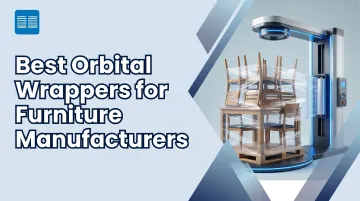
Orbital wrappers rotate stretch film around stationary furniture, delivering consistent containment force without the tipping risk of turntable systems. For manufacturers facing labor shortages and tightening margins, automated packaging cuts labor hours by 35-42% while reducing film waste by up to 50%. This guide evaluates the top orbital wrapper models built for furniture operations.
Key Takeaways
- Orbital wrappers apply stretch film horizontally around stationary products — ideal for long or oversized furniture that can't rotate on a turntable
- Top manufacturers — Robopac, Lantech, Fromm, and Highlight Industries — offer ring diameters from 20 to 120 inches across semi-auto and fully automated models
- Choose based on your largest product cross-section, daily throughput targets, and film flexibility requirements
- ROI typically arrives within 18-24 months through combined labor and material savings
Overview of Orbital Wrappers in Furniture Manufacturing
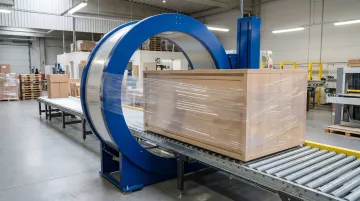
An orbital (horizontal) stretch wrapper passes a rotating film-carrying ring around a product that remains stationary or travels on a conveyor. Unlike vertical turntable wrappers—which spin the load on a platform—orbital systems wrap lengthwise, making them the standard choice for long, flat, or top-heavy furniture that cannot safely rotate.
Furniture manufacturing presents unique packaging demands:
- Sectional sofas, L-shaped desks, and tall headboards don't conform to standard pallet dimensions
- Finished wood, upholstery, and glass require gentle containment that won't abrade surfaces during transit
- Production runs shift constantly between compact nightstands and 8-foot dining tables
- Many pieces need multiple protection layers—foam wrap, kraft paper, or VCI film—before stretch film goes on
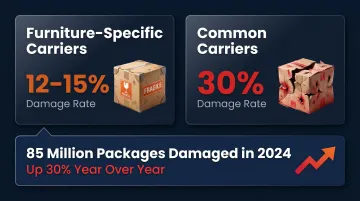
With 85 million packages arriving damaged in 2024—a 30% year-over-year increase—the wrapping system a furniture manufacturer chooses directly affects both customer returns and material costs. The machines below were selected specifically for their ability to handle furniture's size variability, surface sensitivity, and throughput demands.
Best Orbital Wrappers for Furniture Manufacturers
These machines earned recommendations based on wrapping versatility, load-size capacity, film compatibility, build quality, and proven performance in furniture or wood products manufacturing.
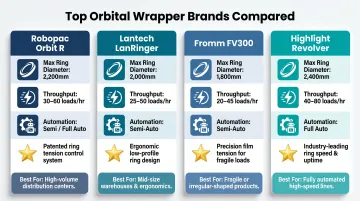
Robopac Orbit R Series
Robopac, part of Italy's Aetna Group, manufactures horizontal wrapping systems through its Robopac Machinery division. The company's orbital line specifically targets profiles, panels, doors, and furniture components common in wood products operations.
Key differentiators:
- High-speed ring rotation up to 180 RPM on smaller models
- Electronic film tension control to protect finished surfaces
- Designed for automated line integration
- S.K.I.D. clamping system produces short film tails, reducing waste and improving package appearance
Key Features
| Feature | Orbit R5 | Orbit R9 | Orbit R13 |
|---|---|---|---|
| Ring Diameter | 520 mm (20.5") | 900 mm (35.4") | 1,340 mm (52.8") |
| Max Ring Speed (125mm reel) | 180 RPM | 120 RPM | — |
| Max Ring Speed (250mm reel) | 150 RPM | 100 RPM | 80 RPM |
| Pre-Stretch Capability | 150% mechanical | 150% mechanical | 150% mechanical |
Technical Specs
| Specification | All Models |
|---|---|
| Power Supply | 400V, 3-phase + neutral, 50 Hz |
| Installed Power | 1.6 kW (R5) to 3.2 kW (R13) |
| Working Air Pressure | 6 bar |
| Control System | Color touchscreen HMI with troubleshooting manual |
| Safety Features | Electro-welded mesh guards, dual rod clamping |
This model suits mid-to-high volume furniture lines running 300+ loads/day on consistent product profiles. The programmable HMI stores up to 20 wrapping recipes, making it a strong match for manufacturers with limited SKU variation who need predictable cycle times.
Lantech LanRinger
Louisville-based Lantech has supported stretch wrapping operations for over 50 years, with a focus on reducing global transit damage. The LanRinger brings the company's patented film delivery technology to horizontal applications common in furniture and building materials.
Key differentiators:
- Power Roller-Stretch film delivery system
- Robust North American parts network for fast service response
- LINC IoT connectivity for real-time performance monitoring
- Built Tough warranty covering unlimited cycles for one year (uncommon in packaging equipment)
Key Features
| Feature | Specification |
|---|---|
| Ring Rotation Speed | Up to 50 RPM |
| Max Load Cross-Section | 2,083 mm (82") diagonal |
| Film Delivery | Power Roller-Stretch System |
| Control Interface | PLC with HMI |
| IoT Integration | LINC (Lantech Intelligent Network Connection) |
Technical Specs
| Specification | Details |
|---|---|
| Enclosure Rating | NEMA 12, UL certified |
| Pneumatic Requirements | 6 bar (80 PSI) |
| Bearing Construction | 5" thick forged steel precision bearing |
| Safety Features | Film break detection (standard) |
| Optional Accessories | Power-Thru conveyor, product stabilizers, accumulation conveyor |
This model fits furniture manufacturers who prioritize domestic service response and parts availability. The 82" diagonal capacity handles oversized sectionals and panel products, and the Power-Thru conveyor option adds support for short or unstable loads.
Fromm Packaging FV300 Series
Swiss family business Fromm Packaging has manufactured strapping and wrapping systems since 1947. The FV300 semi-automatic orbital line offers the widest ring size range among evaluated manufacturers: six diameter options spanning small trim pieces to full furniture panels.
Key differentiators:
- Compact footprint configurations for space-constrained plants
- Dual film reel system for 2x faster throughput
- Stepless ring speed control from 5 to 350 RPM
- Mechanical core brake enables quick film tension adjustments for mixed material runs
Key Features
| Model | FV300/50 | FV300/90 | FV300/125 | FV300/160 | FV300/200 | FV300/250 |
|---|---|---|---|---|---|---|
| Inner Ring Diameter | 50 cm | 90 cm | 125 cm | 160 cm | 200 cm | 250 cm |
| Max Ring Speed | 350 RPM | 140 RPM | 70 RPM | 60 RPM | 50 RPM | 50 RPM |
| Film Reel Widths | 100 mm | 100, 170 mm | 100, 170, 250 mm | 100, 170, 250 mm | 100, 170, 250 mm | 100, 170, 250 mm |
Technical Specs
| Specification | Range Across Models |
|---|---|
| Power Supply | 230V (all models) |
| Power Consumption | 0.26 kW (FV300/50) to 0.55 kW (FV300/250) |
| Control System | Omron or Fuji/Omron inverter and PLC |
| Film Quality | 23 micron standard (30 micron max) |
| Operation Mode | Foot pedal or manual trigger |
This model suits smaller furniture manufacturers or operations with diverse product catalogs that require frequent changeovers. Six ring size options let you spec the exact diameter for your largest SKU rather than over-purchasing capacity.
Highlight Industries Revolver Series
Michigan-based Highlight Industries manufactures end-of-line packaging systems with a specialty in roll wrapping. The company claims more orbital wrapper installations than any other U.S. manufacturer, with nine standard ring sizes plus custom configurations.
Key differentiators:
- Widest standard ring size range available: 24" to 120"
- American-manufactured construction with accessible domestic service
- Competitive entry-level pricing on semi-automatic models
- Hydro-Stretch force-to-load system delivers infinitely adjustable film tension
Key Features
| Feature | Specification |
|---|---|
| Standard Ring Sizes | 24", 36", 48", 60", 70", 80", 90", 100", 120" |
| Custom Sizes | Available on request |
| Film Widths | 6", 10", 20" (custom available) |
| Film Delivery Options | Hydro-Stretch (force-to-load) or Fixed Gear Power Pre-Stretch |
| Conveyor Configurations | Belt, V-Roller, Roller, Concave Belt, Chain, or no conveyor |
Technical Specs
| Feature | Details |
|---|---|
| Automation Levels | Manual, Semi-Automatic, Fully Automatic |
| Revolver Auto Band-It | Applies discrete heat-sealed bands; selectable wraps per band |
| Side Guides | Centers and compresses skewed or off-center products |
| Platens | Hold down products during wrapping cycle |
| Support Bridge | Fills conveyor gap when product centers in ring |
This model works well for furniture manufacturers seeking domestically supported equipment at mid-volume (100–250 loads/day). Nine standard sizes plus custom options cover manufacturers with unusually large or irregularly dimensioned products that fall outside competitor specs.
Key Features to Look for in a Furniture Orbital Wrapper
Ring Diameter and Load Cross-Section Capacity
Ring diameter is the most critical specification—the film-carrying ring must clear your largest product with room to spare. Measure your widest and tallest furniture piece at its largest cross-section (height × width for horizontal orientation), then add 15-20% clearance for product shift and film carriage movement.
A sofa measuring 40" tall × 90" wide, for example, needs a ring bore of at least 100-110" to wrap safely. Undersizing creates operational bottlenecks—operators either hand-wrap oversized items or stop production to reposition loads.
Wrapping Material Compatibility
Stretch film provides containment force, but furniture often demands surface protection:
- Standard LLDPE stretch film for pallet stabilization and moisture barrier
- Foam wrap for cushioned surface protection on finished wood, glass, and upholstery
- Kraft paper as a breathing layer that prevents moisture trapping on wood furniture
- VCI film (vapor corrosion inhibitor) for metal furniture components or hardware
Machines with multi-material film heads allow switching between protection types without reconfiguring the carriage. Some models (like Fromm's FV300) offer dual reel dispensers that apply stretch and protective layers simultaneously, cutting cycle time nearly in half.
Automation Level and Throughput Thresholds
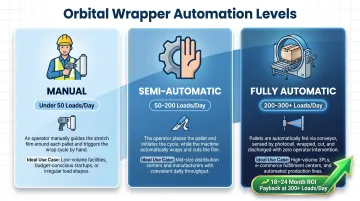
Orbital wrappers span three automation tiers:
| Tier | How It Works | Best For |
|---|---|---|
| Manual | Operator loads, threads film, starts cycle, and cuts | Under 50 loads/day |
| Semi-Automatic | Auto film clamping, cutting, and ring rotation; operator loads/unloads | 50–200 loads/day |
| Fully Automatic | Conveyor-fed loading, photocell triggering, auto discharge | 200–300+ loads/day |
Operations wrapping 300+ loads daily recover the cost premium of full automation within an 18-24 month payback window. At lower volumes, semi-automatic systems deliver better ROI.
Machine Footprint and Line Integration
Furniture plants often operate in legacy buildings with constrained floor space. Before specifying equipment:
- Budget 20-40 feet of total line length for infeed conveyor, machine, and outfeed conveyor
- Allow 3-4 feet of clearance on the operator side for film changes and carriage service
- Verify ceiling height — some ring drives require 9-10 feet of overhead clearance
- Confirm PLC compatibility, conveyor speed matching, and photocell positioning before finalizing automated system specs
Fromm's FV300 series and Highlight's Revolver both offer compact configurations for space-constrained facilities, while Robopac and Lantech provide full line-integration engineering support.
How We Chose the Best Orbital Wrappers
Each machine on this list was evaluated against four criteria specific to furniture manufacturing:
Furniture-Specific Suitability:
- Ring diameter range covering small accent pieces to full sectionals
- Film tension control gentle enough for finished surfaces
- Ability to handle mixed SKU profiles without extensive setup changes
These suitability factors eliminate machines that work fine in lumber yards but damage upholstered edges or stall on irregular profiles.
Manufacturer Support:
- North American parts availability and service response times
- Published technical documentation and operator training resources
- Warranty coverage and preventative maintenance programs
Support quality matters as much as the machine itself — a distributor with same-week parts availability beats an overseas supplier with a better spec sheet.
Automation Range:
- Availability of both semi-automatic and fully automatic configurations
- Upgrade paths from manual to automated operation
- Integration capability with upstream and downstream equipment
Manufacturers grow. Machines that can't scale to higher throughput or connect with conveyor systems become bottlenecks within a few years.
Industry Track Record:
- Verified installations in furniture, cabinetry, or wood products manufacturing
- Case studies or testimonials from similar production environments
- Compatibility with industry-standard film types and protective materials
These criteria also reflect the most common mistakes buyers make when purchasing orbital wrappers. Knowing what to evaluate helps you avoid them.
Common Buyer Mistakes to Avoid
Measure before you budget. A $20,000 machine with a 90 cm ring won't wrap your 48" wide cabinets. Ring diameter is non-negotiable — confirm your widest SKU before shortlisting models.
Factor in film costs, not just the sticker price. Film consumption accounts for 60-70% of total wrapping costs over a machine's lifespan. Power pre-stretch (200-250%) cuts material usage by up to 50%.
Don't undervalue local support. A 2-day parts lead time versus 2-week international shipping determines whether downtime costs you $500 or $15,000 in lost production.
Always run a product trial. Sofa frames behave very differently than flat-pack panels. Demo the machine with your actual SKUs before committing.
Conclusion
Choosing the right orbital wrapper comes down to four factors:
- Production volume: Semi-automatic systems suit operations wrapping 50–200 loads daily
- Product size diversity: Mixed SKUs (chairs, sofas, case goods) require adjustable ring diameter and film tension settings
- Surface protection requirements: Delicate finishes demand pre-stretch film control; raw wood can tolerate standard wrapping
- Automation level: Fully automatic configurations become essential beyond 300 loads/day
Before purchasing, pilot equipment against your actual furniture SKUs. A machine that wraps dining chairs perfectly may struggle with sectional sofas. Factor long-term costs—including film usage, maintenance contracts, and parts availability—into your evaluation rather than focusing solely on purchase price.
That evaluation process is where having the right distributor matters. John Maye Company has worked with Midwest manufacturers since 1983, offering equipment sourcing, factory-certified service, and a parts inventory of 2,500+ SKUs. Contact their team to find the orbital wrapper configuration that fits your operation.
Frequently Asked Questions
How much does an orbital wrapper for furniture cost?
Semi-automatic orbital wrappers typically range from $15,000–$30,000, while fully automatic systems with conveyor integration run $75,000–$200,000+. Ring diameter, automation level, film pre-stretch capability, and control system sophistication drive price differences. Larger ring bores (120"+ for oversized furniture) and integrated conveyors push costs toward the higher end.
What is the lifespan of an orbital wrapper for furniture?
Well-maintained packaging equipment operates 10–20 years or 20,000–40,000 operational hours. Key wear components include film carriage rollers, drive chains, bearings, and photocells. Manufacturer support and parts availability extend operational life considerably. Domestic suppliers typically deliver replacement parts within 1–3 days versus 2–3 weeks for international brands.
Is an orbital wrapper for furniture worth the investment?
ROI typically arrives within 18–24 months through labor savings alone. Automated systems reduce wrapping time from 5–10 minutes per load to 1–2 minutes—a 70–80% reduction. Film savings of 30–50% from power pre-stretch and reduced damage claims (furniture carriers average 12–15% damage rates) accelerate payback further.
What is the difference between an orbital wrapper and a turntable stretch wrapper for furniture?
Turntable wrappers rotate the product on a platform while film remains stationary—suitable for compact, balanced loads like uniform boxes. Orbital wrappers pass a rotating film ring around stationary products, making them the right choice for long, flat, or irregularly shaped furniture that can't safely spin. A 96" sofa would tip or shift on a turntable but wraps securely on an orbital system.
What wrapping film is best for protecting furniture in an orbital wrapper?
Stretch film (LLDPE) provides containment and moisture protection; foam wrap or paper interleaf prevents surface scratches on finished wood and upholstery. VCI (vapor corrosion inhibitor) film protects metal hardware during storage. Machines with multi-material film heads support layering both film types for complete protection.
Can an orbital wrapper handle oversized or irregularly shaped furniture?
Yes. Ring diameter determines capacity, with most manufacturers offering sizes from 50 cm (19.7") to 250 cm (98.4") and custom options beyond that. Models like Lantech's LanRinger (82" diagonal capacity) and Highlight's Revolver (120" standard ring) accommodate sectionals, armoires, and oversized panel products with room to spare.