Orbital wrappers have become essential in lumber mill end-of-line operations for automating load unitization, reducing film waste, and protecting wood products from moisture ingress and handling damage during transport and outdoor yard storage. The global stretch wrap machines market is projected to grow from $927.3 million in 2026 to $1,331.1 billion by 2033, driven partly by construction and building materials applications—reflecting expanding vendor options and technology maturity for mills evaluating capital investment.
With U.S. softwood lumber production capacity standing at approximately 47 billion board feet as of year-end 2023, automated bundling and wrapping isn't optional—it's operationally critical to maintain throughput and reduce labor dependency.
Key Takeaways
- Orbital wrappers rotate a film ring around the load—purpose-built for long, heavy lumber bundles that turntable wrappers can't handle
- Key selection criteria: wrapping speed, cross-section capacity, UV/moisture-resistant film compatibility, and conveyor integration
- Top brands for lumber mills include Robopac Sistemi, Lantech, and Tentoma, each suited to different mill scales and automation needs
- Choosing the right wrapper reduces product damage, cuts packaging cost per unit, and improves overall mill throughput
- John Maye Company supports orbital wrapping equipment across the Midwest with factory-certified technicians and 24-hour parts shipping
Overview of Orbital Wrappers in the Lumber Industry
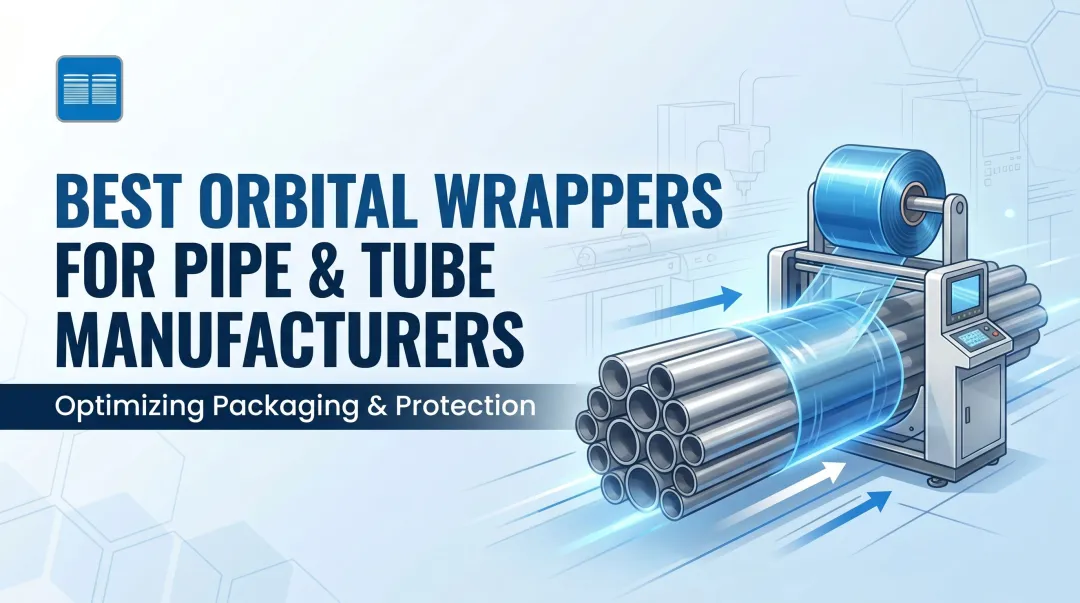
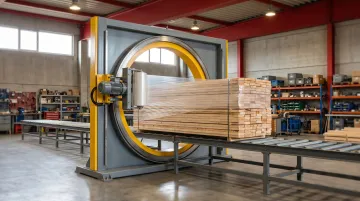
An orbital (horizontal) stretch wrapper passes the product through a rotating ring that applies stretch film in a spiral pattern as it moves horizontally on a conveyor—rather than rotating the load on a turntable. This design is critical for lumber bundles: long, irregular, heavy products that can't be handled by conventional vertical pallet wrappers.
At current production volumes—Oregon alone produced 5.1 billion board feet in 2024, representing roughly 14% of total U.S. output—automated end-of-line packaging is a baseline requirement at most modern mills. Manual wrapping simply can't keep pace with high-throughput sawmill lines.
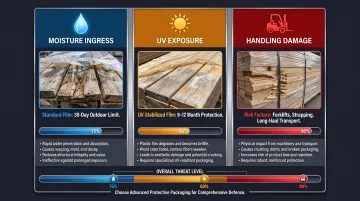
Orbital wrappers protect dimensional lumber from three primary threats during storage and transit:
- Moisture ingress during outdoor storage, which warps and degrades untreated surfaces
- UV exposure that breaks down wood fibers and film integrity over time
- Handling damage from forklifts, strapping, and long-haul transport
Standard stretch film begins degrading within 30 days of outdoor exposure; UV-stabilized film extends protection to 9–12 months. That gap makes film selection as important as the wrapper itself.
The sections below break down the top orbital wrapper options for lumber mill environments, with each model assessed on throughput speed, bundle capacity, durability under mill conditions, and conveyor integration.
Best Orbital Wrappers for Lumber Mills
These orbital wrappers are selected based on proven performance in high-throughput lumber environments, load handling versatility, and overall reliability on the mill floor.
Robopac Sistemi Horizontal Orbital Wrappers
Robopac Sistemi, part of the Aetna Group established in 1985, is one of the largest manufacturers of horizontal stretch wrapping systems, with over 200,000 machines installed worldwide. The company reports €490M+ in sales revenues, 2,000+ employees, and 11 production plants. Robopac's orbital wrapper portfolio explicitly targets timber, panels, doors, and building materials applications across the broadest model range in its category.
The portfolio spans three distinct product lines covering ring diameters from 520 mm to 3,500 mm. For lumber operations specifically, the Spiror BW line handles the heavy lifting: the BW 2600 targets large wooden panels, the BW 3500 ("The GIANT") handles oversized loads, and the BR-X is a custom rectangular design for non-standard cross-sections.
Robopac Sistemi Orbital Wrapper Specifications
| Specification | Details |
|---|---|
| Wrapping Speed / Throughput | 80-260 RPM depending on model; Spiror HP 300 reaches 260 RPM, BW series 80-130 RPM |
| Load Capacity | Ring diameters: 520 mm (Orbit R5) to 3,500 mm (Spiror BW 3500); maximum product diagonal varies by model |
| Key Features | Fixed 150% mechanical pre-stretch (Orbit R); variable pre-stretch (Spiror HP); 4- or 6-sided wrapping (Spiror BW); color touchscreen with 8 stored programs; film width 125-250 mm; designed for in-line conveyor integration with pneumatic pressure units |
Robopac machines accommodate stretch film, polyethylene reels, paper reels, and adhesive tape (LDPE, LLDPE, PVC), making them adaptable to UV-resistant and moisture-barrier film requirements. The range runs from semi-automatic Orbit R machines to fully automatic Spiror HP and BW systems, making Robopac a practical fit when a single production line handles varying bundle dimensions.
Lantech Orbital Stretch Wrappers
Lantech, founded in 1972 by brothers Pat and Bill Lancaster in Louisville, Kentucky, is a U.S.-based stretch wrapping pioneer with over 50 years in business. The company's LanRinger product line offers four models covering load diagonals from 32" to 82", designed for heavy and long-load applications.
Three patented technologies drive the LanRinger's performance. The Power-Thru Conveyor System wraps the product and conveyor together, stabilizing short or unstable loads. The Metered Film Delivery System cuts film consumption by up to 25%. And LINC (Lantech Intelligent Network Connection) provides IoT-based real-time monitoring for mills tracking uptime data.
Lantech LanRinger Orbital Wrapper Specifications
| Specification | Details |
|---|---|
| Wrapping Speed / Throughput | 25-50 RPM depending on model; speed varies by application |
| Load Capacity | LR-4000: 32" diagonal; LR-6000: 52" diagonal; LR-7500: 67" diagonal; LR-9000: 82" diagonal; minimum load length 24" with Power-Thru |
| Key Features | 150% standard pre-stretch (100-250% available); Power Roller-Stretch System; Allen Bradley touchscreen Panel View 600 Plus; 5" thick 1,800 lb. forged steel main bearing; 24/7 service support; film width 20"-30"; effective for millions of wrap cycles |
For Midwest lumber mill buyers, Lantech's Louisville headquarters provides regional service advantages with 24-hour support. The LR-7500 and LR-9000 models, with their larger load diagonal capacities, are most relevant for dimensional lumber bundles. Lantech's emphasis on machine durability ("millions of wrap cycles") combined with the 25% film savings makes the LanRinger worth evaluating for mills where unplanned downtime and consumables costs are the primary budget concerns.
Tentoma RoRo StretchPack Orbital Wrappers
Tentoma, a Danish manufacturer, offers a distinctly different approach with its RoRo StretchPack technology — classified as a horizontal stretch hood packaging machine rather than a traditional orbital wrapper. Instead of spiral-wrapping open-end stretch film, RoRo StretchPack draws tubular stretch film over the product horizontally and seals both ends, producing 6-sided fully sealed, waterproof packaging.
This sealed-end method is Tentoma's core advantage: complete moisture and contamination protection for outdoor lumber storage. The company claims 20-60% film consumption savings versus conventional orbital wrapping, backed by customer case studies. Tentoma's film supports up to 50% recycled polyethylene content and is 100% recyclable, aligning with UN Sustainable Development Goal 12.
Tentoma RoRo StretchPack Specifications
| Specification | Details |
|---|---|
| Wrapping Speed / Throughput | Described as "high throughput" with fully automated operation; specific bundles-per-hour figures not published |
| Load Capacity | Product length: 200-8,000 mm; width: 300-2,200 mm; height: 10-1,400 mm; maximum circumference: 5,500 mm |
| Key Features | 6-sided sealed waterproof enclosure; tubular LD-PE film (30-150 my thickness, 80%+ elasticity); UV-blocking and UV-protection film options; perforated film for moist timber evaporation; supports up to 50% recycled content; cold packaging process (no heat); in-line and standalone configurations |
Tentoma's wood industry installations include Kronospan's Ryomgaard, Denmark facility for wood-based floorboards, with additional case studies covering CLT, glulam, OSB, sawn timber, and doors. Mills with extensive outdoor yard storage — where moisture ingress during transport or seasonal exposure is a recurring problem — will find the sealed-film approach addresses something traditional spiral wrapping simply cannot. It's worth noting this is a different technology category, so direct spec comparisons with the Robopac or Lantech machines above should be made with that distinction in mind.
How We Chose the Best Orbital Wrappers for Lumber Mills
We based selections on lumber-specific performance criteria—not general industrial packaging capability. A common mistake: choosing equipment based on price or brand recognition alone without verifying load dimension compatibility or matching wrapping speed to actual mill throughput requirements.
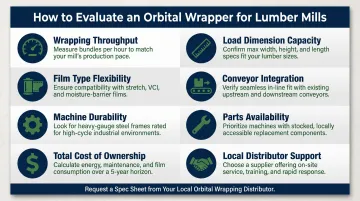
Key evaluation factors tied to business outcomes:
- Wrapping throughput (bundles per shift) matched to mill production capacity
- Load cross-section and length capacity verified against actual lumber bundle dimensions
- Film type flexibility for UV/moisture protection in outdoor storage applications
- Conveyor and line integration ease to avoid production bottlenecks
- Machine uptime and durability in dusty, high-vibration mill environments
- Parts availability to minimize downtime during repairs
- Total cost of ownership: machine price, film consumption, maintenance, and downtime cost combined
- Local distributor support, including certified service technicians, fast parts supply chains, and rental options for peak periods
That last point matters more than most buyers expect. Mills running 24/5 or 24/7 schedules can't absorb multi-day waits when packaging equipment goes down — and no spec sheet will tell you how fast a distributor actually responds.
Conclusion
Choosing the right orbital wrapper for a lumber mill is an operational commitment as much as a capital decision. Throughput capacity, load protection quality, and uptime reliability all determine how efficiently the mill moves product from the line to the customer.
Before finalizing any equipment decision, evaluate total cost of ownership and scalability. Key factors to weigh:
- Machine price + film consumption — the two largest recurring cost drivers
- Maintenance requirements — frequency, parts availability, and technician access
- Downtime cost — what an unplanned outage actually costs per hour
- Volume scalability — whether the machine can keep pace as output grows
A wrapper that bottlenecks the line or fails frequently undermines the entire case for automation.
For Midwest lumber mills, John Maye Company brings 40+ years of packaging equipment experience, factory-certified technicians, and a 24-hour parts ship guarantee. Contact them at info@johnmayecompany.com or call 1-800-441-6293 to discuss the right solution for your operation.
Frequently Asked Questions
What is an orbital wrapper and how does it differ from a standard pallet wrapper?
An orbital (horizontal) wrapper passes the film ring around the length of a horizontal load rather than rotating the load on a turntable. This makes it the correct solution for long products like lumber bundles that cannot be handled by conventional vertical turntable pallet wrappers.
What wrapping speed should a lumber mill look for in an orbital wrapper?
Modern orbital wrappers range from 25 RPM (large ring diameter, heavy loads) to 260 RPM (smaller rings, lighter products). The Wulftec WRWA-200 horizontal lumber wrapper is rated at up to 120 loads per hour. Match wrapping cycles per minute to your actual shift production volume—a machine rated well below your output target will stall your entire packaging line.
Can orbital wrappers handle varying lumber dimensions on the same line?
Most modern orbital wrappers with adjustable ring openings and automatic height/width sensing can handle different bundle cross-sections and lengths. For multi-SKU operations, confirm the following before purchasing:
- Minimum and maximum product dimensions
- Ring adjustment type (manual vs. automatic)
- Whether stored programs support quick changeovers
What type of stretch film works best for wrapping lumber intended for outdoor storage?
UV-stabilized and moisture-barrier stretch film are designed for exterior lumber exposure. Standard film degrades within 30 days outdoors; UV-stabilized film protects for 9-12 months. Before specifying film type, confirm compatibility with your machine's pre-stretch ratio, film width (typically 20"–30"), and core size.
How much does an orbital wrapper for a lumber mill typically cost?
Pricing varies significantly by automation level (semi-automatic vs. fully automatic inline systems), ring size, and conveyor integration requirements. Semi-automatic models may start around $20,000-$40,000; fully automatic systems with custom configurations can exceed $150,000. Request direct quotes from distributors based on your specific throughput and dimension requirements.
Is orbital stretch wrapping better than strapping for bundling lumber?
They serve different functions: strapping provides rigid unitization and withstands rougher handling; orbital wrapping provides moisture, weather, and dust protection with full surface coverage. Many lumber mills use both in combination—strapping for bundle integrity followed by orbital wrapping for environmental protection during transit and outdoor storage.