Introduction
Pipe and tube manufacturers face a persistent challenge at the end of every production line: packaging long, heavy profiles without surface damage, bundle shifting, or transit loss. A 20-foot steel pipe bundle weighing 800 pounds requires consistent, secure wrapping across its entire length—something manual wrapping teams struggle to deliver without repetitive bending, lifting injuries, and film waste. According to the U.S. Bureau of Labor Statistics, manufacturing consistently ranks among the highest-injury industries, with musculoskeletal disorders accounting for a significant share of lost-workday cases. Many of these injuries stem directly from manual wrapping motions: twisting, overhead reaching, and prolonged gripping of film rolls.
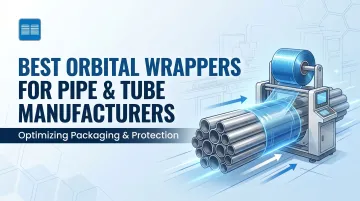
Orbital wrappers solve this by rotating stretch film 360° around the product's full length on a horizontal axis, replacing manual labor with in-line automation. Unlike vertical turntable wrappers built for pallets, orbital machines feed pipe, tube, rod, and bundled profiles through a stationary or rotating ring, wrapping them end-to-end with stretch film, VCI film, or other protective materials.
Choosing the right machine means evaluating several key factors:
- Throughput requirements — cycles per shift and line speed compatibility
- Maximum bundle diameter — ring bore size relative to your largest profile
- Automation level — semi-auto vs. fully integrated conveyor systems
- Total cost of ownership — film consumption, maintenance, and downtime costs
This guide covers the top orbital wrapper options for Midwest pipe and tube manufacturers.
Key Takeaways
- Orbital wrappers use a rotating film ring on a horizontal axis to wrap pipe, tube, and bundled profiles end-to-end with stretch film or other materials
- Top brands include TAB Industries (Reading, PA), FHOPE (China), and Robopac Orbit R series (Italy)—each offering distinct strengths in speed, size range, and automation
- Key selection criteria: wrapping ring diameter, line speed, automation level, wrapping material compatibility, and conveyor integration
- Automated wrapping cuts film consumption by 30–50% versus manual methods
- Most installations deliver ROI within 12–18 months
- Midwest manufacturers should prioritize post-sale service support, spare parts availability, and local distributor expertise when selecting equipment
What Are Orbital Wrappers and Why Do Pipe & Tube Manufacturers Need Them?
Orbital (horizontal) stretch wrappers are machines where a rotating ring carrying the film spool orbits around a stationary or conveyor-fed product on a horizontal axis. Unlike vertical turntable wrappers used for pallets, orbital wrappers are built for long products like pipe, tube, rod, and aluminum extrusions. The horizontal orientation allows products of virtually unlimited length to pass through the ring while film rotates around the full circumference.
That design difference matters on the production floor. Manual wrapping of bundled pipe creates several operational problems:
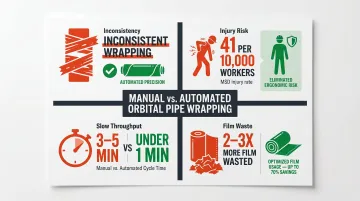
- Labour-intensive and inconsistent: Workers must walk around bundles multiple times, creating uneven film tension and coverage gaps
- Injury-prone: The musculoskeletal disorder (MSD) incidence rate in manufacturing is 41 per 10,000 workers according to NIOSH, driven by repetitive bending, twisting, and overhead reaching—exactly the motions required for manual wrapping
- Slow throughput: Manual wrapping can take 3-5 minutes per bundle versus under one minute for automated systems
- Film waste: Manual wrapping uses 2-3 times more film than automated systems due to inconsistent tension and overlap
The machines covered below were selected based on technical capability, industry adoption, wrapping quality, and support infrastructure — the factors that actually determine whether a wrapper performs in a pipe or tube production environment.
Best Orbital Wrappers for Pipe & Tube Manufacturers
These machines were evaluated on ring diameter range, wrapping speed, automation level, material compatibility (stretch film, VCI film, paper, woven), line integration capability, and manufacturer support reputation.
TAB Industries – TAB Wrapper Tornado
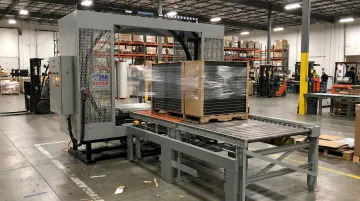
TAB Industries (Reading, Pennsylvania) developed the Wrapper Tornado for manufacturers needing to wrap long, palletized, or bundled loads — including pipe, rod, bar, and channel. The machine wraps stretch film 360° around and under the full load — pallet included — in under one minute.
The ring stays stationary while film rotates around the horizontal axis, letting products of any length feed continuously through via chain, belt, or roller conveyor. One forklift driver handles the entire packaging process without leaving the seat. Real-world case studies show it can double throughput versus manual wrapping while eliminating packaging-related injuries.
The machine ships fully assembled and ready to plug in, with a tiered warranty: frame (5 years), electrical components (2 years), all other parts (1 year).
| Specification | Details |
|---|---|
| Ring/Load Size Options | 80", 100", and 115" standard models; custom sizes available |
| Wrapping Speed | Full load wrapped in under one minute; conveyor-fed for continuous operation |
| Key Features | Stationary ring design, pallet-inclusive wrapping, semi-auto and fully automated configurations, forklift-operable |
FHOPE – E-Series Horizontal Orbital Wrappers
FHOPE (Shanghai/Kunshan, China) manufactures one of the broadest horizontal orbital wrapper ranges available. The series runs from the S200 (bundle OD 500–800mm) up to the P3000 (steel tube and aluminum profile up to 3,000mm OD), covering pipe bundles, rod bundles, aluminum sections, and steel profiles fed via in-feed conveyor.
Key capabilities across the E-Series:
- PLC/HMI controls with photocell sensors for automatic pack positioning
- Double-ring, double-drive wheel system for load stability during wrapping
- Conveyor speeds of 3–12 meters per minute
- Ring diameters from 500mm to 3,500mm — match the machine to your exact product OD
- Load capacity up to 50 tonnes for heavy steel bundle applications
| Specification | Details |
|---|---|
| Ring Diameter Range | 500mm (S200) to 3,500mm (custom configurations) |
| Wrapping Speed | 3-12 m/min conveyor speed; 10-35 items/hour depending on model |
| Key Features | PLC/HMI controls, photocell auto-positioning, double-ring stability system, conveyor in-feed/out-feed compatible |
Robopac – Orbit R Series Orbital Wrappers
Robopac (part of the Aetna Group, Verucchio, Italy) builds horizontal orbital wrappers under the Orbit R brand, serving metalworking and extrusion facilities across Europe and North America for pipe, tube, bar, and profile packaging. Robopac USA handles North American distribution and service.
The Orbit R line delivers high wrapping speeds — up to 180 RPM on the R5 — with precision tension control that protects coated or polished tube surfaces. Modular construction allows direct integration with upstream cutting and bundling lines.
All models include 150% mechanical pre-stretch, touchscreen control panels with integrated manuals, automatic film cutting and clamping, and R-Connect cloud-based remote monitoring for Industry 4.0 environments.
| Specification | Details |
|---|---|
| Ring Diameter Range | 520mm (R5), 900mm (R9), 1,340mm (R13); larger Orbit 16 model for oversized items |
| Wrapping Speed | Up to 180 RPM (R5), 120 RPM (R9), 80 RPM (R13) |
| Key Features | 150% mechanical pre-stretch, automatic film cut/clamp, pneumatic pressers, R-Connect remote monitoring, dual reel capability |
How We Chose the Best Orbital Wrappers
The biggest mistake buyers make is selecting an orbital wrapper on purchase price alone. Ring diameter range, line speed compatibility, and changeover flexibility all determine whether a machine actually fits your operation.
Key evaluation factors:
Ring diameter range: Must exceed maximum bundle OD with clearance for conveyor or support structure. For example, a 60" bundle requires at least an 80" ring to account for pallet width and film carriage clearance.
Wrapping speed: Machine throughput (measured in m/min or cycles/min) must match or exceed upstream line output to avoid bottlenecks. A sawing line producing 12 bundles/hour requires a wrapper with sub-5-minute cycle times.
Material flexibility: Steel tube manufacturers often require VCI (Volatile Corrosion Inhibitor) film, which releases vapor that coats metal surfaces and prevents rust without residue. Not all machines handle VCI film's thickness and stiffness — confirm compatibility before purchase.
Automation level: Semi-automatic machines require manual bundle placement and a push-button start. Fully automatic models integrate with conveyors, use photocell sensors for positioning, and handle film cutting and sealing without operator involvement — essential for high-volume lines.
Service infrastructure: For Midwest manufacturers, local service support and parts availability often matter as much as machine specs. A wrapper sitting idle while waiting on overseas support erases any efficiency gain.
John Maye Company (Waukesha, Wisconsin) covers this gap with factory-trained technicians, a 2,500+ SKU parts inventory with 24-hour shipping, and same-day service response across Wisconsin, Ohio, Illinois, Indiana, Michigan, Minnesota, and Iowa.
Measurable business outcomes tied to each factor:
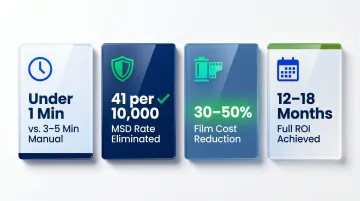
- Throughput: Automated wrapping cuts cycle time from 3–5 minutes (manual) to under one minute
- Injury reduction: Eliminates the repetitive bending and twisting behind manufacturing's 41 per 10,000 MSD rate
- Automated tension control reduces film consumption by 30–50% versus manual wrapping
- Most operations reach payback in 12–18 months through combined film savings and labor reduction
Conclusion
The right orbital wrapper cuts end-of-line costs for pipe and tube manufacturers by reducing labour costs, eliminating packaging injuries, protecting product surfaces, and creating a consistent, professional wrap that reduces transit damage claims.
Before evaluating models, map your specific requirements:
- Maximum bundle OD and length
- Required line speed (bundles/hour or m/min)
- Wrapping material (standard stretch film, VCI film for corrosion protection, kraft paper for polished surfaces)
- Automation budget and integration capability with existing conveyors
Look beyond the spec sheet to assess service network strength, parts availability, and integration support. A strong local service network means faster technician response, same-day parts access, and less unplanned downtime when it matters most.
That's where John Maye Company (Waukesha, Wisconsin) stands out for Midwest pipe and tube manufacturers. Since 1983, they've built relationships with manufacturers like TAB Industries and maintain factory-certified technicians who can spec, install, and support orbital wrappers on the ground. They also carry a rental fleet—useful for validating a machine in your actual production environment before committing to a purchase. Call 1-800-441-6293 to discuss equipment options, request a demo, or check rental availability.
Frequently Asked Questions
What is the difference between an orbital wrapper and a standard stretch wrapper?
Standard stretch wrappers use a vertical turntable that rotates the product (typically a pallet) while film is applied around the sides. Orbital wrappers rotate film around a horizontal axis, making them the correct choice for long products like pipe, tube, bar, and profiles that cannot stand upright on a turntable.
What wrapping materials can orbital wrappers use for pipe and tube packaging?
Most orbital wrappers handle stretch film (standard LLDPE), VCI film for steel tube corrosion protection, kraft paper for scratch prevention on polished surfaces, and woven fabric for heavy-duty protection. Material compatibility varies by model—confirm compatibility at time of purchase, especially for VCI film which may have different thickness and stiffness characteristics.
How fast can orbital wrappers process pipe and tube at typical production speeds?
Speeds vary significantly by model: TAB Wrapper Tornado can wrap a pallet load in as little as 15 seconds, FHOPE models run 10-35 items/hour at 3-12 m/min conveyor speed, and Robopac Orbit R achieves 80-180 RPM ring speed. Match the wrapper's rated throughput to your line's output before purchasing.
Can orbital wrappers be integrated directly into existing pipe and tube production lines?
Most industrial orbital wrappers support in-line conveyor integration (chain, belt, or roller). Semi-automatic models can also operate as standalone stations with manual or forklift placement. Full line integration typically requires a distributor with technical support capabilities to match wrapping speed to upstream output.
What pipe and tube diameters and lengths can orbital wrappers handle?
Ring diameter determines maximum bundle OD. Standard models cover roughly 500mm to 1,340mm; customizable configurations (such as FHOPE's range up to 3,500mm or TAB's 115"/2,921mm ring) handle oversized loads. Product length is generally unlimited when fed by conveyor.
How much does an orbital wrapper cost for a pipe or tube manufacturing operation?
Pricing varies by automation level, ring size, and control system complexity. Factor in total cost of ownership: most operations achieve ROI within 12-18 months through film savings of 30-50% and reduced labor costs. Contact a distributor for a quote based on your specific requirements.