Introduction
HVAC contractors face a packaging problem that standard equipment wasn't built to solve. Long ductwork sections, coils, air handlers, and compressors resist conventional pallet wrapping — they shift in transit, sustain damage, and drive up freight claims.
Traditional turntable wrappers spin the load on a rotating platform, leaving overhangs exposed and irregular shapes inadequately secured.
Orbital wrappers solve this by threading stretch film 360 degrees around and under a load — regardless of shape or length. The result: faster throughput, less labor, and fewer freight claims. According to industry data, up to 11% of unit loads arriving at distribution centers show case damage, with a single rejected load costing $1,000 or more.
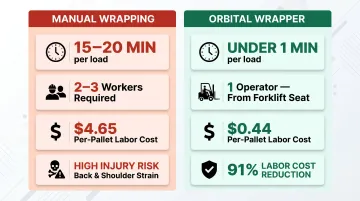
For HVAC operations managing high-value components, orbital automation delivers measurable ROI. TAB Industries research shows automated orbital wrapping reduces per-pallet labor cost from $4.65 to $0.44 — an annual savings of over $27,000 for operations wrapping 25 loads daily.
Key Takeaways
- Orbital wrappers thread film around the entire load — including underneath — making them ideal for long, irregular HVAC components
- Top models include the TAB Wrapper Tornado, Muller LCS Yellow Jacket, Robopac Sistemi, and Lantech Lan-ringer
- Choose based on load dimensions, wrapping speed, automation level, and total cost of ownership
- One operator can wrap a load in under 1 minute — down from 15-20 minutes with a three-person crew
- Midwest HVAC contractors can source equipment directly through John Maye Company, serving Wisconsin and surrounding states
Why HVAC Contractors Need Orbital Wrappers
Ductwork bundles, coil packs, and pipe fittings don't fit neatly on a standard pallet — and standard turntable wrappers can't handle them. An orbital (ring-style) wrapper solves this with a stationary wrapping ring the load passes through, enabling full encapsulation of long, cylindrical, or irregularly shaped HVAC components.
Specific Risks of Manual or Turntable Wrapping for HVAC Loads:
- Film tension is inconsistent on odd-shaped loads, leaving weak points that shift during transport
- Long loads require multiple workers to pass film rolls around the product manually
- Heavy film rolls and repetitive bending expose workers to back injury risk — the Bureau of Labor Statistics reports over 1 million workers suffer back injuries from lifting each year
- Products extending beyond standard pallet edges can't be properly secured with turntable methods
Research on wrapping ergonomics shows that 36% of workplace claims in pallet wrapping are musculoskeletal-related, with hand wrapping requiring extreme trunk flexion and shoulder elevation.
Those injury risks translate directly into labor costs — and that's before accounting for wrapping time.
Business Impact:
TAB Industries benchmarking demonstrates that orbital wrappers complete cycles in under 1 minute with a single operator who never leaves the forklift seat. Manual wrapping of the same load requires 15-20 minutes and two to three workers. For HVAC contractors shipping high-value components to job sites, that's a 91% reduction in labor cost per pallet — plus fewer damage claims.
Top Orbital Wrappers for HVAC Contractors
The products below were evaluated on criteria most relevant to HVAC operations: ability to handle long and irregular loads, single-operator capability, wrapping speed, film waste reduction, footprint, and ease of maintenance.
TAB Wrapper Tornado
TAB Industries is a U.S.-based manufacturer (Reading, Pennsylvania) known for orbital wrapping technology designed to handle loads of varying shapes and sizes — including long metal components up to 12 feet. The Tornado model is a two-time Material Handling Product News Readers' Choice Award winner.
Key Differentiators:
- Wraps 360 degrees around and under entire pallet load in under 1 minute with one operator
- Compatible with wireless remote operation and automated cut-and-wrap
- Can handle loads on lift truck forks without needing to set down the pallet
- Suitable for both standard (40–48 in.) and extended-length (up to 12 ft.) pallets
Specifications:
| Feature | 40-inch Model | 80-inch Model | 100-inch Model |
|---|---|---|---|
| Machine Dimensions (LxWxH) | 5'9" x 4'2" x 6'6" | 9' x 4'2" x 8'6" | 10'6" x 4'2" x 10'2" |
| Machine Weight | 1,650 lbs | 2,000 lbs | 2,500 lbs |
| Max Pallet Size | 24" x 24" | 48" x 48" | 60" x 60" |
| Power Requirements | 240V Single Phase | 120V Single Phase | 240V Single Phase |
| Automation Level | Semi-automatic standard | Semi-automatic standard | Fully automated (Perfect Storm) available |
The 80-inch model suits standard HVAC pallet loads, while the 100-inch model accommodates oversized ductwork and fabrication shop loads. Because the ring is stationary and the load feeds through it, the Tornado handles infinite-length loads — a distinct advantage for HVAC contractors moving long duct sections or profiles.
Muller LCS Yellow Jacket
Where the TAB Tornado excels at long-load versatility, the Cobra Yellow Jacket (formerly Muller LCS, now manufactured by Signode Industrial Group of Glenview, Illinois) is built for shops where floor space and electrical infrastructure are the binding constraints. It operates in tight production spaces, making it practical for HVAC fabrication shops and distribution warehouses.
Key Differentiators:
- Operates on standard 110VAC current (no special electrical install)
- Wraps pallets while still on forklift forks
- Single-operator use with push-button controls
- Proven reliability at high daily cycle counts
Specifications:
| Feature | Specification |
|---|---|
| Footprint (WxLxH) | 91" x 93" x 116" (semi-automatic) |
| Max Load Diagonal | 68" (1725 mm) |
| Max Wrap Length | Approximately 75" (1900 mm including front/back overlap) |
| Power Requirements | 230VAC 1-phase OR 110VAC / 60 Hz / 16A |
| Wrapping Speed | 15–25 pallets per hour (approximately 1 minute per load) |
The plug-and-play 110VAC operation means no dedicated electrical circuit — a real advantage in leased shop spaces where electrical upgrades aren't feasible.
Robopac Sistemi Orbital Wrapper
Robopac (produced by Sotemapack, part of the Aetna Group) is an Italian manufacturer with global distribution, producing orbital wrapping machines built for heavy industrial use — including HVAC equipment, pipes, and profiles. The product line splits into two tiers based on throughput requirements: the fully automatic Spiror BW for high-volume operations, and the semi-automatic Orbit R for lower-cycle environments.
Product Lines for HVAC Applications:
Spiror BW (Fully Automatic):
| Model | Ring Diameter | Primary Applications |
|---|---|---|
| Spiror BW 1800 | 1800 mm | Sliding doors, windows, sectional garage doors, insulated panels |
| Spiror BW 2200 | 2200 mm | Insulated metal panels, plaster boards, building materials |
| Spiror BW 2600 | 2600 mm | Undulated roof sheets, garden fencing, wooden panels |
| Spiror BW 3500 | 3500 mm | Oversized loads, primarily insulation market |
For lower daily volumes, the Orbit R series offers the same orbital wrapping capability in a semi-automatic format.
Orbit R (Semi-Automatic):
| Model | Ring Diameter | Max Ring Speed |
|---|---|---|
| Orbit R 5 | 500 mm | Up to 120 RPM |
| Orbit R 9 | 900 mm | Up to 75 RPM |
| Orbit R 13 | 1300 mm | Up to 55 RPM |
Key Features:
- 7-inch color touch screen with 20 user-defined wrapping programs
- R-Connect Industry 4.0 IoT monitoring for remote diagnostics
- Dual rod cut and clamp system (fully automates film handling)
- Fixed and variable pre-stretch carriages
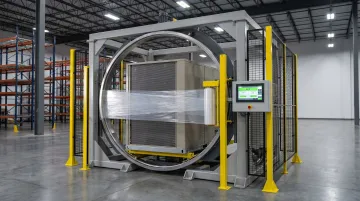
Both series share the R-Connect IoT platform, which enables remote diagnostics — useful for HVAC distributors managing high daily shipping volumes where unplanned downtime is costly.
Lantech Orbital Wrapper
Lantech (Louisville, Kentucky) introduced the first stretch wrapper at the 1973 PMMI trade show and has since placed over 100,000 units worldwide. That depth of installed base translates into something practical: the company stocks parts for every machine they've ever built. Their Lan-ringer series addresses long, oversized, or irregular loads — exactly the profile common in HVAC ductwork shipping.
Lan-ringer Series:
Designed for long, oversized, or difficult-to-bundle products (lumber, piping, carpet, HVAC ductwork) that cannot be wrapped on turntable wrappers.
Available Configurations:
- Lan-ringer Semi-Automatic: Manual feed for lower volume applications
- Lan-ringer Automatic: Fully integrated into conveyor lines for high-speed bundling
Key Technologies:
- LINC (Lantech Intelligent Network Connection): real-time monitoring, performance analytics, and remote access
- Pallet Grip: patented film "rope" at pallet base that prevents load sliding during transport
- Metered Film Delivery: regulates film usage to maintain consistent containment force while cutting material waste
- CFT-6 (Containment Force Tool): measures exact containment force so wrapping is repeatable, not guesswork
Service Network:
- 24/7/365 technical support
- Built Tough Warranty (bumper-to-bumper, unlimited cycle coverage)
- Global certified distributor network across North America
| Feature | Specification |
|---|---|
| Film Efficiency | Metered delivery system reduces waste while maintaining containment force |
| Service Network | 24/7/365 North American service coverage; parts for every machine ever built |
Specific Lan-ringer dimensions, ring sizes, and speeds vary by configuration — contact Lantech or an authorized distributor for a quote tailored to your load profile.
How We Chose the Best Orbital Wrappers for HVAC Contractors
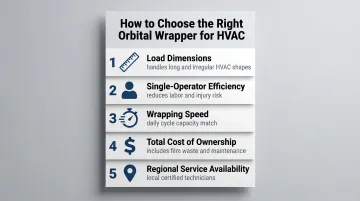
Selection was based on five criteria most critical to HVAC packaging operations:
- Ability to handle long and irregular load dimensions typical of HVAC components
- Single-operator efficiency and safety improvement over manual methods
- Wrapping speed and daily cycle capacity
- Total cost of ownership including maintenance and film consumption
- Regional service and parts availability
A common mistake is choosing a wrapper based solely on purchase price — film waste, downtime risk, and support costs all affect the real number. Matching automation level to your actual volume is just as important:
- Semi-automatic models suit smaller HVAC contractors wrapping fewer than 20 loads per day
- Fully automated systems make financial sense at higher volumes
According to TAB Industries ROI analysis, semi-automatic orbital wrappers (starting at $20,000-$30,000) typically deliver payback in less than one to two years when facilities regularly use two or more workers for wrapping operations.
Before purchasing, confirm the wrapper can be serviced by a local, manufacturer-trained technician. Regional distributors like John Maye Company offer manufacturer-certified support and rental options — letting HVAC contractors evaluate fit before committing to a capital purchase. That access to on-site service and stocked parts is what keeps downtime from becoming a costly problem.
Conclusion
Orbital wrappers deliver measurable operational advantages for HVAC contractors dealing with oversized, irregularly shaped, or high-value components. The right wrapper reduces per-load labor by 91%, eliminates freight damage claims, and frees skilled workers for higher-value tasks.
Before You Buy: Three Questions Worth Answering
Assess your average daily pallet volume, typical load dimensions, and available floor space before finalizing a model. These three variables determine whether a semi-automatic or fully automatic machine delivers the best ROI for your specific HVAC operation.
Contact John Maye Company
HVAC contractors in Wisconsin and the Midwest can reach John Maye Company to evaluate orbital wrappers in person or request a demo:
- Phone: 1-800-441-6293
- Email: info@johnmayecompany.com
- Experience: 40+ years of industrial packaging expertise
- Rental fleet: Test a machine on your actual loads before committing
- Support: Factory-certified technicians for installation and ongoing service
Frequently Asked Questions
Frequently Asked Questions
What is the difference between an orbital wrapper and a turntable stretch wrapper?
A turntable wrapper spins the load on a rotating platform and is best for standard square pallets. An orbital wrapper passes the load through a stationary rotating ring to wrap film around and under the product — making it the correct choice for long, cylindrical, or irregular HVAC components that extend beyond pallet edges.
Can orbital wrappers handle long HVAC ductwork and irregularly shaped components?
Yes. Orbital wrappers are designed for elongated loads: the ring stays fixed while the product passes through it, fully encapsulating ductwork bundles, coil packs, and oversized air handlers regardless of length.
How much does an orbital wrapper cost for an HVAC contractor?
Semi-automatic orbital wrappers start at $20,000-$30,000 based on 2021 pricing data. Fully automatic systems with conveyors and sensors are priced by configuration — contact a distributor for a quote. Rental options are available through distributors like John Maye Company for contractors who want to assess ROI before purchasing.
How many workers are needed to operate an orbital wrapper?
Most orbital wrappers are designed for single-operator use — often operable directly from a forklift cab with a wireless remote. Manual wrapping typically requires two to three workers and 15-20 minutes per load; automation cuts that to under one minute.
What type of stretch film is recommended for wrapping HVAC equipment?
For heavy loads over 1,200 lbs and sharp-edged components, use 100-120 gauge (25-30 micron) blown film with 250-300% pre-stretch capability — blown film resists punctures from metal edges better than cast. Add UV-resistant stretch film for any equipment stored outdoors.
Is it better to buy or rent an orbital wrapper for seasonal HVAC operations?
Seasonal contractors typically get better value from renting during peak periods; consistent year-round shippers see stronger ROI from purchasing outright. John Maye Company's rental fleet offers flexibility with no capital commitment, and some rental programs allow payments to apply toward an eventual purchase.