Introduction
Auto body shop owners face a constant challenge: technicians spend hours each day bending awkwardly, repositioning panels, and working at uncomfortable angles that slow repairs and increase injury risk. Every minute a technician spends contorted over a fender or reaching into an engine bay is a minute of lost productivity, plus a step closer to a costly musculoskeletal injury.
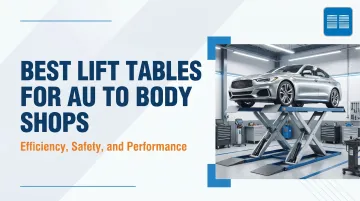
The right lift table changes this equation entirely. By positioning vehicle components, panels, and subassemblies at ergonomic working heights, lift tables have become essential equipment in modern auto body shops. They enable precise panel work, undercarriage access, and ergonomic positioning that reduces worker fatigue and directly impacts shop throughput.
Manufacturing workers, the closest occupational comparison to auto body technicians, experience 38,640 musculoskeletal disorder cases annually with a median of 14 days away from work, according to Bureau of Labor Statistics data. That's the highest recovery time among major industries.
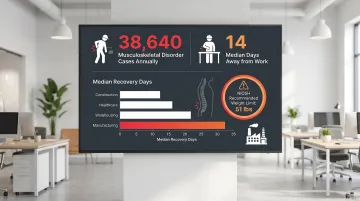
OSHA references the NIOSH Recommended Weight Limit of 51 pounds as the baseline for safe manual lifting. Door skins, hoods, and quarter panels routinely exceed that threshold, which means engineering controls aren't optional — they're the practical standard.
Key Takeaways
- Lift tables raise panels and components to ergonomic working heights — not the same as two-post or four-post vehicle lifts
- Best options balance capacity (2,000–6,000 lbs), platform size, lift height, and ANSI safety compliance
- Top brands include Autoquip, Advance Lifts, Bishamon, Presto Lifts, and Pentalift
- Match actuation type (hydraulic vs. pneumatic) to your shop's infrastructure and volume requirements
- The right lift table cuts technician fatigue, speeds repair cycles, and pays for itself through reduced labor costs
Overview of Lift Tables in the Auto Body Shop Industry
A lift table in the auto body shop context is a scissor-style or hydraulic platform used to raise vehicle components—doors, hoods, engines, full panels—to a comfortable working height. Unlike a two-post or four-post vehicle lift that raises entire cars for undercarriage access, a lift table positions parts and subassemblies at waist height — keeping technicians upright and in control throughout the job.
In body shop workflows, lift tables serve three core functions:
- Reduce strain during panel repairs, sanding, and finish work by keeping surfaces at a natural working height
- Hold components stable at eye level for precision alignment and fitting
- Support heavy subassemblies safely during restoration or collision repair
The right lift table comes down to three factors for shop use: weight capacity, platform size, and how the unit holds up under daily production demands. The sections below evaluate the top options on exactly those terms.
Best Lift Tables for Auto Body Shops
These picks were evaluated across six criteria relevant to body shop work:
- Load capacity and platform size
- Lift height range and collapsed/lowered profile
- Power type (hydraulic, pneumatic, electric)
- Safety certifications and compliance standards
- Specialty configurations (tilters, turntables, low-profile)
- Real-world fit for panel prep, subassembly, and frame work
Autoquip Scissor Lift Tables
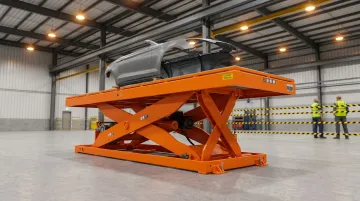
Autoquip, based in Guthrie, Oklahoma, is a U.S. industrial lift table manufacturer with decades of experience producing custom and standard scissor lifts used in manufacturing, assembly, and vehicle service environments. The company offers over 1,000 lift table designs across hydraulic, mechanical, and pneumatic actuation, giving body shops exceptional flexibility for custom specifications.
Key differentiators:
- Heavy-duty welded steel construction
- Wide range of capacities from light-duty to 100,000+ lbs
- Optional turntables and conveyor tops for rotating panels during prep work
- ANSI MH29.1 safety compliance with velocity fuses and maintenance blocking devices
Specifications:
| Feature | Details |
|---------|---------|
| Capacity Range | Up to 4,000 lbs (XLR Hydraulic); heavier capacities available by quote |
| Platform Size Options | 72"–96" W × 96"–120" L (PLTC Dock Series); custom sizes by application |
| Power Type | Hydraulic, mechanical, pneumatic |
| Standout Feature | XLR Hydraulic offers 1/2-inch collapsed height for true floor-level loading |
That 1/2-inch collapsed height eliminates the need for pit installation — a practical advantage in shops where cutting a floor recess isn't an option. Autoquip product page
Advance Lifts
Advance Lifts is one of North America's largest lift table manufacturers, known for standard and custom scissor lifts widely used in industrial and garage settings. Manufacturing all products at a 120,000-square-foot ISO 9001:2015 certified facility in St. Charles, Illinois, the company offers quick-ship availability and a strong distributor network across the Midwest.
Key differentiators:
- Extensive standard product catalog (200+ models)
- Proven reliability in high-cycle shop environments
- 10-year/250,000-cycle warranty on standard models
- Platform Centering Devices that double or triple lift life
Specifications:
| Feature | Details |
|---------|---------|
| Capacity Range | 2,500–12,000 lbs across P, HD, and SD Series |
| Lift Height | 24"–72" travel (P Series); up to 99" (SD Series) |
| Key Safety Feature | UL-listed controller assemblies, velocity fuses, machine-grade cylinders |
| Best for Body Shops | P-6048: 6,000 lb capacity, 48" travel, 7" lowered/55" raised height |
For Midwest body shops, the Illinois manufacturing base means shorter freight lead times — and the 10-year/250,000-cycle warranty is the strongest standard coverage in this category. Advance Lifts catalog
Bishamon Lift Tables
Bishamon is a well-established name in ergonomic material handling, with lift tables commonly found in workshops, garages, and manufacturing floors. Their catalog skews toward compact, lower-capacity units — which makes them a natural fit for smaller body shop bays where floor space is limited.
Key differentiators:
- Compact footprint options ideal for 10' × 12' bays
- Smooth hydraulic operation with minimal maintenance
- Stainless steel platform options suitable for paint prep areas
- Competitive pricing for small-to-mid shops
Specifications:
| Feature | Details |
|---------|---------|
| Capacity Range | 440–6,600 lbs across electric-hydraulic, pneumatic, manual, and battery models |
| Platform Options | Roller tops, tilt tops, stainless steel, turntables, anti-slip surfaces |
| Power Types | Electric-hydraulic, pneumatic, manual foot pump, battery-powered |
| Price Range | Entry-level pneumatic units (e.g., EZU-15 at 1,500 lbs) approximately $4,200 |
The Lo-Profile LX series collapses to 2.9 inches — lower than most competitors — which allows technicians to roll components directly onto the platform without ramps or awkward lifts. Bishamon lift table lineup
Presto Lifts (ECOA Industrial)
Presto Lifts, part of ECOA Industrial, is a well-established North American manufacturer offering a broad line of ergonomic scissor lifts and industrial lift tables. The company is known for both standard catalog units and engineered custom solutions, with a Quick Ship program that delivers many models in one week or less.
Key differentiators:
- Wide variety of specialty configurations (pallet positioners, die handlers, tilt tables)
- Strong ergonomic focus aligned with OSHA lifting guidelines
- Quick Ship availability from Manila, Arkansas
- Hydraulic capacities up to 12,000 lbs
Specifications:
| Feature | Details |
|---------|---------|
| Capacity Range | Up to 12,000 lbs across Light, Standard, Heavy, and Super Heavy-Duty categories |
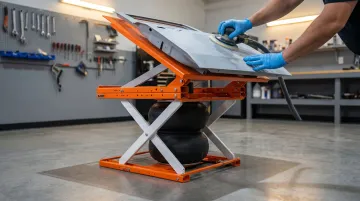
| Specialty Configurations | Pneumatic tilters (angle panels toward technician); High-lift double/triple/quad scissor; Portable foot-pump units |
| Compliance Standards | Designed to OSHA ergonomic guidelines; ANSI MH29.1 compliance not explicitly confirmed on manufacturer site |
| Best Use Cases | Tilters for sanding/finish work; multi-stage lifts for large truck panels |
The pneumatic tilters stand out for panel prep work: angling a door or quarter panel toward the technician reduces overhead reaching and cuts fatigue during long sanding passes. Presto Lifts product page
Pentalift Equipment Corporation
Pentalift, headquartered in Puslinch, Ontario, Canada, produces heavy-duty scissor lifts, tilt tables, and dock equipment known for robustness in demanding industrial environments. The company offers pre-engineered tables from 500 to 40,000 lbs, with custom solutions reaching 120,000 lbs.
Key differentiators:
- Heavy-gauge steel construction rated for high-cycle use
- Ability to handle large platform sizes suited for full body panels or frame sections
- Strong warranty terms and custom engineering support
- Documented custom projects for major motorcycle and truck manufacturers
Specifications:
| Feature | Details |
|---------|---------|
| Capacity Range | 500–40,000 lbs (pre-engineered); up to 120,000 lbs custom |
| Platform Size | Up to 8' × 12' in documented custom applications |
| Custom Engineering | Full custom design service; includes stainless finishes, synchronized multi-lift configurations, and application-specific features |
| Best for Body Shops | IR Series (1,000–2,000 lbs) and Pro Series (2,500–6,000 lbs) for panels; 12L Series (3,000–20,000 lbs) for subassemblies |
Shops handling full truck beds, oversized frame sections, or non-standard panel configurations will find Pentalift's custom engineering team more accessible than most North American manufacturers at this scale. Pentalift capacity guide
How We Chose the Best Lift Tables for Auto Body Shops
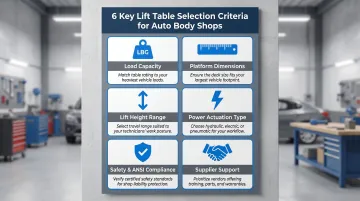
Choosing a lift table based on price alone—or mixing up vehicle lifts with component lift tables—leads to mismatched capacity, unsafe use, and equipment that fails before it pays for itself. Each recommendation here was evaluated against six criteria specific to auto body shop workflows.
Our evaluation framework prioritized six criteria:
1. Rated load capacity vs. actual shop needs
Door skins weigh 50-150 lbs, but fixtures, jigs, and subassemblies push working loads to 500-1,500 lbs. Applying a 2× safety margin puts the body shop sweet spot at 2,000-6,000 lbs.
2. Platform surface dimensions
Full quarter panels and truck bed sides require 48" × 72" platforms minimum. Smaller 24" × 36" units work for hood hinges and trim pieces but limit workflow flexibility.
3. Lift height range
Floor-level loading (3-7" collapsed height) to comfortable standing height (48-60" raised) eliminates bending at both ends of the lift cycle.
4. Power actuation type
Shops with existing compressed air systems benefit from pneumatic tables (simpler maintenance, no electrical). Shops without air default to electric-hydraulic.
5. Safety features and ANSI MH29.1 compliance
Velocity fuses, mechanical locks, and pinch-point guards are non-negotiable. ANSI MH29.1-2020 is the controlling national standard, now incorporated into the International Building Code.
6. Supplier support
Parts availability, lead times, and application engineering matter most for shops with non-standard layouts. Standout examples include Advance Lifts' 10-year structural warranty and Pentalift's track record of purpose-built configurations for irregular floor plans.
Conclusion
The right lift table for an auto body shop depends on the type of work performed, bay size, technician workflow, and budget. But the investment delivers measurable returns: faster repair cycles, reduced technician fatigue, and improved retention in a tight labor market.
Those returns only hold if you're evaluating total cost of ownership—purchase price plus maintenance plus downtime risk—rather than upfront cost alone. Prioritize units that meet ANSI MH29.1 safety standards, offer the actuation type that matches your shop infrastructure, and come from manufacturers with direct application support.
For auto body shops and industrial facilities in the Midwest looking to source ergonomic lift tables and material handling equipment, John Maye Company—a Midwest-based packaging and material handling equipment distributor with over 40 years of expertise—can help identify the right solution for your specific application. Contact their team at 1-800-441-6293 or info@johnmayecompany.com for a consultation.
Frequently Asked Questions
How much does a hydraulic lift table cost?
Hydraulic lift tables range from approximately $1,000 for entry-level manual units to $4,000–$5,000 for powered pneumatic or hydraulic models with moderate capacity (1,500–2,000 lbs). Heavy-duty custom units at 10,000+ lbs are priced on request and vary based on capacity, platform size, and configuration.
What do mechanic shops use to lift cars?
Mechanic shops use two-post, four-post, or scissor car lifts to raise entire vehicles for undercarriage access. Component lift tables are separate equipment used to position parts, panels, and subassemblies at ergonomic working heights — most shops keep both on hand.
Are electric or hydraulic lift tables better?
For paint and body work areas, electric-driven tables are the better fit — they're cleaner, quieter, and eliminate hydraulic fluid contamination risk. Hydraulic tables offer higher force capacity and lower upfront cost but require ongoing fluid maintenance. Your shop environment and cycle frequency should drive the decision.
How tall should a shop be for a car lift?
Standard two-post vehicle lifts require a 12-foot ceiling minimum; baseplate-style units work in ceilings as low as 9.5 feet. Scissor-style component lift tables top out at 55–72 inches raised height, making them a practical option for shops with limited overhead clearance.
What weight capacity do I need in a lift table for auto body work?
Light component work (trim, small panels) requires 1,000–2,000 lbs. Full door, hood, or subframe work demands 3,000–5,000 lbs to account for fixtures and jigs. Size up rather than down — overloading a lift table voids warranties and creates serious safety hazards.
What safety standards should a lift table meet for shop use?
ANSI MH29.1-2020 is the primary national standard for industrial lift tables, covering structural integrity, velocity fuses, maintenance blocking devices, and labeling — incorporated into the International Building Code since 2015. Tables used in commercial shops should also meet OSHA General Industry standards (29 CFR 1910) for safe equipment operation.