Yet with dozens of lift table manufacturers competing for aerospace contracts, procurement teams often struggle to separate marketing claims from genuine engineering capability. Selecting the right lift table for aerospace demands more than browsing a catalog — it requires understanding load dynamics for components weighing up to 60,000 lbs, evaluating actuation types for cleanroom compatibility, and verifying manufacturers' track records with defense and aviation customers. This guide evaluates the five most qualified lift table manufacturers for aerospace applications, cutting through the noise to identify what truly differentiates each option.
Key Takeaways
- Aerospace lift tables support engine assembly, fuselage positioning, test cell access, and ergonomic workstation adjustments across production environments
- Selection requires evaluating load capacity (250 lbs to 60,000 lbs), vertical travel (16 inches to 18 feet), actuation type, and ANSI MH29.1 compliance
- Autoquip and Unidex lead in documented aerospace applications; Advance Lifts tops capacity at 60,000 lbs; Southworth and Vestil offer the widest catalogs
- Custom configurations (rotation, tilt, tandem sync) are standard, with 4-12 week lead times for aerospace-grade builds
- John Maye Company connects Midwest aerospace facilities with manufacturer-trained specialists who match lift tables to specific assembly and ergonomic requirements
Overview of Lift Tables in Aerospace Manufacturing
Industrial lift tables used in aerospace manufacturing fall into four primary configurations:
- Scissor-type lift tables — Linked, folding supports actuated hydraulically, pneumatically, or mechanically; the most common configuration, governed by ANSI MH29.1:2012
- Platform lift tables — Flat working surfaces raised via column or cylinder mechanisms without scissor geometry, suited for heavy component positioning
- Column lifts — Vertical mast structures that achieve high travel with smaller footprints, common in engine assembly
- Custom-engineered systems — Application-specific configurations combining elements like z-axis rotation, shuttle decks, and tandem synchronization
Aerospace-grade lift tables differ from standard industrial models across several dimensions:
- Tighter positional tolerances for precise component alignment
- FOD (foreign object debris) prevention through sealed hydraulic systems and clean-room-compatible materials
- Compatibility with AS9100 quality management systems
- Custom engineering for non-standard load geometries, including engine cradles and fuselage jigs
Primary Aerospace Applications
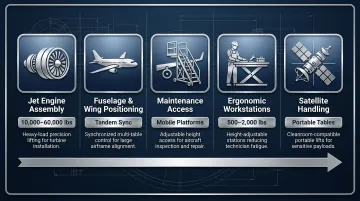
Aerospace facilities deploy lift tables across five critical use cases:
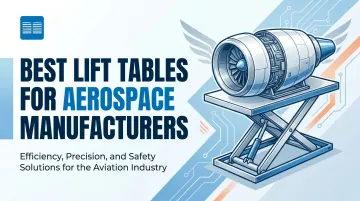
- Jet engine assembly and testing — High-capacity tables (10,000–60,000 lbs) with z-axis rotation position engines precisely during build-up and connect them to test cell fixtures
- Fuselage and wing component positioning — Multiple lift tables working in tandem provide variable working heights along entire fuselage sections during assembly and inspection
- Maintenance access platforms — Lightweight personnel platforms fit through standard doorways to provide technicians safe access to elevated work areas
- Ergonomic workstation adjustment — Production line lifts (500–2,000 lbs) raise components to optimal heights, reducing worker fatigue and repetitive strain injuries
- Satellite handling: Portable scissor tables move and position satellites between storage and launch facilities
Each manufacturer below was selected based on proven aerospace applications, load and travel specifications, safety certifications, and capacity for custom builds.
Best Lift Tables for Aerospace Manufacturers
These five manufacturers were selected for their documented aerospace track records, engineering depth, and capacity to meet the unique demands of aviation component handling.
Unidex Inc.
Based in Warsaw, New York, Unidex specializes in engineered-to-order lifting and positioning equipment with documented aerospace applications spanning jet engine assembly, test cell access, and maintenance platforms.
Key Differentiators:
Unidex operates as a custom engineering house rather than a catalog supplier. Every unit is engineered-to-order and can be modified for specific height requirements, specialized functions like upending or rotating, and unique load geometries.
Aerospace-specific features include z-axis rotation for precise engine placement during assembly, removable guardrails for test cell worker safety while allowing equipment loading access, and ESD (electrostatic discharge) liner options for electronics-sensitive environments.
The company's blog and industry pages explicitly reference aerospace, military, and defense sectors, documenting applications including jet engine assembly lifts and lightweight personnel platforms designed to fit through standard doorways and elevators for maintenance access across large facilities.
| Specification | Details |
|---|---|
| Load Capacity | 250-500 lbs (catalog models); custom aerospace configurations support higher loads via engineered solutions |
| Lift Height Range | 16-inch stroke (PHQL Quick Lifter) to 48-inch stroke (PHL Series); custom aerospace lifts specify travel per application |
| Key Features | Hydraulic actuation, z-axis rotation on engine assembly lifts, removable guardrails, floor-mounted stability designs, ESD liner options, lightweight mobile workstations |
Application Fit: Best for aerospace facilities requiring custom-engineered solutions with specialized features like rotation, tilt, or unique platform geometries not available in standard catalogs.
Southworth Products
This Portland, Maine manufacturer offers one of the broadest standard product lines among lift table suppliers, though it does not reference aerospace or defense applications on its website. Its heavy-duty models and specialty configurations remain relevant to aerospace manufacturing environments.
Key Differentiators:
Southworth's DL Series heavy-duty line handles up to 25,000 lbs with platforms reaching 96" x 156", large enough to accommodate most aerospace components. Floor-height models feature pan-style platforms that lower to floor level for hand pallet truck loading, valuable for flush-floor integration in assembly cells without pit excavation.
Safety features include built-in hydraulic overload relief systems and velocity fuses that prevent uncontrolled descent if hoses fail. The company also manufactures pneumatic lift tables (2,000-4,000 lbs capacity) for cleanroom-adjacent environments where hydraulic fluid contamination must be eliminated, and stainless steel configurations (SSLS series) for corrosion-resistant applications.
| Specification | Details |
|---|---|
| Load Capacity | 2,000-25,000 lbs across product lines |
| Lift Height Range | Up to 100 inches (DL heavy-duty series); 32-56 inches on standard and floor-height models |
| Key Features | Velocity fuses, hydraulic overload relief, floor-level loading, pneumatic actuation options, stainless steel construction, platforms up to 96" x 156" |
Application Fit: Best for aerospace facilities needing heavy-duty capacity and large platform dimensions from a standard catalog, particularly where flush-floor integration is required.
Advance Lifts Inc.
Located in St. Charles, Illinois, Advance Lifts is ISO 9001:2015 certified and offers the widest load capacity range among the five manufacturers, reaching 60,000 lbs in its Jumbo series. The company participated in forming the original ANSI MH29.1 working group over 20 years ago.
Key Differentiators:
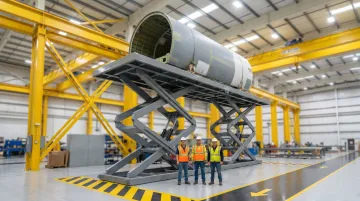
Advance Lifts' Jumbo series platforms reach 8.5 feet x 60 feet, making them dimensionally suited for fuselage section handling. The MSL/BFL multi-stage series delivers 4 to 18 feet of vertical travel, addressing high-travel requirements for engine test cells and large assembly fixtures. The Ultra-High Cycle (UHC) series carries a 3,000,000-cycle warranty, which matters for high-throughput aerospace production lines.
The company operates a 120,000-square-foot integrated facility with an in-house UL listed panel shop, enabling custom control integration. Advance Lifts explicitly states its scissor lifts "can be modified to meet your specifications" and serves government agencies, though it does not name aerospace or defense clients on its website.
| Specification | Details |
|---|---|
| Load Capacity | 2,500-60,000 lbs (Jumbo JSL/JDL series tops capacity range) |
| Lift Height Range | 24-58 inches (standard single/double long series); 4-18 feet (MSL/BFL multi-stage series) |
| Key Features | ISO 9001:2015 certified, rotating/tilting platform options, pit-mount configurations, 2-year parts/labor and 10-year structural warranties, 3,000,000-cycle UHC series, platforms up to 8.5' x 60' |
Application Fit: Best for the heaviest aerospace applications requiring maximum capacity, extreme vertical travel, or ultra-high-cycle production environments. Midwest proximity (Illinois) offers regional installation and service advantages.
Autoquip Corporation
Based in Guthrie, Oklahoma, Autoquip is the only manufacturer among the five maintaining a dedicated aerospace industry page on its website, explicitly documenting partnerships with "top aerospace manufacturers" for aircraft manufacturing, repair, maintenance, and assembly.
Key Differentiators:
Autoquip's aerospace page documents five specific application categories:
- Jet engine test cell lifts using high-travel scissor and heavy-duty ram configurations
- High-travel work platform lifts with adjustable shuttle decks for wing assembly
- Fuselage positioning lifts using multiple portable hydraulic scissor lifts in tandem
- Satellite storage and launching lifts
- Lightweight personnel work platforms
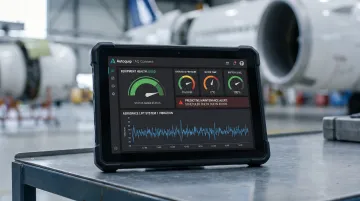
The company operates an in-house Controls Division and manufactures the AQ Connect intelligent monitoring system, providing self-diagnosis and equipment health tracking for aerospace facilities requiring predictive maintenance documentation and uptime visibility. Autoquip also publishes limited pricing data: compact lift models list at approximately $5,155-$8,049, with authorized distributors listing Series 35 models (6,000 lbs capacity) around $7,734.
| Specification | Details |
|---|---|
| Load Capacity | 500-15,000 lbs (Series 35 standard line); higher capacities via vertical ram lifts and custom systems |
| Lift Height Range | 24-60 inches (Series 35); higher travel via custom aerospace configurations |
| Key Features | Dedicated aerospace page with documented use cases, AQ Connect intelligent monitoring, in-house Controls Division, tandem synchronization, shuttle decks, turntables, 360-degree rotation options |
Application Fit: Best for aerospace procurement teams prioritizing documented industry experience, intelligent controls integration, and manufacturers with explicit aerospace credentials.
Vestil Manufacturing
This Angola, Indiana manufacturer operates as a high-volume producer and distributor offering over 1,000 different product lines, many available for immediate shipment. Vestil does not reference aerospace applications on its website but provides catalog breadth and stock availability.
Key Differentiators:
Vestil's strength lies in immediate availability and competitive pricing for standard configurations rather than custom engineering. The EHLT series handles up to 12,000 lbs on 48" x 48" platforms. The EHLTX low-profile series features collapsed heights as low as 3.25 inches, enabling flush-floor integration without pit excavation when paired with approach ramps.
The stainless steel EHU-12-SS model provides full stainless construction for cleanroom-adjacent or corrosion-sensitive aerospace environments. Standard power is 460V, 3-phase with 6.5 HP motors on high-capacity units. The company's catalog breadth reduces lead times for facilities needing multiple units across different applications.
| Specification | Details |
|---|---|
| Load Capacity | 1,000-12,000 lbs (EHLT standard scissor series) |
| Lift Height Range | 33-82 inches raised height; 35.75-inch travel on low-profile EHLTX series |
| Key Features | Hydraulic, electric, and pneumatic actuation options; ultra-low 3.25-inch collapsed height (EHLTX); full stainless steel construction (EHU-12-SS); broad in-stock catalog; competitive pricing for multi-unit orders |
Application Fit: Best for aerospace facilities needing standard-duty equipment quickly, multiple units for different workstations, or low-profile models without custom engineering lead times.
How We Chose the Best Lift Tables for Aerospace Manufacturers
Aerospace manufacturing imposes stricter demands than general industrial use. Common procurement mistakes include selecting lift tables based solely on static load rating while ignoring platform dimensions for large wing sections, overlooking ANSI MH29.1 compliance requirements, or choosing standard models incapable of the rotational or tilt adjustments aerospace assembly requires.
Our evaluation applied six criteria specific to aerospace environments:
Load Capacity and Duty Cycle Static load ratings alone don't tell the full story. Aerospace applications also require understanding:
- Dynamic loading during component rotation
- Edge loading when assemblies overhang the platform
- Duty cycle demands on high-throughput production lines
Advance Lifts' 3,000,000-cycle UHC series warranty directly addresses longevity, while Autoquip's vertical ram lifts handle "extremely high axle loads" for jet engine handling.
Vertical Travel Range Engine test cells and fuselage assembly may require 4-18 feet of travel — a specification that immediately narrows the field to Advance Lifts' multi-stage series and Autoquip's custom high-travel platforms. Ergonomic workstation lifts need only 24-48 inches, where Vestil's standard catalog excels.
Actuation Type and Environmental Compatibility Hydraulic systems offer the highest load capacity but introduce fluid contamination risk in FOD-sensitive areas. Pneumatic systems eliminate leak hazards and suit cleanroom-adjacent environments. Electro-mechanical options provide rapid cycle times with no fluid. Match actuation type to your facility's contamination controls before specifying.
Customization Depth Unidex and Autoquip operate as engineering houses offering z-axis rotation, shuttle decks, tandem synchronization, and custom platform geometries. Advance Lifts states all products "can be modified to meet your specifications." Vestil operates primarily from catalog. Customization depth determines how well a lift table suits your specific assembly application.
Safety Certifications and Standards Compliance OSHA 1910.179 applies exclusively to overhead and gantry cranes — not industrial lift tables. The governing standard is ANSI MH29.1:2012 (Safety Requirements for Industrial Scissors Lifts), which was incorporated into the International Building Code Section 3001.2. Advance Lifts participated in developing this standard and states all products comply. Aerospace facilities should verify ANSI MH29.1 compliance and request material certifications for AS9100 quality management system compatibility.
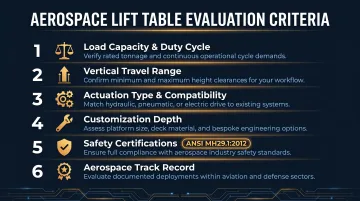
Manufacturer Aerospace Track Record Only Autoquip maintains a dedicated aerospace page documenting specific use cases. Unidex references aerospace applications through blog content and industry pages. The remaining three manufacturers don't explicitly reference aerospace customers but possess the engineering specifications to serve these applications. Documented industry experience matters during procurement justification.
John Maye Company's manufacturer-trained specialists help Midwest aerospace operations match the right lift table configuration to their assembly requirements, ergonomic goals, and facility constraints.
Conclusion
Selecting the right lift table for aerospace manufacturing is a precision decision where catalog specifications tell only part of the story. The right equipment reduces injury risk by positioning components at optimal ergonomic heights, improves assembly accuracy through precise rotation and tilt control, and supports repeatable quality across high-stakes production environments where equipment failures can delay entire production programs.
Evaluate candidates not just on load capacity and travel height, but on the supplier's ability to customize, certify, and support equipment over its operational life. The right questions to ask:
- Can they document aerospace applications similar to yours?
- Will they provide material certifications for AS9100 compliance?
- Do they offer monitoring systems that support predictive maintenance?
Suppliers who can answer these clearly are the ones worth shortlisting.
Aerospace manufacturers in the Midwest looking for expert guidance on lift table selection and procurement can reach out to John Maye Company for a consultation. With 40+ years of industrial equipment distribution experience and manufacturer-trained specialists, they match the right lift table solution to your facility's specific requirements — from initial needs assessment through installation, training, and ongoing technical support.
Frequently Asked Questions
What types of lift tables are most commonly used in aerospace manufacturing?
Scissor lifts handle general component positioning and assembly line ergonomics. Platform lifts support heavy engine assembly work. Specialized configurations include engine test cell lifts with high vertical travel, rotating work platforms with shuttle decks for wing access, and lightweight personnel platforms for maintenance access to elevated structures.
What load capacity should an aerospace lift table have?
Requirements range from 500 lbs for personnel platforms to 60,000 lbs for heavy engine assembly. Size capacity 20-30% above your heaviest anticipated load to accommodate tooling, fixtures, and provide a safety margin per ANSI MH29.1 guidelines. Don't forget to account for dynamic loads during rotation or movement.
What safety certifications should aerospace lift tables meet?
ANSI MH29.1:2012 is the correct industry standard for industrial scissor lifts — not OSHA 1910.179, which applies only to overhead cranes. Aerospace facilities with government or defense contracts may require additional material certifications, traceability documentation, and AS9100 quality management system compatibility from the lift manufacturer.
What is the difference between hydraulic and electric lift tables for aerospace use?
Hydraulic lifts offer higher load capacity (up to 60,000 lbs) and smoother, more controlled motion for heavy components, but carry fluid contamination risk. Electric lifts provide cleaner operation with no hydraulic fluid, making them better suited for cleanroom-adjacent environments or facilities with strict FOD controls.
Can lift tables be customized for aerospace-specific component dimensions?
Yes. Unidex, Autoquip, Advance Lifts, and Southworth all offer engineered-to-order configurations including custom platform sizes, tilt and rotate functions, flush-floor pit-mount options, tandem synchronization for multi-table fuselage positioning, and specialized surface finishes. Expect 4-12 week lead times depending on customization complexity.
How much do industrial lift tables for aerospace manufacturing cost?
Standard catalog models start around $5,000-$8,000 for lighter-duty applications (500-2,000 lbs). Heavy-duty and custom aerospace assembly lifts — those requiring high capacity, extended travel, rotation, or specialized controls — typically run $30,000 to well over $100,000 depending on configuration. Request quotes directly from manufacturers for aerospace-specific builds.