Introduction
When a Midwest manufacturer needs new packaging equipment, the sourcing decision matters as much as the equipment itself. Should you go through a large integrated provider like ProMach, or work with an independent regional distributor? The answer affects how fast you get support, how well the equipment fits your line, and what happens when something breaks down mid-shift.
ProMach and independent brand distributors (IBDs) both offer broad packaging solutions, but the business model behind each shapes day-to-day outcomes in different ways. ProMach operates as a Cincinnati-based conglomerate owning more than 50 packaging brands sold through a national network.
IBDs are regional specialists representing multiple manufacturers — a single point of contact for sourcing, service, and support, without being tied to a single manufacturer's portfolio.
This post breaks down where each model genuinely excels — and where the gaps tend to show up for Midwest manufacturers making long-term equipment decisions.
Key Takeaways
- ProMach owns 50+ packaging brands sold through a national network; IBDs represent multiple manufacturers with regional expertise
- ProMach locks you into one brand ecosystem; IBDs give you flexibility to mix manufacturers for each application
- Service speed differs significantly—regional IBDs typically hold local inventory and dispatch technicians faster
- IBDs often provide more competitive pricing through multi-brand quoting
- The right choice hinges on operation size, equipment diversity, and whether regional relationships or national infrastructure matter more
ProMach vs. Independent Brand Distributors: Quick Comparison
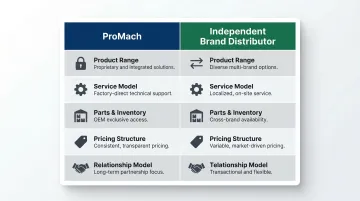
| Category | ProMach | Independent Brand Distributor |
|---|---|---|
| Product Range | Proprietary brands only (Federal, Pacific, Serpa, 50+ others) | Curates across multiple manufacturers—not limited to one portfolio |
| Service Model | Cross-trained technicians from centralized offices; national coverage | Dedicated regional techs with brand-specific, factory-certified expertise |
| Parts & Inventory | Centralized depots; lead times vary by location | Regional stock on-hand; leading IBDs offer same-day or 24-hour ship |
| Pricing | Bundle-oriented within the ProMach ecosystem | Competitive quoting across brands with direct price and feature comparison |
| Relationship | Standardized national account processes | Single regional rep who knows your facility and production environment |
Product Range
ProMach: Locks you into Federal, Pacific, Panther, Serpa, and 50+ sister brands. If the right solution exists outside that portfolio, it's not on the table.
IBD: Sources across the industry, letting you compare manufacturers side-by-side and select based on actual fit—not corporate catalog constraints.
Service Model
ProMach: Cross-trained technicians cover multiple brands from centralized offices, providing consistent national reach across regions.
IBD: Regional technicians carry factory certifications on specific manufacturers, meaning deeper product knowledge and faster local dispatch when something goes down.
Parts & Inventory
ProMach: Centralized parts depots support the installed base. Delivery times depend on your distance from the nearest depot.
IBD: Parts held regionally, close to the customer. The strongest IBDs back this with same-day or 24-hour ship guarantees on in-stock items.
Pricing Structure
ProMach: Pricing is bundle-oriented within its brand family, which simplifies the vendor relationship but limits your negotiating leverage.
IBD: Competitive quotes from multiple manufacturers put price and specs side by side before you commit—giving procurement a real comparison, not a catalog.
Relationship Model
ProMach: National account processes deliver consistency but little flexibility. Your facility is one of hundreds managed through standardized workflows.
IBD: One regional rep, long-term. They know your line speeds, your seasonal peaks, and which machines your team has run for a decade.
What is ProMach?
ProMach is a Cincinnati-based packaging machinery conglomerate headquartered in Covington, Kentucky. Founded in 1998 to consolidate the fragmented packaging equipment market, ProMach has grown primarily through strategic acquisitions—completing more than 30 acquisitions since 2019 alone.
The company now owns and operates more than 50 product brands across nine business lines:
- Filling
- Bottling & capping
- Decorative labeling
- Flexibles & trays
- Pharma
- Handling & sterilizing
- Labeling & coding
- Robotics & end of line
- Systems & process
ProMach positions itself as a "single-source" packaging partner, offering turnkey solutions from a unified portfolio backed by more than 90 manufacturing facilities worldwide.
Customers get one vendor relationship covering a wide equipment portfolio under a shared service umbrella. ProMach invests in cross-brand engineering and shared support infrastructure to back that promise. According to S&P Global's June 2025 credit upgrade, aftermarket products and services account for approximately 50% of ProMach's consolidated revenues, with an adjusted EBITDA base of $400M–$450M. ProMach's business model depends as much on ongoing service and parts revenue as on new equipment sales.
Use Cases of ProMach
ProMach best fits large national manufacturers or multi-plant operations needing standardized equipment across sites. Those operations use consolidated vendor relationships and corporate-level account management to cut administrative complexity across sites.
For example, high-volume food and beverage or pharmaceutical manufacturers with plants in multiple states often standardize case packing and labeling equipment to simplify maintenance training and spare parts management across all facilities. ProMach's single-vendor, multi-brand-under-one-roof model reduces cross-site coordination complexity when rolling out identical systems.
What is an Independent Brand Distributor?
An Independent Brand Distributor (IBD) is a regional packaging equipment specialist that represents multiple manufacturers—not tied to a single manufacturer. IBDs act as trusted advisors, sourcing the right equipment from whichever brand best fits the customer's application, budget, and line configuration.
IBDs build deep manufacturer relationships, often becoming factory-authorized for specific brands, and typically serve defined geographic regions. This allows them to provide responsive, accountable service that national distributors rarely match.
Core Operational Advantages
IBDs offer several distinct advantages:
- Local parts inventory — Leading IBDs maintain extensive on-hand stock, often 2,000-2,500+ SKUs, enabling same-day or next-day fulfillment
- Faster response times — Regional technicians dispatch from nearby locations, not distant national offices
- Brand flexibility — Ability to match the best solution to the specific problem rather than staying within one portfolio
- Multi-manufacturer integration — Can integrate equipment from competing manufacturers on the same line without vendor conflict
John Maye Company is a concrete example of what this looks like in practice. With 40+ years serving the Midwest, 2,500+ SKUs stocked at its Waukesha distribution center, factory-certified technicians, and a 24-hour ship guarantee, it delivers the kind of regional expertise and fast parts access that keeps production lines running.
Use Cases of IBDs
IBDs best fit mid-market manufacturers, growing food & beverage operations, regional e-commerce fulfillment, and pharmaceutical companies needing tailored solutions, fast parts access, and a partner who understands their specific production environment.
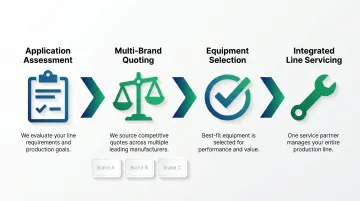
IBDs excel in multi-machine integration projects where the best outcome requires combining equipment from different manufacturers—a flexibility ProMach's closed portfolio cannot match. Take a Midwest beverage company upgrading its filling and coding lines at the same time. They want the best-rated filler for their specific viscosity range—not necessarily a ProMach brand—and the most competitive price on labeling. An IBD can spec both, quote across manufacturers, and service both machines from a single point of contact, with seamless integration built in.
Which Model Is Right for Your Packaging Operation?
The primary factor driving this decision: whether your operation prioritizes vendor consolidation and national coverage, or localized expertise and best-of-breed flexibility. These two goals are often in tension.
Choose ProMach if:
You're managing standardized equipment across multiple national facilities, require a single corporate account structure, and your production environment already runs ProMach-owned brand equipment. Consolidated vendor management and cross-brand support from one team can reduce administrative complexity at scale.
Choose an IBD if:
You need fast response times, local parts availability, or your line requires mixing equipment from multiple manufacturers. IBDs also make more sense when your team values a dedicated rep who knows your facility and can advise on both capital purchases and rental solutions for seasonal surges.
Total Cost of Ownership Considerations
These criteria connect directly to cost—and the gap can be substantial. ProMach's centralized model can introduce hidden costs including longer parts lead times, less pricing flexibility, and service delays tied to national dispatch schedules.
The stakes are high when a line stops. ABB's 2026 survey of 3,600 industrial decision-makers found:
- 47% report downtime costs of $10,000–$99,999 per hour
- 29% report $100,000–$499,999 per hour
- Average per-hour cost: $169,889
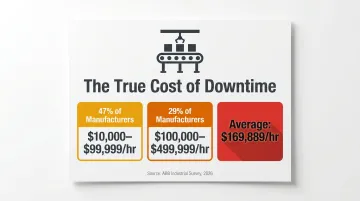
Every hour spent waiting on parts or a technician carries five- to six-figure consequences. IBDs often offset any equipment price differences through competitive multi-brand quoting and local inventory that keeps lines running—delivering lower total cost of ownership where it counts.
Service Continuity Risk in Acquisition-Heavy Models
When a brand gets acquired into a larger conglomerate, support structures can shift. Specialized technician knowledge may dilute across broader product lines as cross-training becomes standard, and customers may notice changes in responsiveness as service models centralize.
ProMach has completed acquisitions at an accelerating pace. Recent additions include:
- Fogg Filler (2020)
- Panther Industries (2020)
- Serpa Packaging (2021)
- TechniBlend (2022)
- Zacmi (2024)
- LAKO (March 2026)
Before committing to any equipment, verify the brand's ownership history and get explicit service continuity commitments in writing—especially if an acquisition has occurred within the last two to three years.
Real-World Scenarios: When Each Model Wins
Scenario Favoring ProMach
A national food manufacturer with plants in five states needs standardized case packing and labeling equipment to simplify maintenance training and spare parts management across all sites. The single-vendor, multi-brand-under-one-roof model of ProMach reduces cross-site coordination complexity, enables bulk parts ordering, and provides one service contact for all locations.
Scenario Favoring an IBD
A growing Midwest beverage company needs to upgrade their filling and coding lines simultaneously but wants to use the best-rated filler for their viscosity range (not necessarily a ProMach brand) while getting the most competitive price on labeling. An IBD can spec both, quote across manufacturers, and provide local service from one point of contact. With nearby inventory, 24-hour parts availability is realistic rather than aspirational.
If your operation looks more like the second scenario — or you're unsure which model fits — a regional distributor with decades of Midwest manufacturing experience can map your specific constraints to the right sourcing model. John Maye Company has helped hundreds of manufacturers across Wisconsin and the Midwest work through these tradeoffs, with rental fleet options available for operations that want to evaluate equipment performance before committing to a purchase.
Conclusion
ProMach and independent brand distributors both serve legitimate needs—the right choice depends on your operation's scale, equipment diversity, geographic footprint, and how much you value speed of service over vendor simplicity.
For most mid-market Midwest manufacturers, a strong IBD delivers advantages that directly affect production performance:
- Multi-brand flexibility to match the right equipment to each application
- Local inventory that supports faster fulfillment and reduced downtime
- Dedicated regional support from a partner accountable to your production outcomes, not national sales quotas
- Competitive pricing without the overhead of a consolidated corporate structure
That regional accountability is increasingly consequential. With the Midwest leading in food manufacturing employment concentration and Wisconsin alone attracting $1.117 billion in F&B capital expenditure in 2024, the difference between a locally embedded distributor and a national account manager shows up on the production floor.
Frequently Asked Questions
Is ProMach a manufacturer or a distributor?
ProMach is an OEM (original equipment manufacturer) that designs and builds packaging machinery under more than 50 brand names. It sells through its own sales structure—not through independent distributors—and supports its equipment directly via company-owned facilities.
Can an independent distributor get me ProMach-branded equipment?
Most ProMach-owned brands (Federal, Pacific, Panther, Serpa, and others) are sold through ProMach's own sales structure. Independent distributors typically represent non-ProMach manufacturers, giving buyers access to competing brands that may better suit their specific application or offer more competitive pricing.
What are the main advantages of using an independent packaging equipment distributor?
IBDs provide multi-brand flexibility, local parts inventory with same-day or 24-hour ship guarantees, and faster on-site service from regional technicians. A single regional contact can source across manufacturers and manage multi-brand line integration without vendor conflicts.
Does buying packaging equipment directly from a manufacturer or large OEM save money?
Buying direct doesn't always mean lower total cost. IBDs create price transparency through multi-brand quoting, and local parts inventory reduces downtime exposure. At an average of $169,889 per hour in downtime costs, that exposure can quickly dwarf any upfront capital savings.
What happens to service and support when a packaging equipment brand gets acquired?
Post-acquisition, service models can change as technicians become cross-trained across multiple brands, potentially reducing deep brand-specific expertise. Buyers should ask about service continuity commitments, parts availability guarantees, and technician certification levels before and after any ownership change to understand potential impacts.
How do I evaluate whether a regional packaging distributor is the right partner?
Key questions to ask: How many SKUs are in local inventory? Are technicians factory-certified or generically trained? How many manufacturers do they represent? What's the average dispatch time? How long have they served the region? Distributors like John Maye Company—with 2,500+ SKUs, factory-certified technicians, and 40+ years in the Midwest—set a useful baseline for comparison.