
Introduction
The magazine publishing industry handles staggering volumes—USPS periodicals mail totaled 2,748 million pieces in FY2024, generating $912 million in revenue, yet this represents an 8.2% year-over-year decline from 2,993 million pieces in FY2023. With shrinking margins and persistent circulation pressures, every piece of fulfillment equipment must deliver maximum efficiency. The choice of packaging machinery directly impacts whether magazines arrive on time, in pristine condition, and at a sustainable cost per piece.
L-bar sealers (also called L-clip machines) fill a defined role in publishing operations: sealing individual issues or bundles in shrink film to meet postal regulations and maintain a consistent, professional finish. Each machine completes a seal in two motions—an L-shaped seal followed by heat shrink tunnel finishing—turning a flat magazine into a protected package ready for newsstand distribution or subscription fulfillment.
Print circulation across the top 50 U.S. magazines has declined roughly 5% year-over-year in H2 2024, but the remaining volume is still enormous—AARP The Magazine alone averages 22.2 million copies per issue. That scale justifies dedicated shrink wrapping equipment capable of handling 10,000 to 50,000+ pieces per shift without compromising seal quality or operator safety.
Key Takeaways
- L-clip machines use a heated L-shaped bar to create three-sided seals, completed through a downstream shrink tunnel
- Evaluate on throughput speed, film compatibility (polyolefin vs. polyethylene), seal consistency, and mailing line integration
- Top models covered: Texwrap TLS-2219, PAC Machinery Clamco 6750EL, Shanklin A-27A, Eastey VSA1721, and Minipack Torre Media
- Semi-automatic systems handle 12–25 packages/minute; fully automatic models reach 35–60 packages/minute
- Wrong machine selection causes film waste above 15%, seal failures, and downtime costs that exceed any upfront savings
Overview of L-Clip Machines in Magazine Publishing
An L-bar sealer is a packaging device that uses an L-shaped heated cutting and sealing bar to create a three-sided seal around a product inserted into center-folded shrink film. The machine makes two perpendicular seals simultaneously (the end seal of one package and the front seal of the trailing package), then advances the product to a heat tunnel where forced air shrinks the film tightly around the magazine.
This separates L-bar sealers from flow wrappers, which create continuous fin seals for uniform products at high speeds, and from band sealers, which simply seal pre-made bags without wrapping from roll stock.
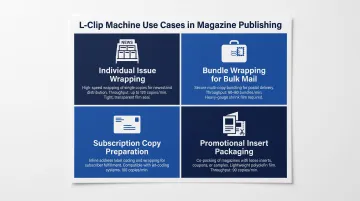
Magazine publishers deploy L-clip machines across four distinct use cases:
- Individual issue wrapping for retail newsstand distribution requiring pristine presentation
- Bundle wrapping for bulk mail drops where multiple copies ship to a single postal zone
- Subscription copy preparation with inline address coding and postal compliance features
- Promotional insert packaging where magazines include samples, cards, or supplements
Each use case demands different throughput capacity and film characteristics. A regional publisher wrapping 3,000 subscription copies weekly needs a semi-automatic machine with quick format changeover. A national fulfillment center processing 50,000+ pieces per shift requires continuous-motion automation with upstream collating integration and downstream labeling.
Best L-Clip Machines for Magazine Publishers
The following machines were evaluated against criteria relevant to publishing and direct mail operations:
- Throughput speed under sustained production conditions
- Seal consistency across coated and glossy magazine stock
- Compatibility with publishing-grade polyolefin and polyethylene films
- Size changeover ease across trim formats (digest to oversized)
- Documented use in print publishing or direct mail fulfillment
Texwrap Continuous Motion L-Bar Sealers
Texwrap, a brand within the SOCO System family (now part of ProMach), builds continuous-motion shrink wrap systems for high-speed publishing, printing, and direct mail lines. Their L-bar sealers eliminate the stop-start cycles that cause mechanical wear and seal inconsistency on glossy stock.
The TLS-2219 intermittent motion model incorporates Motion Trim technology—a patented feature that keeps conveyors running while seal jaws are in motion, cutting dead time between cycles. This drives throughput to 50 packages per minute while maintaining seal integrity on coated cover stock. Synchronized Allen Bradley PLC controls connect with upstream collating systems common in magazine fulfillment, and heavy-duty welded tubular steel construction supports continuous-duty production.
| Specification | TLS-2219 | Spartan 2215L |
|---|---|---|
| Throughput Speed | Up to 50 PPM | Up to 30 PPM |
| Max Package Size | 19"L × 15.5"W × 9"H | 19"L × 15.5"W × 5"H |
| Film Compatibility | POF, PE; 28" max centerfold | POF, PE; 28" max centerfold |
| Machine Footprint | 77.5"L × 57.5"W × 71.25"H | 78.625"L × 37.625"W × 60"H |
| Electrical | Allen Bradley PLC/HMI, 115V | 115V, 15A (standard outlet) |
| Warranty | 10-year Built-Better Backed-Better | Standard manufacturer warranty |
The TLS-2219's 10-year warranty is the longest confirmed coverage in this category—a meaningful factor for capital-constrained operations calculating total cost of ownership. The Spartan 2215L is the entry point: its 115V/15A power requirement means it plugs into a standard outlet with no electrical infrastructure upgrades.
Eastey Enterprise L-Sealers
Eastey Enterprise manufactures a tiered range of L-sealers from entry-level semi-automatic models to fully automatic systems, serving publishing, retail distribution, and direct mail fulfillment across the U.S. Their modular approach lets publishers start with manual equipment and scale to automation as volume grows.
The semi-automatic Performance Series uses hot wire seal bars with adjustable dwell time and analog temperature controls—useful for operators managing magazines with varying cover finishes. The automatic Value Series moves to hot knife insert-style seal bars for continuous, airtight seals at higher speeds.
All models feature 12-gauge welded steel construction and heavy-duty casters. Digital controls and quick film threading cut changeover time when switching between magazine formats, which matters for publishers running multiple titles through a single line.
| Specification | EM1622T (Semi-Auto) | VSA1721 (Auto) |
|---|---|---|
| Automation Level | Manual loading, automatic cycle | Automated conveyor feed |
| Seal Bar Technology | Hot wire (molten edge bead) | Hot knife (continuous seal) |
| Seal Area | 16" × 22" | 17"W × 21"L |
| Throughput | Operator-dependent (~15-20/min) | 20-25 cycles/min |
| Film Compatibility | POF, PE, PVC | POF, PE, PVC |
| Price Range | $8,500 (confirmed retail) | Quote required |
| Lead Time | Typically in stock | 2-4 weeks |
The EM1622T's confirmed $8,500 price point is the only transparent budget anchor in this category—every other manufacturer requires a quote request. It suits mid-volume regional publishers processing fewer than 3,000 pieces per shift.
PAC Machinery (Conflex) Shrink Wrappers
PAC Machinery distributes the Clamco brand of shrink packaging systems and incorporates the former Conflex division, which was built specifically for print, media, and publishing applications. Conflex, headquartered in Germantown, Wisconsin, identifies "Printing & Publication shrink wrapping applications for mailing" as a core specialty, with equipment engineered for postal regulation compliance.
The Clamco 6750EL runs entirely on electricity—no compressed air required—cutting both installation complexity and utility overhead. At 60 packages per minute, it holds the highest confirmed throughput among automatic L-sealers in this review. Key features include PTFE-coated sealing knives for extended wear resistance, a touchscreen with 50-program memory for fast format recall, and an optional label printer applicator that prints and applies barcodes or shipping information inline. That last feature is the deciding factor for subscription mailing runs requiring address personalization. Gentle product transport prevents compression or curl damage on lightweight magazine covers.
| Specification | Clamco 6750EL |
|---|---|
| Publishing-Specific Features | Label printer applicator (optional), postal regulation compliance, soft start/stop to prevent shingling, PTFE-coated knives |
| Integration Capability | Modular shrink tunnel, film economizer wheels, optional PE cross seal bar for 0.5-3 mil polyethylene |
| Throughput Capacity | Up to 60 PPM |
| Seal Dimensions | 20" × 25" |
| Max Product Height | 8" |
| Machine Footprint | 86"L × 60"W × 65"H |
| Electrical | 220V, 1Ph, 18A (all-electric, no air) |
| Film Compatibility | POF, PE, ReviveWrap recyclable shrink film |
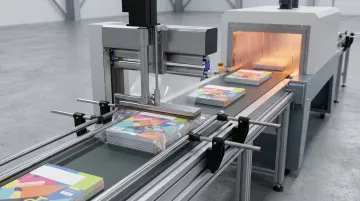
The Clamco 6750EL fits high-volume national fulfillment operations processing tens of thousands of pieces per shift. Inline label application and postal compliance features reduce labor touchpoints and accelerate mailing processing at scale.
Minipack Torre L-Sealers
Minipack Torre, an Italian packaging equipment manufacturer with over 50 years of history, produces compact L-sealer and shrink systems used in European and North American publishing, print, and retail operations. Machines are CE certified and distributed in the U.S. through Minipack America.
The Media semi-automatic model's standout feature is a combined sealer-and-tunnel monoblock design at a 91"L × 28.5"W footprint—the most space-efficient configuration in this review. Impulse seal bar technology applies heat in brief bursts rather than continuously, lowering the risk of scuffing on high-gloss coated covers. The machine supports eco-friendly and recycled shrink films, which matters for publishers facing sustainability mandates. Three working modes (Bag Only, Bag & Shrink, Multiples) handle different product types within a single run.
| Specification | Media (MF17BH12) |
|---|---|
| Machine Footprint | 91"L × 28.5"W (compact monoblock) |
| Throughput | 12-16 wraps/min |
| Seal Area | 22" × 16" × 9" |
| Film Types Supported | POF, PVC, center-folded films up to 24" width |
| Seal Blade Type | Impulse (lower sustained heat) |
| Weight | 755 lbs (shipping weight) |
| Electrical | 200-240V, 3Ph, 21A |
| Country of Origin | Italy (manufactured in Dalmine) |
| U.S. Support Network | Minipack America distributor network |
The Media model targets regional or niche magazine operations running fewer than 3,000 pieces per shift, offering European-built quality at a mid-tier price point with U.S.-based technical support through Minipack America.
Shanklin (Sealed Air) L-Bar Sealers
Shanklin, now part of Sealed Air Corporation, is one of the oldest industrial shrink wrapping brands with decades of deployment in large-scale publishing, catalog distribution, and direct mail fulfillment centers. Their A-Series L-bar sealers are built for continuous-duty industrial environments with heavy-gauge steel construction.
The A-27A accommodates magazines up to 31 inches long—the largest format capacity among all machines reviewed. Its 21" × 33" seal area handles oversized issues, special editions, and bundled promotional inserts without a format change. Publishers already working with Sealed Air gain the option to consolidate film procurement, service contracts, and preventive maintenance under a single vendor. Available options include print registration, adjustable flight bar infeeds for randomly spaced product, and closing discharge conveyors. The picture-based HMI cuts operator training time and simplifies format changeovers.
| Specification | A-27A |
|---|---|
| Build Quality / Duty Cycle | Compact, rugged steel construction; continuous-duty industrial rated |
| Service & Parts Network | Sealed Air national service network, factory parts availability, preventive maintenance programs |
| Speed & Film Width | Up to 35 PPM, 30" max centerfold (60" flat with centerfolder) |
| Seal Size | 21"W × 33"L (largest format reviewed) |
| Max Product Height | 7.5" (9.5" with optional height kit) |
| Conveyor Belt Width | 17" |
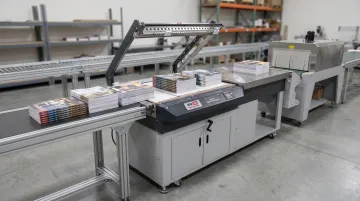
The A-27A is the default choice for publishers whose formats run large or whose production mix includes special editions alongside standard issues. For operations in John Maye Company's Midwest service territory, Sealed Air's national parts and service network means minimal downtime exposure on a machine running multiple shifts.
How We Chose the Best L-Clip Machines
Machines were evaluated against a framework tied directly to publishing business outcomes rather than generic packaging specifications. Six criteria drove every recommendation.
Seal integrity across common magazine cover stocks determines whether shrink film preserves the cover image without scuffing, haze, or thermal damage. Publishers returning to manual banding due to seal failures lose the productivity gains that justified automation in the first place. Cover stocks tested included high-gloss coated, matte, and uncoated finishes.
Throughput speed relative to typical publishing run volumes directly impacts on-time mailing schedules. A publisher processing 10,000 weekly subscription copies needs minimum 15-20 packages per minute sustained over an 8-hour shift. Running that volume on a 12 PPM semi-automatic machine creates bottlenecks that push back postal drop deadlines. Conversely, purchasing a 60 PPM automatic system for 2,000 pieces weekly represents overinvestment with payback periods exceeding equipment lifespan.
Film compatibility separates machines worth considering from those that aren't. Polyolefin (POF) film offers high clarity and gloss explicitly recommended for printed materials, but requires precise temperature control to avoid cover warping. Polyethylene handles bulk bundle wrapping at lower cost but produces hazy seals unsuitable for retail newsstand presentation.
Match film type to distribution channel: POF for individual subscriptions and newsstand copies, PE for bulk transport bundles.
Seal bar technology—impulse versus constant heat—affects both energy cost and seal consistency. Impulse systems deliver heat only during the seal cycle, reducing electricity consumption and minimizing sustained heat exposure that can damage coated stock. Constant-heat systems maintain temperature continuously for faster cycle times but require careful calibration to prevent cover scorching on lightweight paper stocks under 80# cover weight.
Ease of format changeover directly determines labor cost for publishers running multiple title sizes—digest, standard, and oversized formats—on a single machine. Quick-adjust sealing arms and film roll changes should take minutes, not hours. Machines without photo-eye automatic length compensation force manual adjustments at every format change, adding 15-30 minutes of unproductive setup time per run.
The most common mistake publishers make is selecting equipment based on purchase price alone rather than total cost of ownership:
- An $8,500 semi-automatic machine with 15% film waste due to poor trim control costs more over three years than a $30,000 automatic system with film economizer wheels reducing waste to 3%
- Seal failure rates above 2% generate postal returns, replacement copies, and customer service labor that quickly exceed any upfront equipment savings
- Format changeover downtime compounds across a full year—30 minutes per run adds up fast across a multi-title publishing operation
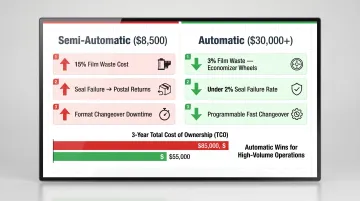
These factors informed every machine rating in this guide.
Conclusion
The right L-clip machine depends on operational specifics, not brand recognition or the lowest purchase price. Throughput requirements vary wildly—a regional arts quarterly wrapping 1,200 copies four times annually has fundamentally different needs than a national association magazine fulfilling 100,000+ monthly subscriber copies. Floor space constraints, film sustainability commitments, downstream postal automation integration, and in-house technical capabilities all shape the optimal equipment choice.
Publishers evaluating L-bar sealers must prioritize ongoing service support and parts availability over initial purchase terms. A machine running reliably at 10,000 issues per week needs to hold up when circulation grows to 50,000, or drops to 5,000 during seasonal fluctuations.
Before committing to a supplier, confirm:
- Their service network covers your Midwest facility
- Replacement parts ship within 24 hours, not 2 weeks from overseas
- They can scale rental or additional equipment alongside publication growth without multi-month lead times
Those criteria point to a short list of qualified suppliers. For magazine publishers across Wisconsin, Ohio, and the broader Midwest looking to source, demo, or service L-clip and shrink wrap systems, John Maye Company brings over 40 years of packaging equipment expertise with factory-certified technicians and direct experience in publishing fulfillment demands. As a regional leader for SOCO System/Texwrap, John Maye Company offers hands-on equipment guidance, an active rental fleet for trial periods or seasonal volume spikes, and same-day technical support throughout the region.
Contact John Maye Company at their Waukesha, Wisconsin location by calling 1-800-441-6293 or emailing info@johnmayecompany.com to discuss your specific magazine wrapping requirements and explore demo opportunities.
Frequently Asked Questions
What is an L-clip machine and how does it work for magazine packaging?
An L-bar sealer uses an L-shaped heated sealing bar to simultaneously cut and seal shrink film around a magazine on two perpendicular sides. The sealed package then advances through a heat tunnel where forced air shrinks the film tightly around the product, creating a professional, tamper-evident wrap.
What is the difference between an L-bar sealer and a flow wrapper for magazines?
Flow wrappers use a continuous fin seal and excel at high-speed runs of uniform products, but changeovers for varying sizes are complex. L-bar sealers handle mixed magazine dimensions more easily and suit low-to-mid volume runs (under 60 PPM) where size variety matters more than raw speed.
How fast can an L-clip machine wrap magazines?
Semi-automatic models handle 12-25 packages per minute, while fully automatic continuous-motion systems reach 35-60 packages per minute. The PAC Machinery Clamco 6750EL leads at 60 PPM; Shanklin A-27A and Texwrap TLS-2219 deliver 35-50 PPM; Eastey VSA1721 achieves 20-25 cycles/min; Minipack Torre Media processes 12-16 wraps/min.
What type of shrink film should magazine publishers use with an L-clip machine?
Polyolefin (POF) film is preferred for individual magazine wrapping — high clarity, glossy finish, and gauges from 35 to 100 make it ideal for printed goods. Polyethylene (PE) film suits heavy bundle or bulk applications but produces hazier seals unsuitable for retail presentation.
Can one L-clip machine handle different magazine trim sizes?
Most modern L-bar sealers handle varying sizes through adjustable sealing arms and photo-eye length compensation. The Texwrap TLS-2219 and Shanklin A-27A cover formats from 4" to 31" length. For frequent changeovers, look for quick-adjust mechanisms and programmable memory — the Clamco 6750EL stores up to 50 format programs.
How much does a commercial L-clip machine for magazine publishing cost?
Semi-automatic models start around $8,500 (Eastey EM1622T), while fully automatic systems with integrated tunnels and conveyors run $30,000-$60,000+. The Clamco 6750EL, Shanklin A-27A, and Texwrap TLS-2219 are priced by direct quote only.