L-clip machines have become the standard for frozen meal packaging precisely because they deliver what heat sealers can't: consistent closure integrity at temperatures where adhesive bonds fail, speed that matches high-volume fill lines, and the mechanical simplicity that keeps production running when ambient temperatures drop below freezing. Yet the market offers dozens of clipping systems, each claiming superiority for frozen food applications.
This guide cuts through the marketing noise with a focused comparison of clip closing technology evaluated specifically for frozen meal production demands—helping you match machine capabilities to your line speed, bag format, and facility conditions.
Key Takeaways
- L-clip machines apply metal clips to seal frozen meal bags, offering faster throughput and better cold-temperature performance than heat sealing
- Key selection factors: clip speed (cycles/min), cold-environment durability, food-grade compliance, and bag format compatibility
- Two major manufacturers dominate this space: Tipper Tie (up to 200 pieces/min) and Poly-clip System (up to 126 cycles/min)
- Matching throughput to your upstream fill rate prevents bottlenecks that idle entire production lines
- John Maye Company (Waukesha, WI) has sourced and supported industrial packaging equipment for Midwest food producers since 1983
What Are L-Clip Machines and Why Frozen Meal Producers Use Them
A clip closing machine is packaging equipment designed to close bags using metal or plastic clips—a mechanical alternative to heat sealing or shrink wrapping. These machines apply L-shaped or U-shaped aluminum or steel clips to flexible packaging—pouches, bags, and casings—used across food production environments.
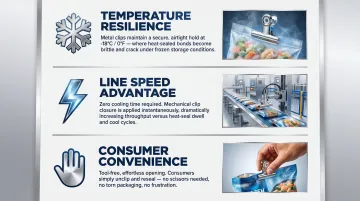
Frozen meal producers specifically prefer clip closing over heat sealing for three operational reasons:
- Temperature resilience: Metal clips hold at sub-zero storage temperatures (-18°C/0°F or below) where heat-sealed bonds can crack or fail as packaging materials contract and expand through freeze cycles.
- Line speed advantage: Clip closing eliminates the cooling time required after heat sealing, allowing faster throughput on high-volume production lines. Where heat sealers must pause for thermal bonding, clip machines apply mechanical closures instantaneously.
- Consumer convenience: Clips allow easy opening without scissors or tools—a small but meaningful advantage for retail frozen meal packaging that improves the end-user experience.
The global frozen food packaging market reached USD 45.69 billion in 2023, with bags and pouches representing over 34% of revenue. With demand projected to hit USD 67.48 billion by 2030, producers who standardize on clip closing now are positioning their lines ahead of a packaging volume increase that shows no signs of slowing.
Best L-Clip Machines for Frozen Meal Producers
Each machine below was evaluated on clip speed, food-grade compliance, cold-environment durability, and documented use in food processing applications.
Tipper Tie Clip Closing Systems
Tipper Tie (now part of JBT Marel) manufactures one of the broadest clip closing product lines in food processing, spanning manual pneumatic clippers to fully automatic double-clipping systems. Their range covers small-batch operations through automatic double clippers reaching up to 200 pieces per minute.
The TT1815/TT1512 models include NewCon (Newton Control) electronic clip closure force monitoring, which prevents machine damage through adjustable pressure thresholds. All Signature Throat Series models meet NAMI (North American Meat Institute) hygienic design standards with stainless steel and non-corrosive construction.
| Feature Category | Specifications |
|---|---|
| Key Features | Stainless steel construction, NAMI hygienic design compliance, NewCon force monitor (TT1815/TT1512), touchscreen recipe management, Z-series aluminum alloy clips with radiused lubricated legs |
| Clip Speed / Throughput | Manual/semi-auto: Up to 20 cycles/min (CVW Clipper Vac) • Automatic: Up to 200 pieces/min (TT1815/TT1512) |
| Ideal Use Case | Medium to high-volume frozen meal lines (500-5,000 units/hour) requiring flexibility across bag formats; facilities needing USDA-compliant materials and vacuum-clip combination capability |
Poly-clip System FCA Series
Poly-clip System is a German-engineered manufacturer offering the FCA series of automatic clippers designed specifically for high-speed food production environments. The FCA 90 reaches up to 126 cycles per minute, marketed as the "world's fastest automatic machine for moulded products."
Exclusive automatic central lubrication eliminates manual maintenance in cold environments where lubricant viscosity changes — a practical advantage on frozen meal lines. PC control with a SAFETY TOUCH 10-inch display, recipe management, and WS Food Standard interface integrate cleanly with automated fill lines. The clip-pak system targets soups, sauces, and ready meals, claiming 30% lower packaging costs versus cans and up to 81% reduced CO₂ footprint compared to thermoformed packaging.
| Feature Category | Specifications |
|---|---|
| Key Features | Automatic central lubrication, servo-driven frequency converter with three speed levels, tool-free die quick-change, R-ID Clip (bacteria-proof closure on plastic casings), SGS ISO 9001 and ISO 22000 certified |
| Clip Speed / Throughput | FCA 80: Up to 125 cycles/min • FCA 90: Up to 126 cycles/min • Clip-pak portfolio: Up to 300 portions/min (depending on configuration) |
| Ideal Use Case | High-volume automated lines (3,000-8,000 units/hour) requiring maximum throughput, minimal manual intervention, and advanced integration with upstream filling equipment; ideal for ready-meal production with portion sizes from 50g to 5kg |
Key Factors to Consider When Choosing an L-Clip Machine for Frozen Meal Production
Cold-Environment Performance
Frozen meal production environments (0°F to 40°F) stress mechanical components in ways that room-temperature facilities do not. Metal contracts, lubricants thicken, and moisture condenses on exposed surfaces. Buyers should prioritize:
- Stainless steel frames: 304 or 316L austenitic stainless steel offers corrosion resistance in humid, cold conditions
- Sealed bearings and cold-rated lubricants: Prevent contamination and maintain smooth operation in sub-freezing temperatures
- Moisture management: Equipment designed for frequent washdown without harboring bacteria or ice buildup
BW Flexible Systems recommends keeping packaging areas slightly cooler than standard room temperature, with adequate spacing between conveyor units for cold air circulation and equipment designed for frequent cleaning to prevent ice buildup.
Clip Compatibility and Bag Format Range
Clip size, material (aluminum versus steel), and loop diameter must match your bag neck width and film thickness. Poor matches cause seal failures: either crushed film or loose closures that allow air infiltration and freezer burn.
Standard clip configurations:
- Poly-clip uses standard spreadings of 26mm, 30mm, 36mm, and 44mm
- Tipper Tie offers Z-series (Z95SP, Z96SP), 100T, Z200, Z400, and 600 series clips
- Clip material: Aluminum alloy (lighter, corrosion-resistant) or PVC-coated steel (higher retention force)
Match clip specifications to your specific frozen meal format—retail pouches (typically smaller caliber, 38-80mm) require different clip dimensions than bulk institutional bags (80-160mm caliber).
Line Speed and Throughput Matching
Your clipping machine's cycles-per-minute rating must meet or exceed your upstream fill rate. A bottleneck at the closing station idles the entire production line.
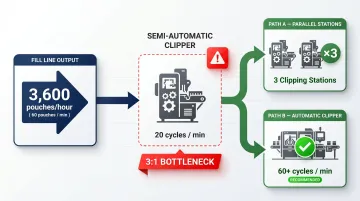
Example scenario: If your fill line produces 3,600 pouches per hour (60 per minute), a semi-automatic clipper rated at 20 cycles per minute creates a 3:1 bottleneck—you'd need three clipping stations or a single automatic clipper rated at 60+ cycles per minute to avoid backing up the line.
Top-performing machines in this comparison:
- Tipper Tie TT1815/TT1512: Up to 200 pieces/min
- Poly-clip FCA 90: Up to 126 cycles/min
- Tipper Tie CVW Clipper Vac: Up to 20 cycles/min (semi-automatic)
Sanitation and Food-Grade Compliance
Machines used in frozen food production must meet food-safety standards and be designed for rapid cleaning without bacterial harborage. Key certifications to verify:
- NSF/ANSI/3-A 14159-1-2024 — Mandatory standard covering materials, design, and construction of meat and poultry packaging equipment; requires resistance to high-pressure washdown
- 3-A Sanitary Standards (voluntary) — Food contact surfaces must be smooth, nonporous, non-absorbent, and corrosion-resistant; SS 304 minimum, SS 316 preferred; continuous TIG-welded joints and Third Party Verification (TPV) required
- USDA/FDA facility alignment — Both Tipper Tie and Poly-clip offer stainless steel construction and food-grade certifications; request specific compliance documentation before purchase to confirm it matches your audit requirements
Conclusion
The right L-clip machine for your frozen meal operation comes down to four core factors:
- Clip speed matched to your upstream fill rate
- Cold-temperature durability through stainless steel construction and sealed components
- Bag format compatibility with clip dimensions
- Food-grade compliance confirmed through NSF, USDA, or 3-A certifications
Evaluate total cost of ownership—machine price, clip consumable costs, maintenance frequency, and parts availability—alongside initial equipment cost. A lower upfront price means little if consumables are expensive, parts take weeks to arrive, or service requires costly on-site technician travel.
John Maye Company has helped food manufacturers navigate packaging equipment selection and ongoing service needs for over 40 years from their base in Waukesha, Wisconsin. Whether you're upgrading a single line or designing a greenfield frozen meal facility, their team provides consultation matched to your production requirements. Contact them at info@johnmayecompany.com or call 1-800-441-6293 for a consultation.
Frequently Asked Questions
What is the use of an L sealer machine?
An L-sealer (L-bar sealer) is a completely different machine from an L-clip closing machine. L-sealers use heated sealing bars to seal and shrink-wrap products in plastic film. L-clip machines apply metal clips to close bags mechanically—no heat involved. The confusion stems from similar naming, but the technologies serve different packaging needs.
Are food vacuum sealers worth buying compared to clip closing machines for frozen meals?
Vacuum sealers extend shelf life but are significantly slower—better suited for low-volume specialty runs than high-volume frozen meal lines. L-clip machines deliver up to 200 pieces/min, prioritizing throughput over air removal. For operations that need both, Tipper Tie's CVW Clipper Vac combines vacuum extraction with clip closure.
What is an L-clip machine and how does it differ from a heat sealer?
L-clip machines use metal clips (not heat) to close bags, making them more reliable in cold and frozen environments where heat-sealed bonds can fail or become brittle. Clips provide mechanical closure that doesn't depend on thermal adhesion, eliminating cooling time and improving throughput on high-speed lines.
What clip sizes are typically used for frozen meal bag packaging?
Retail frozen meal pouches typically use clips in the 38-80mm caliber range with standard spreadings of 26mm, 30mm, 36mm, or 44mm. Bulk institutional bags may require larger calibers (80-160mm). Clip size must match bag neck width and film thickness—consult equipment manufacturers for precise sizing charts based on your specific bag material and format.
How do I maintain an L-clip machine in a frozen food facility?
Use lubricants rated for cold temperatures, inspect clip magazines regularly for ice buildup or moisture contamination, follow food-safe cleaning protocols with washdown-compatible stainless steel models, and adhere to manufacturer-recommended service intervals. Poly-clip's automatic central lubrication reduces manual maintenance frequency in cold environments.
Can L-clip machines be integrated into automated frozen meal production lines?
Yes. Most commercial L-clip machines support conveyor integration and PLC-controlled operation. Poly-clip FCA series includes upstream synchronization via IFC interface; Tipper Tie TT1815/TT1512 models offer touchscreen recipe management. Verify PLC brand compatibility and conveyor interface protocols before purchasing.